Mindfulness-Based Therapy for Depression Relapse Prevention
Mindfulness-based therapy cuts depression relapse risk in recurrent cases. Here is what MBCT is, what the trials found, and how the eight weeks actually run.
Mindfulness-Based Therapy for Depression Relapse Prevention
Getting well is one job. Staying well is a different one.
Most depression care is built for the first job.
You see a doctor. You start a drug. Over weeks, the weight lifts.
Then the plan runs out. Nobody tells you what the second job involves.
That gap is where relapse lives.
Mindfulness-based therapy was built for that gap. Specifically, a course called MBCT.
It is not a wellness trend. It came out of a research programme aimed at one question.
Why does depression keep coming back, and can anything stop it?
This guide answers that plainly.
We cover what MBCT is, and how it differs from the meditation you may already know.
We cover what the trials actually found, with the numbers.
We walk through the eight weeks, session by shape.
We cover who it suits, and who should wait.
And we cover how to make it work in a real Indian week.
One note first. This is general guidance, not medical advice.
Never change your medicine on the strength of an article.
And do not start a course mid-crisis.
There is a right time for this work. We will come to that.
Why Relapse Is the Real Problem
Depression is rarely a one-off event. That is the part people are not told.
Look at what the largest treatment study found.
In the STAR*D trial, people who needed more treatment steps relapsed more often. Rates ran from 40% up to 71% (Source: Current Psychiatry Reports, 2007 — pubmed.ncbi.nlm.nih.gov).
Read that again. Up to seven in ten, in the harder-to-treat group.
So the question is not only how to get well.
It is how to hold the ground you gained.
Two things make relapse likely.
The first is that low mood leaves a track behind it.
After an episode, small dips start to trigger the old pattern faster. A bad morning pulls in old thoughts about failure.
The brain has learned a route. It takes it more easily each time.
The second is what happens when treatment ends.
Medicine often stops. Therapy ends. Life fills the space.
Nothing replaces the structure that held you up.
The weeks after discharge are the risky ones.
Everyone relaxes. The calendar empties.
That is exactly when a plan is needed most.
MBCT was designed to sit exactly here.
Not to lift you out of an episode. To stop the next one forming.
That is an unusual goal for a therapy, and it is why the course looks odd at first.
You are not brought in to talk about your childhood.
You are brought in to learn a skill.
The skill is noticing, early, before the slide starts.
Q: Why does depression keep coming back after treatment?
A: Each episode makes the next easier to trigger. Small dips start pulling in old thinking faster. When treatment ends, nothing replaces the structure that was holding things steady.
What MBCT Actually Is
MBCT stands for mindfulness-based cognitive therapy.
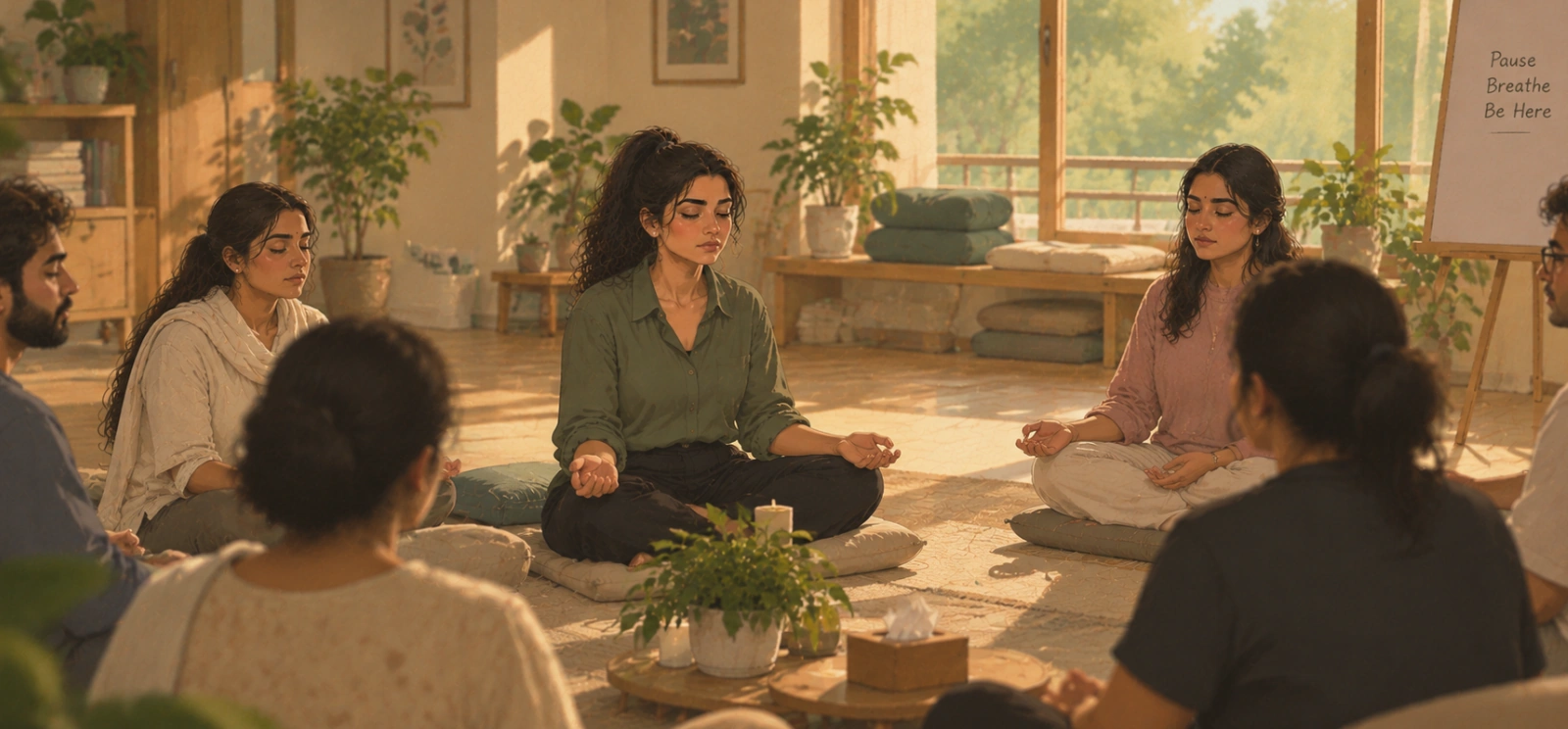
It is an eight-week group course. Most groups meet once a week for around two hours.
There is daily home practice between sessions. That part is not optional.
The course blends two things.
From mindfulness training, it takes attention practice. Breath, body, and sound, done in a structured way.
From cognitive therapy, it takes the study of thinking patterns.
The join between them is the clever part.
Cognitive therapy usually asks you to examine a thought and test it.
MBCT asks something different. It asks you to notice the thought and let it pass.
That sounds small. In practice it changes everything.
Here is the reasoning behind it.
When you are already well, arguing with low thoughts can restart them.
You get pulled into a loop of self-examination. The loop is the problem.
So MBCT trains a different move. Step back, name what is happening, return attention to the body.
Not fighting. Not fixing. Just stepping out.
It takes practice to make that move on a bad day.
That is all the eight weeks are really for.
You are building a habit, not learning a fact.
The course also teaches early warning signs.
You build your own list of what an oncoming dip looks like for you.
Then you build a plan for what to do when you see it.
That plan is written down. On paper, in your own words.
It names who you will tell. It names what you will stop doing.
Most people have never written one. It helps more than it sounds.
Q: What is mindfulness-based cognitive therapy in simple terms?
A: An eight-week group course that trains you to spot low mood early and step out of rumination. It blends mindfulness practice with cognitive therapy, and is built to prevent relapse.
How It Differs From Ordinary Meditation
This matters, because many people assume they are the same thing.
They are not, in four ways.
The aim is different. Most meditation aims at calm or insight.
MBCT aims at one clinical target. Fewer depressive episodes.
The curriculum is fixed. Eight sessions, in order, with set practices each week.
It is a treatment protocol, not an open practice.
The teacher is trained differently. MBCT teachers train in the model and in depression itself.
They know what rumination looks like and how to work with it.
The content includes depression education. You learn how episodes build and what keeps them running.
That teaching is part of the treatment, not an extra.
There is one more difference, and it is the most practical.
MBCT does not tell you to feel calm.
Some sessions involve sitting with discomfort on purpose, in a controlled way.
The skill being built is tolerance, not relaxation.
People who arrive expecting a peaceful hour are often surprised.
People who arrive expecting to fail are often surprised too.
A wandering mind is not a sign you cannot do this.
Noticing the wandering is the practice.
You cannot get it wrong by drifting.
So if you have tried a meditation app and given up, that is not a verdict on this.
Different aim. Different method. Different support around it.
A group also does something an app cannot.
You hear other people describe your own head back to you.
That alone lands for many people in week two.
Q: Is MBCT the same as using a meditation app?
A: No. An app teaches practice with no clinical aim. MBCT is a structured eight-week course with a set curriculum, a trained teacher, and depression relapse as its target.
What the Evidence Shows
This is where MBCT separates itself from most wellness offerings.
The strongest study pooled individual patient data from randomised trials.
It covered 1,258 patients, with a mean age of 47.1 years (Source: JAMA Psychiatry, 2016 — pmc.ncbi.nlm.nih.gov).
Here is the headline result.
Patients who received MBCT had a reduced risk of relapse over a 60-week follow-up, with a hazard ratio of 0.69 (Source: JAMA Psychiatry, 2016 — pmc.ncbi.nlm.nih.gov).
In plain terms, that is a clear drop in risk over more than a year.
The second result matters more, though.
Compared with other active treatments, MBCT still showed reduced relapse risk, with a hazard ratio of 0.79 (Source: JAMA Psychiatry, 2016 — pmc.ncbi.nlm.nih.gov).
Those active comparisons included antidepressants.
So this is not a soft add-on. It held up against standard care.
One more finding is worth knowing.
People with more severe symptoms before starting got a larger benefit from MBCT (Source: JAMA Psychiatry, 2016 — pmc.ncbi.nlm.nih.gov).
That runs against the usual assumption. Many people think mindfulness suits only mild cases.
The data says the opposite here.
More residual symptoms meant more to gain.
So do not rule yourself out for being too unwell.
The study also checked whether age, sex, education, or number of past episodes changed the effect. None showed a significant interaction (Source: JAMA Psychiatry, 2016 — pmc.ncbi.nlm.nih.gov).
Now the honest caveat.
Therapy of this kind is not established as a full replacement for medicine in resistant depression. Added to treatment, it gives real relief (Source: World Psychiatry, 2023 — pmc.ncbi.nlm.nih.gov).
So treat MBCT as a strong preventive tool. Not a substitute decided on your own.
Used well, it does two things at once.
It lowers the odds of the next episode.
And it gives you something to do when the mood starts to dip.
Quick Facts: MBCT and Depression Relapse
The main meta-analysis pooled individual data from 1,258 patients — (Source: JAMA Psychiatry, 2016 — pmc.ncbi.nlm.nih.gov).
MBCT cut relapse risk over 60 weeks versus usual care, with a hazard ratio of 0.69 — (Source: JAMA Psychiatry, 2016 — pmc.ncbi.nlm.nih.gov).
Against other active treatments the hazard ratio was 0.79 — (Source: JAMA Psychiatry, 2016 — pmc.ncbi.nlm.nih.gov).
Relapse rates in the STAR*D follow-up ran from 40% to 71% — (Source: Current Psychiatry Reports, 2007 — pubmed.ncbi.nlm.nih.gov).
Current depression prevalence in India is 2.7%, and lifetime is 5.2% — (Source: National Mental Health Survey, NIMHANS, 2016 — indianmhs.nimhans.ac.in).
India's treatment gap across mental disorders runs from 28% to 83% — (Source: National Mental Health Survey, NIMHANS, 2016 — indianmhs.nimhans.ac.in).
Inside the Eight Weeks
People commit more easily when they know the shape. So here it is.
Weeks one and two. Attention training starts.
You practise noticing where the mind goes. A long body scan is the main home practice.
Most people find this dull or frustrating. That reaction is itself part of the material.
Weeks three and four. Short practices get added.
You start noticing pleasant and unpleasant events during the day, and what the body does with each.
The link between thought, mood, and body starts becoming visible.
Weeks five and six. The difficult part arrives.
You practise turning towards discomfort rather than away from it, in small doses.
This is where the tolerance skill gets built.
Week seven. Planning starts.
You map your own early warning signs, and what you will do about each.
You also look at the balance of draining and nourishing activity in your week.
Week eight. Consolidation and the plan for after.
The group ends. Practice continues, usually shorter than during the course.
Two practical points.
Home practice during the course runs around 30 to 45 minutes on most days.
That is the commitment people underestimate, and the main reason courses get abandoned.
After the course, practice usually shortens. Many people settle at 10 to 20 minutes.
The course gives you the tools. The months after decide if they stick.
Most teachers offer a follow-up session. Take it if offered.
Missing a day is not failure. Stopping for three weeks is where drift begins.
So plan for the gaps now.
Pick a short practice you can do on a bad day.
Five minutes done beats forty minutes skipped.
Q: How long does an MBCT course take?
A: Eight weekly group sessions of about two hours each, plus daily home practice. During the course, practice runs about 30 to 45 minutes on most days.
Who It Suits, and Who Should Wait
MBCT has a clear target group and clear limits. Both matter.
Good fit. You have had depression before, and you are currently well or mostly well.
Good fit. You have had more than one episode, and you fear the next one.
Good fit. You want to come off antidepressants one day, under guidance.
Good fit. Residual symptoms remain after treatment, such as low energy or dwelling on things.
Wait. You are in a severe episode right now.
Concentration is usually too impaired for the practices to land, and the course can feel like another failure.
People who have tried therapy and disliked talking at length often do well here.
There is far less talking about the past than in most therapies.
The focus is on this week, and on what the body is doing now.
For some people that is a relief.
For others it feels too plain at first. Give it three weeks.
Q: Should I do MBCT while I am still depressed?
A: Usually not during a severe episode. Concentration is too affected, and the course is built for prevention. Treat the current episode first, then use MBCT to stay well.
Doing It Alongside Medicine
This question comes up in almost every first session.
The short answer is that the two work together.
The trials tested MBCT both with medicine and against it as an alternative for some patients (Source: JAMA Psychiatry, 2016 — pmc.ncbi.nlm.nih.gov).
Here is how to think about it in practice.
If you are on antidepressants and stable, MBCT is an addition, not a swap.
Start the course while staying on your usual dose.
If you hope to reduce medicine later, that is a reasonable goal to raise.
Never taper because a course has started going well. Week four optimism is not evidence.
There is a practical reason too.
Stopping medicine causes withdrawal effects that look like relapse.
If that happens mid-course, you cannot tell what caused what.
So sequence it. Finish the eight weeks. Keep practising for a few months. Then review the medicine.
And tell your teacher what you take.
They are not prescribing, but they should know the picture.
Tell them about past episodes too.
How many, and how bad. It changes how they pace the group.
Q: Can MBCT replace my antidepressants?
A: Not on your own decision. Some patients do reduce medicine after MBCT, but only with psychiatrist guidance. Stopping suddenly causes withdrawal effects that can look exactly like relapse.
Making It Work in an Indian Week
The course was designed in the West. The practice is older than that, and much of it is Indian in origin.
Still, fitting it into a real week here takes planning.
Find the time honestly. Thirty to forty-five minutes is real. Do not pretend otherwise.
Early morning works best for most people, before the house wakes.
Claim a space. A corner, a mat, a closed door for half an hour.
In a joint family home, this needs saying out loud rather than hoping.
Tell the household what it is. Say it is part of treatment, like a tablet.
That framing stops it being read as idleness.
Separate it from religious practice. Many Indian homes already have a prayer routine.
MBCT is not a substitute for that, and it is not a competitor to it.
Keeping them separate helps both stay intact.
Beware the app trap. Apps are useful for short practice later.
During the course, use the recordings your teacher provides. The sequence matters.
Check the teacher's training. Ask directly whether they are trained in MBCT.
Meditation experience alone is not the same qualification.
Ask two more things while you are there.
How big is the group. And who else is in it.
A group of peers works better than a mixed one.
Consider the online option. Groups run online too.
Access is the real barrier here. The treatment gap across mental disorders runs from 28% to 83% (Source: National Mental Health Survey, NIMHANS, 2016 — indianmhs.nimhans.ac.in).
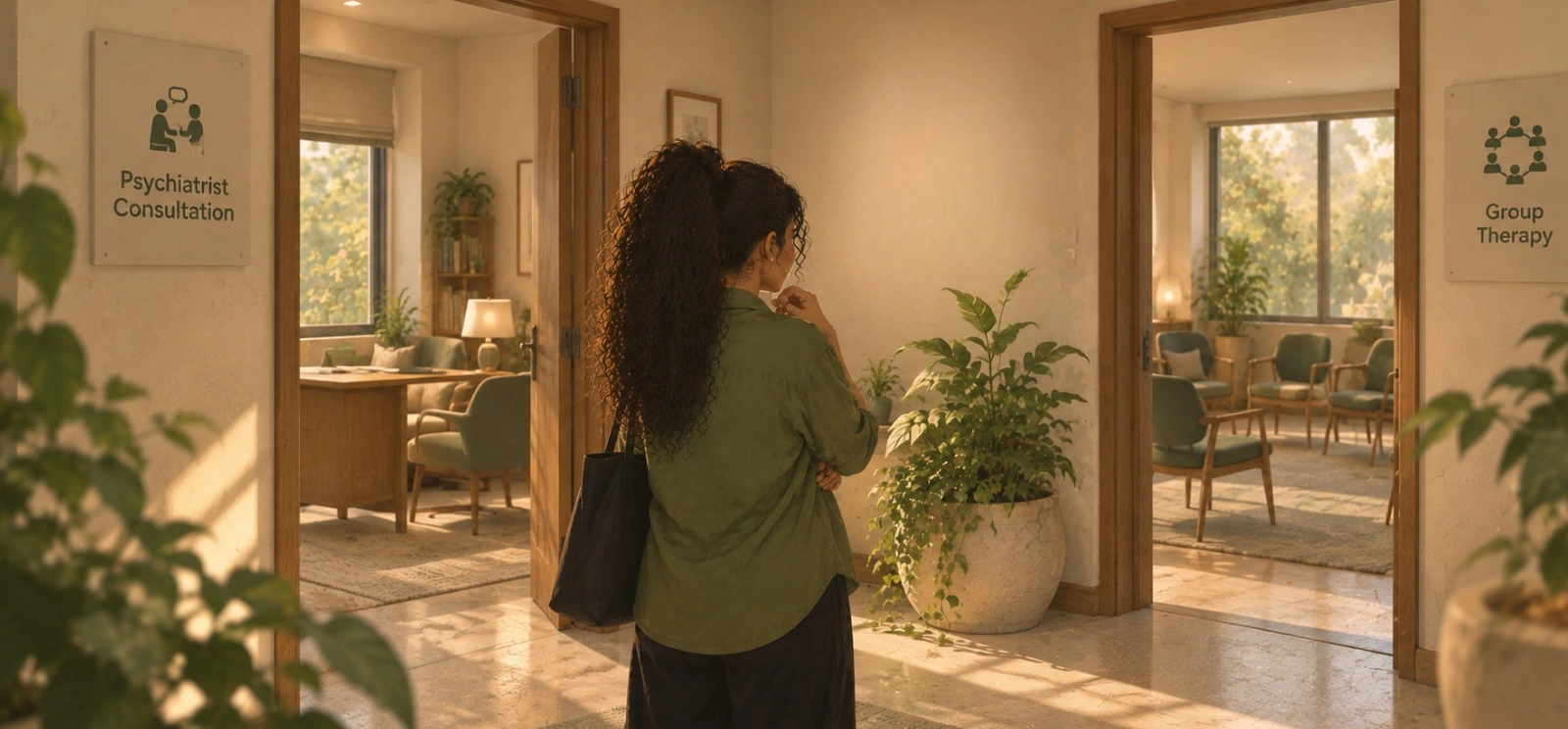
If a formal group is not available near you, ask your psychiatrist what the nearest option is.
Online groups widen that reach a lot.
So do hospital psychiatry departments in larger cities.
Ask both before deciding it is not available.
Q: How much time does mindfulness practice really take?
A: About 30 to 45 minutes daily during the eight-week course. After it ends, most people settle around 10 to 20 minutes. Consistency matters more than length.
How Ganaa Uses Mindfulness in Depression Care
Ganaa has worked in mental health care in India since 2012. We treat psychiatric conditions and substance use across age groups (Source: Ganaa, 2026 — ganaa.in).
Our approach blends psychiatric treatment with psychology sessions, family counselling, and holistic therapy (Source: Ganaa, 2026 — ganaa.in).
Mindfulness work sits inside that mix, not on top of it.
We are careful about timing. Attention practice asks a lot of a mind in a heavy episode.
So the sequence usually runs treatment first, then stability, then relapse prevention.
The prevention stage is where this work does most of its good.
Most people are seen as outpatients. Our clinics sit in Faridabad, Greater Kailash, and Greater Noida.
Live-in centres are in Delhi, Gurugram, Greater Noida, and South Goa (Source: Ganaa, 2026 — ganaa.in).
A residential stay suits people whose daily life cannot hold a routine yet.
Where a stay is needed, published guidance puts programme length at 30 to 90 days (Source: Ganaa FAQ, 2026 — ganaa.in).
Aftercare continues once someone goes home, with reviews and therapy sessions (Source: Ganaa FAQ, 2026 — ganaa.in).
For relapse prevention, that aftercare stage is the whole point.
Treatment is tailored to the person, not run off a template.
Support runs 24 hours a day.
If depression has come back more than once, ask about a prevention plan by name.
Speak to a Ganaa counsellor on +91 8750075006, or write to info@ganaa.in. You can also book a consultation at ganaa.in/booking.
Conclusion: Treat Staying Well as Its Own Job
Depression treatment usually ends the day you feel better. That is too early.
The evidence on relapse is blunt. In harder cases it reached 71% in follow-up (Source: Current Psychiatry Reports, 2007 — pubmed.ncbi.nlm.nih.gov).
Mindfulness-based therapy exists for that second stage.
It is not a calming exercise. It is a structured eight-week course with a clinical target.
The data behind it is strong. Over 60 weeks, MBCT cut relapse risk against usual care.
It also held up against other active treatments, including medicine.
It asks for real effort. Thirty to forty-five minutes a day for eight weeks.
It is not for a severe episode happening right now. It is for the ground after.
If you have been well for a while and dread the next dip, this is worth asking about.
Ask your psychiatrist whether MBCT is available near you.
Ask whether the teacher is trained in the model itself.
Then give the eight weeks a fair run.
Getting well took work. Staying well is worth the same.
Start with one question at your next visit.
Ask what your plan is for the next twelve months.
If there is no answer, that is the gap this fills.
FAQ
Q: What is mindfulness-based cognitive therapy?
A: It is an eight-week group course that blends mindfulness training with cognitive therapy. It is built to stop depression coming back, not to treat an active episode. Most groups meet weekly for about two hours.
Q: Does MBCT actually prevent depression relapse?
A: The evidence is good. A meta-analysis of 1,258 patients found MBCT cut relapse risk over 60 weeks compared with usual care. It also beat other active treatments over the same period.
Q: How is MBCT different from ordinary meditation?
A: Ordinary meditation aims at calm. MBCT trains you to notice low mood early and step out of rumination. It is a structured clinical course with a set curriculum, not an open practice.
Q: Can I do MBCT while taking antidepressants?
A: Yes, and many people do. MBCT was tested both alongside medicine and as an alternative for some patients. Never change a dose to start a course. Plan any change with your psychiatrist.
Q: Who is MBCT suitable for?
A: It suits people who have recovered from depression and want to stay well. It is designed for those with repeated past episodes. It is not a first treatment for someone in a severe episode now.
Q: How much daily practice does MBCT need?
A: Around 30 to 45 minutes of home practice on most days during the course. That is the part people underestimate. Shorter practices are used after the eight weeks end.
Q: Is mindfulness-based therapy available in India?
A: Yes, through hospitals, private clinics, and some online groups. Ask whether the teacher is trained in MBCT specifically. A general meditation class is not the same treatment.
Eating disorders in India hide behind praise for discipline and thinness. Learn the early warning signs, what to say, and how treatment actually works.
High functioning anxiety hides behind good work and a calm face. Learn the hidden signs, what the body does, and when coping turns into the problem itself.
The cost of mental health rehab in India is rarely published openly. Here is what moves the price, what insurance must cover by law, and what to ask first.