Antidepressants Explained: SSRIs, SNRIs, and What They Actually Do
Antidepressants explained in plain words. How SSRIs and SNRIs work, common side effects, the first six weeks, and how to talk to your psychiatrist.
Antidepressants Explained: SSRIs, SNRIs, and What They Actually Do
Antidepressants are one of the most misunderstood medicines around.
Some people fear they numb you. Others expect a magic switch. Both ideas are wrong. This guide has antidepressants explained in plain, simple words.
Here is the short answer. Antidepressants help balance brain chemicals tied to mood. They do not create false happiness. They lift the floor so you can function, sleep, and heal.
The most common kinds are SSRIs and SNRIs. You may have heard these names from a doctor or a friend. They sound technical. They are not that complex once you break them down.
Depression is common and treatable. Around 280 million people live with it worldwide (Source: WHO, 2023 — who.int). Medicine is only one part of care. Therapy, sleep, and support matter too.
This blog walks through the main antidepressant types. We cover how SSRIs and SNRIs work. We look at SSRI side effects and the first six weeks. We bust common myths. We also share questions to ask your psychiatrist.
No dosages here. No "start this drug" advice. That is your prescriber's job. This is education, so you feel calmer and clearer.
What Antidepressants Actually Do in the Brain
Let us clear up the biggest myth first.
Antidepressants do not make you happy on demand. They work on brain chemistry over time. Think of them as support, not a switch.
Your brain uses chemical messengers. These are called neurotransmitters. Serotonin and norepinephrine are two of them. They help shape mood, sleep, and focus.
In depression, these signals can run low or uneven. Antidepressants help steady them. They give your brain a better base to recover from.
Most modern antidepressants slow "reuptake". Reuptake is when the brain reabsorbs a chemical too fast. Slowing it leaves more of the messenger in place. That helps nerve cells talk to each other.
This is why relief is slow, not instant. The chemistry shifts within days. The mood change takes weeks. Your brain needs time to adjust.
The old story was simple. Low serotonin caused depression. Boost it and the sadness lifts.
The truth is richer than that. Depression is not one broken chemical. Genes, stress, sleep, and life all play a role.
So antidepressants do not "fix a shortage". They nudge the system toward balance. Your brain then does slow repair work.
This matters for how you use them. Do not expect a sudden lift. Expect a gentle, steady climb instead.
A: No. They help correct a chemical imbalance so your brain can heal. They are not a numbing agent. Most people say they feel more like themselves, not less. Therapy alongside medicine treats the root, not just the surface.
Research backs this up. In one large review, all 21 antidepressants studied worked better than a placebo for adults with major depression (Source: PubMed / The Lancet, 2018 — pubmed.ncbi.nlm.nih.gov).
Medicine is a tool. It is not the whole plan. A good psychiatrist pairs it with therapy and lifestyle care.
- About 280 million people live with depression worldwide — . - Roughly 5% of adults have depression globally — . - All 21 antidepressants in one major review beat placebo for adults — . - India's treatment gap for mental disorders runs between 70% and 92% — . - Nearly 150 million Indians need mental health care each year — .
SSRIs Explained: The Most Common First Choice
SSRIs are usually the first medicine a doctor tries.
The name stands for Selective Serotonin Reuptake Inhibitors. Long name, simple job. They keep more serotonin working in your brain.
Serotonin helps with mood, calm, and sleep. When it stays in place longer, signals get stronger. Over weeks, mood tends to lift.
Doctors like SSRIs for good reasons. They are well studied. They are often gentle to start. Side effects, when they come, are usually mild.
Common SSRI names include fluoxetine, sertraline, and escitalopram. Your psychiatrist chooses based on your history. Never pick one yourself.
SSRIs treat more than depression. They also help anxiety, panic, and OCD. This makes them a flexible first step.
A: SSRIs are well tested and easy to tolerate for most people. They treat both depression and anxiety, which often occur together. The starting side effects tend to be mild and short. That safety record makes them a sensible first choice.
Give an SSRI time to work. The full effect often takes four to six weeks (Source: NIMH, 2024 — nimh.nih.gov). Early weeks can feel bumpy. That is normal, and it passes.
There is another reason doctors reach for them. Anxiety and depression often travel together. One SSRI can ease both at once. That keeps the plan simple.
Doses usually start low. Your doctor may raise them slowly. This gentle build limits early side effects. It also lets your body settle.
If one SSRI does not suit you, that is fine. There are many antidepressant types to try. Finding the right fit can take patience.
Do not read too much into brand names. The generic name is what matters. Two brands can hold the same medicine. Your pharmacist can explain any label.
SNRIs Explained: A Second Path
SNRIs are the close cousins of SSRIs.
The name stands for Serotonin and Norepinephrine Reuptake Inhibitors. They raise two chemicals, not one. That is the key difference.
Serotonin supports mood and calm. Norepinephrine adds energy and focus. Together they can lift both mood and drive.
This makes SNRIs useful in certain cases. They may help when low energy is a big problem. They can also ease some kinds of long-term pain.
Common SNRI names include venlafaxine and duloxetine. Again, only a psychiatrist should prescribe them. The choice depends on your full picture.
Doctors may move to an SNRI later. This can happen if an SSRI does not fully work. It is a normal step, not a failure.
A: An SNRI may fit when fatigue, poor focus, or nerve pain sit alongside low mood. It works on norepinephrine too, which can add energy. Some people also switch to it if an SSRI helps only part way. The decision is always tailored to your symptoms.
SNRIs share many side effects with SSRIs. Some people notice a small rise in blood pressure. Your doctor will keep an eye on this. Regular check-ins matter here.
SNRIs also help beyond low mood. Some ease nerve pain and body aches. This is handy when pain and depression mix. One medicine can then serve two needs.
Stopping an SNRI needs care as well. A slow taper is key. Quick stops can bring flu-like feelings. Your doctor plans this with you.
Both drug classes need time and follow-up. Neither is better for everyone. The right one is the one that suits you.
Antidepressant Types Compared: A Simple Table
There is no single "best" antidepressant.
Different antidepressant types suit different people. The main groups work in slightly different ways. Here is a clear side-by-side view.
TypeHow it worksCommon usesTypical onsetSSRIRaises serotonin onlyDepression, anxiety, OCD4 to 6 weeksSNRIRaises serotonin and norepinephrineDepression, anxiety, some pain4 to 6 weeksAtypicalActs on other brain pathwaysDepression, sleep, low energy2 to 6 weeksTricyclic (TCA)Older class, broad actionDepression, chronic pain2 to 4 weeksMAOIBlocks an enzyme that breaks down mood chemicalsHard-to-treat depression2 to 6 weeks
SSRIs and SNRIs are the modern front line. They are safer and easier to tolerate. Older classes still have a place.
Tricyclics and MAOIs came first, decades ago. They work well but carry more side effects. Doctors use them with more care.
Atypical antidepressants sit outside the neat boxes. Some help sleep. Some lift energy. Your psychiatrist matches the drug to your needs.
A: Not always. Newer SSRIs and SNRIs are easier to tolerate for most people. But older classes can work well for certain cases. The best choice depends on your symptoms, health, and past response, not the launch date.
The timings above are rough guides. Everyone responds at their own pace. Do not judge a medicine in the first week.
SSRI Side Effects and What to Expect
Let us talk honestly about SSRI side effects.
Most are mild. Most are short. Knowing them in advance takes away the fear.
Early on, some people feel nausea or headache. Sleep may be off. Appetite can change. These often show up in the first days.
Here is the good news. These effects usually fade fast. Many settle within one to two weeks (Source: Royal College of Psychiatrists, 2024 — rcpsych.ac.uk).
Simple steps can help you cope. Take the medicine with food. Drink water. Keep a steady sleep routine. Go easy on caffeine.
Some side effects last longer for a few people. Sexual changes and emotional blunting can occur. These are worth raising with your doctor. The plan can be adjusted.
A: Tell your prescriber, but do not stop the medicine on your own. Many side effects ease with time or a small change in plan. Some can be managed with simple habits. Your psychiatrist will guide any switch or dose change safely.
There are warning signs to act on fast. Watch for worse mood or thoughts of self-harm. Watch for signs of high energy or agitation. Call your doctor right away if these appear.
Everyone reacts a little differently. Some people feel almost nothing. Others need a few weeks to settle. Neither response is wrong.
There is a simple mindset that helps. Track side effects like weather. Note them, ride them out, and report the big ones. Most storms pass quickly.
Side effects are not a reason to fear medicine. They are a reason to stay in touch. Good follow-up keeps you safe and on track.
The First Six Weeks: A Simple Timeline
The start of treatment can feel confusing.
You take a pill each day. Nothing shifts at once. This waiting period trips up many people.
Here is a rough map of the early weeks. It is a guide, not a rule. Your path may look a little different.
Week 1 to 2. Side effects may peak now. You might feel nausea or poor sleep. Mood has not lifted yet. This is the hardest stretch.
Week 2 to 4. The body settles. Early side effects fade. You may sleep or eat a bit better. Small signs of hope appear.
Week 4 to 6. The real mood change tends to arrive. The full effect often lands here (Source: NIMH, 2024 — nimh.nih.gov). Many people feel steadier and lighter.
A: The brain needs time to adjust to new chemical levels. Signals must rebuild over weeks, not hours. Sleep and appetite often improve before mood does. That slow build is normal and expected.
The biggest mistake is quitting too soon. Many people stop in week two. That is often just before relief begins. Patience truly pays here.
Stay in close contact during these weeks. Note how you feel each day. Share it with your psychiatrist. Small tweaks can make a big difference.
A simple diary can help a lot. Rate your mood out of ten each day. Note sleep, appetite, and energy too. Patterns often show before you feel them.
Loved ones can spot progress first. They may see you laugh again. They may notice you leaving the house. Ask them to share what they see.
If nothing shifts by six weeks, that is useful too. Your doctor may adjust the plan. A switch or a new dose can help.
Antidepressant Myths vs Facts
Fear grows in the gaps where facts are missing.
Myths around medicine keep many people away. They wait, worry, and suffer longer. Clear facts can change that.
Let us replace some common myths with clear facts. This alone can make starting treatment easier.
Myth: Antidepressants are addictive. Fact: They are not addictive like alcohol or opioids. You do not crave them or chase a high. Your body can adjust, so doses are lowered slowly. That is dependence-safe, not addiction.
Myth: They change who you are. Fact: Most people feel more like themselves again. The medicine lifts the fog, not your identity. A few notice muted feelings, which can be managed.
Myth: You will need them forever. Fact: Many people use them for months, not life. Some need longer support. Your psychiatrist reviews this over time.
Myth: Feeling better means you can stop. Fact: Feeling better often means the medicine is working. Stopping early can bring the low back. Always taper with medical guidance.
A: Not at all. Depression is a health condition, like diabetes or asthma. Treating it with medicine is a smart, brave step. Seeking help is a sign of strength, never weakness.
Myth: Medicine alone will fix everything. Fact: Medicine works best with therapy and support. It lifts the floor so other work can begin. A full plan heals better than a pill alone.
Myth: Only "serious" cases need medication. Fact: Depression comes in many sizes. Mild cases may need only therapy. Others benefit from medicine early. A psychiatrist helps you judge.
Stigma is strong in many Indian homes. People fear judgement from family or work. This silence delays care for years. Naming the myths helps break it.
Facts calm fear. When you know the truth, the choice feels lighter. Talk it all through with a trusted clinician.
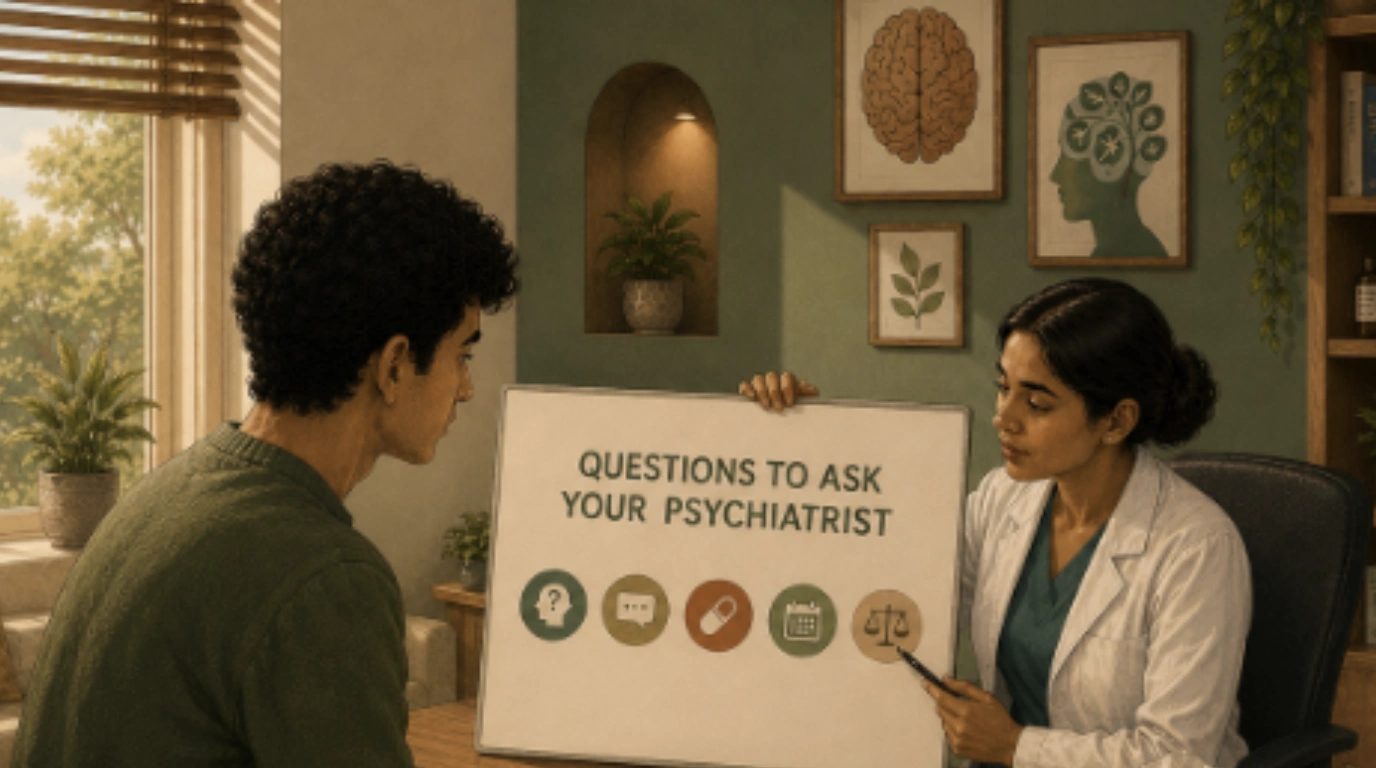
Questions to Ask Your Psychiatrist
A good appointment is a two-way talk.
You are allowed to ask questions. In fact, you should. Clear answers help you feel in control.
Here is a simple checklist to take with you. Copy it into your phone. Use it at your next visit.
A: Bring your written list and hand it over. Ask for a follow-up call or visit if needed. A good psychiatrist welcomes your questions. You deserve time and clear answers about your care.
Write the answers down during the visit. Memory fades under stress. A short note helps you follow the plan.
Be honest about your full history. Mention past medicines and reactions. Share any other health issues. This helps your doctor choose well.
Ask about therapy at the same visit. Medicine and therapy work best together. Your psychiatrist can guide the mix. One plan, two tools.
Bring a family member if that helps. A second pair of ears is useful. They can support you between visits too.
Never leave confused about your plan. If something is unclear, ask again. Your safety depends on understanding it well.
How Ganaa Supports People Starting Treatment
Starting medicine can feel lonely. It should not be.
At Ganaa, we walk this path with you. We are a mental health and rehabilitation network in India. We blend modern clinical care with calm, human support.
Our psychiatrists guide every step. They explain each choice in plain words. They track your progress with care. No one is left to figure it out alone.
We know medicine is only one part. So we pair it with therapy, such as CBT and DBT. We add yoga, mindfulness, and steady daily structure. This whole-person care helps healing hold.
We offer both OPD clinics and residential centres. Our residential centres sit across Delhi NCR, Greater Noida, and Goa. Our OPD clinics support those who prefer regular visits. Care is built around your life and needs.
Our settings are calm and green. A peaceful space aids recovery. You get round-the-clock support. You also get privacy and dignity.
Families matter to us too. We guide loved ones on how to help. Depression affects the whole home, not one person. We support everyone in it.
We never rush a plan. We never push a pill as a quick fix. We build a tailored plan with you, at your pace. Trust and clarity come first.
If you or someone you love is struggling, reach out. A short conversation can open the door to care. You do not have to carry this alone.
Speak to a Ganaa clinician today. Visit ganaa.in to learn more about our programs. Ask any question you have. Help is closer than it feels.
Conclusion: Knowledge Makes the First Step Easier
Antidepressants are not magic, and they are not the enemy.
They are a well-studied tool for a real health condition. SSRIs and SNRIs help balance the brain chemicals tied to mood. They work slowly, over weeks, not overnight.
You now know the main antidepressant types. You know how SSRIs and SNRIs differ. You know what SSRI side effects look like. You know the first six weeks take patience.
Medicine works best inside a bigger plan. Therapy, sleep, and support all matter. A good psychiatrist ties it all together for you.
Fear often comes from not knowing. Facts make the first step lighter. You deserve care that is clear, kind, and steady.
If you are weighing depression medication in India, do not decide alone. Speak to a qualified psychiatrist. Ask your questions. Take your time.
Recovery is possible, and it is common. Millions walk this path and heal. Many start with a single call. With the right help, so can you.
Reach out to a Ganaa clinician when you are ready. The door is open whenever you need it.
FAQ
Q: How long do antidepressants take to work?
A: Most people feel the full effect in four to six weeks (Source: NIMH, 2024 — nimh.nih.gov). Sleep and appetite may lift first. Mood often shifts later. Give it time, and stay in touch with your psychiatrist.
Q: What is the difference between an SSRI and an SNRI?
A: An SSRI raises serotonin alone. An SNRI raises serotonin and norepinephrine. SNRIs may help when low energy, focus problems, or certain pain are part of the picture. Your psychiatrist picks based on your symptoms and history.
Q: Are SSRI side effects permanent?
A: Most early side effects are mild and fade within one to two weeks. Nausea, headache, and poor sleep are common at the start. If a side effect stays or feels severe, tell your prescriber. Do not stop the medicine on your own.
Q: Can I stop antidepressants once I feel better?
A: Never stop on your own, even when you feel well. Stopping suddenly can cause withdrawal-type symptoms. Your psychiatrist will lower the dose slowly when the time is right. Feeling better often means the medicine is working.
Q: Are antidepressants addictive?
A: Antidepressants are not addictive in the way alcohol or opioids are. You do not crave them or chase a high. Your body can adjust to them, which is why doses are lowered slowly. This is different from dependence.
Q: Do antidepressants change your personality?
A: No. They do not erase who you are. Most people say they feel more like themselves again. A few notice emotional blunting, where feelings seem muted. Tell your psychiatrist if that happens, as the plan can be adjusted.
Q: Is it easy to see a psychiatrist for depression medication in India?
A: Access is growing, though many people still face long gaps in care. A large share of Indians who need help never reach a specialist (Source: NIMHANS, 2016 — indianmhs.nimhans.ac.in). OPD clinics and residential centres like Ganaa make it easier to start. A trained psychiatrist should always guide any depression medication in India.
Eating disorders in India hide behind praise for discipline and thinness. Learn the early warning signs, what to say, and how treatment actually works.
High functioning anxiety hides behind good work and a calm face. Learn the hidden signs, what the body does, and when coping turns into the problem itself.
The cost of mental health rehab in India is rarely published openly. Here is what moves the price, what insurance must cover by law, and what to ask first.


.webp)