Cost of Mental Health Rehab in India: A Transparent Breakdown
The cost of mental health rehab in India is rarely published openly. Here is what moves the price, what insurance must cover by law, and what to ask first.
Cost of Mental Health Rehab in India: A Transparent Breakdown
Most families call about money in the first minute. Very few get a straight answer.
They are told it depends. Which is true, and also useless on its own.
So here is the version that is actually useful.
This piece does not give you one figure. Nobody honest can.
What it gives you is the anatomy of the bill.
The cost of mental health rehab in India moves with a small set of things. Once you can name them, you can ask better questions.
You can also spot the centre that is hiding something.
We will walk through what sits inside a monthly fee. And what almost always sits outside it.
We will cover what your insurer must pay for by law. And where that law still fails in practice.
We will cover the free and low-cost rungs below private care.
And we will end with the questions to ask before you pay any deposit.
One note. This is general guidance on cost, not a quote.
Any real number has to follow an assessment of the person.
Why No Honest Centre Quotes One Number
Think about what you are buying.
Not a hotel room. A level of medical care.
Two people can walk into the same centre on the same day.
One needs a medically supervised detox with hourly checks. The other needs a quiet month of therapy and routine.
Those are not the same product. They cannot share a price.
Level of care is the first fork.
Detox and acute care need more staff per person. More nursing. More night cover. More doctor time.
Stable, longer-stay care needs less of all that.
The second fork is the room. Shared rooms cost less than private ones. That part is simple.
The third fork is the clinical mix. Daily psychiatry review costs more than weekly.
So when a centre quotes before assessing, be careful.
Either they are guessing, or they are selling a room and calling it treatment.
A good admissions team asks about the diagnosis first. Then about safety. Then about history.
The number comes after that.
That order is a good sign. It means care leads, and money follows.
The reverse order is a warning.
You are not being rude by asking twice. You are being careful.
Q: Why will a rehab centre not tell me the price on the phone?
A: Because the fee follows the level of care needed. Detox, acute care, and stable long-stay care all cost differently. An honest quote comes after an assessment.
The Five Things That Move the Price
Here are the levers. Almost every quote in India moves on these.
Level of care. Detox and acute care sit at the top. Stable residential care sits lower.
Length of stay. Most programmes run 30 to 90 days (Source: Ganaa FAQ, 2026 — ganaa.in).
A 90-day stay is not three times better than 30. But it does cost about three times as much.
Room type. Shared, twin, or private. This is the easiest lever to pull if money is tight.
Staff ratio. How many nurses per patient at night? How often does a psychiatrist review?
This is the lever that matters most and gets asked about least.
Location. A city centre bed costs more than one an hour outside. Land and staff both cost more.
Two more things shift the total without appearing on the brochure.
Dual diagnosis raises cost. Treating a mood disorder and a substance problem together needs more input.
So does a history of leaving treatment early. That usually means closer supervision.
None of this is a trick. It is just what care costs when it is done properly.
Ask which levers apply to your case. Then ask which ones you can move.
Room type is the one most families can move. Ask for a shared room first.
Length is harder to cut. A short stay that fails costs more than a full one that works.
Staff ratio is the one to never cut.
Q: What raises the cost of rehab the most?
A: The level of care needed. Detox and acute care need more staff, more night cover, and more doctor time. Room type and length of stay come next.
What Is Inside the Fee, and What Is Not
This is where most surprises live.
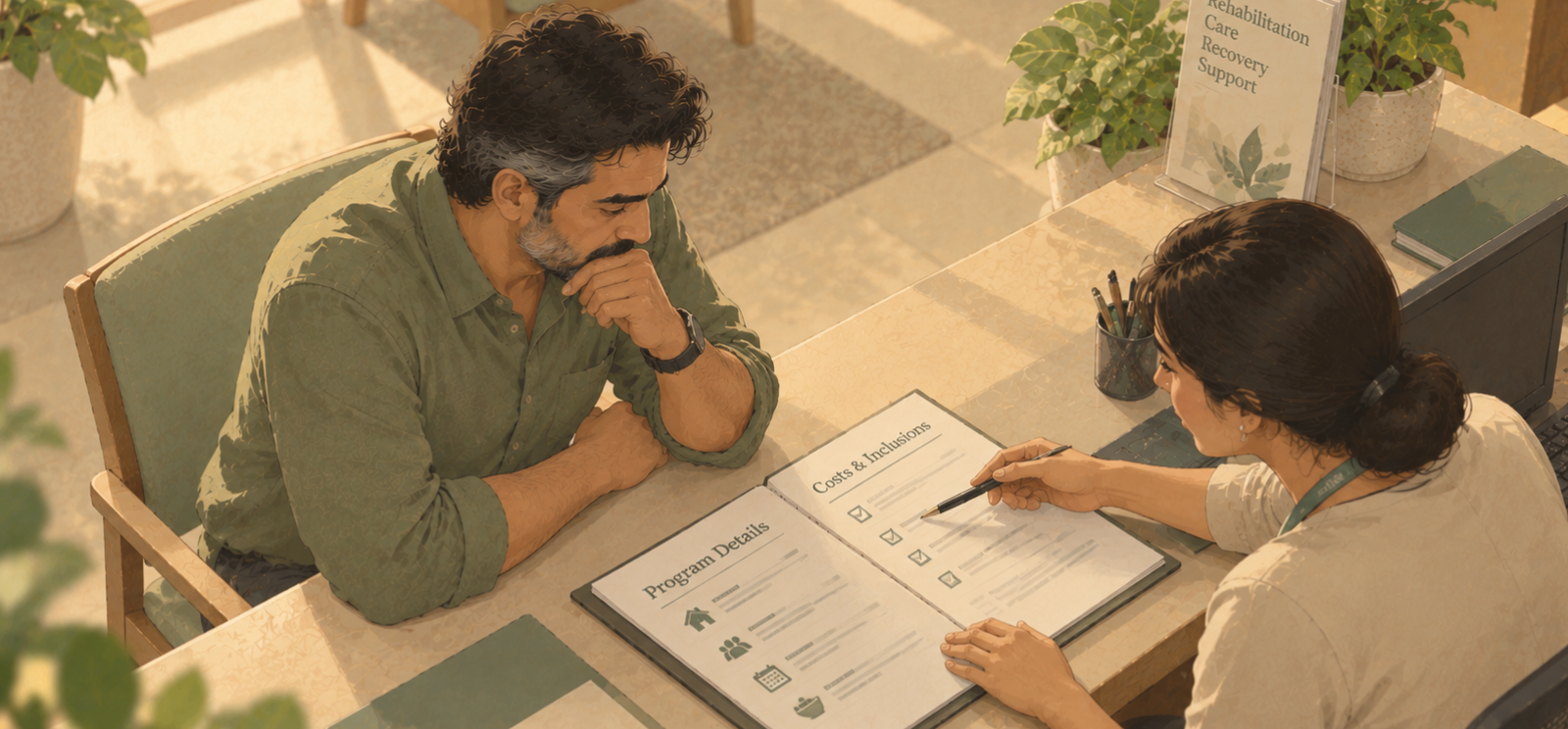
Ask for the inclusion list in writing. Not a verbal summary.
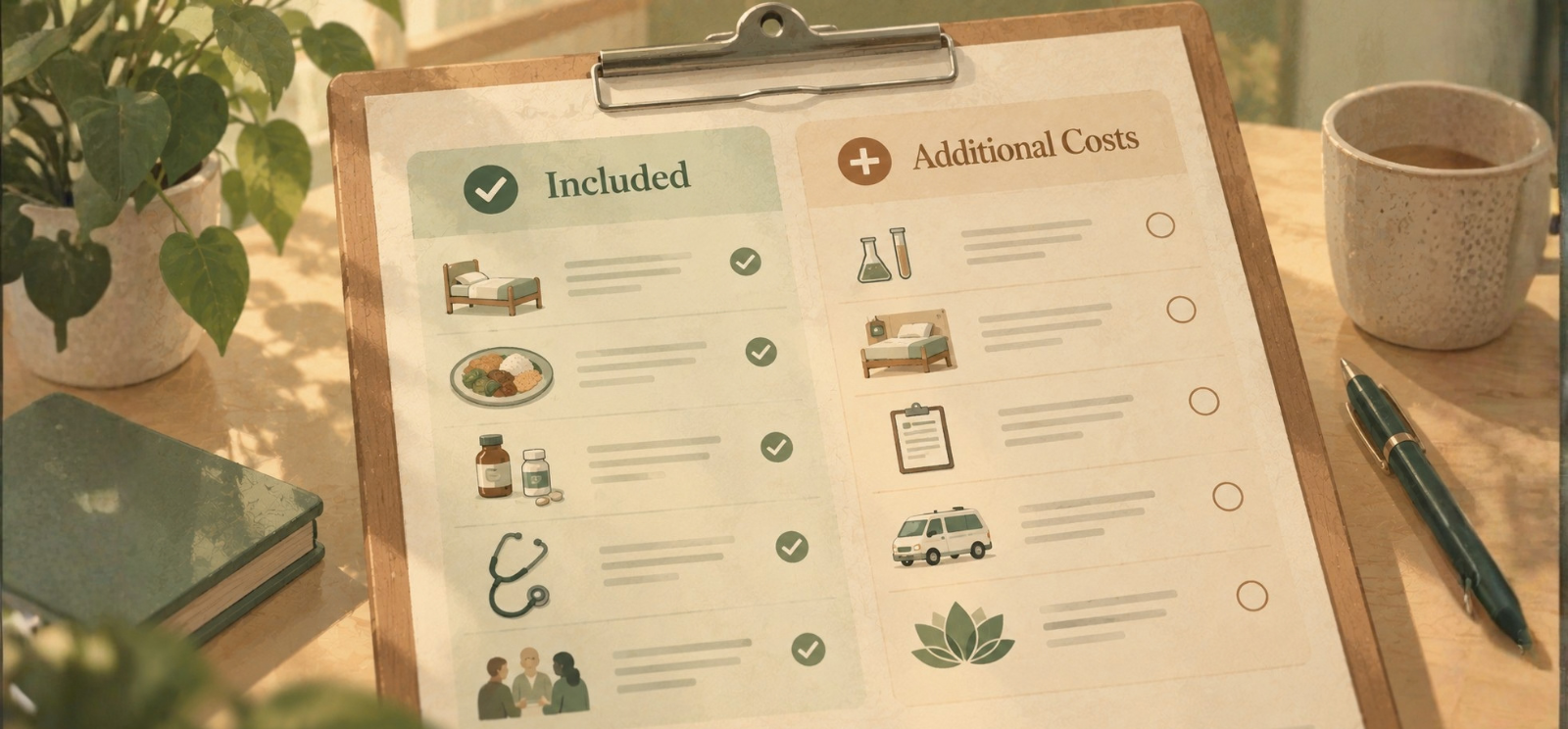
Usually inside the monthly fee:
The bed and the room.
All meals
Nursing cover, including nights.
Doctor and psychiatrist reviews.
Group therapy and scheduled activities.
Housekeeping and laundry
Ganaa publishes its own list of basic facilities (Source: Ganaa FAQ, 2026 — ganaa.in).
It covers rooms, meals and all-day dining. It covers personal care and round-the-clock staff support.
It also covers housekeeping, laundry and security. Plus recreation, organised activities, transport and an emergency ambulance.
Often outside the fee:
Medicines
Blood tests and scans.
Specialist opinions from outside doctors.
Hospital transfer if a medical problem appears.
Extra one-to-one therapy beyond the set number.
Family sessions beyond the set number.
Aftercare once the person goes home.
Medicines are the big one. Psychiatric drugs vary hugely in price.
A generic mood stabiliser costs little. A newer branded drug can cost many times more.
Ask for a medicine estimate for the first month. A good centre can give a range.
Then ask the second question. What happens if the plan changes mid-stay?
Because it often does. A dose changes. A new drug is added. A test gets repeated.
You want to know now how that lands on the bill.
Ask for a weekly bill, not one at the end.
A weekly bill lets you catch a surprise while it is small.
Most centres will do this if you ask on day one.
Q: What is usually not included in a rehab fee?
A: Medicines, lab tests, scans, outside specialist opinions, and hospital transfers. Extra therapy sessions and aftercare are often billed separately too. Ask for the exclusion list in writing.
What Indian Families Already Spend
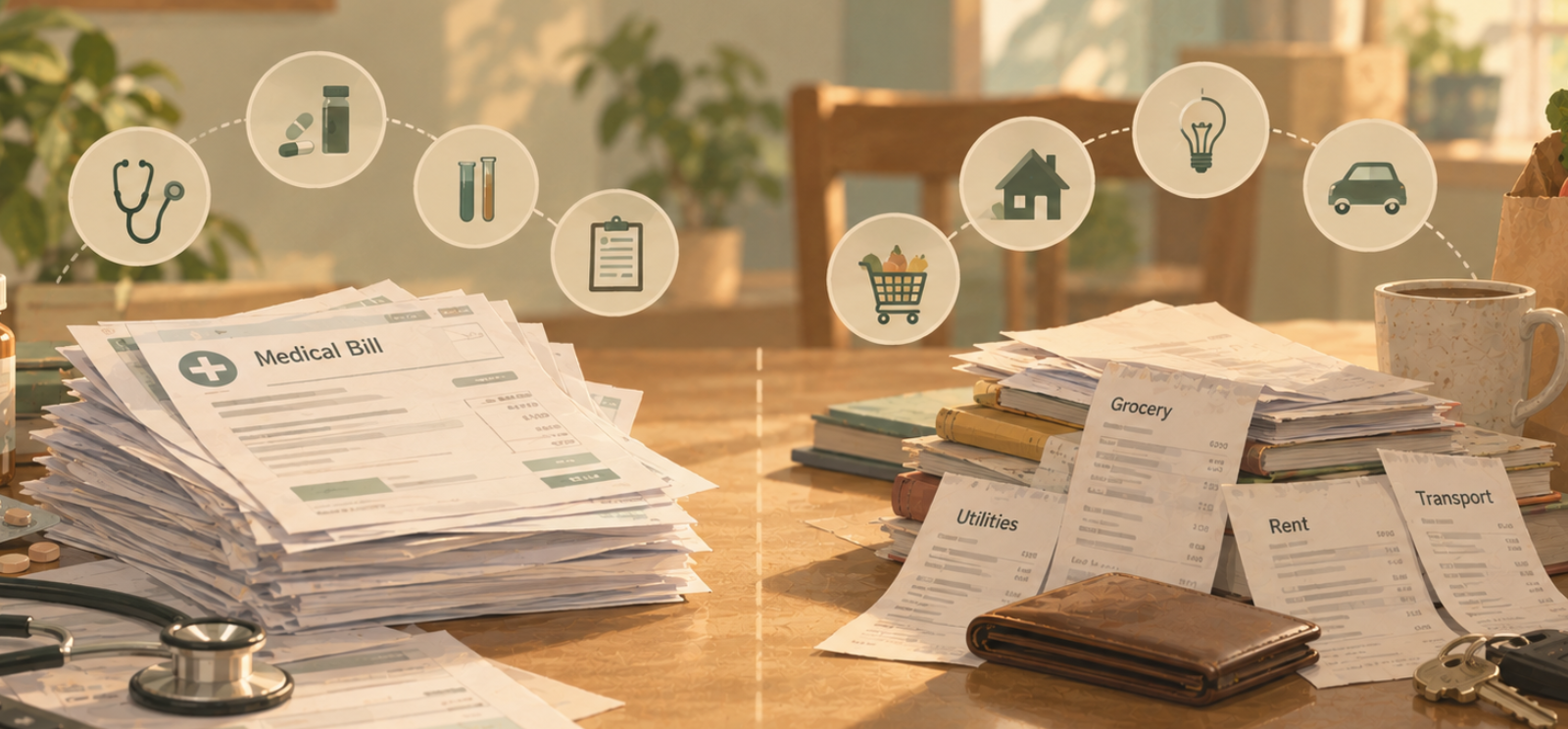
Private rehab is not where most Indian spending happens. It is the visible tip.
The National Mental Health Survey looked at what families pay out of pocket.
The median out-of-pocket spend was roughly ₹1,000 to ₹1,500 a month, mainly on treatment and travel (Source: National Mental Health Survey, NIMHANS, 2016 — indianmhs.nimhans.ac.in).
That sounds small until you see the other number.
Median household income in the surveyed homes was about ₹9,000 a month (Source: National Mental Health Survey, NIMHANS, 2016 — indianmhs.nimhans.ac.in).
So ongoing care alone can take more than a tenth of household income. Before any hospital stay.
The survey was blunt about the cause. Most families pay directly, because state or insurance cover does not reach them (Source: National Mental Health Survey, NIMHANS, 2016 — indianmhs.nimhans.ac.in).
That shapes the whole market.
It also explains the treatment gap. Across mental disorders it runs from 28% to 83% (Source: National Mental Health Survey, NIMHANS, 2016 — indianmhs.nimhans.ac.in).
Most people never reach care at all. Cost is a large part of why.
There is a hidden cost too, and it is bigger than the fee.
Nearly half of people with major depression report trouble with daily tasks (Source: National Mental Health Survey, NIMHANS, 2016 — indianmhs.nimhans.ac.in).
Lost work. Lost study years. A relative who stops earning to provide care.
Untreated illness is rarely the cheaper path. It just spreads the cost out.
Count the lost days too. Sick leave, missed exams, a parent who stops working.
Those do not show on any bill. They still get paid.
Set them beside the fee before you call it too costly.
Quick Facts: Paying for Mental Health Care in India
Median out-of-pocket spend on care is about ₹1,000 to ₹1,500 a month — (Source: National Mental Health Survey, NIMHANS, 2016 — indianmhs.nimhans.ac.in).
Median household income in surveyed homes was about ₹9,000 a month — (Source: National Mental Health Survey, NIMHANS, 2016 — indianmhs.nimhans.ac.in).
The treatment gap across mental disorders runs from 28% to 83% — (Source: National Mental Health Survey, NIMHANS, 2016 — indianmhs.nimhans.ac.in).
Of 235 health policies reviewed, only 37.5% covered mental illness — (Source: Indian Journal of Psychological Medicine, 2024 — pmc.ncbi.nlm.nih.gov).
Ayushman Bharat covers up to ₹5 lakh per family a year, including 22 mental health procedures — (Source: Centre for Mental Health Law and Policy, 2025 — cmhlp.org).
Tele-MANAS passed 10 lakh free helpline calls, averaging 3,500 a day — (Source: Press Information Bureau, 2024 — pib.gov.in).
What Insurance Must Cover by Law
Most families do not know this, so read it twice.
Mental illness cover is not optional for insurers in India. It is a legal duty.
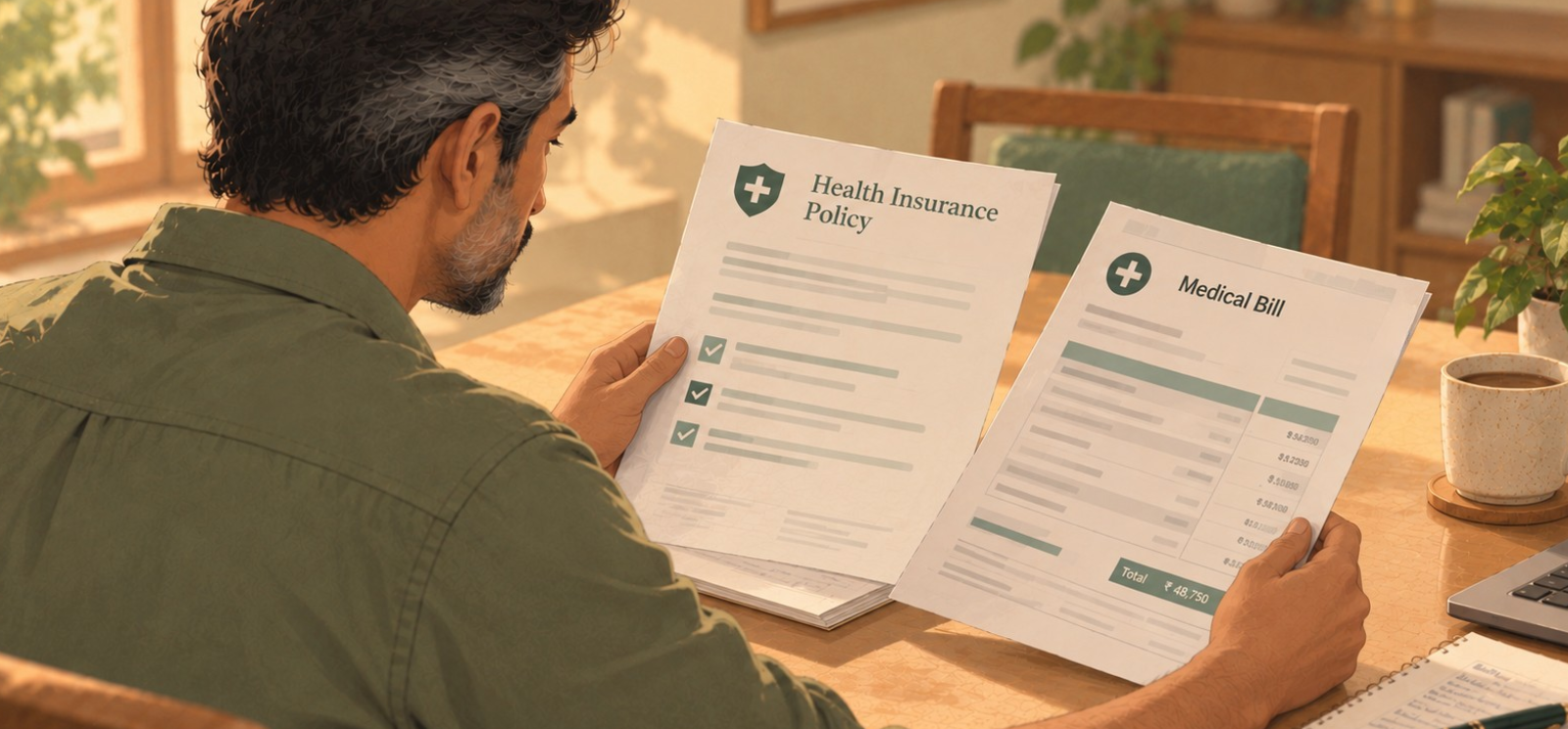
The Mental Healthcare Act 2017 says every insurer shall provide for medical insurance for mental illness on the same basis as physical illness (Source: Indian Journal of Psychological Medicine, 2024 — pmc.ncbi.nlm.nih.gov).
The insurance regulator has pushed this repeatedly.
A circular in August 2018 told insurers to comply. Another in October 2022 set a hard compliance date of 31 October 2022 (Source: Indian Journal of Psychological Medicine, 2024 — pmc.ncbi.nlm.nih.gov).
So what does that mean for you?
It means a psychiatric admission is not automatically outside your policy. Ask.
It means you can quote the Act by name when a claim is refused on principle.
It means your employer group policy is covered by the same rule.
Practical steps before admission:
Call your insurer and ask for the mental illness clause in writing.
Ask whether the centre is on their network list. Cashless only works inside the network.
Ask for pre-authorisation before admission, not after.
And keep every paper. Discharge summary, prescriptions, bills, doctor notes.
Claims fail on paperwork more often than on principle.
Keep a single folder. Paper and a phone photo of each page.
Write the date on everything.
If a claim is queried months later, that folder is your whole case.
Q: Is a psychiatric admission covered by health insurance in India?
A: By law it must be. The Mental Healthcare Act 2017 requires insurers to cover mental illness on the same basis as physical illness. Ask your insurer for the clause in writing.
Where That Law Still Falls Short
Now the honest part. The law is ahead of the market.
A review of health insurance policies found the gap clearly.
Of 235 policies looked at, only 37.5% covered mental illness. Around 51% offered no mental health cover at all (Source: Indian Journal of Psychological Medicine, 2024 — pmc.ncbi.nlm.nih.gov).
The conditions attached matter too.
Waiting periods for mental illness claims ran from 24 to 48 months (Source: Indian Journal of Psychological Medicine, 2024 — pmc.ncbi.nlm.nih.gov).
That is two to four years after buying the policy.
Substance use is worse. Only 2 of 30 companies covered alcohol or substance use disorders (Source: Indian Journal of Psychological Medicine, 2024 — pmc.ncbi.nlm.nih.gov).
Outpatient cover was limited too, reaching about 36.6% of companies and often capped (Source: Indian Journal of Psychological Medicine, 2024 — pmc.ncbi.nlm.nih.gov).
So plan for the real world, not the ideal one.
If the stay is for dependence, assume you may pay yourself. Then be pleasantly surprised.
If you are buying a policy now, read the waiting period before the premium.
And if a claim is denied, you can escalate. Write to the insurer's grievance officer first.
If that fails, the Insurance Ombudsman takes complaints from policyholders.
None of this is quick. But refusals are not always final.
Put every request in writing. Email, not phone calls.
Ask for the reason for refusal in writing too.
A written reason is much easier to challenge than a spoken one.
Q: Why do insurers still reject mental health claims?
A: Practice lags the law. Many policies still carry long waiting periods, and most exclude substance use disorders. Ask for the clause in writing before you admit anyone.
The Options Below Private Rehab
Private residential care is one rung. It is not the only one.
Work down the ladder before you assume you cannot afford help.
Tele-MANAS. A free, round-the-clock mental health helpline run by the government.
Dial 14416 or 1-800-891-4416. It offers support in several languages.
It passed 10 lakh calls since its October 2022 launch, running about 3,500 calls a day across 51 cells (Source: Press Information Bureau, 2024 — pib.gov.in).
Government medical colleges. Psychiatry departments there charge very little.
Waiting times are longer. The clinical quality is often excellent.
Ayushman Bharat. For eligible families, this covers up to ₹5 lakh a year for hospital care.
It includes 22 mental health procedures among its listed packages (Source: Centre for Mental Health Law and Policy, 2025 — cmhlp.org).
Day care packages for mental health were added in 2022, covering assessment, counselling and treatment (Source: Centre for Mental Health Law and Policy, 2025 — cmhlp.org).
Use is still low. Mental health takes under 1% of funds released under the scheme (Source: Centre for Mental Health Law and Policy, 2025 — cmhlp.org).
That means the cover exists and is under-claimed. Ask whether your hospital is empanelled.
Day programmes. Structured therapy by day, home by night. Cheaper than a bed.
Start at the rung that fits. Step up only if it does not hold.
Many people jump straight to the top rung out of fear.
That is costly, and often not needed.
A good clinician will tell you which rung fits. Ask them to.
Q: What free mental health support exists in India?
A: Tele-MANAS is a free 24-hour helpline on 14416, available in several languages. Government medical colleges run low-cost psychiatry clinics. Ayushman Bharat covers hospital care for eligible families.
Questions to Ask Before You Pay a Deposit
Print this. Take it to every centre you call.
What is the daily or monthly rate for the level of care you recommend?
What exactly does that include? Please send the list.
What is billed on top? Please send that list too.
What is the medicine estimate for month one?
How many nurses are on duty at night for how many patients?
How often will a psychiatrist review the patient?
How many one-to-one therapy sessions are included per week?
How many family sessions are included?
Is the centre empanelled with my insurer?
Will you help with pre-authorisation paperwork?
What is the refund rule if we leave early?
What does aftercare cost, and for how long?
Two red flags worth naming.
A centre that will not put inclusions in writing is telling you something.
So is one that quotes a price before asking a single clinical question.
One more. Ask what happens if the person wants to leave.
Q: What is the biggest red flag when choosing a rehab centre?
A: A firm price quoted before any clinical assessment. It means the centre is selling a room, not treatment. Refusing to put inclusions in writing is the second red flag.
How Ganaa Handles the Money Conversation
Ganaa has worked in mental health care in India since 2012. We treat psychiatric conditions and substance use across age groups (Source: Ganaa, 2026 — ganaa.in).
We do not publish a single fee, and we will explain why.
The right number depends on the level of care a person needs. That is settled by assessment, not by a web page.
So the first call is clinical, not commercial.
What we can tell you is how the choices are laid out.
Our centres differ by design, and that affects cost. Ganaa Delhi I is our budget-friendly facility.
Ganaa Delhi II sits on a five-acre nature-wrapped site in Chhatarpur. Ganaa Gurugram is an acute care premium facility with a women-only wing.
Ganaa Greater Noida is a modern facility, and Ganaa Goa sits riverside in South Goa (Source: Ganaa, 2026 — ganaa.in).
For many people a stay is not needed at all. Our clinics in Faridabad, Greater Kailash and Greater Noida handle outpatient care.
Where a stay is right, published guidance puts programme length at 30 to 90 days (Source: Ganaa FAQ, 2026 — ganaa.in).
On insurance, cover varies by policy, so we ask families to check their own terms directly (Source: Ganaa FAQ, 2026 — ganaa.in).
Care blends psychiatric treatment with psychology sessions, family counselling and holistic therapy (Source: Ganaa, 2026 — ganaa.in).
Treatment is tailored to the person, not sold as a package.
Ask us for the inclusion list in writing. We would rather answer that on day one than on the bill.
Speak to a Ganaa counsellor on +91 8750075006, or write to info@ganaa.in. You can also book a consultation at ganaa.in/booking.
There is no single price for rehab in India, and anyone who gives you one is guessing.
What there is, is a structure you can read.
Level of care sets the base. Length of stay multiplies it. Room type adjusts it.
Staff ratio is the lever that decides quality, and it is the one nobody asks about.
Get the inclusion list in writing. Get the exclusion list too.
Get a medicine estimate for the first month.
Check your policy for the mental illness clause before admission, not after.
Expect waiting periods. Expect substance use to be harder to claim.
And do not skip the cheaper rungs. A free helpline, a government clinic, or an outpatient plan may be enough.
Money is a real barrier, and pretending otherwise helps nobody.
But an unasked question costs more than an awkward one.
Make the call. Ask for the anatomy of the bill.
Then decide with your eyes open.
FAQ
Q: Why do rehab centres not publish their fees?
A: Because the fee depends on the level of care each person needs. A detox bed, a shared room, and a private room are different costs. An honest quote follows an assessment, not a web page.
Q: What should be included in a residential rehab fee?
A: Usually the bed, meals, nursing, doctor reviews, therapy sessions, and basic housekeeping. Ask for that list in writing. Medicines, lab tests, and scans are often billed on top.
Q: Does health insurance cover mental health treatment in India?
A: By law it must. Section 21(4) of the Mental Healthcare Act 2017 requires insurers to cover mental illness on the same basis as physical illness. Regulators have ordered compliance since 2018.
Q: Why was my mental health claim rejected if the law says it is covered?
A: Practice still lags the law. One review of 235 policies found only 37.5% covered mental illness. Waiting periods ran from 24 to 48 months, and most insurers excluded substance use disorders.
Q: Are there free or low-cost mental health options in India?
A: Yes. Tele-MANAS is a free 24-hour helpline on 14416. Government medical colleges run low-cost psychiatry clinics. Ayushman Bharat covers some mental health hospital packages for eligible families.
Q: How long does a rehab stay usually last?
A: Most programmes run 30 to 90 days, depending on severity and how long the problem has run. Ganaa publishes that same range. Cost scales with length, so ask about both together.
Q: What should I ask before paying a rehab deposit?
A: Ask for the daily rate, the inclusion list, and the refund rule in writing. Ask who reviews the patient and how often. Ask what a month looks like in a worst case, not a best case.
Treatment resistant depression in India is common and treatable. Learn what the label means, what to rule out first, and the steps that follow failed medicine.
Bipolar misdiagnosed as depression is common, and the delay runs close to nine years. Learn the clues, why hypomania is missed, and how to get a better review.
Adolescent mental health in India is under-treated. Learn 11 warning signs parents miss, what the data shows, how to start the talk, and when to seek help.