Mental Health Care Act 2017: Your Rights, Explained Simply
The Mental Health Care Act 2017 gives every Indian a right to care, dignity and privacy. Learn your rights, the admission rules and where to complain.
Mental Health Care Act 2017: Your Rights, Explained Simply
Most families meet this law on their worst day.
A son is unwell. A hospital hands over a form. Someone says the word "section", and nobody explains it.
The Mental Health Care Act 2017 is the law behind that form. It gives every person in India a right to mental healthcare from public services. It also says a person with mental illness keeps their dignity and privacy (Source: Mental Healthcare Act 2017, Sections 18 and 20 — egazette.gov.in).
A quick note on the name. The official title is the Mental Healthcare Act, 2017, with "healthcare" as one word (Source: Mental Healthcare Act 2017, Section 1 — egazette.gov.in). People search for it both ways. Both mean the same law.
This guide puts the law in plain words. You will see what rights it gives, how a stay works, and what it bans.
You will also see where to complain, and where the law still falls short.
One thing before we start. This is general information, not legal advice. For a live dispute, speak to a lawyer.
The law gives you a right to free legal help (Source: Mental Healthcare Act 2017, Section 27 — egazette.gov.in). We will come back to that.
What the Mental Health Care Act 2017 Actually Does
Start with what it replaced.
This law repealed the Mental Health Act of 1987 (Source: Mental Healthcare Act 2017, Section 126 — egazette.gov.in). It was also written to match a UN rights treaty on disability (Source: Mental Healthcare Act 2017, Preamble — egazette.gov.in).
The President signed it on 7 April 2017 (Source: Gazette of India, 2017 — egazette.gov.in). It came into force on 29 May 2018 (Source: Phoenix Legal on Delhi High Court rulings, 2021 — mondaq.com).
So who does it cover?
The Act calls mental illness a substantial disorder of thinking, mood, perception, orientation, or memory. It must badly affect judgment, behaviour, the grip on reality, or daily life (Source: Mental Healthcare Act 2017, Section 2 — egazette.gov.in).
The same line takes in mental conditions linked to alcohol and drug abuse. So care for substance use sits inside this law too.
Intellectual disability is left out. The Act uses an older term for it.
The law reaches almost every place of care, by whatever name it goes. Public, trust, and private centres all count. Only a family home is left out (Source: Mental Healthcare Act 2017, Section 2 — egazette.gov.in).
It also limits labels.
Nobody can be called mentally ill for breaking social, moral, or religious norms. Past care alone does not prove illness today. And a diagnosis does not make you of "unsound mind" unless a court says so (Source: Mental Healthcare Act 2017, Section 3 — egazette.gov.in).
Think of a daughter who refuses a marriage. Her family may be upset. That alone is not a mental illness.
One idea runs through the whole law. It is called capacity.
Every person is deemed able to make their own care choices if they can do three things (Source: Mental Healthcare Act 2017, Section 4 — egazette.gov.in).
Understand the facts about the care on offer.
See what is likely to happen after a choice.
Share the choice by speech, gesture, or any other means.
Now the part families find hardest. A choice that looks wrong to you does not prove a lack of capacity.
Say your father stops his medicine, and you think that is a mistake. He may still have capacity. The test is whether he can weigh the choice, not whether you agree.
Q: Does the Mental Health Care Act 2017 cover alcohol and drug problems?
A: Yes. Its definition of mental illness takes in mental conditions linked to alcohol and drug abuse. So a rehab or de-addiction centre must follow the same rules.
Your Core Rights, Section by Section
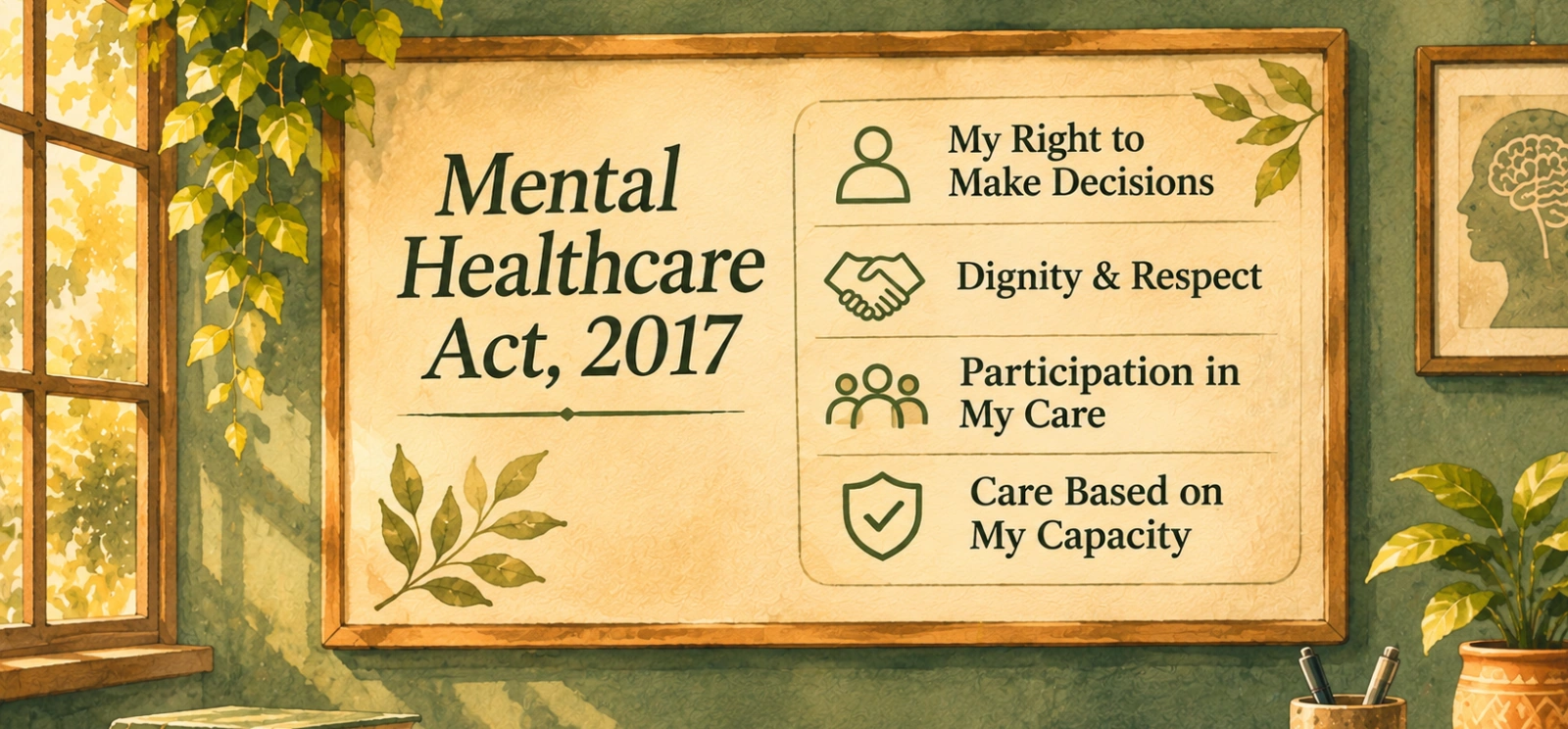
Chapter V is the heart of this mental healthcare act. It lists the rights of persons with mental illness (Source: Mental Healthcare Act 2017, Chapter V — egazette.gov.in).
Some of these rights bind the state. Others bind every hospital and centre.
Here is the short version.
SectionRightIn plain wordsSection 18Access to careGood, low-cost care from public servicesSection 19Community livingNobody stays in a centre only for lack of a home or familySection 20DignityClean, safe living, privacy, your own clothes, no forced workSection 21EqualityThe same care as for physical illness, with ambulances and insuranceSection 22InformationYou are told the illness, the plan, side effects, and the section usedSection 23PrivacyStaff must keep your details private, with set exceptionsSection 24MediaNo photo or detail goes to the media without your consentSection 25RecordsYou can see your basic medical recordsSection 26ContactYou can accept or refuse visitors and calls at reasonable timesSection 27Legal aidFree legal help to use your rightsSection 28ComplaintsYou can complain about poor care, step by step
Four of these need a closer look.
Access. This is the widest right. Care must be low-cost, good, close to home, and free of bias. Public services must exist in each district at the very least. Long stays should be a last resort (Source: Mental Healthcare Act 2017, Section 18 — egazette.gov.in).
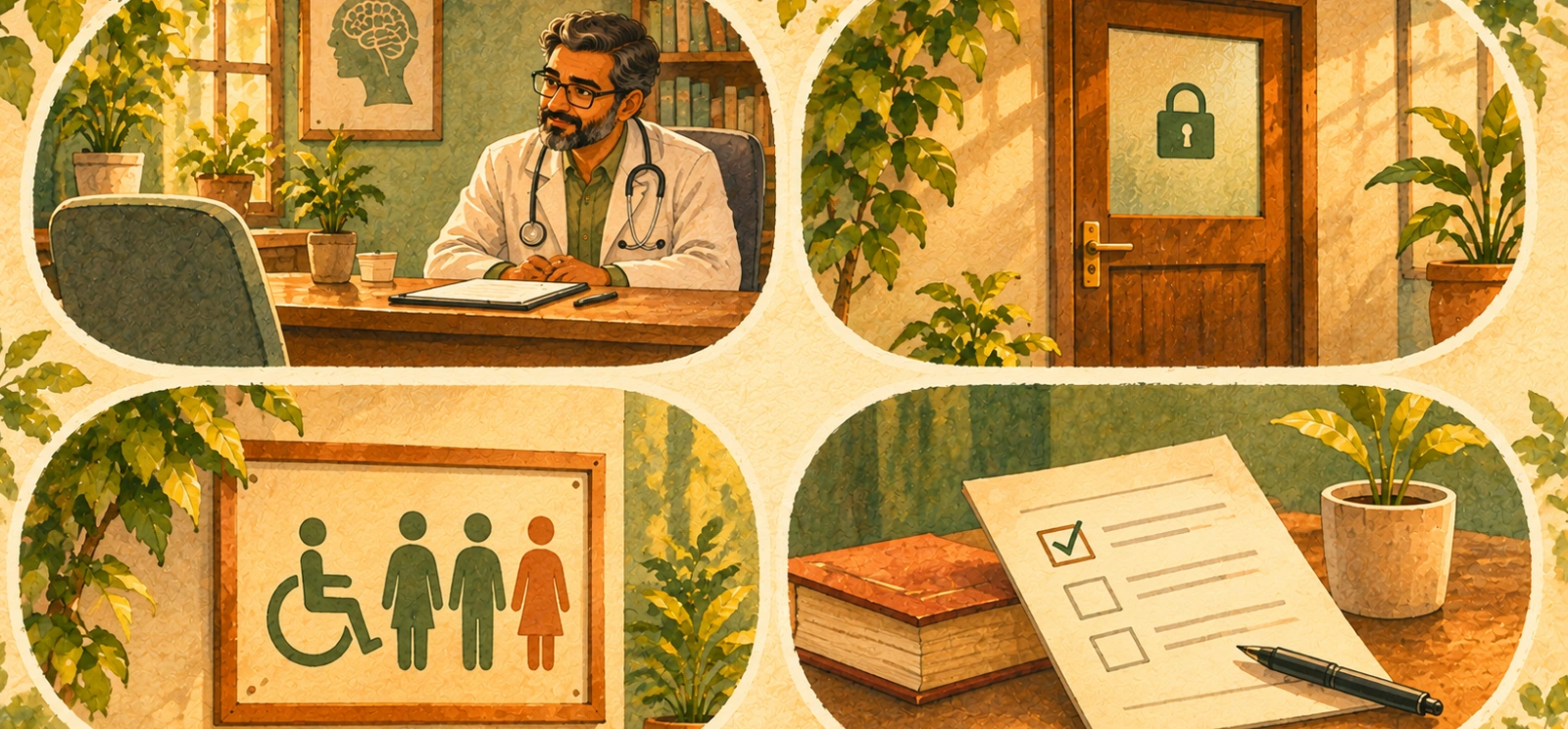
Daily dignity. Section 20 gets very practical. It covers food, toilets, and period products for women. It bans forced head shaving. You may wear your own clothes, not a uniform. You must be safe from physical, verbal, emotional, and sexual abuse (Source: Mental Healthcare Act 2017, Section 20 — egazette.gov.in).
Privacy. Staff must keep your care private. They can share details with your treating team and with the person who speaks for you. They can also share what is needed to prevent harm, or when a court or Board orders it (Source: Mental Healthcare Act 2017, Section 23 — egazette.gov.in).
So a worried cousin may not get every detail. That is not rudeness. That is the law at work.
Records. You can ask for your basic records. Staff may hold back a detail if it could cause serious harm. If so, they must tell you that you can ask the Board to release it (Source: Mental Healthcare Act 2017, Section 25 — egazette.gov.in).
One more right that many mothers never hear about. A child under three should not normally be kept away from a mother in care. Any split needs a safety reason, and a review every fifteen days (Source: Mental Healthcare Act 2017, Section 21 — egazette.gov.in).
Q: Do these rights apply in private hospitals?
A: Yes, for rights inside a centre, such as dignity, privacy, and being told about your care. The law covers private centres too. The access right in Section 18 is about public services.
Advance Directives and Nominated Representatives
Two tools let you plan before a crisis. Both are easy to miss.
The first is an advance directive. Think of it as a note from your well self to your future care team.
Any adult can write one. It can say how you want to be treated, how you do not, and who should speak for you (Source: Mental Healthcare Act 2017, Section 5 — egazette.gov.in).
It only comes into use if you lose capacity. It stops once you get capacity back. While you have capacity, your spoken choice beats the paper.
It has limits. It cannot ask for something against the law. It does not apply to emergency care (Source: Mental Healthcare Act 2017, Sections 5 and 9 — egazette.gov.in).
Doctors must follow a valid directive. A doctor or relative who disagrees must go to the Board. The Board then hears everyone, you included (Source: Mental Healthcare Act 2017, Sections 10 and 11 — egazette.gov.in).
Here are the steps under the 2020 rules (Source: Central Mental Health Authority Regulations, 2020, Regulation 3 — legitquest.com).
Get Form A. It is free at all mental health centres.
Write your wishes, and sign in front of two witnesses.
Ask the person you name to sign too.
Register it with the Board where you live. There is no fee.
Keep your copy, and tell your doctor.
That last step matters. A doctor is not liable for missing a directive that nobody showed them (Source: Mental Healthcare Act 2017, Section 13 — egazette.gov.in).
The second tool is a nominated representative. We will call this person your nominee. It is the person who helps with care choices if you need support.
Any adult can name one, in writing on plain paper, with a signature or thumb mark. The nominee must be an adult, be fit for the role, and agree in writing. You can change your mind at any time (Source: Mental Healthcare Act 2017, Section 14 — egazette.gov.in).
What if you never name anyone? The law sets an order. First comes the person named in your directive. Next comes a relative, then a care-giver, then someone the Board picks (Source: Mental Healthcare Act 2017, Section 14 — egazette.gov.in).
For a child, the legal guardian fills this role, unless the Board says otherwise (Source: Mental Healthcare Act 2017, Section 15 — egazette.gov.in).
A nominee has real duties. They must respect your wishes and values. They can ask about your care, help plan discharge, and take a complaint to the Board (Source: Mental Healthcare Act 2017, Section 17 — egazette.gov.in).
Naming someone does not mean you have lost capacity. The law says so in plain terms (Source: Mental Healthcare Act 2017, Section 14 — egazette.gov.in).
Q: Does my nominee have to be a family member?
A: No. Any adult who is fit for the role and agrees in writing can act for you. If you name nobody, the law looks to a relative first, then a care-giver.
Admission Routes, and the Treatments the Law Bans
The law sets out clear routes into care. Each has its own rules.
RouteSectionWho starts itTime limitIndependentSections 85, 86The personLeaves on request, with one narrow exceptionMinorSection 87The nomineeBoard reviews stays past 30 daysSupportedSection 89The nomineeUp to 30 daysSupported, longerSection 90The nominee, with two psychiatristsUp to 90 days at first, if the Board agreesEmergency careSection 94A registered doctorUp to 72 hours
Independent admission is the default. The law wants this route as far as possible (Source: Mental Healthcare Act 2017, Section 85 — egazette.gov.in).
An independent patient needs no relative to sign. They cannot be treated without informed consent. They can ask to leave, and the centre must let them go. There is one exception. A hold of up to 24 hours for a check is allowed if staff see serious risk (Source: Mental Healthcare Act 2017, Sections 86 and 88 — egazette.gov.in).
Supported admission is the route families ask about most. The nominee applies, and two experts examine the person separately. The person must show recent risk of self-harm, violence, or being unable to care for themselves. They must need very high support to make decisions. And the stay must be the least restrictive option (Source: Mental Healthcare Act 2017, Section 89 — egazette.gov.in).
The centre must tell the Board too. It has three days for a woman or a minor, and seven days for anyone else (Source: Mental Healthcare Act 2017, Section 89 — egazette.gov.in).
Children get extra care. They stay apart from adults. Their nominee or an attendant must stay with them the whole time (Source: Mental Healthcare Act 2017, Section 87 — egazette.gov.in).
Emergency care has limits too. A registered doctor can act to prevent death, serious harm, or serious damage to property. ECT is not allowed in this window (Source: Mental Healthcare Act 2017, Section 94 — egazette.gov.in).
For now, some north-eastern and hill regions get slightly longer time limits (Source: Mental Healthcare Act 2017, Section 114 — egazette.gov.in).
Now the hard limits. The law bans these four things (Source: Mental Healthcare Act 2017, Section 95 — egazette.gov.in).
ECT without anaesthesia and muscle relaxants.
ECT for a child, unless a psychiatrist asks, the guardian agrees, and the Board permits it.
Sterilisation as a treatment for mental illness.
Chains, in any form.
Seclusion and solitary rooms are not allowed either (Source: Mental Healthcare Act 2017, Section 97 — egazette.gov.in).
Physical restraint is tightly limited. It can be used only when nothing else can stop immediate harm, and only if the psychiatrist agrees. It can never be a punishment. A staff shortage is no excuse. The nominee must be told within 24 hours (Source: Mental Healthcare Act 2017, Section 97 — egazette.gov.in).
Q: Can a hospital keep someone for months with no outside check?
A: No. A stay past 30 days needs two psychiatrists and the Board's permission. The Board must decide within 21 days. It must also ask if care could be given in a less restrictive place.
Review Boards: Where You Take a Complaint
A right is only as strong as the place you can take it.
Under this law, that place is the Mental Health Review Board. The State Authority sets it up for a district or a group of districts (Source: Mental Healthcare Act 2017, Section 73 — egazette.gov.in).
It is not a hospital committee. Its chair is a district judge, or someone fit to be one. It also has a district official, a psychiatrist, and a doctor. Two more members are patients, care-givers, or from groups that help them (Source: Mental Healthcare Act 2017, Section 74 — egazette.gov.in).
Three things make it useful for families (Source: Mental Healthcare Act 2017, Section 77 — egazette.gov.in).
There is no fee to apply.
The person, their nominee, or a registered NGO with consent can apply.
In rare cases, an admitted person can apply by phone.
It must also move fast. A challenge to a supported admission must be settled in seven days. Longer stays get twenty-one days. Most other matters get ninety (Source: Mental Healthcare Act 2017, Section 80 — egazette.gov.in).
Hearings are private. They take place at the centre where the person is staying. You can bring a lawyer or anyone else you choose (Source: Mental Healthcare Act 2017, Section 80 — egazette.gov.in).
The Board has teeth. It can fine a centre up to five lakh rupees for ignoring its orders. Its word can also lead to a centre losing its registration (Source: Mental Healthcare Act 2017, Section 82 — egazette.gov.in).
If you disagree with the Board, you have thirty days to go to the High Court (Source: Mental Healthcare Act 2017, Section 83 — egazette.gov.in).
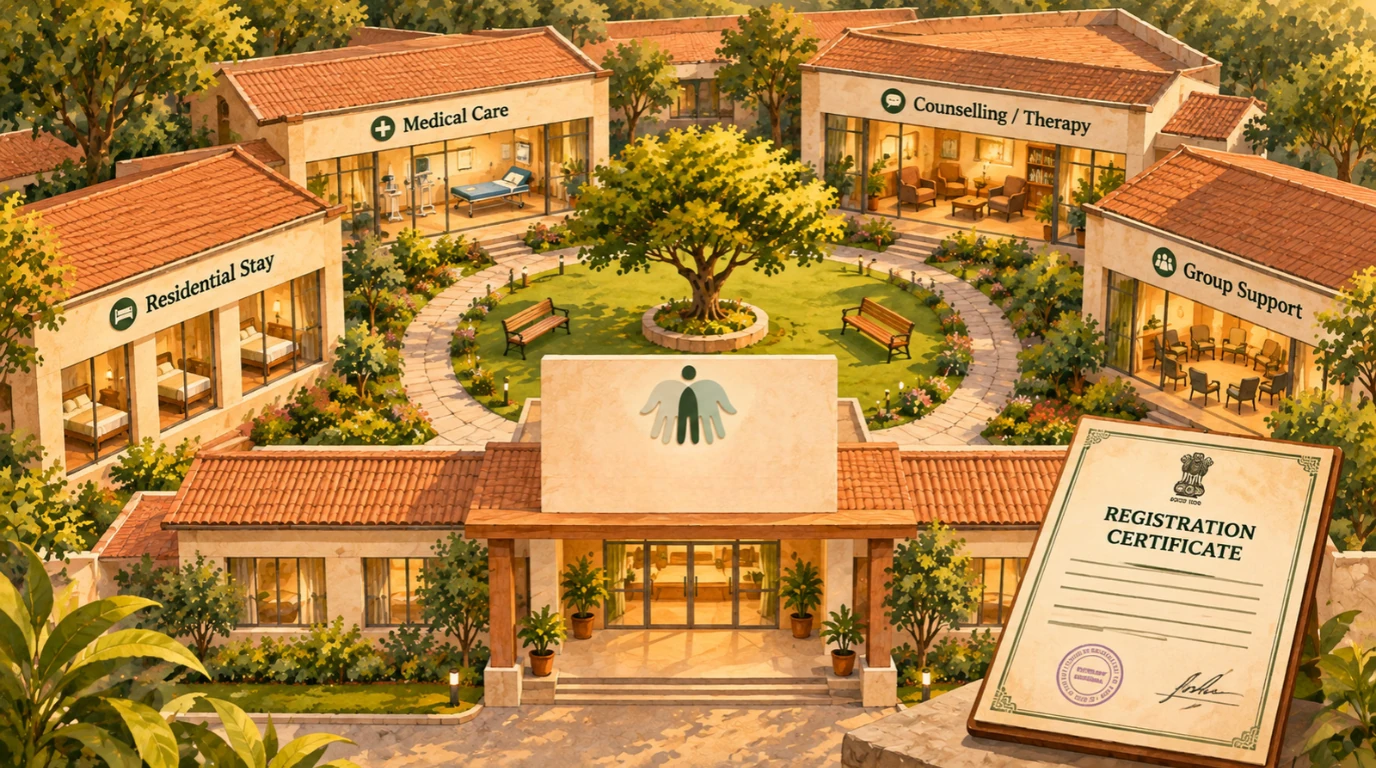
Registration is your other safeguard. The law says no centre can run without it (Source: Mental Healthcare Act 2017, Section 65 — egazette.gov.in).
The certificate must be on show for every visitor. The Board's contact details must be on show too, and on the website. The centre must also give you the forms and free calls to the Board (Source: Mental Healthcare Act 2017, Sections 70 and 72 — egazette.gov.in).
Q: Do I need a lawyer to go to a Review Board?
A: No. You can appear yourself, or bring a lawyer or someone else you choose. A person with mental illness also has a right to free legal help.
Insurance, Free Care and Suicide: Three Rules Families Miss
These three rules cost people the most when nobody tells them.
Rule one: insurance must treat mental illness fairly.
Every insurer must cover mental illness on the same basis as physical illness (Source: Mental Healthcare Act 2017, Section 21 — egazette.gov.in).
The insurance regulator said so again on 18 October 2022. It told insurers to comply without any deviation (Source: SCC Times, 2022 — scconline.com).
Courts have backed it. In one 2021 case, an insurer turned down a claim for schizoaffective disorder under an exclusion clause. The Delhi High Court held that all insurers must follow Section 21(4) (Source: Phoenix Legal on Delhi High Court rulings, 2021 — mondaq.com).
Cover can still vary by policy, so check yours first (Source: Ganaa FAQ, 2026 — ganaa.in).
Rule two: some care must be free.
People below the poverty line get free care at public centres, with or without a BPL card. So do people who are destitute or homeless (Source: Mental Healthcare Act 2017, Section 18 — egazette.gov.in).
Medicines on the Essential Drug List must be free for all people with mental illness. That holds at public health centres, from Community Health Centres upward (Source: Mental Healthcare Act 2017, Section 18 — egazette.gov.in).
Rule three: a suicide attempt calls for care, not punishment.
Section 115 presumes that a person who attempts suicide has severe stress. They are not to be tried or punished under the old Section 309 of the Indian Penal Code. The state must also give care, to lower the risk of another attempt (Source: Mental Healthcare Act 2017, Section 115 — egazette.gov.in).
Criminal law has changed since then. The Bharatiya Nyaya Sanhita of 2023 has no general offence for attempted suicide. One narrow offence stays: an attempt made to force or stop a public servant in their duty (Source: Bharatiya Nyaya Sanhita 2023, Section 226 — egazette.gov.in).
If you or someone near you is in crisis today, call Tele-MANAS on 14416. It is the health ministry's toll-free helpline (Source: Ministry of Health, 2026 — telemanas.mohfw.gov.in).
Q: Can police file a case after a suicide attempt?
A: The law treats an attempt as a sign of severe stress and a reason for care. The one narrow offence left is an attempt made to force or stop a public servant. For a live case, speak to a lawyer.
Using the Mental Health Care Act 2017 in Real Life
Laws help only when you use them. Here is how the mental health care act 2017 works in five common moments.
Your relative is admitted and nobody explains why.
Ask which section the stay falls under. The person and their nominee have a right to know. They can also ask about the illness, the plan, and side effects, in a language they follow (Source: Mental Healthcare Act 2017, Section 22 — egazette.gov.in).
Your adult child signed in, and now wants to leave.
If they came in as an independent patient, they can leave, even against advice. If staff see serious risk, they can hold them for up to 24 hours for a check. Then the person is either let go or moved to supported admission (Source: Mental Healthcare Act 2017, Section 88 — egazette.gov.in). Our guide on Does My Family Member Need Rehab or Just Outpatient Therapy? can help you think this through.
You see restraint, chains, or a locked room.
Chains are banned. Restraint has strict limits. Raise it in writing, and keep a copy. If you believe someone is being ill-treated or neglected, the law says to tell the police (Source: Mental Healthcare Act 2017, Sections 95, 97 and 101 — egazette.gov.in).
The insurer refuses a claim.
Ask for the refusal in writing, and note the exact clause. Quote Section 21(4). Then go to the Insurance Ombudsman. If that fails, speak to a lawyer.
You are well now, and want to plan ahead.
This is the best time to act. Name a nominee on plain paper. Talk to that person first. If you have strong views on care, ask your doctor about an advance directive.
Before any stay, ask these three questions.
Under which section will this admission happen?
Who will be recorded as the nominee?
May I see your registration and the Board's contact details?
If something goes wrong, climb this ladder (Source: Mental Healthcare Act 2017, Section 28 — egazette.gov.in).
Complain to the doctor in charge of the centre.
If that fails, go to the Review Board.
If that fails, go to the State Authority.
You can still go to court at any stage. Keep copies of everything, with dates.
Q: Who gives free legal help under this law?
A: The Act says a person with mental illness has a right to free legal help. Police, magistrates, and the doctor in charge of a centre must tell them so, and share contact details.
Where the Law Still Falls Short
This mental healthcare act is strong on paper. On the ground, it is patchy.
A five-year review ran in the Indian Journal of Psychiatry. It said the Act appears to be a non-starter in most of India. It said mental health gets under 1% of the health budget. It also said 80% of those who need care do not get it (Source: Malhotra, Indian Journal of Psychiatry, 2023 — pmc.ncbi.nlm.nih.gov).
Newer tracking shows the same gaps. By November 2025, 26 states and 3 union territories had a State Authority. Only 16 states, and no union territories, had formed Review Boards (Source: Centre for Mental Health Law and Policy, 2025 — cmhlp.org).
That has a direct cost for you. In many places, a local Board may not exist yet.
The courts are watching. On 28 October 2025, the Supreme Court moved a long-running case on this law to the National Human Rights Commission. The Health Ministry had told the court that the authorities were notified. The Commission will now monitor how they work (Source: The Hindu, in NHRC press clippings, 2025 — nhrc.nic.in).
In July 2025, the Supreme Court also tied mental health to the right to life (Source: LiveLaw, 2026 — livelaw.in).
Some psychiatrists doubt the design too. The same review says the nominee idea can sideline Indian families. It also says the supported admission test can delay care until a person is very unwell (Source: Malhotra, Indian Journal of Psychiatry, 2023 — pmc.ncbi.nlm.nih.gov).
These debates are real. The rights of persons with mental illness stand either way.
If you cannot find a Board, ask the centre for the details it must display. You can also write to your State Authority, or ask your local legal aid office for help.
Q: What if my state has no Review Board?
A: Ask the centre first, since it must show the Board's details. If no Board exists, write to the State Authority. You can also use free legal aid, or go to the High Court through a lawyer.
Here are the key facts in one place.
Quick Facts: Mental Health Care Act 2017
The Act came into force on 29 May 2018 — (Source: Phoenix Legal, 2021 — mondaq.com).
Supported admission is limited to 30 days at first — (Source: Mental Healthcare Act 2017, Section 89 — egazette.gov.in).
Emergency care is limited to 72 hours, or until assessment if that comes first — (Source: Mental Healthcare Act 2017, Section 94 — egazette.gov.in).
Chains are banned in any manner or form — (Source: Mental Healthcare Act 2017, Section 95 — egazette.gov.in).
Only 16 states and no union territories had formed Review Boards by November 2025 — (Source: Centre for Mental Health Law and Policy, 2025 — cmhlp.org).
Tele-MANAS offers toll-free support on 14416 — (Source: Ministry of Health, 2026 — telemanas.mohfw.gov.in).
How Ganaa Works Within This Law
Rights mean little if a centre treats them as paperwork. We try to treat them as part of care.
Ganaa has served patients since 2012. We run five hospitals and rehabs, in South Delhi, Chattarpur, Gurugram, Greater Noida, and South Goa. A sixth is opening soon in Lonavala (Source: Ganaa, 2026 — ganaa.in).
We treat both voluntary and involuntary patients. Our work rests on compliance, safety, and confidentiality (Source: Ganaa, 2026 — ganaa.in).
You can view our licences and certifications on one page. If you are choosing a centre, ask to see the same from anyone else.
Our live-in centres offer a 2:1 staff-to-client ratio. Medical and psychiatric support runs 24/7 (Source: Ganaa, 2026 — ganaa.in).
The need for a stay is judged after a full review by a psychiatrist or clinical psychologist. Our guidance puts the usual stay at 30 to 90 days, based on severity (Source: Ganaa FAQ, 2026 — ganaa.in).
Families stay in the loop. A psychologist gives regular updates, along with daily WhatsApp updates (Source: Ganaa FAQ, 2026 — ganaa.in).
Not everyone needs a live-in stay. We also run five outpatient clinics, in Greater Kailash II, Gurugram, Greater Noida, Faridabad, and Panaji (Source: Ganaa, 2026 — ganaa.in).
If you need longer support, you can read about our psychiatric rehabilitation care. A Ganaa clinician can talk you through the options.
We cannot give legal advice. But we can explain how a stay works, what the forms mean, and what your family can expect.
Speak to a Ganaa counsellor on +91 8750075006, or write to info@ganaa.in. You can also book a consultation at ganaa.in/booking.
Conclusion: Knowing the Law Changes the Conversation
The mental health care act 2017 does not make illness easier. It does change who holds power in the room.
It says a person with mental illness is still a person. They keep their dignity, their privacy, and a say in their care.
It says care should be close, low-cost, and equal to care for the body.
It bans chains. It puts firm limits on restraint.
It gives you a Board to go to, and free legal help to get there.
It is far from perfect. Boards are missing in many places, and services are thin.
But a family that knows the law asks better questions. Which section is this? Who is the nominee? May I see the certificate?
Those questions are not rude. They are your right.
If you are well today, name a nominee. Tell that person what you would want.
If someone you love is unwell today, start with one call. You do not have to know every section to ask for help.
Knowing a few of them just means you will not walk in alone.
FAQ
Q: What is the Mental Health Care Act 2017 in simple words?
A: It is India's main mental health law. It gives people a right to mental healthcare from public services. It also protects the dignity, privacy, and choices of people with mental illness. And it sets the rules for admission and treatment.
Q: Who can admit a person without their consent?
A: Nobody can do it alone. A supported admission needs an application from the nominee and two separate exams. The person must meet strict risk tests, and the stay is limited to 30 days at first.
Q: Is an advance directive legally binding in India?
A: Yes. A valid advance directive must be followed once a person loses capacity. It does not apply to emergency care. The Board can review it if a doctor or relative applies.
Q: Can an independent patient leave a hospital at any time?
A: Yes, on request. The one exception is a hold of up to 24 hours for a check, if staff see serious risk. After that, the person is either let go or moved to supported admission.
Q: Does health insurance have to cover mental illness?
A: The law says every insurer must cover mental illness on the same basis as physical illness. The regulator and the Delhi High Court have backed this. Cover can still vary by policy, so read yours and ask in writing.
Q: Is ECT allowed under the Act?
A: Yes, with limits. ECT without anaesthesia and muscle relaxants is banned. ECT for a child needs a psychiatrist's view, a guardian's consent, and the Board's permission. It cannot be given as emergency care.
Q: Is attempted suicide a crime in India now?
A: The Act presumes severe stress and calls for care, not punishment. The new criminal code has dropped the general offence. One narrow offence stays for attempts made to force or stop a public servant.
A nasha mukti kendra can help a person heal or cause real harm. Learn what happens inside, what the law bans, and how to check a centre before admission.
Learn how to stop drinking alcohol safely: when quitting suddenly is dangerous, when you need medical detox, and a step-by-step plan for life in India.
Looking for the best mental hospital in India? Use this family guide to check registration, staffing, safety rules, visits and aftercare before admission.