Learn how to stop drinking alcohol safely: when quitting suddenly is dangerous, when you need medical detox, and a step-by-step plan for life in India.
How to Stop Drinking Safely: A Step-by-Step Plan
Deciding to stop is a good decision. For some people, stopping suddenly is also a dangerous one.
If you drink every day, or drink heavily, your body may now depend on alcohol. Take it away overnight and the body can react badly. That reaction can include shaking, seizures, and confusion.
So this guide on how to stop drinking starts with safety, not willpower.
You are not unusual for needing help. Every third alcohol user in India needs help for alcohol problems (Source: Press Information Bureau, Government of India, 2019 — pib.gov.in).
This plan is written for people with jobs, families, and busy lives.
Below is a clear way to check how much you really drink. You will also learn how to judge if you need a doctor before you stop. Then comes a plan for cravings, weddings, office parties, and bad days.
The same steps work if you are reading this for a spouse, parent, or child. Learning how to stop drinking alcohol is easier when two people do it together.
One note before we start. This is general guidance, not a diagnosis. Only a doctor who has examined you can say what is safe for you.
Read This First: When Stopping Suddenly Is Not Safe
Alcohol slows the brain down. When you drink every day, the brain works harder to keep up.
Then the alcohol stops. The brain and nerves keep running at that higher speed, with nothing to slow them down. That overactive state is alcohol withdrawal.
About half of people with an alcohol use disorder get withdrawal signs if they suddenly stop or cut down (Source: American Family Physician, 2021 — aafp.org).
The early signs are shaking, poor sleep, nausea, vomiting, and anxiety. Without proper care, withdrawal can move on to seizures, delirium tremens, and death (Source: American Family Physician, 2021 — aafp.org).
Delirium tremens is the most serious form. People become deeply confused and may see things that are not there. Death rates for this state run at about 8% (Source: Kattimani and Bharadwaj, Industrial Psychiatry Journal, 2013 — pmc.ncbi.nlm.nih.gov).
Here is how this often plays out at home. A man who drinks every evening has a fight with his family and swears he is done. Two days later his hands shake and he cannot sleep. He starts to sweat and talks strangely.
His family thinks he is being weak or dramatic. He is not. He is medically unwell.
So the first rule is simple. If you drink daily or heavily, speak to a doctor before you stop. The US National Institute on Alcohol Abuse and Alcoholism gives the same advice (Source: NIAAA, 2025 — niaaa.nih.gov).
Go to a hospital straight away if you or someone at home has a seizure. Do the same for confusion, or for seeing and hearing things that are not there.
Doctors treat these as signs of complicated withdrawal, and they are an emergency (Source: Kattimani and Bharadwaj, Industrial Psychiatry Journal, 2013 — pmc.ncbi.nlm.nih.gov).
A: It depends on how you drink. If you drink daily or heavily, stopping without medical advice can be dangerous, so see a doctor first. If you only drink now and then and never get shaky, you can usually start with the steps below.
Quick Facts: Stopping Alcohol in India
About 14.6% of Indians aged 10 to 75 are current alcohol users, or about 16 crore people — (Source: Press Information Bureau, 2019 — pib.gov.in).
Harmful or dependent use affects about 5.2% of Indians, or more than 5.7 crore people — (Source: Press Information Bureau, 2019 — pib.gov.in).
Just about one in 38 people with alcohol dependence report getting any treatment — (Source: Press Information Bureau, 2019 — pib.gov.in).
Around 2.6 million deaths worldwide were caused by alcohol in 2019 — (Source: World Health Organization, 2024 — who.int).
About half of people with an alcohol use disorder get withdrawal signs if they stop suddenly — (Source: American Family Physician, 2021 — aafp.org).
A review of 118 trials backs naltrexone and acamprosate as first-line medicines, alongside counselling — (Source: McPheeters et al., JAMA, 2023 — pmc.ncbi.nlm.nih.gov).
Step 1: How to Stop Drinking Starts With an Honest Count
You cannot plan around a number you are guessing.
Many people underplay how much they drink (Source: Kattimani and Bharadwaj, Industrial Psychiatry Journal, 2013 — pmc.ncbi.nlm.nih.gov). It is rarely a lie. A home peg is not measured. A beer with dinner does not feel like it counts.
So keep a simple diary for one week. Use the notes app on your phone, or a small card in your wallet.
Write down each drink. Add the time, the place, who you were with, and how you felt.
Writing each drink down before you have it can also help you slow down (Source: NIAAA, 2024 — niaaa.nih.gov).
Count everything. Country liquor and Indian-made spirits are the most common drinks in India, at about 30% each (Source: Press Information Bureau, 2019 — pib.gov.in). Beer, wine, and the drink at a friend's house all go on the list too.
Take the AUDIT test. The Alcohol Use Disorders Identification Test is a short screening tool from the World Health Organization.
A score of 8 to 14 suggests hazardous or harmful drinking. A score of 15 or more points to likely alcohol dependence (Source: AUDIT scoring guide, 2026 — auditscreen.org).
Check for withdrawal. Think about what happens as alcohol wears off. Common signs are trouble sleeping, shakiness, restlessness, nausea, sweating, and a racing heart (Source: NIAAA, 2025 — niaaa.nih.gov).
If you get these, take them seriously. Your body has adapted to alcohol. Go to Step 2 before you change anything.
Decide between cutting down and quitting. Many people first ask how to reduce alcohol consumption. For some people, that is a fair goal.
Quitting is strongly advised if any of these apply (Source: NIAAA, 2024 — niaaa.nih.gov).
You have tried cutting down but cannot stay within your limit.
You have an alcohol use disorder, or any of its symptoms.
Drinking causes or worsens a physical or mental health problem.
You take a medicine that interacts with alcohol.
You are pregnant, or might be.
See no progress after two to three months of cutting down? Consider quitting, getting professional help, or both (Source: NIAAA, 2024 — niaaa.nih.gov).
Q: How many drinks a day counts as too much?
A: There is no safe line that fits everyone. Even low levels of alcohol carry some health risk, and your body, medicines, and health history all matter. Use your diary and the AUDIT score, then ask a doctor to look at both.
Step 2: Find Out If You Need Medical Detox
Detox means getting alcohol out of your system with medical care. It keeps you safe through withdrawal. It is the start of treatment, not the whole of it.
Not everyone needs a hospital bed. But the decision should come from a doctor, not from a guess.
Family doctors use a clear list of warning signs when they judge who may need hospital care (Source: American Family Physician, 2021 — aafp.org). In plain words, the list includes these.
You drink more than eight standard drinks a day.
You had severe withdrawal in the past year.
You have no one at home to look after you.
You have an active mental health condition.
You have another serious or unstable medical condition.
You also depend on opioids or other substances.
You are at risk of harming yourself or someone else.
The same source lists other factors that raise the risk of severe withdrawal. These include past seizures or delirium, repeated past withdrawals, and being over 65 (Source: American Family Physician, 2021 — aafp.org).
What outpatient care looks like. If your symptoms are mild and your risk is low, a doctor may manage you at home. A family member stays close. The doctor checks you often. Reviews can run daily for up to five days after your last drink (Source: American Family Physician, 2021 — aafp.org).
This suits someone with a stable home, a sober adult nearby, and no history of seizures.
What inpatient care looks like. You stay in a hospital or rehab with 24-hour medical cover. Nurses track your symptoms. Doctors adjust medicines as needed. The treatment for severe withdrawal belongs in this setting (Source: Kattimani and Bharadwaj, Industrial Psychiatry Journal, 2013 — pmc.ncbi.nlm.nih.gov).
This suits someone who drinks heavily every day or has had seizures. It also suits someone whose attempts at home have failed.
A word on cutting down alone. Many websites explain how to reduce alcohol consumption little by little. That can work for lighter drinkers. If you are dependent, please do not design your own plan. Ask a doctor to guide it.
Also avoid the quick fixes sold online. Be wary of any powder or drops that promise to stop drinking in secret. Giving someone a medicine without their knowledge is unsafe and unfair to them.
Q: Who should go to rehab instead of detoxing at home?
A: Rehab or hospital care suits people with heavy daily drinking, past seizures or delirium, other health conditions, or no safe support at home. It also suits people whose attempts at home have failed. A psychiatrist can make this call after a proper check.
Step 3: Set a Date, Tell One Person, Clear the House
Once you know it is safe to begin, make the plan real.
Pick a date. Choose a day in the next two weeks. Avoid the week of a wedding, a work deadline, or a big family event. Then write the date down and tell yourself why it matters.
List your reasons in your own words. Your liver report. Your son's school function. Waking up clear on a Sunday. Keep the list on your phone, so it is close on hard days (Source: NIAAA, 2024 — niaaa.nih.gov).
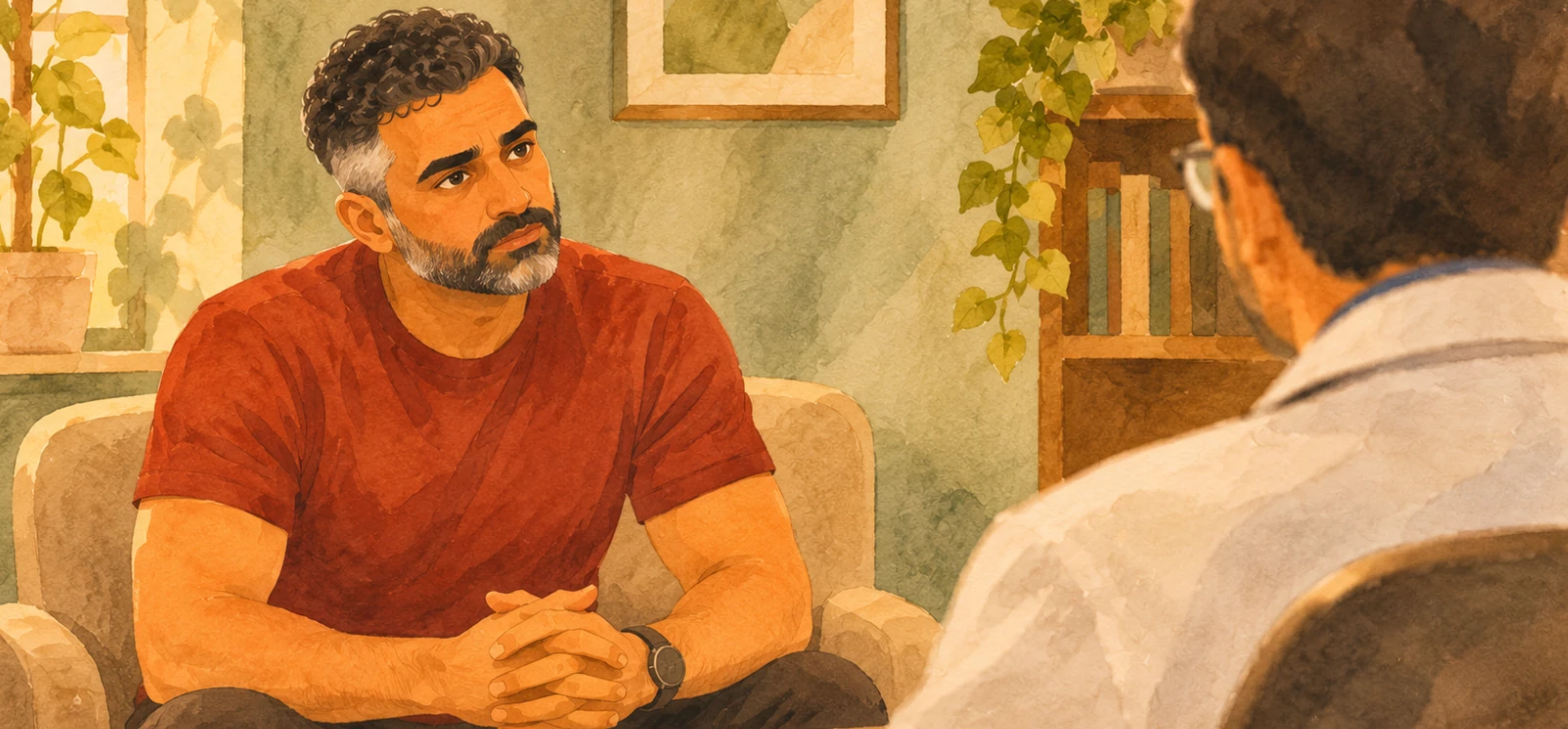
Tell one person. You do not have to tell the whole family. Start with one person you trust, ideally someone who does not drink heavily.
Tell them three things. What you are doing, when you start, and what help you want from them.
That help can be small. A call at 8 p.m. A walk after dinner. A promise not to lecture.
Clear the house. Keep little or no alcohol at home (Source: NIAAA Rethinking Drinking, 2026 — rethinkingdrinking.niaaa.nih.gov).
That means the bottle in the cupboard, the gift bottle from Diwali, and the one in the car. If others at home drink, ask them to keep it out of sight for now.
Plan your evenings. Evenings are when most routines break. If you always drink at seven, something else must happen at seven.
Book a walk, a gym class, a call with a friend, or dinner earlier than usual. Keep cold drinks you like at home. Lime soda and buttermilk work well, and they give your hands something to do.
Plan your sleep and food. Eat regular meals and go to bed at a set time. Tell your doctor if sleep stays poor. Do not borrow sleeping pills from anyone.
Q: Should I tell my boss I am trying to stop drinking?
A: You do not have to. Your health is private, and you can simply say you are not drinking right now. If treatment needs time off, a doctor's note covering medical leave is usually enough.
Step 4: Plan for Cravings Before They Come
Cravings will come. That is normal, and it does not mean the plan has failed.
The NIAAA calls urges to drink short-lived, predictable, and controllable (Source: NIAAA Rethinking Drinking, 2026 — rethinkingdrinking.niaaa.nih.gov).
Predictable is the useful word. Your diary from Step 1 already shows when they show up.
Triggers come in two kinds. External ones are people, places, things, and times of day. The friend who always pours. The bar near the office. Six o'clock on a Friday.
Internal ones come from inside you. A sudden thought, excitement, frustration, a headache, or tension can set off an urge (Source: NIAAA Rethinking Drinking, 2026 — rethinkingdrinking.niaaa.nih.gov).
Avoid what you can for now. Take a different road home. Skip the Friday group for a few weeks.
You are not giving these up forever. You are buying time while the new habit grows stronger (Source: NIAAA Rethinking Drinking, 2026 — rethinkingdrinking.niaaa.nih.gov).
For the ones you cannot avoid, the NIAAA suggests four simple moves (Source: NIAAA, 2024 — niaaa.nih.gov).
Read your list of reasons.
Talk to someone you trust.
Get busy with something healthy, such as a walk or a hobby.
Accept the urge and ride it out, knowing it will rise like a wave and pass.
You do not have to fight the feeling. You can notice it, breathe, and let it pass.
Write your plan down in advance. Use a simple line for each trigger. For example: when I pass the wine shop, I will call my brother.
If urges stay very hard, or nothing improves after a few weeks, see a doctor. Medicines can reduce the desire to drink (Source: NIAAA Rethinking Drinking, 2026 — rethinkingdrinking.niaaa.nih.gov).
Q: What should I do in the first ten minutes of a strong craving?
A: Move your body and change the room. Drink water, step outside, and call someone from your list. Read your reasons out loud. Do not decide anything until the feeling has dropped.
Step 5: How to Stop Drinking at Weddings and Office Parties
In India, alcohol is often tied to being polite. A host pours for you. A senior raises a glass. An uncle says, one peg will do nothing.
Knowing how to stop drinking in those rooms matters as much as knowing what to do at home.
The NIAAA splits social pressure into two kinds (Source: NIAAA Rethinking Drinking, 2026 — rethinkingdrinking.niaaa.nih.gov). Direct pressure is when someone offers you a drink. Indirect pressure is when you feel tempted just by being around people who are drinking.
Skip some events at first. Your cousin's sangeet will not fall apart without you. For the first weeks, you can come for the ceremony and leave before the bar opens.
If you feel guilty, remember this is not forever. You can go back once you feel stronger.
Have your no ready. Keep it clear, firm, and friendly. Long explanations only give people more to argue with (Source: NIAAA Rethinking Drinking, 2026 — rethinkingdrinking.niaaa.nih.gov).
Make eye contact and do not pause. If the person pushes, go up one level at a time.
First, say no, thank you.
Next, say no thanks, I don't want to.
Then say I'm not drinking now, my doctor told me to stop.
Finally, say I'd really appreciate your help with this.
The doctor line works well in India. Few people will argue with a medical reason, and you do not owe anyone the details.
If someone keeps going, repeat the same short line. And if words fail, you can walk away (Source: NIAAA Rethinking Drinking, 2026 — rethinkingdrinking.niaaa.nih.gov).
Hold a glass. Get a soda or a juice in your hand as soon as you arrive. People rarely offer a drink to someone already holding one.
Bring an ally. Tell your spouse or a friend before you go. Agree on a signal that means it is time to leave.
Own your exit. Take your own car, or book your own cab. Then you can leave when you want to.
Plan for work. At client dinners, order first, so your drink is set before anyone asks.
Rehearse your lines out loud at home. Saying no is harder than people expect at first, and practice builds confidence (Source: NIAAA Rethinking Drinking, 2026 — rethinkingdrinking.niaaa.nih.gov).
Q: What do I say when elders insist I have a drink?
A: Stay respectful and keep it short. Say that your doctor has asked you not to drink, thank them, and move the talk on. Most elders accept a health reason, and you do not need to share more.
Step 6: Get Proper Help: Medicines, Therapy and Peer Support
Learning how to quit alcohol is rarely a solo job. If you may have an alcohol use disorder and decide to stop, do not go it alone (Source: NIAAA, 2024 — niaaa.nih.gov).
Three kinds of help have good evidence behind them. They work well together.
Medicines. During detox, doctors commonly use benzodiazepines to prevent seizures and delirium. Thiamine, a B vitamin, helps protect the brain (Source: Kattimani and Bharadwaj, Industrial Psychiatry Journal, 2013 — pmc.ncbi.nlm.nih.gov).
After detox, other medicines help you stay stopped. The NIAAA lists three approved in the US, and doctors decide if any of them suit you.
Naltrexone helps reduce the urge to drink.
Acamprosate eases the unpleasant feelings that can come with not drinking.
Disulfiram causes unpleasant symptoms if you drink.
All three are nonaddictive (Source: NIAAA, 2025 — niaaa.nih.gov).
A 2023 review of 118 trials and 20,976 people supported naltrexone and acamprosate as first-line options, used with counselling (Source: McPheeters et al., JAMA, 2023 — pmc.ncbi.nlm.nih.gov).
These medicines need a prescription and regular check-ups. Your liver, kidneys, and other medicines all shape the choice, so never start one on your own.
Therapy. Cognitive behavioural therapy helps you spot the feelings and situations behind your drinking. You then build new ways to cope (Source: NIAAA, 2025 — niaaa.nih.gov).
Motivational therapy is shorter. It helps you weigh the pros and cons and build a plan for change.
Treat any mental health problem at the same time (Source: NIAAA, 2025 — niaaa.nih.gov). If anxiety or depression stays untreated, the urge has a reason to return.
Peer support. Alcoholics Anonymous offers free peer support, and it runs in India. You can find contact details on the AA India website.
A 2020 Cochrane review looked at structured twelve-step programmes. They kept more people abstinent than other set treatments, such as CBT (Source: Kelly et al., Cochrane Database of Systematic Reviews, 2020 — pmc.ncbi.nlm.nih.gov).
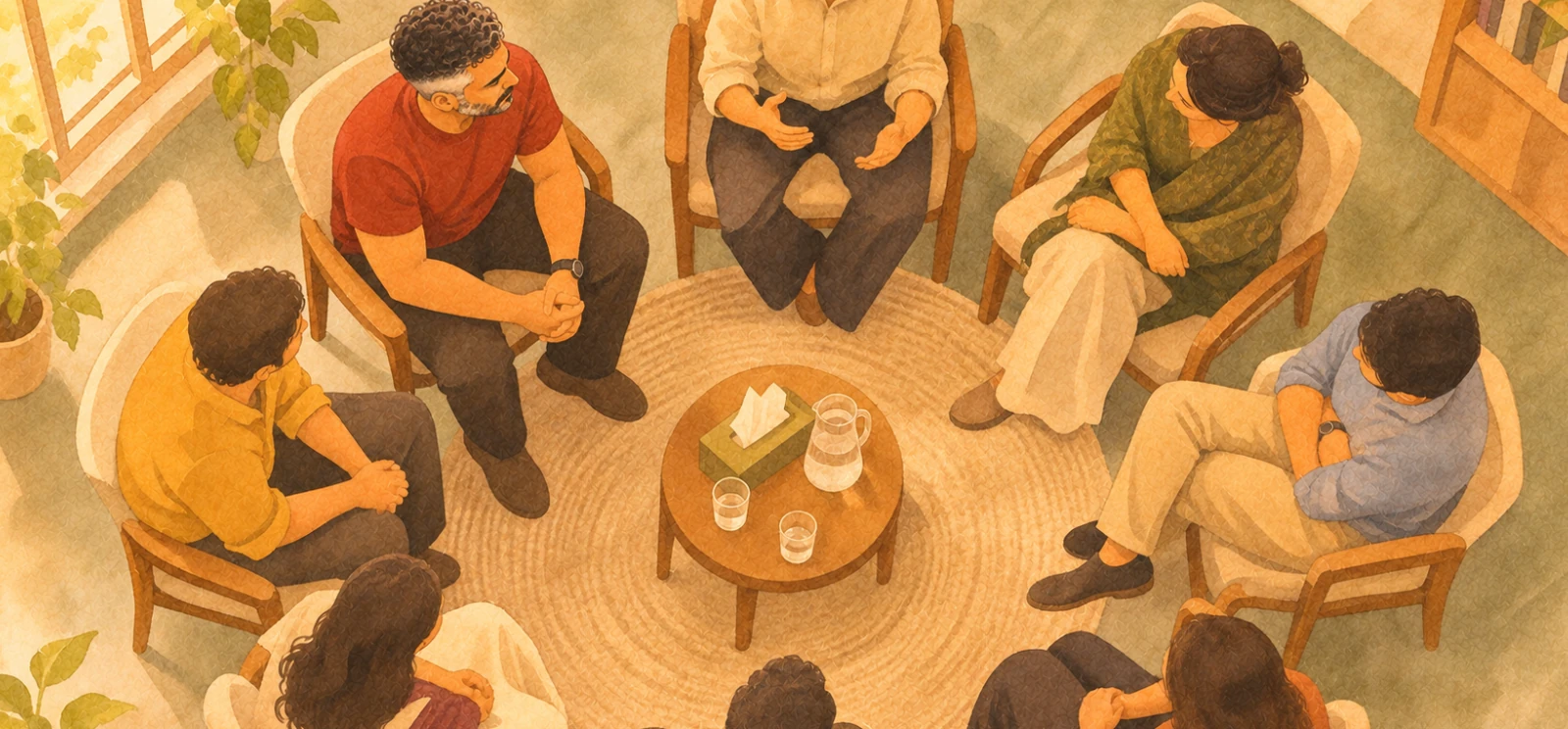
People in these groups have been through it, and they do not judge.
Free helplines. India's Tele-MANAS line, on 14416, offers mental health counselling around the clock (Source: Press Information Bureau, 2026 — pib.gov.in). A separate government helpline for people affected by addiction runs on 14446 (Source: Press Information Bureau, 2026 — pib.gov.in).
Q: Do I have to stay on medicine forever to stay sober?
A: Usually not, though there is no fixed rule. Your doctor will review how you are doing and decide how long to continue. Many people use these medicines as support during the hardest period, alongside therapy and peer groups.
Step 7: Know What to Do After a Slip
A slip is one drink, or one night, after you decided to stop. It happens to many people.
Overcoming an alcohol problem is an ongoing process that can include setbacks. It is rare for someone to go to treatment once and then never drink again (Source: NIAAA, 2025 — niaaa.nih.gov).
The danger is rarely the drink itself. The danger is what you tell yourself next.
Researchers call this the abstinence violation effect. Seeing a slip as a personal failure brings guilt. That guilt can make you drop the goal altogether (Source: Hendershot et al., Substance Abuse Treatment, Prevention, and Policy, 2011 — pmc.ncbi.nlm.nih.gov).
It sounds like this. I have ruined it anyway, so I may as well finish the bottle.
One drink has not ruined anything. Your progress in the long run is what counts (Source: NIAAA Rethinking Drinking, 2026 — rethinkingdrinking.niaaa.nih.gov).
Write this plan down now, while you feel strong. Follow these steps if a slip comes.
Stop drinking as soon as you can.
Tell your doctor or a sober friend the same day.
Pour out any alcohol at home.
Go to a meeting or book your next therapy session.
Work out what led to it, and write it down.
Change one thing so it does not happen the same way again.
These steps follow the NIAAA's advice for getting back on track (Source: NIAAA Rethinking Drinking, 2026 — rethinkingdrinking.niaaa.nih.gov).
There is one safety point here. If a slip has turned into several days of heavy drinking, do not just stop on your own again. Your body may have gone back to depending on alcohol. Call your doctor first, and go back to Step 2.
Families have a big part to play at this moment. Shouting feels natural, but shame pushes people back to the bottle. Try saying this instead: I am glad you told me, so what do we do next?
Relapse does not mean treatment has failed. The US National Institute on Drug Abuse says relapse is common. Rates are similar to those for high blood pressure and asthma (Source: NIDA, 2020 — nida.nih.gov).
Q: If I drink once after quitting, do I have to start all over?
A: No. You do not lose what you learned or the days you stayed sober. Stop as soon as you can, tell someone, and look at what led to it. If you drank heavily for days, speak to a doctor before stopping again.
How Ganaa Can Help You Stop Safely
We have worked in mental health and de-addiction care in India since 2012 (Source: Ganaa, 2026 — ganaa.in).
If you are not sure where you stand, start with a talk. Our helpline runs 24 hours a day on +91 8750075006. A counsellor can help you work out your next step (Source: Ganaa, 2026 — ganaa.in).
For mild concerns, you can see a psychiatrist or therapist at one of our five clinics. They are in Greater Kailash II, Gurugram, Greater Noida, Faridabad, and Panaji (Source: Ganaa, 2026 — ganaa.in).
For higher risk, our hospitals and rehabs offer residential care, from supervised detox to intensive psychiatric care. They are in South Delhi, Chattarpur, Gurugram, Greater Noida, and South Goa. A sixth is opening soon in Lonavala (Source: Ganaa, 2026 — ganaa.in).
Our residential centres have a 2:1 staff-to-client ratio, with 24/7 medical and psychiatric support (Source: Ganaa, 2026 — ganaa.in).
You will work with psychiatrists, psychologists, and holistic therapists. We also involve loved ones in care, because recovery has to continue at home (Source: Ganaa, 2026 — ganaa.in).
Each plan is tailored to the person. A rehab stay usually runs 30 to 90 days, depending on how severe the problem is (Source: Ganaa FAQ, 2026 — ganaa.in).
Care does not end at discharge. Post-care includes reviews with a psychiatrist, therapy with a psychologist, and AA sessions (Source: Ganaa FAQ, 2026 — ganaa.in).
You can read more about our alcohol de-addiction programme. You can also speak to a Ganaa admissions counsellor on +91 8750075006, or write to info@ganaa.in.
A first call does not commit you to anything. It only gives you clearer facts.
Conclusion: How to Stop Drinking Without Putting Yourself at Risk
Now you know how to stop drinking alcohol in the right order.
Check your safety first. If you drink daily or heavily, see a doctor before you stop. Never treat seizures or confusion as something to wait out.
Then count honestly. Keep the diary, take the AUDIT test, and decide if you need medical detox.
Set your date. Tell one person. Clear the house.
Plan for cravings before they arrive. Practise your no before the wedding invitation lands.
Ask a doctor about medicines. Add therapy and a peer group. Knowing how to quit alcohol also means knowing who to lean on.
And write your slip plan today. A bad night does not cancel the good days before it.
Most people do not get this right on the first try. That is normal. Even for people with an alcohol use disorder, studies show that most do recover (Source: NIAAA, 2024 — niaaa.nih.gov).
You do not need to feel ready. You only need one honest talk with someone who can help. If you are unsure where to begin, start your diary tonight.
Then make that call this week.
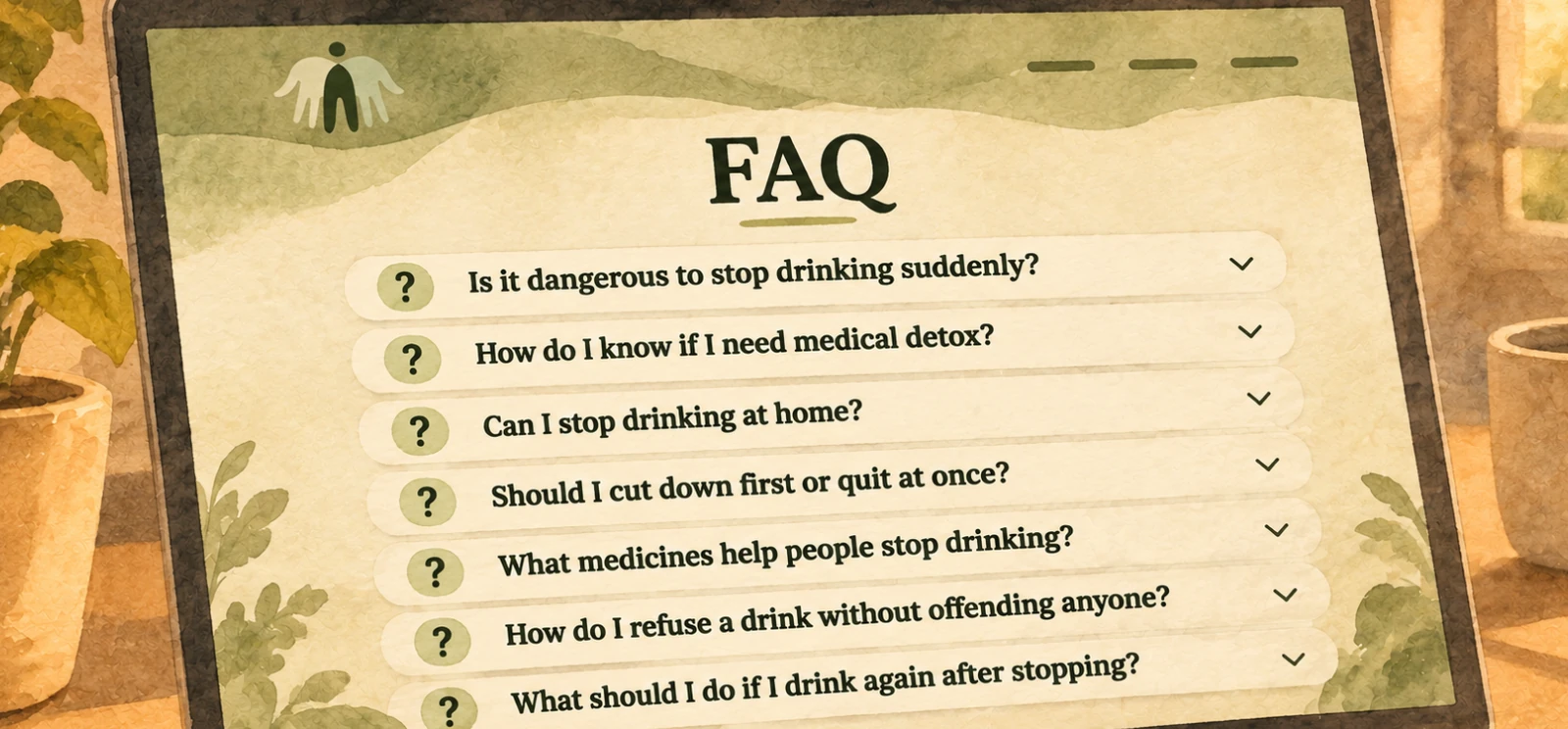
FAQ
Q: Is it dangerous to stop drinking suddenly?
A: It can be, if your body depends on alcohol. Sudden stopping after heavy or daily drinking can cause shaking, seizures, and delirium tremens, which can be life-threatening. Speak to a doctor before you stop.
Q: How do I know if I need medical detox?
A: Warning signs include shaking or sweating when alcohol wears off, past seizures, and past severe withdrawal. Drinking more than eight standard drinks a day is another. Other health conditions and having no support at home also matter. A doctor can judge your risk after a proper check.
Q: Can I stop drinking at home?
A: Some people can, with a doctor's guidance, if their symptoms are mild and their risk is low. It needs a sober adult nearby and regular medical review. People at higher risk are safer in a hospital or rehab.
Q: Should I cut down first or quit at once?
A: It depends on how much you drink and your health. Quitting is strongly advised if you have tried cutting down and failed. The same goes if you have symptoms of an alcohol use disorder or are pregnant. If you are dependent, a doctor should guide the process.
Q: What medicines help people stop drinking?
A: Doctors may use naltrexone, acamprosate, or disulfiram after detox, depending on your health. These medicines are nonaddictive and work best alongside counselling. They need a prescription and regular check-ups.
Q: How do I refuse a drink without offending anyone?
A: Keep it short, friendly, and firm. Saying that your doctor has asked you not to drink works well. You do not owe anyone more detail. Holding a soft drink also stops most offers.
Q: What should I do if I drink again after stopping?
A: Stop as soon as you can and tell your doctor or a sober friend. Then look at what led to it. A slip does not wipe out your progress. If you drank heavily for several days, speak to a doctor before stopping again.
Looking for the best mental hospital in India? Use this family guide to check registration, staffing, safety rules, visits and aftercare before admission.
Compulsive pornography use has a clinical definition, and it is not what most people assume. Learn where the line sits, what drives it, and what treatment works.