Compulsive Pornography Use: When Habit Becomes Dependence
Compulsive pornography use has a clinical definition, and it is not what most people assume. Learn where the line sits, what drives it, and what treatment works.
Compulsive Pornography Use: When Habit Becomes Dependence
Most writing on this subject is not medicine. It is opinion wearing a lab coat.
Some of it says the habit rewires your brain beyond repair.
Some of it says there is no such thing as a problem here at all.
Both claims are too tidy, and neither helps someone who cannot stop.
There is a clinical answer, and it is more useful than either side.
Compulsive pornography use sits inside a recognised diagnosis. It is just not the one people expect.
This guide sets out what that diagnosis actually says.
It covers where the line falls between heavy use and a disorder.
It covers a trap that sends many people to the wrong kind of help.
It covers what Indian research has found, which is specific and recent.
It covers what usually sits underneath the behaviour.
And it covers what treatment involves, in plain terms.
The tone here is deliberate. No shaming, no panic, no moral lecture.
Shame is not a treatment. It is usually part of the problem.
One note first. This is general guidance, not a diagnosis.
If this is your own worry, read it slowly.
If it is about someone you love, read it twice.
The second read is where the useful part lands.
And take your time with the first two parts.
They do most of the work.
What the Diagnosis Actually Says
The relevant category is compulsive sexual behaviour disorder.
It appears in the World Health Organization's ICD-11 under the code 6C72 (Source: World Health Organization, 2025 — icd.who.int).
It was added to the ICD-11 after a formal review process (Source: World Psychiatry, 2018 — pmc.ncbi.nlm.nih.gov).
The core description is a persistent pattern of failure to control intense, repetitive sexual urges and behaviours (Source: Journal of Behavioral Addictions, 2022 — pmc.ncbi.nlm.nih.gov).
Five features are used to identify it (Source: Journal of Behavioral Addictions, 2022 — pmc.ncbi.nlm.nih.gov).
Time. Too much time given to sex, at the cost of health, self-care, interests and duties.
Reduced control. Repeated attempts to cut down that do not succeed.
Continuing despite harm. The behaviour goes on even as consequences build.
Continuing without reward. It carries on even when it brings little or no satisfaction.
Distress or impairment. Real trouble across areas of life, or in how someone copes.
Notice what is absent from that list.
There is no number of hours. No frequency count. No content type.
The definition is about control and consequences, not about volume.
That is a more honest test than any hour limit, and a harder one to argue with.
Read the five features again, honestly.
If four of them describe your last six months, this is worth raising with a clinician.
Not four out of five means you are fine.
It means you have less to work with, and that is good news.
Either way, one visit settles it.
You do not have to be sure before you go.
Being unsure is a fine reason to ask.
Q: What is compulsive sexual behaviour disorder?
A: A recognised ICD-11 condition marked by repeated failure to control sexual urges and behaviour. It involves excessive time, failed attempts to cut down, and continuing despite harm.
Why "Addiction" Is the Wrong Word Clinically
This distinction sounds academic. It changes the treatment, so it is worth ten lines.
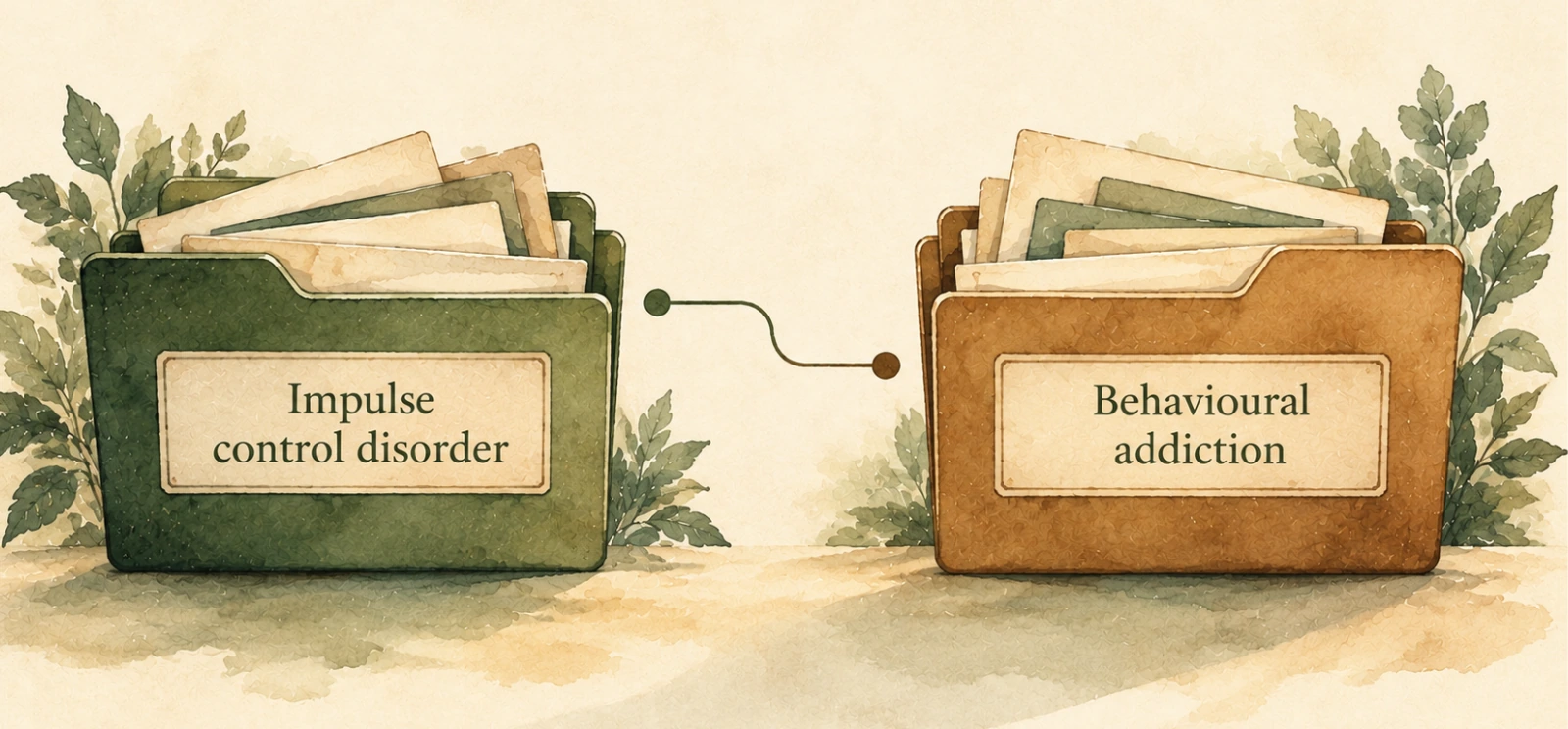
In the ICD-11, compulsive sexual behaviour disorder is classified as an impulse control disorder (Source: Journal of Behavioral Addictions, 2022 — pmc.ncbi.nlm.nih.gov).
It is not classified as a behavioural addiction, which is a separate group in the same manual.
Addiction models push one answer. Stop fully, count your days, treat any use as a slip.
Impulse control models push another. Build control, work on triggers, treat what drives the urge.
For some people, a full stop is the right plan. For many others it is not.
The second reason is honesty about the evidence.
The research base here is younger and thinner than for alcohol or drugs.
Anyone who tells you the science is settled is overselling it.
What is agreed is that some people genuinely lose control, and that it causes real harm.
That is enough to justify treatment. It does not require the addiction label.
One practical consequence follows from all this.
Be careful with programmes built on day counts and public confession.
Some people do well in them. Others come out with more shame and the same behaviour.
Ask what a programme is built on before you join it.
Ask what happens on a bad week.
If the answer is a day count and a public admission, think again.
A good answer sounds calm.
We look at triggers. We plan for hard days. We treat the low mood too.
Q: Is pornography use classified as an addiction?
A: Not in the ICD-11. Compulsive sexual behaviour disorder is listed as an impulse control disorder, not a behavioural addiction. That difference shapes which treatment approach is used.
Where the Line Actually Sits
People want a number. There isn't one, and that is not a dodge.
Here is what clinicians actually look for instead.
Failed attempts. You have decided to stop or cut down, more than once, and it did not hold.
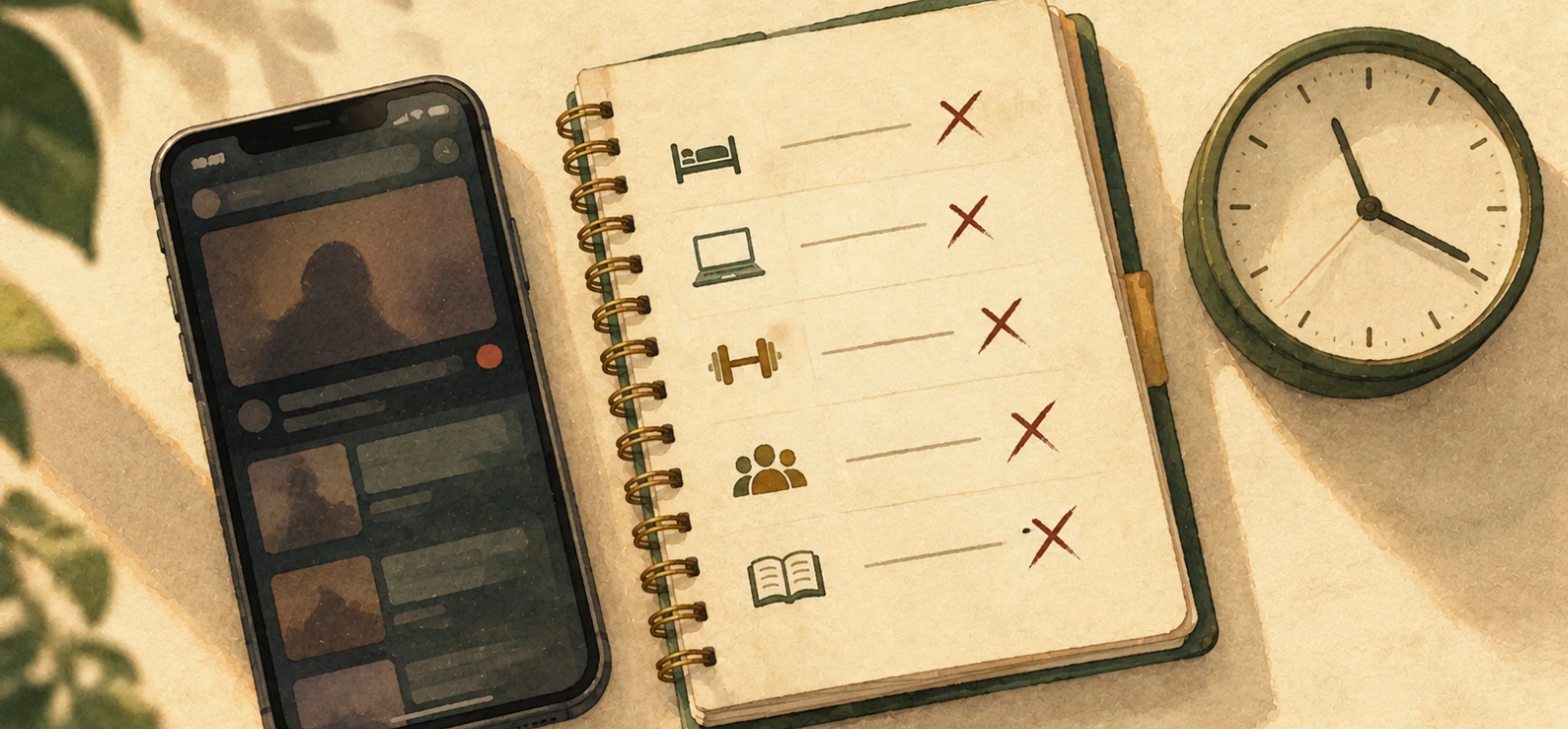
Escalating time. Sessions get longer, or start earlier, or eat into sleep.
Displacement. Things you used to do have quietly dropped away.
Use at costly moments. In work hours, at the cost of sleep, or in risky places.
Loss of satisfaction. It stops being enjoyable and becomes something you just do.
Secrecy that grows. More hiding, more deleting, more explaining.
Effect on intimacy. Difficulty being present with a partner, or a growing gap between you.
Mood dependence. It becomes the automatic response to stress, boredom or low mood.
Going on despite costs. A warning at home, a problem at work, and still it goes on.
Duration matters too. This should be a pattern over an extended period, not one bad month.
A rough few weeks after a breakup is not this.
Neither is a bad stretch during exams.
Look for a pattern that has held for months.
Six months is the usual mark.
It is not a magic line. It just rules out a bad patch.
Now the opposite list, which gets less attention.
Using pornography is not by itself a disorder.
Using it more than your friend does is not a disorder.
Feeling embarrassed about it is not a disorder.
Being told by someone else that it is wrong is not a disorder.
The difference is control and harm. Everything else is noise.
Hold on to those two words.
Control. Harm.
Most of what you read online is about neither.
Much of it is about fear.
Some of it is selling you a cure.
Neither is care.
Q: How many hours of use counts as compulsive?
A: There is no hour threshold. Clinicians look at failed attempts to cut down, neglect of responsibilities, continuing despite harm, and continuing when it brings little satisfaction.
The Moral Distress Trap
This is the most important section here, and the least discussed.
The ICD-11 guidelines include a specific safeguard.
Distress from moral judgement alone is not enough to meet the criteria (Source: Journal of Behavioral Addictions, 2022 — pmc.ncbi.nlm.nih.gov).
That covers disapproval about sexual urges or behaviour.
Read that twice, because it is easy to skim.
It means suffering alone does not make a diagnosis.
Say the distress comes from believing the act is wrong.
That is not the same as losing control of it. This category does not apply.
Researchers call this moral incongruence. The gap between what you do and what you believe.
It produces real pain. It just produces a different problem, needing different help.
Why does this matter so much in practice?
People in that spot often get pushed into heavy treatment they do not need.
They are told they have a disease. They count days. They relapse, and feel worse.
Meanwhile the actual issue, a conflict between values and behaviour, goes unaddressed.
This matters a lot in India. Sexual guilt runs deep here, and talk runs thin.
Here is a fair way to separate the two, for yourself.
Ask whether you could stop if you decided to, and simply have not.
Then ask whether you have decided to, repeatedly, and could not.
The first is a values question. The second is a clinical one.
Both deserve support. They do not deserve the same support.
This is not a small point.
The wrong help can make things worse here.
It costs time, money, and a lot of self-blame.
So start with the right question.
Not am I bad. But can I stop when I choose to.
Q: What if I feel guilty but my use is not out of control?
A: That is moral incongruence, not a disorder. The guidelines say distress from moral judgement alone does not meet the criteria. Counselling about values and beliefs helps more than abstinence programmes.
What Indian Research Found
Data from India on this is scarce. One recent study helps.
Researchers surveyed 112 Indian adults who had experienced pornography-related difficulties in the past six months (Source: International Journal of Sexual Health, 2025 — pubmed.ncbi.nlm.nih.gov).
Participants were aged 18 to 46, with a mean age of 25.5 years, and 81.3% were male (Source: International Journal of Sexual Health, 2025 — pubmed.ncbi.nlm.nih.gov).
The findings are worth reading closely.
Most began viewing in early adolescence, at a mean age of 14.1 years (Source: International Journal of Sexual Health, 2025 — pubmed.ncbi.nlm.nih.gov).
Smartphones were the main route, for 79.5% of participants (Source: International Journal of Sexual Health, 2025 — pubmed.ncbi.nlm.nih.gov).
Negative effects in at least one area of life were reported by 75.89% (Source: International Journal of Sexual Health, 2025 — pubmed.ncbi.nlm.nih.gov).
Those areas were family, social life, and work.
Guilt or shame was reported by 63.39%, and self-esteem problems by 48.21% (Source: International Journal of Sexual Health, 2025 — pubmed.ncbi.nlm.nih.gov).
Now the two numbers that say the most about India specifically.
Some 86% perceived little or no support from friends and family (Source: International Journal of Sexual Health, 2025 — pubmed.ncbi.nlm.nih.gov).
And 68.75% avoided discussing their pornography habits with partners (Source: International Journal of Sexual Health, 2025 — pubmed.ncbi.nlm.nih.gov).
That is near-total isolation around the problem.
Think about what that does.
No one to ask. No one to check with. No sense of whether this is normal.
So the worry grows in the dark, on its own.
That is the part you can change this week.
Tell one person. Just one.
It does not have to be a partner. A doctor counts.
The study also compared groups. Those with problematic use had stronger motives around stress reduction, fantasy, emotional distraction and boredom (Source: International Journal of Sexual Health, 2025 — pubmed.ncbi.nlm.nih.gov).
They also showed higher levels of depression, anxiety and stress (Source: International Journal of Sexual Health, 2025 — pubmed.ncbi.nlm.nih.gov).
That last line is the treatment clue, and we will return to it.
It points at what to treat first.
Not the habit. The mood under it.
Do both, and it holds.
Do one, and it comes back by spring.
Quick Facts: Compulsive Pornography Use
Compulsive sexual behaviour disorder appears in the ICD-11 as code 6C72 — (Source: World Health Organization, 2025 — icd.who.int).
It is classified as an impulse control disorder, not a behavioural addiction — (Source: Journal of Behavioral Addictions, 2022 — pmc.ncbi.nlm.nih.gov).
Distress from moral judgement alone does not meet the criteria — (Source: Journal of Behavioral Addictions, 2022 — pmc.ncbi.nlm.nih.gov).
In an Indian survey of 112 adults, first viewing came at a mean age of 14.1 years — (Source: International Journal of Sexual Health, 2025 — pubmed.ncbi.nlm.nih.gov).
Negative effects in at least one life area were reported by 75.89% of them — (Source: International Journal of Sexual Health, 2025 — pubmed.ncbi.nlm.nih.gov).
Some 86% perceived little or no support from friends and family — (Source: International Journal of Sexual Health, 2025 — pubmed.ncbi.nlm.nih.gov).
How the Pattern Builds
Nobody sets out to build this. It assembles itself, slowly.
That matters for how you think about it.
Nobody chose this at fourteen.
Blame does not fit a thing that built itself.
But you do get to choose what happens next.
That part is yours.
And it starts smaller than you think.
The usual sequence looks like this.
Early exposure. Often in the teens, usually by chance, usually on a phone.
Casual use. Occasional, without much thought attached.
A function appears. It becomes useful for something. Winding down, sleeping, escaping a bad day.
Pairing. The behaviour attaches itself to a mood. Stress arrives, and the response is automatic.
Tolerance of a kind. The same use gives less relief, so time or intensity creeps up.
Displacement. Other ways of coping fall away through disuse.
Secrecy. Hiding starts, then grows, and the hiding itself becomes stressful.
The loop closes. Stress from hiding drives the behaviour that creates the stress.
That final loop is the engine, and it explains why willpower alone tends to fail.
You are not fighting a preference. You are fighting your only remaining stress response.
The Indian data fits this exactly. Motives clustered around stress relief, distraction and boredom (Source: International Journal of Sexual Health, 2025 — pubmed.ncbi.nlm.nih.gov).
There is one more accelerator specific to now.
The supply is infinite, free, private and in your pocket.
Nothing around you creates friction. Every other habit has some.
So friction has to be built on purpose. That is part of what treatment does.
Think of a bar and a drink.
You have to leave the house. You have to pay. Someone sees you.
None of that is true here. That is the whole change.
So the old advice does not fit.
You cannot avoid the bar. The bar is in your hand.
Q: Why can't I stop even though I want to?
A: Because the behaviour has become a stress response, not just a preference. Removing it without replacing it leaves the stress with nowhere to go, so the pattern returns.
What Usually Sits Underneath
This is where treatment either works or wastes everyone's time.
Compulsive sexual behaviour rarely stands alone. Something is usually being managed by it.
The common companions:
Depression. Low mood, low motivation, and a behaviour that gives brief relief.
Anxiety. Above all social anxiety, where closeness feels risky and this does not.
Loneliness. Very common, and rarely named out loud.
Boredom. Underrated as a driver, and specifically named in the Indian findings.
Trauma history. In some people, though not most, and it needs careful handling.
The Indian study measured this directly. Those with problematic use showed elevated depression, anxiety and stress (Source: International Journal of Sexual Health, 2025 — pubmed.ncbi.nlm.nih.gov).
So here is the practical implication.
Treating the behaviour and ignoring the mood underneath usually fails.
The behaviour was doing a job. Remove it, leave the job undone, and it comes back.
Good treatment works on both at once.
That is also why a proper assessment matters more than a blocking app.
Apps block a route. They do not touch a reason.
Block one route and another opens by evening.
Use them, but do not expect them to do the work.
Set them up on a calm day, not a bad one.
And let someone else hold the code.
Q: Does depression cause compulsive pornography use?
A: They often travel together. Indian research found higher depression, anxiety and stress among people with problematic use. Treating only the behaviour, without the mood underneath, usually fails.
What Treatment Looks Like
Treatment is ordinary, structured, and much less dramatic than people fear.
Assessment first. A clinician works out whether this meets the clinical picture at all.
That step separates a genuine control problem from moral distress. The two need different help.
Cognitive behavioural work. This is the usual core.
You map triggers, situations and moods. Then you build different responses to each.
Approaches built on shame, public confession or punishment tend to backfire.
Given that 86% already feel unsupported, adding shame is not a plan.
And for most people, this is outpatient work. A residential stay is for severe cases or where other conditions dominate.
That is worth saying plainly.
You do not need to leave home for this.
Most of it is an hour a week and some honest notes.
That is a small ask for what it returns.
Most people see a shift in two months.
Q: What treatment works for compulsive pornography use?
A: Cognitive behavioural therapy is the usual core, alongside treating depression or anxiety underneath. Device friction helps but is not enough alone. Couples work matters where trust is damaged.
How Ganaa Treats Compulsive Sexual Behaviour
Ganaa has worked in mental health care in India since 2012. We treat psychiatric conditions and substance use across age groups (Source: Ganaa, 2026 — ganaa.in).
People rarely arrive talking about this directly. It usually comes up later, once trust is there.
So the first thing we offer is a conversation without judgement.
Assessment comes next, and it has a specific job.
We work out whether this is a control problem, a values conflict, or a symptom of something else.
That answer decides the plan. Getting it wrong wastes months.
We also look for what sits underneath. Depression, anxiety, sleep problems and alcohol use all get checked.
Care blends psychiatric treatment with psychology sessions, family counselling and holistic therapy (Source: Ganaa, 2026 — ganaa.in).
Most people are seen as outpatients. Our clinics sit in Faridabad, Greater Kailash, and Greater Noida.
Live-in centres are in Delhi, Gurugram, Greater Noida, and South Goa (Source: Ganaa, 2026 — ganaa.in).
A residential stay is considered where other conditions dominate, or where daily life has broken down.
Where a stay is needed, published guidance puts programme length at 30 to 90 days (Source: Ganaa FAQ, 2026 — ganaa.in).
Aftercare continues once daily life resumes, with reviews and therapy sessions (Source: Ganaa FAQ, 2026 — ganaa.in).
What you say here stays private, as with every condition we treat.
Treatment is tailored to the person, not run off a template.
Support runs 24 hours a day.
Have you tried to stop several times and failed?
That is a clinical fact. Not a character flaw.
Speak to a Ganaa counsellor on +91 8750075006, or write to info@ganaa.in. You can also book a consultation at ganaa.in/booking.
Conclusion: Ask About Control, Not About Volume
The useful question here is not how much, or how often.
It is whether you have tried to stop and could not.
That is the line the ICD-11 draws, and it is a fair one.
Compulsive sexual behaviour disorder is real, recognised, and treatable.
It is listed as an impulse control disorder, which shapes how it should be treated.
If your distress comes only from believing the behaviour is wrong, that is a different problem.
It is still worth help. It just is not this diagnosis, and abstinence programmes may make it worse.
The Indian picture is one of isolation. Most people felt unsupported, and most told no partner.
That silence is doing more damage than the behaviour in many cases.
Look underneath before you look at the habit. Depression, anxiety and loneliness travel with this.
Build friction, but do not mistake an app for treatment.
And expect slips. Plan for them rather than treating each as proof of failure.
One honest conversation with a clinician will tell you more than a year of searching.
Ask about control. The rest follows from there.
And tell one person this week.
A doctor. A partner. A friend.
The silence is doing half the damage.
You will likely find it lands better than you fear.
Most people have heard worse.
And most will just be glad you said it.
FAQ
Q: Is porn addiction a real medical diagnosis?
A: Not under that name. The ICD-11 recognises compulsive sexual behaviour disorder, listed as an impulse control disorder rather than an addiction. Problematic pornography use is usually understood within that category.
Q: How much pornography use counts as a problem?
A: There is no hour count. The markers are failed attempts to cut down and neglect of duties. Also continuing despite harm, and continuing when it brings little joy.
Q: Does feeling guilty about pornography mean I have a disorder?
A: No. The guidelines are explicit that distress coming entirely from moral judgement or disapproval is not enough for a diagnosis. Loss of control and real-life harm are what matter clinically.
Q: What does Indian research say about problematic pornography use?
A: A 2025 survey of 112 Indian adults with pornography-related difficulties found first viewing at a mean age of 14.1 years. Around 76% reported negative effects in at least one life domain.
Q: What usually sits underneath compulsive pornography use?
A: Often stress, low mood, anxiety, loneliness, or boredom. In the Indian study, motives clustered around stress relief and distraction. Depression and anxiety scores were higher too.
Q: What treatment works for compulsive sexual behaviour?
A: Cognitive behavioural approaches are the usual starting point, alongside treating any depression or anxiety underneath. Couples work helps where trust has been damaged. Shame-based approaches tend to backfire.
Q: Should someone be shamed or punished into stopping?
A: No. Shame drives secrecy, and secrecy makes the pattern worse. Indian research found most people felt little support and avoided telling partners. Treatment works better than confrontation.
Online therapy matches in-person results for most conditions. Here is what the trials found, where each format wins, and how to choose for your own situation.
Mindfulness-based therapy cuts depression relapse risk in recurrent cases. Here is what MBCT is, what the trials found, and how the eight weeks actually run.