Online Therapy vs In-Person: Which Works Better, for Whom?
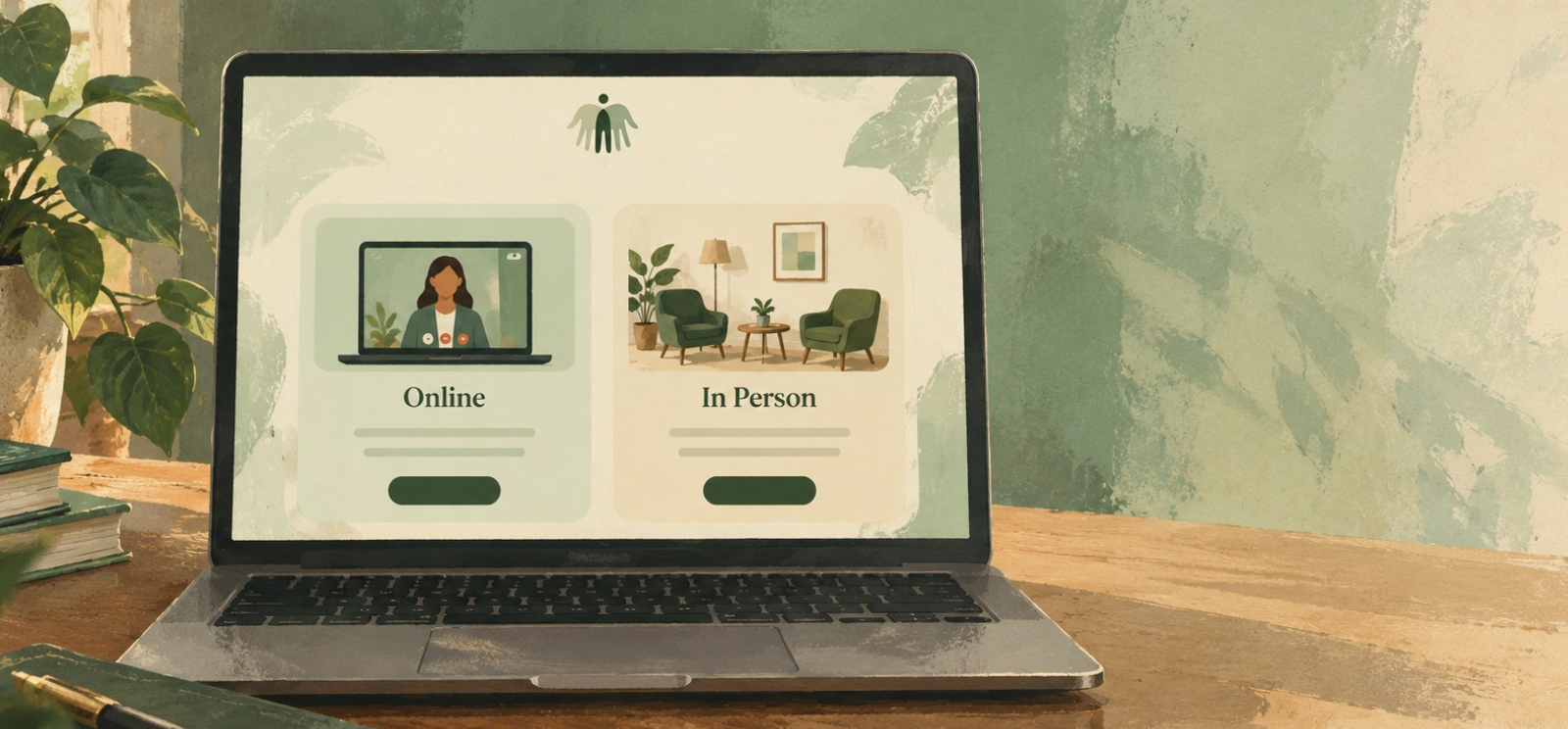
Online therapy matches in-person results for most conditions. Here is what the trials found, where each format wins, and how to choose for your own situation.
Online Therapy vs In-Person: Which Works Better, for Whom?
The honest answer surprises most people.
For most common problems, the format barely matters.
What matters is whether you go at all, and whether you keep going.
That is not a soft statement. It comes out of the trial data, and we will walk through it.
Online therapy grew fast, then stayed. Many people now choose it by default.
Others assume it is a lesser version. A stopgap. Second best.
Both views miss the real picture, which is more interesting.
Some things transfer well over video. A few things do not.
And which group you fall into depends less on the illness than on your situation.
This guide covers what the research compared, and what it found.
It covers where online holds up, and where a room still wins.
It covers the rules in India, which many people do not know exist.
And it ends with a way to decide for yourself.
One note first. This is general guidance, not a clinical recommendation.
If you are in crisis right now, do not choose a format. Get help today, by any route.
Call a helpline. Walk into a hospital. Ring a friend.
The rest of this can wait a day.
A bad hour is not a life. But it can feel like one.
Get through today first.
What the Research Actually Compared
Before the numbers, a word on what was studied.
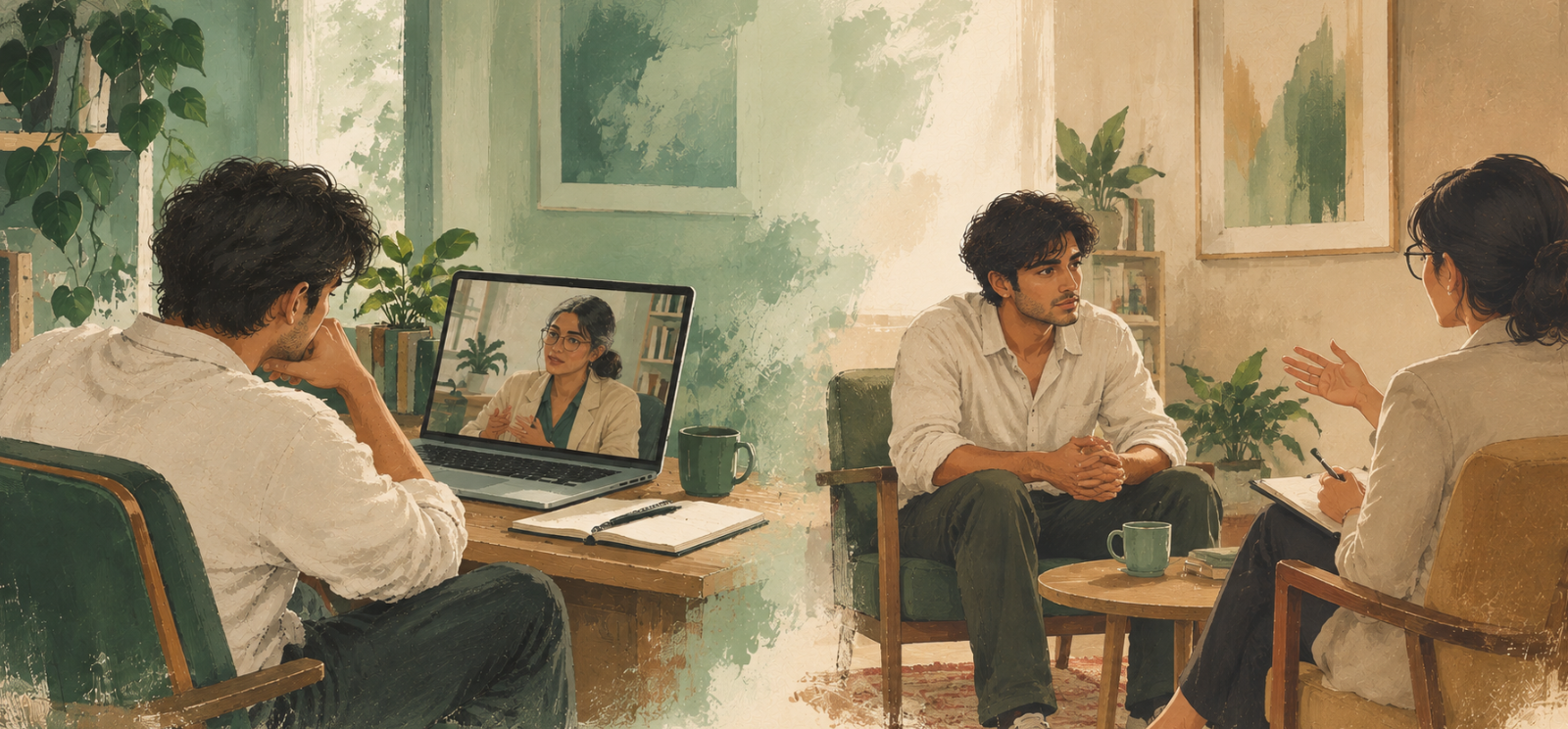
The main comparison is live video therapy against therapy in a room.
That is a narrower question than it sounds, and it matters.
It does not mean chat-based apps. It does not mean self-guided programmes.
It does not mean a chatbot. It means a real therapist, live, on video.
So when someone says the research shows online therapy works, ask which kind.
The evidence for live video is strong. The evidence for other formats varies a lot.
So check what you are buying.
A live human, on video, once a week. That is the thing with the data behind it.
A daily chat box is a different product.
It may still help. It is just not this.
Know which one you signed up for.
One large meta-analysis is the anchor here.
It identified 56 within-group studies covering 1,681 participants (Source: Clinical Psychology and Psychotherapy, 2021 — pubmed.ncbi.nlm.nih.gov).
It also included 47 between-group studies covering 3,564 participants (Source: Clinical Psychology and Psychotherapy, 2021 — pubmed.ncbi.nlm.nih.gov).
That is a solid base to reason from.
Note what it is not. It is not a study of Indian patients specifically.
Culture, language, and family involvement all shape therapy here.
So read the findings as a strong general signal, not a local guarantee.
Still, a strong signal is worth having.
Most of us had nothing but guesswork ten years ago.
Now there is a base to reason from.
Q: Does research on online therapy include chat apps?
A: Mostly no. The strongest evidence covers live video sessions with a real therapist. Chat-based and self-guided formats are studied separately and the results vary much more.
What the Numbers Show
Three findings matter most.
Online therapy works. The pre-post effect size for video therapy was large, at g = 0.99 (Source: Clinical Psychology and Psychotherapy, 2021 — pubmed.ncbi.nlm.nih.gov).
It also beat waiting-list comparison groups, with an effect size of 0.77 (Source: Clinical Psychology and Psychotherapy, 2021 — pubmed.ncbi.nlm.nih.gov).
It matches in-person care. The difference from in-person therapy was negligible (Source: Clinical Psychology and Psychotherapy, 2021 — pubmed.ncbi.nlm.nih.gov).
That is the headline most people want, and it holds up.
The therapy type matters more than the screen. Effect size was 1.34 for cognitive behavioural therapy, against 0.66 for other approaches (Source: Clinical Psychology and Psychotherapy, 2021 — pubmed.ncbi.nlm.nih.gov).
That gap is larger than any gap between online and in-person.
So the better question is not screen or room. It is which therapy, done properly.
Ask the therapist what method they use.
Ask how a session is built.
Good answers sound plain.
We set goals. We track them. We review at week six.
Vague answers sound grand and say little.
If there is no clear answer, that tells you more than the format does.
By condition, results clustered tightly.
Anxiety, depression, and post-traumatic stress each had effect sizes near 1.00 (Source: Clinical Psychology and Psychotherapy, 2021 — pubmed.ncbi.nlm.nih.gov).
Now the honest part, which most articles skip.
Adjusted for possible publication bias, the overall within-group effect fell to 0.54 (Source: Clinical Psychology and Psychotherapy, 2021 — pubmed.ncbi.nlm.nih.gov).
That is still a real, useful effect. It is just smaller than the headline.
Good evidence includes its own corrections. Treat sources that never mention them with care.
Here is the short version of all of it.
Video therapy works. It works about as well as a room.
And what you do in the session matters far more than where you sit.
Quick Facts: Online Therapy Evidence
Video therapy had a large pre-post effect size of 0.99 — (Source: Clinical Psychology and Psychotherapy, 2021 — pubmed.ncbi.nlm.nih.gov).
The difference from in-person therapy was negligible — (Source: Clinical Psychology and Psychotherapy, 2021 — pubmed.ncbi.nlm.nih.gov).
Effect size was 1.34 for cognitive behavioural therapy and 0.66 for other approaches — (Source: Clinical Psychology and Psychotherapy, 2021 — pubmed.ncbi.nlm.nih.gov).
Adjusted for publication bias, the overall effect was 0.54 — (Source: Clinical Psychology and Psychotherapy, 2021 — pubmed.ncbi.nlm.nih.gov).
India's treatment gap across mental disorders runs from 28% to 83% — (Source: National Mental Health Survey, NIMHANS, 2016 — indianmhs.nimhans.ac.in).
Tele-MANAS passed 10 lakh free helpline calls, averaging 3,500 a day — (Source: Press Information Bureau, 2024 — pib.gov.in).
Where Online Works Just as Well
Based on the evidence and on ordinary practice, online suits these well.
Anxiety disorders. Structured work on avoidance transfers cleanly to video.
Depression, when it is mild to moderate. Sessions, homework, and mood tracking all work remotely.
Follow-up appointments. Once a plan is running, reviews rarely need a room.
Relapse prevention work. Skills practice and planning do not need physical presence.
Family sessions across cities. This is where video genuinely beats a room.
Getting a brother in Dubai and parents in Kanpur into one session is only possible online.
People in smaller towns. Where there is no psychiatrist within reach, video is not second best. It is the only option.
People with mobility or health limits. Travel can be the single barrier that stops care.
Anyone whose main risk is dropping out. Attendance beats format every time.
Think about your own last try at care.
What stopped it? Time, travel, cost, or shame.
Pick the format that removes that one thing.
That is the whole choice, most of the time.
Not which is better. Which one gets you there.
That last point deserves weight.
A good therapist you actually see weekly beats a better one you visit twice and quit.
Consider the Indian backdrop. The treatment gap across mental disorders runs from 28% to 83% (Source: National Mental Health Survey, NIMHANS, 2016 — indianmhs.nimhans.ac.in).
Most people here are not choosing between two good options.
They are choosing between something and nothing.
Seen that way, the debate changes shape.
A video call is not a watered down room.
For most of India, it is the first room that ever opened.
That is the shift worth sitting with.
Not a lesser care. A wider door.
Q: Is online therapy good enough for anxiety and depression?
A: For most people, yes. Effect sizes for anxiety, depression, and post-traumatic stress were near 1.00 in video therapy research, and close to in-person results.
Where In-Person Still Wins
Some situations need a room. These are not preferences.
Any risk to life. Active suicidal thinking needs in-person assessment and a safety plan.
Substance withdrawal. Detox from drink or some drugs is a medical event.
Good therapists plan for this. Ask what the plan is before starting.
A simple plan is enough.
Who you will call. Where you will sit for ten minutes.
Write it down before session one, not after a hard one.
Q: When should I choose in-person therapy over online?
A: When there is risk to life, substance withdrawal, severe illness, or no private space at home. Young children and some trauma work also need the room.
What Changes About the Relationship
People worry the connection will feel thin. Mostly it does not.
But some things do change, and knowing them helps.
You see less of the body. A therapist reads posture, hands, and restlessness.
On video they see a head and shoulders. Some signal is lost.
Silences feel different. A pause in a room feels natural. On video it feels like a fault.
Both of you may rush to fill it. Silence is useful in therapy, so let it sit.
Endings are abrupt. A session in a room has a walk to the door.
Online, it ends instantly and you are back in your kitchen.
Build a buffer. Five minutes of nothing before returning to work.
Distraction is easier. Notifications, other tabs, someone at the door.
Treat the session as you would an appointment you travelled for.
Shut the other windows. Turn off alerts.
An hour is a small ask. Give it the whole hour.
Being seen on screen is odd. Watching your own face is distracting.
Most platforms allow hiding your self-view. Do that.
It is a small change. It helps more than you would think.
You stop watching yourself and start talking.
Light helps too. Face a window if you can.
A dark face on screen is hard to read.
A few things improve online.
Some people speak more freely from their own space. Shame is easier to voice at home.
Some people find eye contact easier when it is not quite eye contact.
And nobody sees you in a waiting room, which in India removes a real barrier.
Stigma is still heavy here.
Plenty of people will start on video who would never walk into a clinic.
That alone is worth a lot.
Q: Does online therapy feel less personal?
A: Some body language is lost and endings feel abrupt. Many people speak more freely from their own space. Connection quality and privacy matter more than the format itself.
The Rules in India
Many people do not know that teletherapy here has a formal framework.
It does, and it is worth knowing.
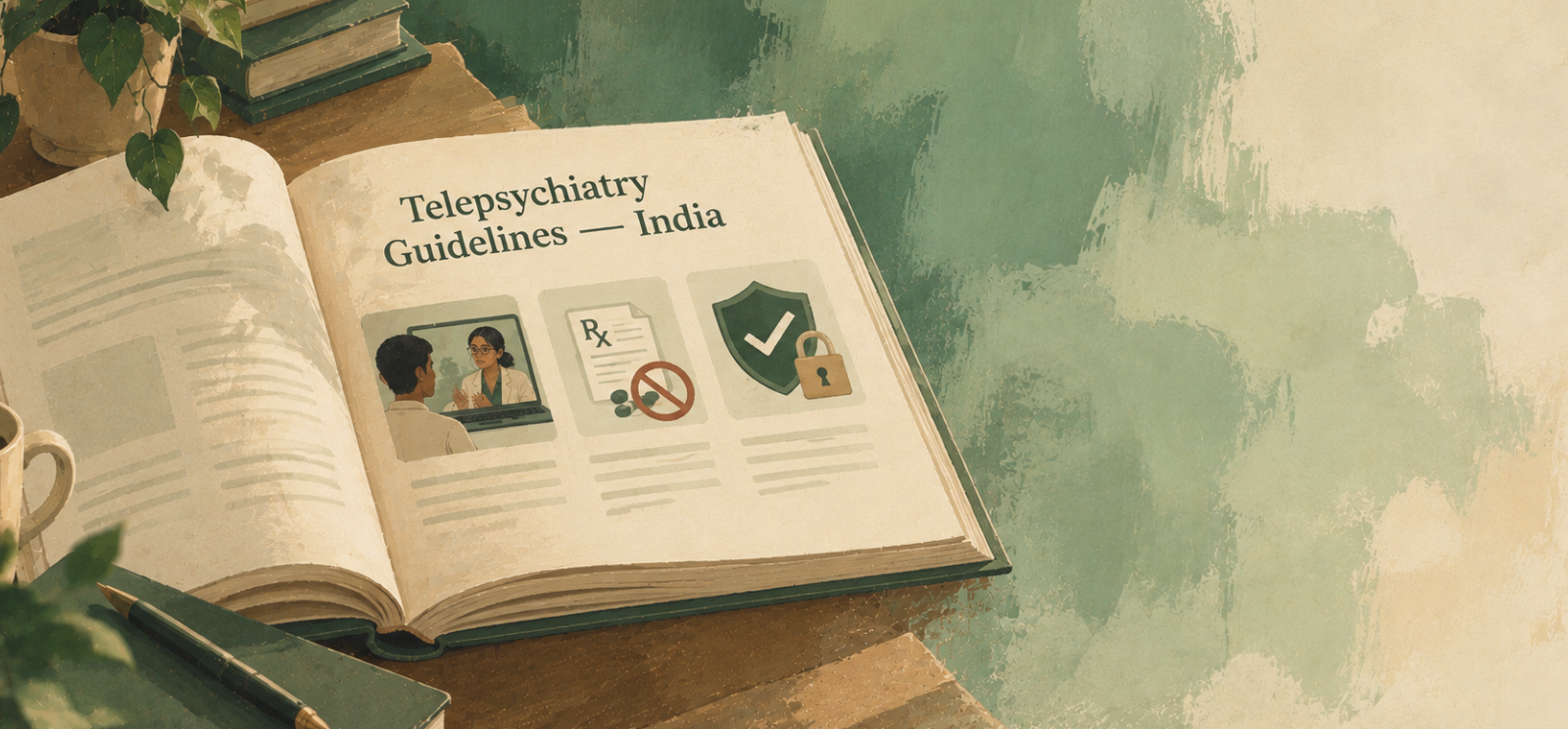
Telepsychiatry Operational Guidelines were published in 2020 (Source: NIMHANS, 2020 — nimhans.co.in).
They came from the Indian Psychiatric Society and the Telemedicine Society of India, with NIMHANS.
They focus on video-based services specifically (Source: BJPsych International, 2021 — cambridge.org).
They also sit alongside existing law, including the Mental Healthcare Act 2017 (Source: BJPsych International, 2021 — cambridge.org).
What that means for you, practically.
Teleconsultation with a psychiatrist is a recognised form of care, not a grey area.
Prescribing is allowed within defined limits, and certain drug categories are restricted.
So ask directly what can be prescribed remotely and what needs a visit.
Consent and record-keeping requirements apply just as they do in a clinic.
You are entitled to know who you are speaking to and what their qualification is.
There is also a free public route worth naming.
Tele-MANAS is a government helpline on 14416, running around the clock in several languages.
It passed 10 lakh calls after its October 2022 launch, averaging about 3,500 a day (Source: Press Information Bureau, 2024 — pib.gov.in).
That is a first step for anyone unsure where to start.
It costs nothing. It runs at night.
And it can point you to care near you.
Use it as a door, not as the whole house.
Q: Is teletherapy officially recognised in India?
A: Yes. Telepsychiatry Operational Guidelines were issued in 2020 by the Indian Psychiatric Society and Telemedicine Society of India with NIMHANS. They work alongside the Mental Healthcare Act 2017.
The Practical Side Nobody Mentions
Small things decide whether online therapy works for you.
Find the private hour. This is the real problem in shared homes.
Options that work: a car, or an empty office room.
A park bench with earphones works too. So does early morning, before the house wakes.
Use earphones every time. It protects privacy and improves sound.
Test the connection beforehand. A five-minute check saves a wasted session.
Sit somewhere consistent. The same spot each week helps the mind settle faster.
Keep paper nearby. Writing by hand beats typing during a session.
A notebook also gives your eyes somewhere to rest.
Staring at a screen for an hour is tiring on its own.
Put the phone in another room. Use a laptop if you have one.
Agree a backup. Decide in advance what happens if the call drops.
A phone number to switch to removes ten minutes of panic.
Agree a safety plan. Your therapist should know where you are and who to contact in an emergency.
This is not a formality. It is the one thing a room gives you automatically.
In a clinic, someone knows where you are.
On a call, nobody does unless you say.
So say it in session one. Address, and one phone number.
Check payment and cancellation terms up front. Online practice varies a lot here.
And one question people forget to ask.
Ask whether the therapist is registered, and what their training is.
A video call makes that harder to judge by eye. Ask directly.
A good clinician will answer without fuss.
They may even send the details before you ask.
Hesitation is the answer you needed.
Q: How do I get privacy for online therapy in a joint family home?
A: A car, an empty office room, or an early-morning slot before the house wakes all work. Earphones are essential. Tell your therapist if privacy is limited.
How to Choose for Your Own Situation
Work through these in order. The first yes decides it.
Is there any risk to life right now? Choose in-person, today.
Is alcohol or drug withdrawal involved? Choose in-person and medical care.
Is the illness severe, with daily function badly affected? Start in-person.
Is there a private space at home for an hour? If not, in-person or a borrowed space.
Is there a qualified therapist within reasonable travel? If not, online wins by default.
Does travel realistically stop you attending weekly? Choose online.
Does the work involve family across cities? Choose online.
If none of those settle it, pick what you will actually keep doing.
Most people do not need to choose permanently.
A blended pattern works well. Start in person for assessment, continue online, return to the room when needed.
Give any format four sessions before judging it. First sessions are awkward in both.
Week one is mostly history taking.
That is true in a room as well.
Week two is often flat.
The work usually starts around week three or four.
And if it is not working, say so to the therapist rather than disappearing.
That conversation is often the useful one.
Therapists expect it. It is not rude.
A session spent fixing the fit is rarely wasted.
Q: Can I mix online and in-person therapy?
A: Yes, and many people do. A common pattern is an in-person assessment, online follow-ups, and a return to the room when something changes. Ask your clinician to plan it.
How Ganaa Blends Both
Ganaa has worked in mental health care in India since 2012. We treat psychiatric conditions and substance use across age groups (Source: Ganaa, 2026 — ganaa.in).
We do not treat online and in-person as rival products. They answer different needs.
Assessment usually works best in person. First visits carry a lot of information.
Once a plan is running, many reviews and therapy sessions can happen remotely.
Most people are seen as outpatients. Our clinics sit in Faridabad, Greater Kailash, and Greater Noida.
Live-in centres are in Delhi, Gurugram, Greater Noida, and South Goa (Source: Ganaa, 2026 — ganaa.in).
Our Gurugram centre is an acute care premium facility, which matters when someone is acutely unwell (Source: Ganaa, 2026 — ganaa.in).
Care blends psychiatric treatment with psychology sessions, family counselling, and holistic therapy (Source: Ganaa, 2026 — ganaa.in).
Family counselling is where remote sessions earn their place. Relatives are rarely in one city.
Where a stay is needed, published guidance puts programme length at 30 to 90 days (Source: Ganaa FAQ, 2026 — ganaa.in).
Aftercare continues once daily life resumes, with reviews and therapy sessions (Source: Ganaa FAQ, 2026 — ganaa.in).
That aftercare stage is where online delivery does the most good.
Treatment is tailored to the person, not run off a template.
Support runs 24 hours a day.
If you are unsure which format fits, ask us during the first call.
Speak to a Ganaa counsellor on +91 8750075006, or write to info@ganaa.in. You can also book a consultation at ganaa.in/booking.
Conclusion: The Format Matters Less Than the Fit
The research answer is clear enough.
For most common conditions, live video therapy performs about as well as sitting in a room.
The bigger difference is which therapy you get. Structured approaches did far better than unstructured ones.
So stop asking which format is superior. Ask which one you will keep.
Online wins when travel, distance, or scattered family would otherwise stop you.
The room wins when there is risk to life, withdrawal, severe illness, or no privacy at home.
In India, the real choice is usually not between two good options.
It is between care and no care, and online removes several reasons for no care.
Travel goes. Waiting rooms go. Half a day off work goes.
Those are not small things. They are most of the reason people never start.
Strip those away and the rest gets easier.
Not easy. Easier. That is often enough.
Check the practical things before you start. Private hour, earphones, backup number, safety plan.
Ask about registration and what can be prescribed remotely.
Then give it four sessions before you decide.
The best therapy is the one that happens every week.
So pick the one you can reach.
Then show up. That part has never been about the screen.
Book the first one this week.
Not next month. This week.
The hardest session is always the one you have not booked.
FAQ
Q: Is online therapy as effective as in-person therapy?
A: For most common conditions, yes. A 2021 meta-analysis found video therapy differed negligibly from in-person treatment. Gains were strongest for anxiety, depression, and post-traumatic stress.
Q: Which therapy types work best online?
A: Structured approaches do best. In the same meta-analysis the effect size was 1.34 for cognitive behavioural therapy and 0.66 for other approaches. Session structure carries well over video.
Q: When is in-person therapy better than online?
A: When there is risk to life, active substance withdrawal, severe illness, or no private space at home. Children, some trauma work, and anyone needing physical checks also do better in the room.
Q: Is online therapy legal in India?
A: Yes. Telepsychiatry Operational Guidelines were published in 2020 by the Indian Psychiatric Society and the Telemedicine Society of India with NIMHANS. They sit alongside the Mental Healthcare Act 2017.
Q: Can a psychiatrist prescribe medicine over a video call in India?
A: Prescribing by teleconsultation is allowed within defined limits, and some drug categories are restricted. Your psychiatrist will tell you what can and cannot be issued remotely.
Q: Does the therapy relationship suffer over video?
A: Research suggests it holds up well. What matters more is picture quality, a private space, and both people staying present. Poor connection harms the relationship more than the format does.
Q: Is there free online mental health support in India?
A: Yes. Tele-MANAS is a free government helpline on 14416, running around the clock in several languages. It passed 10 lakh calls after its launch in October 2022.
Mindfulness-based therapy cuts depression relapse risk in recurrent cases. Here is what MBCT is, what the trials found, and how the eight weeks actually run.
Eating disorders in India hide behind praise for discipline and thinness. Learn the early warning signs, what to say, and how treatment actually works.
High functioning anxiety hides behind good work and a calm face. Learn the hidden signs, what the body does, and when coping turns into the problem itself.