How Do I Know If I'm Drinking Too Much or Have a Problem?
Am I drinking too much? The real limits, the eleven questions doctors ask, and the quiet signs of problem drinking that show up long before rock bottom.
How Do I Know If I'm Drinking Too Much or Have a Problem?
Almost nobody asks this question on a good day.
It usually arrives after something small. A blank patch in last night's memory. A comment from your wife.
Or just an odd moment in the kitchen, counting bottles, wondering when the last one went.
Then the mind does what minds do. It reaches for the stereotype.
You picture someone who has lost a job, a family, a home. You look nothing like that.
So you close the question and pour a drink. Many people repeat that loop for years.
Here is the problem with that stereotype. It describes the end of a road, not the road.
Most people with a real drinking problem hold jobs. They pay bills. They look fine at work.
The medical question is not whether you have hit rock bottom. It is whether alcohol has started making decisions for you.
This article gives you a straight way to check.
We will start with the actual numbers doctors use. Not opinions, not family judgement.
Then the eleven questions behind a formal diagnosis. Then the quiet early signs that show up years before trouble does.
We will cover tolerance and withdrawal, because those two are the hinge. We will look at what the Indian picture really is.
And we will be clear about one danger. Stopping heavy daily drinking on your own can be unsafe.
You do not need to have decided anything to read this. You just need to be honest for ten minutes.
Let us start with the limits.
What Counts as Too Much: The Actual Numbers
Every family has its own idea of normal. That is exactly why numbers help.
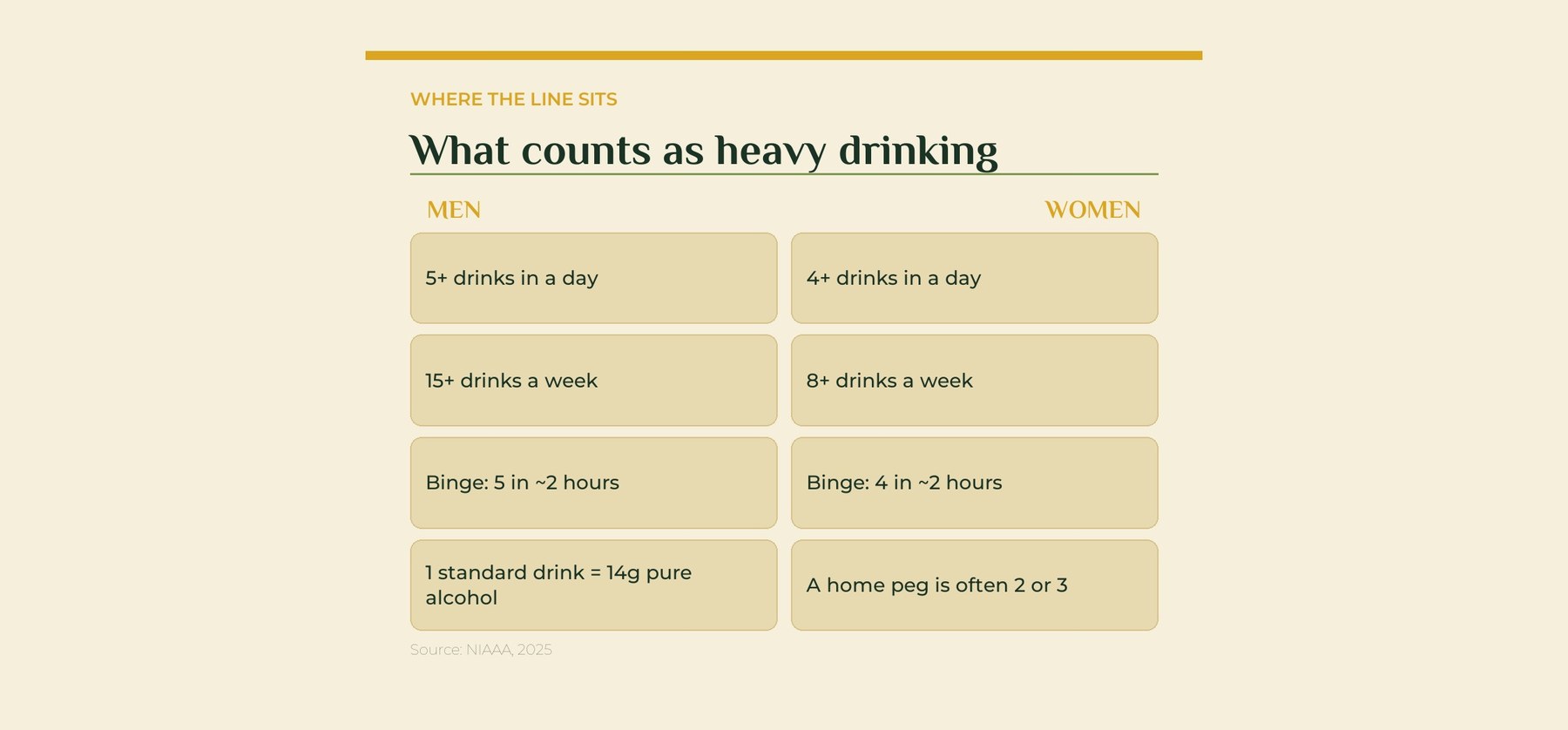
Health agencies define heavy drinking clearly. For men it is five or more drinks on any day, or fifteen or more per week (Source: NIAAA, 2025 — niaaa.nih.gov).
For women it is four or more on any day, or eight or more per week (Source: NIAAA, 2025 — niaaa.nih.gov).
Binge drinking has its own line. It means about five drinks for a man, or four for a woman, in roughly two hours (Source: NIAAA, 2025 — niaaa.nih.gov).
Now the important footnote. A standard drink is smaller than the one you pour.
It contains about 14 grams of pure alcohol (Source: NIAAA, 2025 — niaaa.nih.gov).
That is roughly 30 ml of spirits at 40%. A generous home peg is often two standard drinks, sometimes three.
So a person having three whiskies at home may be drinking six to nine standard drinks. That reframes a lot of evenings.
There is one more fact worth having. There is no risk-free level of drinking (Source: WHO, 2024 — who.int).
That is not moralising. It is what the evidence now shows.
Still, numbers alone do not settle this. Two people can drink the same amount with very different results.
That is why doctors look at harm and control, not only volume. That comes next.
A: A home peg is rarely one standard drink. Two large pegs of spirits can be four or more standard drinks. Once a man is regularly past five standard drinks in a day, that meets the definition of heavy drinking. For a woman, that line sits at four.
The Eleven Questions Doctors Actually Ask
Formal diagnosis does not use the word alcoholic. That word left medicine years ago.
The current term is alcohol use disorder, and it comes in three sizes. Mild, moderate and severe.
It is measured with eleven questions about the past year. Read them honestly.
One. Have you often drunk more, or for longer, than you meant to?
Two. Have you wanted to cut down or stop, and found you could not?
Three. Do you spend a lot of time drinking, or recovering from it?
Four. Do you get strong cravings or urges to drink?
Five. Has drinking got in the way of home, work or study?
Six. Have you kept drinking despite trouble with family or friends over it?
Seven. Have you given up things you enjoyed in order to drink?
Eight. Have you drunk in situations where it was risky, such as before driving?
Nine. Have you kept drinking despite a health or mood problem it caused or worsened?
Ten. Do you need more than before to get the same effect?
Eleven. Do you get withdrawal signs when the effect wears off, or drink to avoid them?
Two or three yes answers meet the threshold for a mild disorder. Four or five is moderate. Six or more is severe.
Read that scale again, because it changes the whole conversation.
You do not need to be at the extreme end to qualify. Two honest yes answers are enough to be worth treating.
That is a feature, not a technicality. Mild problems respond to help far faster than severe ones.
A: Doctors no longer use that word. Two yes answers meet the threshold for a mild alcohol use disorder. Mild does not mean unimportant. It means you are at the easiest possible point to change course.
The Numbers Behind Problem Drinking in India
The Indian picture is often misread, so here it is plainly.
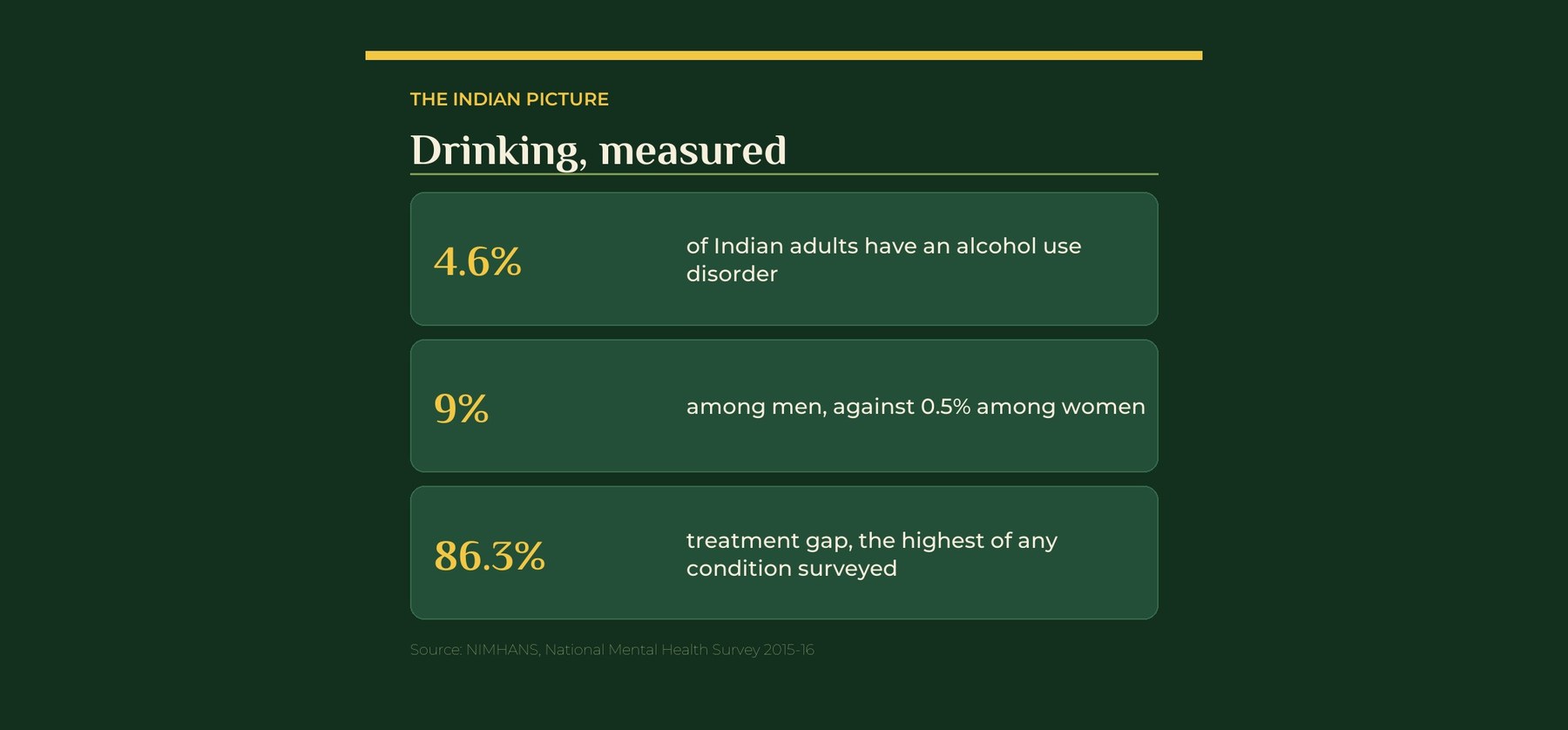
- 4.6% of Indian adults have an alcohol use disorder, at 9% among men and 0.5% among women — . - Substance use disorders overall, including tobacco and other drugs, affect 22.4% of Indian adults — . - The treatment gap for alcohol use disorder in India is 86.3%, the highest of any condition surveyed — . - Worldwide, around 2.6 million deaths were caused by alcohol in 2019 — . - An estimated 400 million people, or 7% of people aged 15 and over, live with alcohol use disorders — . - Alcohol was linked to 4.4% of cancers diagnosed globally and 401,000 cancer deaths in 2019 — .
The number to sit with is 86.3%.
Almost nine in ten Indians with an alcohol use disorder receive no treatment at all.
That is not because treatment does not work. It is because almost nobody asks the question early.
Notice the survey's own caution too. It captured the more severe end of the spectrum.
The real number of people drinking harmfully is likely higher than 4.6%.
And note the gender gap. Reported rates among Indian women are low, at 0.5%.
Under-reporting is a real factor there. Women in India face far more shame around drinking, so it stays hidden longer.
That hiding is itself dangerous, because problems get found later and treated harder.
The Quiet Signs That Show Up Years Before Trouble
Big consequences are easy to spot. These early ones are not.
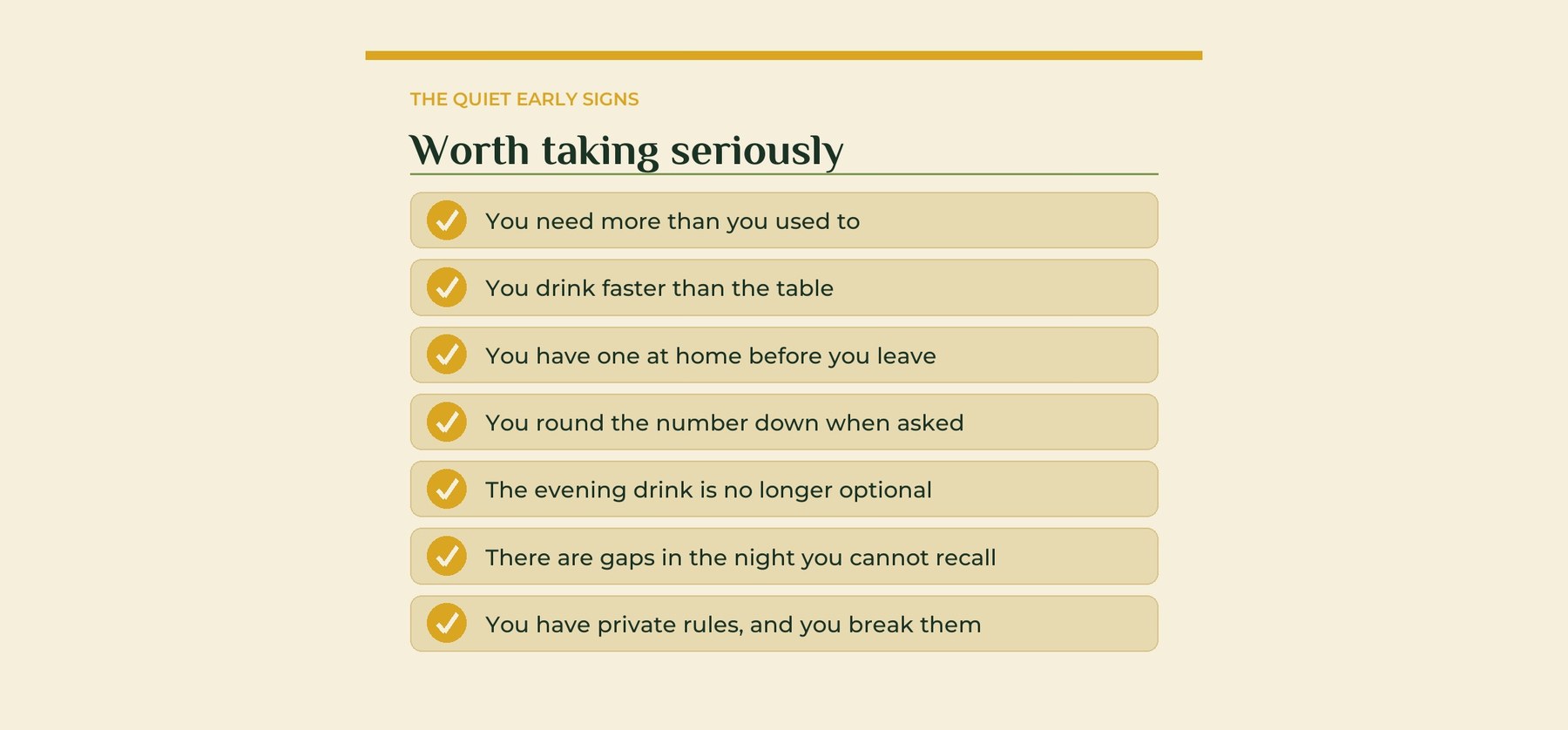
Your tolerance has gone up. You need three where two used to do. This is the earliest reliable sign.
You drink faster than the people around you. You are on your second while the table is still on its first.
You pre-drink. One at home before you leave, so you feel comfortable when you arrive.
You round down when asked. Two becomes one. Four becomes a couple.
You plan around it. You choose the restaurant that serves, or feel a small drop when it does not.
The evening drink is no longer optional. A day without it feels off, not just different.
You drink alone more than you used to. Not celebration. Maintenance.
There are gaps in the night. You cannot recall getting home, or the end of a conversation.
You feel guilty in the morning. Not hungover. Guilty.
You have already made private rules. Only after eight. Only beer. Only weekends. And you have broken them.
That last one carries a lot of weight. People who do not have a problem do not need rules about it.
There is an Indian version of these signs worth naming too.
Drinking that only happens at gatherings, but never stops at one. The host keeps pouring and nobody counts.
Office culture where deals are done over whisky, so heavy drinking looks like ambition.
Drinking hidden entirely from parents or in-laws, even at forty. Secrecy that is normal at home is still secrecy.
And the family line that everybody uses. He only drinks after work, he never misses a day of it.
Never missing a day is the concerning part of that sentence, not the reassuring part.
Alongside these, watch the body. Poor sleep, morning nausea, a racing heart, and rising blood pressure.
Sleep in particular is worth naming. Alcohol makes you fall asleep faster and breaks the second half of the night.
If you wake at three most nights and drank at nine, those are the same fact.
A: It can, and social drinking is where most problems start. The question is not the setting, it is the pattern. Blackouts, arguments, missed mornings and broken personal rules all count regardless of the company.
Tolerance and Withdrawal: The Two That Change Everything
If you take one section seriously, make it this one.
Tolerance means your body has adapted. The same amount does less than it once did.
That is not a strong head. It is a nervous system that has recalibrated around alcohol.
Withdrawal is the other side of that adaptation. Take the alcohol away and the system runs hot.
The early signs are easy to miss. Shakiness in the hands. Sweating. Nausea in the morning.
Then anxiety that lifts after the first drink of the day. That relief is the diagnostic moment.
If a drink fixes how you feel in the morning, you are treating withdrawal.
This matters for a reason beyond diagnosis. It changes how you must stop.
Withdrawal signs can appear within hours of the last drink (Source: StatPearls, 2024 — ncbi.nlm.nih.gov).
Seizures typically occur between 8 and 48 hours after stopping (Source: StatPearls, 2024 — ncbi.nlm.nih.gov).
Withdrawal delirium can develop 3 to 8 days after the last drink. Affects about 3 to 5% of people in withdrawal (Source: StatPearls, 2024 — ncbi.nlm.nih.gov).
That last condition is a medical emergency. It can be fatal without care.
So please read this clearly. If you drink heavily every day, do not stop suddenly on your own.
Speak to a doctor first. Medically supervised detox exists exactly for this, and it is safe and routine.
The person most at risk is often the one most convinced they can handle it alone.
What Heavy Drinking Quietly Does to Your Body and Mood
Most harm from alcohol builds without symptoms. That is what makes it dangerous.
Start with the liver, because it complains last. Fat builds up first, and that stage has no signs at all.
A blood test picks it up years before you feel anything. This is why doctors ask for one early.
Blood pressure is next. Regular heavy drinking pushes it up quietly.
Many men in their forties discover both problems in the same appointment. Neither had a warning.
Then there is cancer risk, which surprises people most. Alcohol was linked to 4.4% of cancers diagnosed globally in 2019 (Source: WHO, 2024 — who.int).
The mood side matters just as much, and gets discussed far less.
Alcohol is a depressant. It lifts you for an hour and lowers your baseline over months.
So the drink taken to manage low mood slowly deepens the low mood. That loop is very common.
Anxiety follows the same pattern. The morning after heavy drinking often brings a wave of dread.
People call it hangover anxiety. It is a real nervous-system rebound, not imagination.
Sleep takes the biggest hit of all. Alcohol shortens the time to fall asleep and wrecks the second half of the night.
Broken sleep then worsens mood and judgement the next day. Which makes the next drink easier to justify.
Weight, blood sugar and memory all sit in this same picture.
None of this is said to frighten anyone. It is said because these changes are quiet and reversible early.
The body repairs remarkably well when drinking stops or drops. That is the encouraging half of the story.
A: Often, yes. Liver enzymes and red-cell size can shift before you feel anything at all. A normal result does not clear you, and an abnormal one is a useful early warning. Ask your doctor for a liver panel if you are unsure.
What to Do Next, Without Waiting for a Crisis
You do not need certainty to act. You need one honest step.
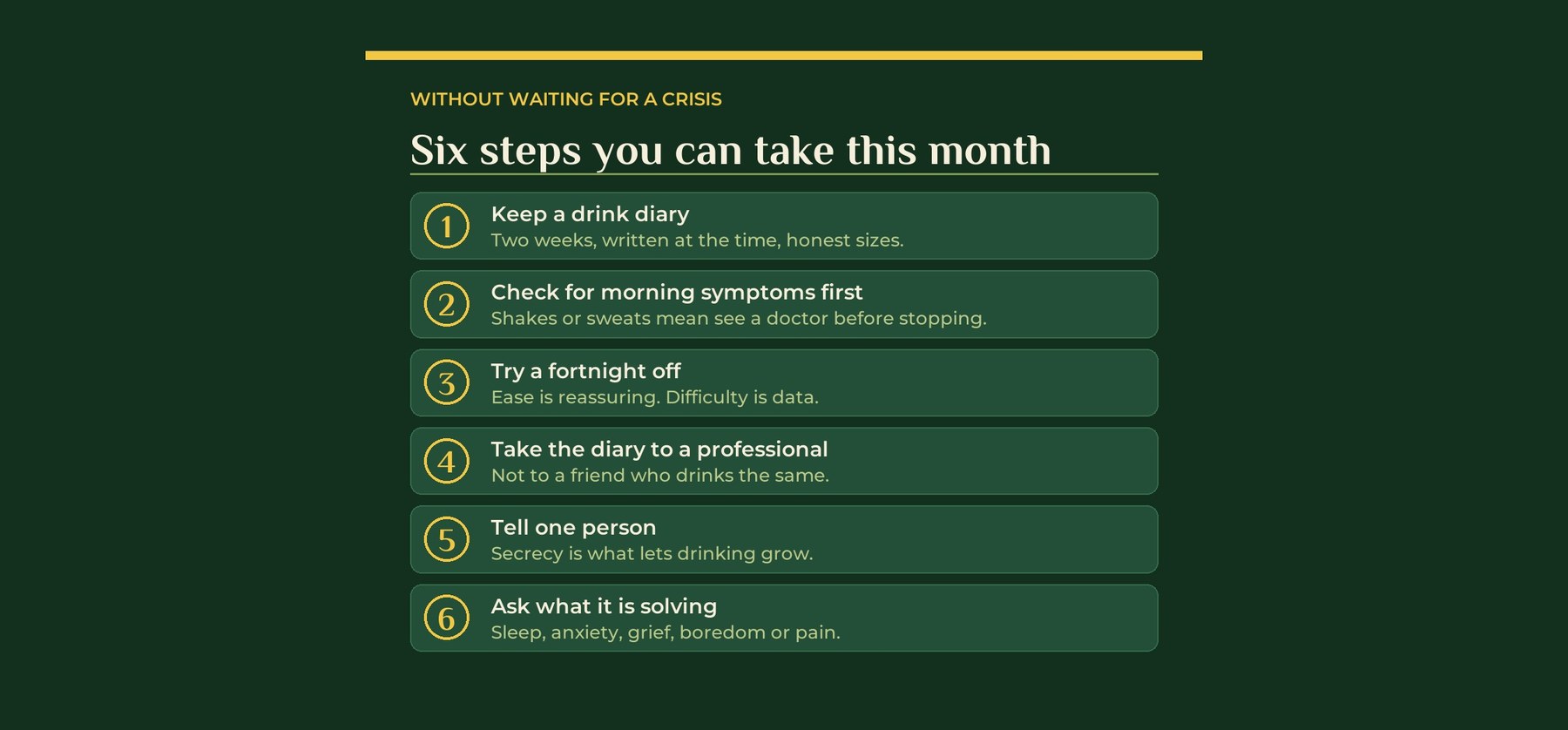
Step one: keep a drink diary for two weeks. Every drink, written down at the time, not from memory.
Record the size honestly. A large peg is not one drink.
Most people are surprised by their own number. That surprise is useful information.
Step two: try a fortnight off. Not forever. Two weeks.
Watch what happens. Ease is reassuring. Difficulty is data.
If two weeks feels impossible to even attempt, you have your answer already.
Step three: check for morning symptoms first. Shakes, sweats or sickness mean you should see a doctor before stopping.
Do not attempt a dry fortnight if that describes you. That is the one situation where doing it alone is risky.
Step four: take the diary to a professional. A psychiatrist or a doctor, not a search engine.
They will ask the eleven questions properly and check your liver and blood pressure.
Step five: tell one person. Secrecy is what lets drinking grow.
One honest conversation removes more of the problem than a month of private resolve.
Step six: look underneath. Ask what the drinking is doing for you.
Sleep, anxiety, grief, boredom, pain, social nerves. Most heavy drinking is solving something.
Unless that something gets another solution, willpower has to do all the work forever.
That is why treatment addresses both together. It is also why it works better than trying harder.
A few things not to do, since they waste months.
Do not compare yourself to the heaviest drinker you know. That bar is set by someone else's illness.
Do not swap spirits for beer and call it progress. Standard drinks are what count, not the label.
Do not wait for your family to confront you. Most families avoid it for years, out of love or fear.
And do not treat one failed attempt as proof. Cutting down is a skill, and skills need more than one try.
One more practical note for readers in India.
Many people worry that seeing a psychiatrist about drinking creates a record that follows them.
Speak plainly to the clinician about your concerns on privacy. Reputable services handle this every day.
Fear of being labelled keeps far more people unwell than the label ever would.
How Ganaa Helps When Drinking Has Become a Question
Asking the question is the hard part. The next steps are easier with support.
Ganaa is a mental health and rehabilitation brand in India. We work with adults across the full range of alcohol use, from early problems to long dependence.
Not everyone who comes to us needs to stop forever. Some need a clear assessment and a plan.
Care starts with an honest picture. Drinking pattern, tolerance, morning symptoms, sleep, mood and physical health.
Blood tests and a liver check come early, because alcohol harm is often silent.
Where withdrawal is a risk, medically supervised detox comes first. This is done safely, with monitoring, not with grit.
Therapy then does the longer work. Cognitive behavioural therapy, motivational work and relapse-prevention planning.
Dual diagnosis matters here. Depression and anxiety sit underneath a great deal of heavy drinking.
Treating one and ignoring the other rarely holds. We treat both together.
Families are included by design, because drinking is never a solo event in an Indian household.
Medication that supports staying off alcohol is discussed openly with a psychiatrist where it fits.
Every plan is tailored to the person in front of us. Nothing is copy-pasted from a template.
Ganaa runs five residential centres in India. These are Ganaa South Delhi, Ganaa Chattarpur, Ganaa Gurgaon, Ganaa Goa and Ganaa Greater Noida.
We also run three OPD clinics for outpatient care, in Faridabad, Greater Kailash and Greater Noida.
Many people start as outpatients and never need admission. Care can fit around a job.
If this article has been uncomfortable to read, please treat that as useful. Speak to a Ganaa counsellor, or visit ganaa.in to learn about our programmes.
The best time to ask this question is while it still feels early.
Conclusion: The Question Is Better Asked Early
You came here asking whether you are drinking too much.
The useful answer is not a number, though the numbers matter.
Five or more in a day for men, or four for women, meets the definition of heavy drinking (Source: NIAAA, 2025 — niaaa.nih.gov).
Remember that a home peg is often two standard drinks, sometimes more.
Then look past volume to control. The eleven questions are the real test.
Two honest yes answers already meet the threshold for a mild disorder. That is early, and early is good news.
Watch for the quiet signs. Rising tolerance. Drinking alone. Rounding down. Private rules you keep breaking.
Take morning shakes and sweats seriously. They mean your body has adapted, and stopping alone can be unsafe.
Keep a two-week diary. Try a fortnight off, unless morning symptoms rule that out.
Then take what you find to a doctor. Not to a friend who drinks the same amount as you.
In India, 86.3% of people with an alcohol use disorder get no treatment at all (Source: NIMHANS, National Mental Health Survey 2015-16 — indianmhs.nimhans.ac.in).
Nothing about that number is inevitable. It exists because the question gets asked too late.
You are asking it now, which puts you ahead of most people.
That is not a reason for shame. It is a reason to make one appointment this week.
FAQ
Q: How much drinking is too much?
A: Health agencies define heavy drinking as five or more drinks in a day, or fifteen or more a week, for men. For women it is four or more in a day, or eight or more a week. But the amount is only half the picture. What the drinking is doing to your life matters just as much.
Q: What are the early signs of problem drinking?
A: Needing more to feel the same effect is usually first. Then comes drinking alone, hiding how much you had, and a growing gap between what you planned and what you drank. Feeling restless or shaky the morning after is a later and more serious sign.
Q: Can you have a drinking problem without being an alcoholic?
A: Yes, and this is the most common situation. Doctors now use alcohol use disorder, which can be mild, moderate or severe. Many people sit at the mild end, where the harm is real but the picture looks nothing like the stereotype.
Q: Is it safe to stop drinking suddenly on my own?
A: Not always. If you drink heavily and daily, stopping suddenly can cause seizures and a dangerous state called withdrawal delirium. Anyone who shakes, sweats or feels sick in the morning should speak to a doctor before stopping. Medical detox makes this safe.
Q: Does drinking only on weekends count as a problem?
A: It can. Doctors look at the pattern and the harm, not the day of the week. Drinking six or seven units in one sitting on Saturday still counts as binge drinking. Weekend-only drinking that causes blackouts, arguments or missed Mondays is a problem.
Q: What should I do if I think I am drinking too much?
A: Start by writing down every drink for two weeks, honestly. Then take that record to a doctor rather than to the internet. Do not wait for a crisis to justify the appointment. Mild problems are far easier to treat than severe ones.
Online therapy matches in-person results for most conditions. Here is what the trials found, where each format wins, and how to choose for your own situation.
Mindfulness-based therapy cuts depression relapse risk in recurrent cases. Here is what MBCT is, what the trials found, and how the eight weeks actually run.
Eating disorders in India hide behind praise for discipline and thinness. Learn the early warning signs, what to say, and how treatment actually works.