EMDR therapy in India helps the brain reprocess painful memories. Learn the 8 phases, what a session feels like, and who trauma therapy suits best.
EMDR Therapy Explained: How It Heals Trauma
Some memories do not fade. They stay sharp. They hijack the body years later.
EMDR therapy in India offers a different path for these memories. It does not ask you to relive every detail out loud. Instead, it helps your brain reprocess what got stuck.
EMDR stands for eye movement desensitisation and reprocessing. It is a structured trauma therapy. It is built around a clear eight-phase plan.
The aim is simple. A memory that once felt like a live wound starts to feel like an old fact. The event still happened. But it stops controlling your mood, sleep, and body.
This matters in India. The treatment gap for mental disorders here runs as high as 85 percent (Source: NMHS, 2015-16 — pmc.ncbi.nlm.nih.gov). Many people carry trauma without ever naming it.
This guide explains how EMDR works. You will learn the eight phases. You will see what a session feels like. You will learn who it suits, and how it compares with CBT.
Let us start with what is actually happening in the brain.
What Is EMDR Therapy and Why It Works
EMDR is a trauma therapy. It helps the brain file away painful memories properly.
Think of a normal memory. It has a time stamp. You know it is over. It sits in the past.
A traumatic memory often does not get filed this way. It stays raw. A smell, a sound, or a date can trigger it. The body reacts as if the event is happening now.
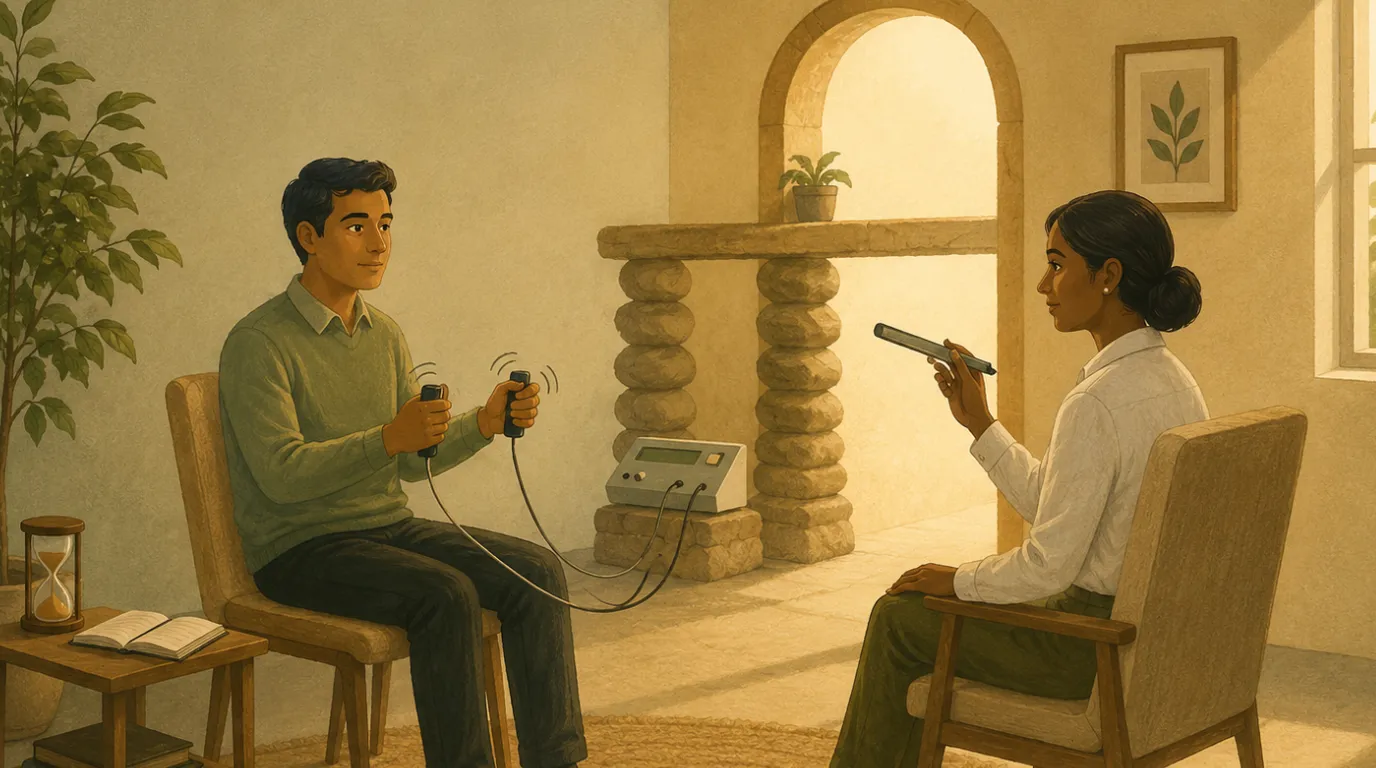
EMDR targets these stuck memories. You recall the memory in short bursts. At the same time, you follow a moving hand, lights, or taps. This is called bilateral stimulation.
This back-and-forth input seems to free the brain to reprocess the memory. Many people find the memory loses its emotional charge. The facts stay. The terror fades.
The method was developed by psychologist Francine Shapiro. It now sits among the most researched trauma treatments worldwide (Source: EMDR Institute, 2024 — emdr.com).
Q: Does EMDR erase the memory? A: No. EMDR does not delete what happened. It changes how the memory is stored. You keep the facts. You lose the heavy fear, shame, or panic attached to them.
The science is still being studied. But the results are strong enough that major bodies now recommend it for PTSD treatment.
There is a guiding theory behind it too. It is called the adaptive information processing model. The idea is that the brain wants to heal, much as the body heals a wound.
Trauma can block that natural healing. The memory gets stuck in a raw, unprocessed state. EMDR aims to remove the block so processing can finish.
You do not need to explain every detail of the trauma. That relief alone helps many people start.
For people who freeze when asked to talk, this is a real gift. The work can move even when words run dry.
The Evidence Base Behind EMDR
EMDR is not a fringe idea. It is backed by decades of research.
The World Health Organization recommends EMDR for PTSD. It names EMDR and trauma-focused CBT as the two psychotherapies for people with PTSD (Source: WHO, 2013 — who.int).
That recommendation covers adults, children, and teens. It is part of WHO global mental health guidance.
The American Psychological Association also lists EMDR as a treatment for PTSD (Source: APA, 2017 — apa.org). So do guidelines in the UK and many other countries.
The numbers help explain why. Some studies report that 84 to 90 percent of single-trauma cases no longer met PTSD criteria after three 90-minute sessions (Source: EMDR Institute, 2024 — emdr.com).
That is a striking result for a single trauma. It is also based on more than 25 controlled trials over the years (Source: EMDR Institute, 2024 — emdr.com).
Why does this matter in India? Trauma is common, but rarely treated.
The National Mental Health Survey found a current prevalence of mental disorders of 10.56 percent (Source: NMHS, 2015-16 — pmc.ncbi.nlm.nih.gov). Most of these people never reach care.
Q: Is EMDR proven, or still experimental? A: It is well past the experimental stage. The WHO and APA both recommend it for PTSD. That places it among established, evidence-based trauma therapies.
Evidence guides good care. It is wise to choose a therapy that research supports.
The 8 Phases of EMDR Therapy
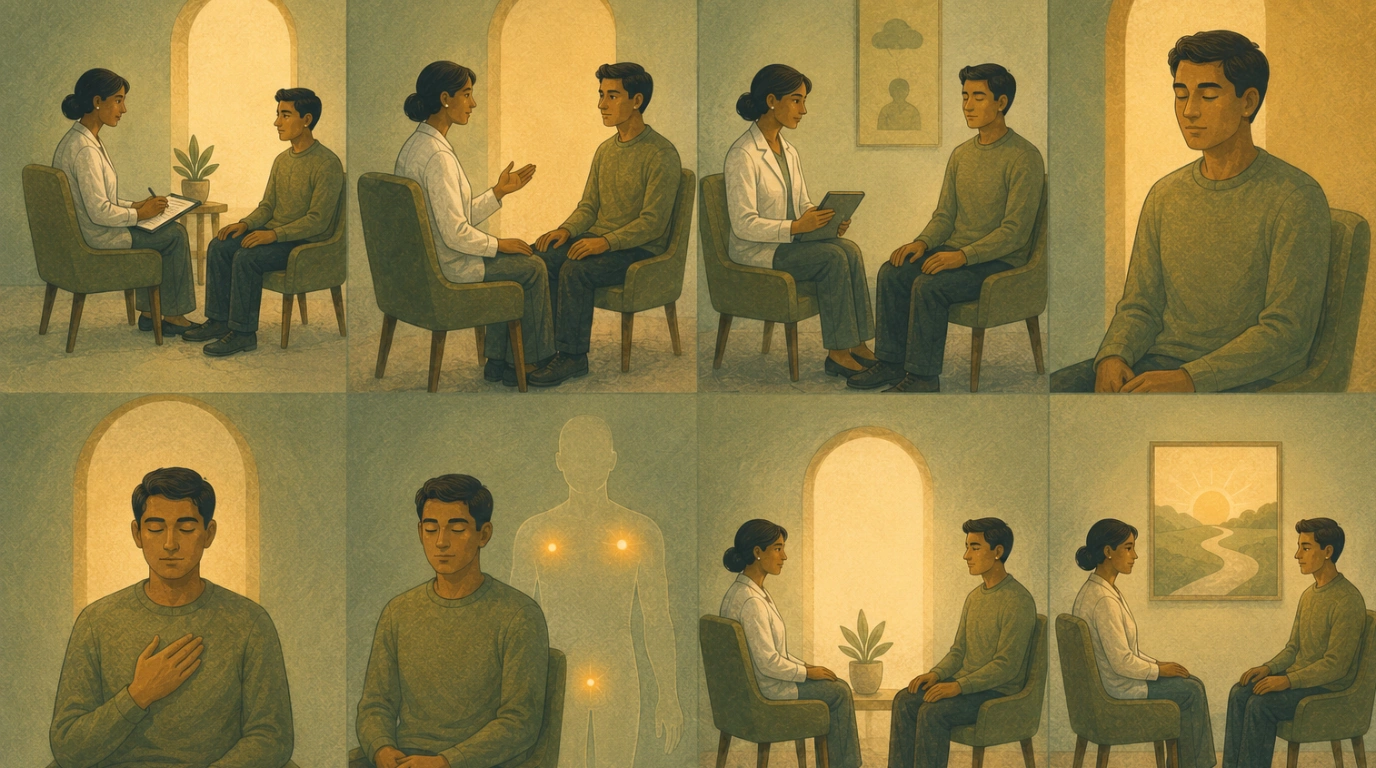
EMDR follows a clear eight-phase protocol. This structure is what makes it a method, not a guess (Source: EMDR Institute, 2024 — emdr.com).
Here is what each phase does.
Phase 1: History and planning. The clinician learns your story. Together you pick target memories to work on.
Phase 2: Preparation. You learn what to expect. The therapist teaches calming and grounding skills first. This builds safety.
Phase 3: Assessment. You name the target memory. You note the negative belief tied to it. You also note a positive belief you would prefer.
Phase 4: Desensitisation. You hold the memory in mind. You follow the bilateral stimulation in short sets. Distress is tracked and lowered.
Phase 5: Installation. The therapist strengthens the positive belief. The aim is to link it firmly to the memory.
Phase 6: Body scan. You notice any leftover tension in the body. More sets clear what remains.
Phase 7: Closure. Each session ends with grounding. You leave calm, not raw.
Phase 8: Reevaluation. The next session checks the last one. Gains are confirmed. New targets are set.
This sequence repeats across sessions. Simple trauma may need only a few rounds.
Q: Do all eight phases happen in one session? A: No. Phases 1 and 2 often take the first session or two. The reprocessing phases repeat over several sessions, guided by your progress.
The structure keeps the work safe and paced. You are never thrown into the deep end.
What an EMDR Session Actually Feels Like
People often picture something strange. The reality is calmer than that.
You sit in a quiet room. You are fully awake. You are in control the whole time.
The therapist asks you to bring up a target memory. You hold the image, the feeling, and the body sensation together.
Then the bilateral stimulation starts. You may follow the therapist's hand moving side to side. Or you may track lights, hold buzzers, or hear tones in alternating ears.
Each set is short. It usually lasts under a minute. Then you pause.
The therapist asks what came up. A new thought. A linked memory. A shift in feeling. There is no right answer.
You repeat the sets. Slowly, the memory loses its sting. Many people describe it growing smaller or more distant.
Q: Will I have to describe the trauma in detail? A: No. This surprises people. EMDR needs far less spoken detail than many talk therapies. You notice what arises, but you do not have to narrate the whole event.
Some people feel tired after a session. Some feel lighter at once. Both are normal.
Between sessions, more processing can happen. Dreams or stray thoughts may surface. Your therapist gives you tools to stay grounded.
Sessions usually run 60 to 90 minutes. The pace is set with you, not forced on you. Eye movement desensitisation works best when you feel safe.
Who EMDR Therapy Suits Best
EMDR was built for trauma. That is still its core use.
It is recommended for PTSD by the WHO and the APA (Source: WHO, 2013 — who.int). PTSD can follow assault, accidents, disaster, or abuse.
But trauma takes many forms. EMDR is also used more widely.
It can help with childhood trauma. It can ease distress after a single shocking event. It is used for grief tied to loss.
It is also applied to phobias, panic, and some anxiety rooted in past events. The common thread is a memory that still hurts.
EMDR can support people with dual diagnosis too. Trauma and substance use often go together. Addiction recovery sometimes uncovers old wounds that need care.
Q: Who should not start EMDR right away? A: People in acute crisis, or with very unstable symptoms, may need stabilising care first. A clinician decides timing. EMDR works best once basic safety and coping are in place.
It is not a fit for everyone, and not for every week. That is normal.
Certain medical or dissociative conditions need careful screening. This is why phase one matters so much.
The honest answer is this. Only a qualified clinician can say if EMDR suits you now. Speak to a psychiatrist or trauma-trained therapist before you begin. They will weigh your history and current state.
Families often ask if a loved one qualifies. The answer depends on a proper assessment, not a guess.
Age is rarely a barrier. EMDR is used with children, teens, and adults alike. The approach is simply adapted to suit them.
A good fit is half the work. The right timing protects you.
EMDR vs CBT for Trauma
Both EMDR and CBT treat trauma well. Both are recommended for PTSD (Source: WHO, 2013 — who.int). The choice is about fit, not ranking.
Here is a simple comparison.
FeatureEMDRTrauma-focused CBTCore methodBilateral stimulation while recalling memoryStructured talking and reframing thoughtsSpoken detail neededLowHigherHomeworkLittle to noneOften weekly tasksTypical focusReprocessing the stuck memoryChanging thoughts and behaviourBoth recommended for PTSDYesYes
CBT asks you to examine thoughts in detail. You learn to challenge unhelpful beliefs. You practise new responses between sessions.
EMDR asks for less talking. It leans on the brain's own reprocessing. Many people prefer this when words feel too hard.
Some people respond better to one than the other. Some use both at different stages.
Q: Should I pick EMDR or CBT first? A: There is no single rule. If detailed talking feels overwhelming, EMDR may suit you. If you like structure and tasks, CBT may fit. A clinician helps you decide together.
Trauma therapy is not a contest between methods. It is about matching the method to the person.
In a residential setting, both can sit inside one plan. A team can shift the focus as you heal.
Common Myths About EMDR
Myths put people off useful care. Let us clear a few.
Myth: EMDR is hypnosis. It is not. You stay fully awake and aware. You are not under anyone's control.
Myth: It wipes your memory. It does not. You keep the facts. Only the heavy emotional charge eases.
Myth: It only uses eye movements. Not true. Taps and tones work too. Any bilateral stimulation can serve the same role.
Myth: It is a quick fix for everything. No. Single trauma can resolve fast. Complex or repeated trauma takes longer and steady support.
Myth: It has no evidence. Wrong. It is backed by the WHO and APA and many trials (Source: APA, 2017 — apa.org).
Q: Can EMDR make things worse before they get better? A: Some people feel stirred up between early sessions. This is usually short-lived. A trained therapist paces the work and gives you grounding tools to manage it.
Myth: It is only for soldiers. Not so. PTSD and trauma touch people from all walks of life. Accidents, loss, abuse, and disaster all qualify.
Myth: You must be ready to cry. No. Some sessions are quiet. Healing does not require a flood of tears to count.
Trauma care should never feel reckless. A skilled clinician keeps you safe.
Belief in a therapy helps you commit to it. Facts beat fear here.
- EMDR and trauma-focused CBT are the psychotherapies the WHO recommends for PTSD in adults, children, and teens
- Some studies report 84 to 90 percent of single-trauma cases no longer met PTSD criteria after three 90-minute sessions
- EMDR follows a structured eight-phase protocol developed by psychologist Francine Shapiro
- The APA recommends EMDR as a treatment for PTSD in adults
- The current prevalence of mental disorders in India is 10.56 percent
- The treatment gap for mental disorders in India runs as high as 85 percent .
How to Find Good EMDR Care in India
Quality matters with trauma work. The wrong fit can stall progress.
Start with training. Ask if the therapist holds accredited EMDR training. This is the single most useful question.
Ask about experience too. How many trauma cases have they handled? Have they worked with your kind of trauma before?
Check the setting. Online EMDR can work well for many people. Severe or complex cases may need in-person care, or a residential team.
Ask about the plan. A good clinician explains the eight phases. They do not rush you into reprocessing on day one.
Cost and access vary across India. Sessions are offered in many cities and online. Some centres fold EMDR into wider mental health programmes.
Watch for red flags. Be wary of anyone who promises a guaranteed cure. Trauma healing is real, but never guaranteed.
Q: What should I ask before booking EMDR? A: Ask about accredited training, experience with your trauma type, and how they pace the work. A clear, calm answer is a good sign. Vague or pushy answers are not.
Trust your gut on fit. You should feel safe with the person guiding you.
If you are unsure where to start, speak to a psychiatrist. They can point you toward trauma-trained care.
A steady start protects the whole process. Take your time choosing.
Trauma-Focused Care at Ganaa
Trauma rarely heals in isolation. It helps to have a team and a calm setting.
Ganaa is a residential mental health and rehabilitation provider in India. We were founded in 2012. In 2026 we merged with Mindvriksha to widen our care.
We run five residential centres. These are Ganaa Delhi,Ganaa Chhatarpur, Ganaa Gurugram, Ganaa Goa, and Ganaa Greater Noida.
We also run three outpatient clinics. They sit in Faridabad, Greater Kailash, and Greater Noida.
Our care blends modern clinical science with calm, nature-based settings. We use evidence-based therapies alongside yoga, meditation, and Ayurveda.
We offer trauma-focused therapy, including EMDR where it is clinically indicated. Whether EMDR fits is decided case by case. A psychiatrist and therapist assess each person first.
This matters for trauma. A tailored plan beats a one-size approach. Some people need stabilising care before reprocessing begins.
Our programmes run as 30, 60, or 90-day residential stays. Aftercare follows, so progress holds at home.
Support is available around the clock. Families are part of the journey, not bystanders.
We do not promise instant cures. Healing takes time and the right care. What we offer is structure, safety, and a skilled team.
If trauma is shaping your life, or a loved one's, help exists. Speak to a Ganaa clinician about whether residential care or EMDR could fit. Visit ganaa.in to learn about our programmes (Source: Ganaa — ganaa.in).
Conclusion: A Steady Path Through Trauma
Trauma can feel permanent. It is not.
EMDR therapy in India gives the brain a way to reprocess stuck memories. It uses bilateral stimulation across a structured eight-phase plan. The aim is freedom from the grip of the past.
The evidence is strong. The WHO and APA both recommend it for PTSD treatment. It is one of the most studied trauma therapies in the world.
It is not magic. It asks for trust, timing, and a trained clinician. Complex trauma takes longer than a single shock.
But the path is real. Many people find that old wounds finally settle. The memory stays. The pain loosens.
If this speaks to you, take one small step. Talk to a psychiatrist or a trauma-trained therapist. Ask whether eye movement desensitisation could help your story.
You do not have to carry it alone. Trauma therapy works best with support around you.
Trauma shaped your past. It does not have to script your future.
The brain can learn to let old memories rest. EMDR gives it a structured way to do that. With the right guide, change is within reach.
Healing is possible. The first move is reaching out. Speak to a Ganaa clinician when you are ready.
FAQ
Q: Is EMDR therapy available in India? A: Yes. EMDR therapy in India is offered by trained psychologists and psychiatrists across many cities, both in person and online. Trauma-focused care, including EMDR where clinically indicated, is also part of residential mental health programmes. Ask whether your clinician holds accredited EMDR training.
Q: How many EMDR sessions does trauma therapy take? A: It varies by person. Some studies report that 84 to 90 percent of single-trauma cases no longer met PTSD criteria after three 90-minute sessions. Complex or repeated trauma usually needs more time. Your clinician sets a plan after the first assessment.
Q: Does EMDR work for PTSD treatment? A: Yes. The World Health Organization recommends EMDR as one of the treatments for PTSD in adults, children, and teens. The American Psychological Association also lists it for PTSD. It is one of the most studied trauma therapies in the world.
Q: What does eye movement desensitisation feel like? A: You hold a distressing memory in mind while following a moving hand, lights, taps, or tones. Each short set lasts under a minute. Most people feel the memory grow less sharp over the session. You stay awake and in control the whole time.
Q: Is EMDR better than CBT for trauma? A: Neither is simply better. Both are recommended for PTSD. EMDR uses bilateral stimulation and little homework. CBT uses structured talking and practice tasks. The right fit depends on you, and a clinician helps you choose.
Q: Is EMDR therapy safe? A: EMDR is widely regarded as safe when run by a trained clinician. Some people feel tired or stirred up between sessions. A good therapist builds coping skills first and paces the work. Always seek care from a qualified mental health professional.
Q: Can EMDR help with addiction or dual diagnosis? A: Trauma and substance use often travel together. EMDR can be part of a broader plan for dual diagnosis, alongside medical care and other therapies. It is not a standalone cure. Speak to a psychiatrist about whether it fits your situation.
Mindfulness-based therapy cuts depression relapse risk in recurrent cases. Here is what MBCT is, what the trials found, and how the eight weeks actually run.
Eating disorders in India hide behind praise for discipline and thinness. Learn the early warning signs, what to say, and how treatment actually works.
High functioning anxiety hides behind good work and a calm face. Learn the hidden signs, what the body does, and when coping turns into the problem itself.