How Do I Know If I Have Depression or Am Just Sad?
You feel low. You have felt low for a while now.
And a quiet worry starts. Is this normal sadness, or is it something more?
That question, depression or sadness, is one of the most common we hear. It is also one of the most human.
Both feelings hurt. Both can weigh you down. But they are not the same thing.
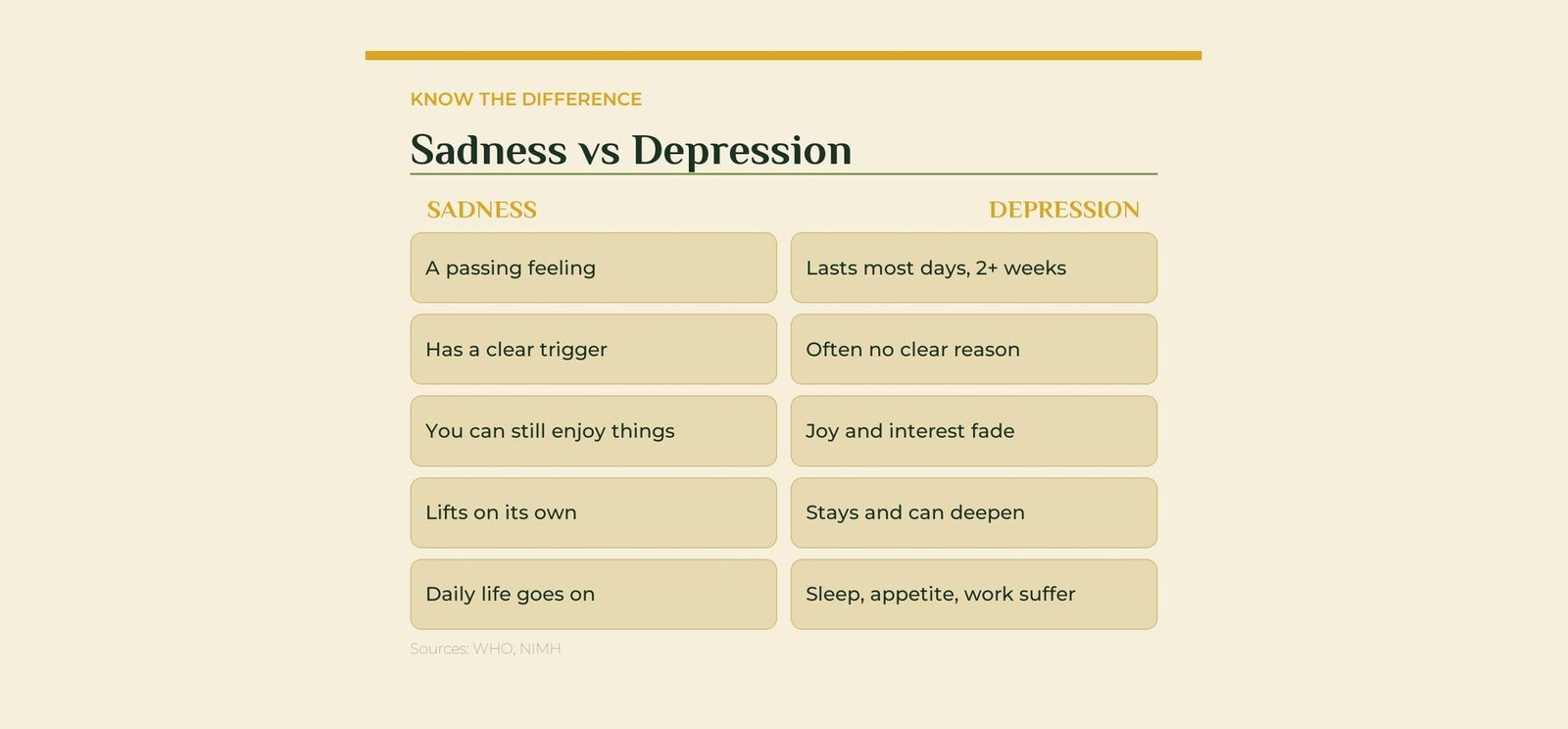
Sadness is a feeling. It comes, it passes, it fades with time. Depression is a health condition. It stays, it spreads, and it needs care.
Telling them apart can feel hard from the inside. When you are low, everything blurs together.
So this guide will help you see the line. We will look at what makes sadness normal. And what turns low mood into depression.
We will walk through the two-week rule. The real signs of depression beyond a low mood.
We will cover how depression feels different. A gentle self-check you can do at home.
Then simple, caring steps to take next. And how to find help in India.
You do not have to figure this out alone. Let us start with the basic difference.
Sadness Is an Emotion, Depression Is a Condition
Start with the simplest truth. Sadness and depression are not the same.
Sadness is a normal human emotion. It is healthy. It is even useful.
We feel sad after a loss. After a fight. After bad news or a hard day.
This sadness has a cause. You can usually point to it. "I feel low because of this."
And it moves. It rises, then it eases. Good moments still break through.
You can laugh at a joke. You can enjoy a meal. The sadness sits beside your life, not on top of it.
Depression is different. It is a medical condition, not a passing mood.
Depression is a common but serious mental health condition. It affects how you feel, think, and act (Source: NIMH, 2024 — nimh.nih.gov).
It does not always need a clear cause. Some days there is no reason at all. The low mood is just there.
And it does not lift on its own the way sadness does. It settles in. It colours everything grey.
Joy fades. Interest fades. Even small tasks feel heavy.
Think of it this way. Sadness is like rain. It comes and it goes.
Depression is like a long, grey season. The light seems to disappear for weeks.
This is why "just cheer up" never works. You cannot will away a health condition.
Depression is also far from rare. About 280 million people live with it worldwide (Source: WHO, 2023 — who.int).
So if this is you, you are not weak. And you are not alone.
Q: Is depression just extreme sadness?
A: No. Sadness is a normal emotion tied to a cause, and it passes. Depression is a health condition that lasts, spreads into daily life, and often needs treatment. They can feel similar, but they are not the same.
The Two-Week Rule
Here is the clearest test doctors use. It is about time.
A bad day is normal. A bad week can be too. But depression has a longer shape.
The key sign is how long low mood lasts. Doctors look for symptoms that stay two weeks or more.
Not just here and there. Most of the day. Nearly every day. For at least two weeks (Source: NIMH, 2024 — nimh.nih.gov).
That is the two-week rule. It is a simple, useful line.
Sadness fades within days. You feel low, then slowly you feel lighter.
Depression does not fade like that. The low mood holds. Day after day, it stays.
So ask yourself one question. How long has this feeling lasted?
If it has been a few days, it may just be a low patch. Give it time and care.
If it has been two weeks or longer, pay attention. That is a signal worth taking seriously.
But time is only half the picture. Reach matters too.
Ask how far the low mood has spread. Is it only your mood? Or is it touching everything?
Sleep. Appetite. Energy. Focus. Interest in the things you love.
When low mood spreads into all of these, and it lasts two weeks, it points to depression.
This is not about labelling yourself. It is about noticing a pattern.
You know your own baseline. You know what "normal you" feels like.
So watch for a real shift from that baseline. A shift that holds, and does not lift.
One rough fortnight after a big loss can still be grief, not depression. Context matters, and a doctor can help you read it.
Q: How long does sadness last before it becomes depression?
A: Sadness usually eases within a few days. If low mood stays most of the day, nearly every day, for two weeks or more. It affects daily life, that fits depression. Two weeks is the line doctors watch.
Signs of Depression Beyond Low Mood
Many people think depression is just feeling sad. It is much more than that.
Low mood is only one sign. Depression shows up in the body and the mind too.
Here are the signs of depression to watch for. Notice how many go beyond mood.
First, loss of interest. Things you once loved feel flat. Doctors call this anhedonia.
Hobbies stop mattering. Friends stop mattering. Even good news lands with a dull thud.
Second, changes in sleep. You may sleep far too much. Or you may lie awake, unable to rest.
Third, changes in appetite. Food may lose its taste. Or you may eat much more than usual. Weight can shift either way.
Fourth, low energy. A deep tiredness sets in. Simple tasks feel like heavy work.
Even after rest, the fatigue stays. Getting out of bed can feel like too much.
Fifth, poor focus. The mind feels foggy. You read the same line again and again.
Decisions feel impossible. Even small choices can freeze you.
Sixth, feelings of worthlessness. A harsh inner voice takes over. It says you are a burden. It says you are failing.
Guilt grows over small things. Self-blame runs on a loop.
Seventh, slowed thoughts or movements. Some people feel restless. Others feel like they are moving through mud.
And in some cases, thoughts of death or self-harm. This sign is serious. We will return to it with care later.
You will not have every sign. That is normal.
Doctors look for several signs together, lasting two weeks. Low mood or lost interest is usually at the core.
The point is simple. Depression is a whole-body condition, not just a bad mood.
Q: What are the signs of depression apart from sadness?
A: Look for lost interest, changes in sleep and appetite, low energy, poor focus, and feelings of worthlessness. Slowed thoughts and, in serious cases, thoughts of self-harm can also appear. Several signs lasting two weeks point to depression.
How Depression Feels Different From Sadness
Signs are one thing. But how it feels from the inside is another.
People often ask, "am i depressed, or just very sad?" The feel of it can help you answer.
Sadness usually has movement. It comes in waves. You cry, then you feel some relief.
You can still connect. A hug helps. A friend's call lifts you, at least a little.
Depression feels flatter. Many describe it as numbness, not sadness.
Not "I feel so sad." More like "I feel nothing at all." An empty, grey blankness.
Others cannot cry, even when they want to. The tears will not come.
Sadness lets hope in. You know things will get better. The future still exists.
Depression steals that hope. The future feels closed. Nothing seems worth the effort.
Sadness stays near its cause. You feel low about one thing.
Depression floods everything. Work, home, self, all of it feels wrong at once.
With sadness, you still like yourself. You are hurting, but you are okay as a person.
With depression, the self-view turns dark. "I am worthless." "I am a burden." These thoughts feel like facts.
Sadness leaves your energy mostly intact. You can still function, even while low.
Depression drains the tank. Getting dressed can feel like climbing a hill.
There is one more key difference. Sadness responds to good things.
A treat, a friend, a sunny day, these still reach you. Depression blocks them out.
That is anhedonia again. The joy switch stops working, no matter what you try.
So if pleasure feels out of reach, week after week, that is a strong clue. This is more than sadness.
None of this is your fault. Depression changes brain chemistry and mood systems. It is an illness, not a choice.
Q: How does depression feel different from sadness?
A: Sadness often feels like painful waves that ease with comfort and time. Depression feels flatter, number, and more constant. It blocks pleasure, drains energy, and darkens how you see yourself. Good moments stop reaching you.

A Simple Self-Check, Not a Diagnosis
Let us make this practical. Here is a gentle self-check.
This is not a diagnosis. Only a doctor can diagnose depression. But it can help you see a pattern.
Doctors often use a short screening tool. It asks about the last two weeks.
You can reflect on the same areas at home. Be honest, and be kind to yourself.
Over the past two weeks, how often have you felt these? Ask calmly, one by one.
One. Little interest or pleasure in doing things. Have the things you enjoy gone flat?
Two. Feeling down, low, or hopeless. Has that mood held most days?
Three. Trouble with sleep. Too little, too much, or broken rest?
Four. Feeling tired or low on energy. Is the tank empty most of the time?
Five. Poor appetite or overeating. Has your relationship with food shifted?
Six. Feeling bad about yourself. A sense of failure, guilt, or being a burden?
Seven. Trouble focusing. Hard to read, work, or follow a show?
Eight. Moving or speaking slowly. Or feeling restless and unable to sit still?
Nine. Any thoughts that you would be better off gone. This one matters most.
If you nodded to number nine, please read the safety note below, and act on it.
Now step back. How many did you recognise?
A few, now and then, may just be a hard patch. That is human.
But several of these, most days, for two weeks? That pattern fits depression.
The more boxes you tick, and the longer it lasts, the stronger the signal.
Please do not use this to label or scare yourself. Use it as information.
It is a nudge, not a verdict. A reason to talk to someone who can help.
Write down what you noticed. Take that note to a doctor. It will make the conversation easier.
Q: Can I test myself for depression at home?
A: You can reflect on your symptoms, but you cannot diagnose yourself. Screening questions about mood, sleep, energy, and interest over two weeks can reveal a pattern. Only a doctor can confirm depression, so share what you notice with one.
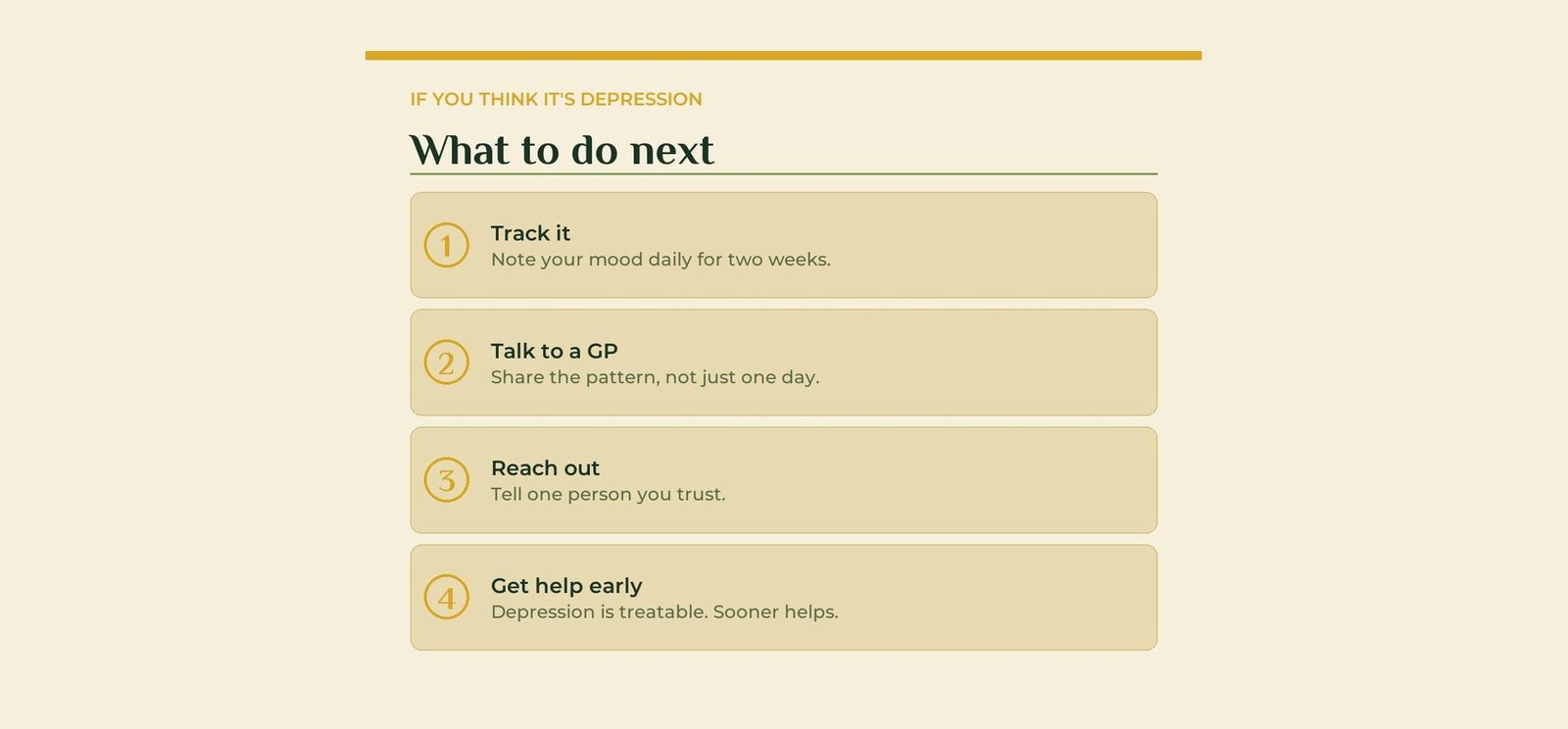
What to Do If You Think It's Depression
So you have spotted the pattern. What now?
The good news is clear. Depression is very treatable. Most people get better with support.
Here are simple, concrete steps you can take. Start with any one of them today.
First, talk to a doctor. This is the most important step.
Book a visit with a GP or a psychiatrist. Say plainly, "I think I may be depressed."
You do not need perfect words. Just show up and be honest.
Second, keep a mood log for two weeks. A notebook or phone note works fine.
Each day, jot your mood, sleep, and energy. Note what helped and what did not.
This gives the doctor real data. It also helps you see the pattern clearly.
Third, reach out to one person you trust. Do not carry this alone.
Tell a friend, partner, or family member. Say, "I have been struggling, and I need support."
You do not have to explain everything. Just letting someone in already lightens the load.
Fourth, ask about a proper screening. Doctors can use a short, validated questionnaire.
It takes minutes. It helps guide the right care for you.
Fifth, protect the basics while you wait. Small steps still matter.
Try to keep a steady sleep time. Eat something regular. Step outside for a short walk.
None of these cure depression. But they steady the ground under you.
And please, do not wait for it to "just pass." Early help works better than late help.
If low mood has held for weeks, that is reason enough to act. You do not need to hit rock bottom first.
A safety word, gently. If you have any thoughts of self-harm, do not wait.
Reach out right now. Contact a doctor or a mental health helpline immediately. Tell someone close to you today.
You deserve care and support. Asking for it is a sign of strength, not weakness.
Q: What should I do if I think I have depression?
A: Talk to a doctor and say plainly how you feel. Keep a two-week mood log, reach out to someone you trust, and ask about a screening. If you have any thoughts of self-harm, seek help immediately.
Getting Help in India
Reaching out can feel hard. Especially with the stigma around mental health.
But things are changing. And help in India is more available than many people think.
Depression is common here, and it is often missed. The national survey found a wide treatment gap (Source: NMHS / NIMHANS, 2016 — indianmhs.nimhans.ac.in).
Many people who need care never receive it. Often that is due to stigma or low awareness.
So let us be clear. Depression is a health condition, like diabetes or asthma.
You would see a doctor for a body illness. The mind deserves the same care.
Where can you start? You have several options.
Start with a GP or family doctor. They can assess you and refer you onward.
You can also see a psychiatrist directly. They diagnose and treat mental health conditions.
A clinical psychologist can offer therapy. Talking therapy helps many people with depression.
Depression is one of the most treatable conditions there is. It is also a leading cause of disability worldwide, which is why care matters (Source: WHO, 2023 — who.int).
Treatment usually blends a few things. Therapy, such as CBT. Sometimes medication. Steady daily habits.
You do not have to choose the path alone. A professional will guide you.
Cost and access can be real worries. Many public hospitals have psychiatry departments. Some offer low-cost care.
There are also helplines and clinics across the country. And residential centres for those who need deeper support.
Once more, a gentle safety note. If things feel unbearable, or you have thoughts of self-harm, act now.
Contact a doctor or a mental health helpline immediately. Do not wait for morning.
The first step is often the hardest. But it is also the one that changes everything.
Q: Where can I get help for depression in India?
A: Start with a GP, a psychiatrist, or a clinical psychologist. Public hospitals often have psychiatry departments, and helplines and clinics exist across the country. If you have thoughts of self-harm, contact a doctor or a mental health helpline immediately.
Quick Facts: Depression or Sadness in India
- About 280 million people live with depression worldwide — (Source: WHO, 2023 — who.int).
- Depression is a leading cause of disability across the world — (Source: WHO, 2023 — who.int).
- Depression means low mood or lost interest most of the day, nearly every day, for at least two weeks — (Source: NIMH, 2024 — nimh.nih.gov).
- India's national survey found a wide treatment gap for mental health conditions — (Source: NMHS / NIMHANS, 2016 — indianmhs.nimhans.ac.in).
- Depression is one of the most treatable mental health conditions — (Source: NIMH, 2024 — nimh.nih.gov).
How Ganaa Helps With Depression
Sometimes low mood runs deep. Deeper than self-help alone can reach.
That is where support makes a real difference. Ganaa is here for exactly that.
Ganaa is a mental health and rehabilitation brand in India. We help people living with depression, anxiety, and related conditions.
We began in 2012. In 2026, we merged with Mindvriksha to grow our care.
Our approach is warm and clinical at once. We do not just treat a symptom. We look at the whole person.
Care can include talking therapy, such as CBT. It can include psychiatric support and steady daily routine.
It can also include mindfulness and yoga. Each plan is tailored to the person, never generic.
For depression, structure helps. Our residential settings are built around calm, rhythm, and rest. That steadiness helps the mind slowly heal.
Ganaa runs five residential centres across India. These are Ganaa Delhi I and Ganaa Delhi II in Chhatarpur. Also Ganaa Gurugram, which has a women-only wing. Plus Ganaa Goa and Ganaa Greater Noida.
We also run three OPD clinics. These are in Faridabad, Greater Kailash, and Greater Noida.
Many people start with outpatient care. Support can flex around your work and life.
Others need deeper, round-the-clock care. Our residential centres offer that safe space.
You do not have to know what you need yet. That is what the first conversation is for.
If low mood has held you down, please reach out. Speak to a Ganaa counsellor, or visit ganaa.in to learn more.
Help is real. Recovery is real. And the first step can start today.
Conclusion: You Deserve to Feel Like Yourself Again
Low mood is confusing from the inside. But the line is clearer than it feels.
When you weigh depression or sadness, look at two things. Time and reach.
Sadness has a cause. It eases within days. Good moments still break through.
Depression holds most days for two weeks or more. It spreads into sleep, energy, focus, and joy.
The signs of depression go beyond a low mood. Lost interest. Poor sleep. Deep fatigue. A harsh inner voice.
If that pattern fits you, please do not wait. Talk to a doctor. Keep a mood log. Reach out to someone you trust.
And if you ever have thoughts of self-harm, seek help at once. Contact a doctor or a mental health helpline immediately.
Depression is common. It is also very treatable. Most people feel better with the right care.
So be gentle with yourself. Noticing the problem is already a brave first step.
You are not weak. You are not alone. And you do not have to carry this by yourself.
Reach out today. Speak to a Ganaa counsellor, or visit ganaa.in. You deserve to feel like yourself again.
FAQ
Q: How do I know if I have depression or am just sad?
A: Look at time and reach. Sadness is usually tied to a cause and lifts within days. Depression stays most of the day, nearly every day, for two weeks or more. It also spreads into sleep, appetite, energy, and interest. If low mood is stealing your daily life, it is worth speaking to a doctor.
Q: What are the main signs of depression?
A: Low mood is only one sign. Watch for loss of interest in things you once enjoyed. Watch for changes in sleep and appetite, low energy, poor focus, and feelings of worthlessness. When several of these last two weeks or more, they point to depression, not passing sadness.
Q: Can sadness turn into depression?
A: Yes, it can. Sadness is a normal, healthy feeling that usually passes. But when heavy stress or loss lingers, low mood can deepen and settle. If sadness lasts for weeks and affects sleep, work, or relationships, it may have become depression and deserves care.
Q: Am I depressed or just tired and stressed?
A: Stress and tiredness usually ease with rest and time. Depression does not lift the same way. It brings low mood plus loss of interest, and it lasts most days for two weeks or more. If rest is not helping and joy feels out of reach, a doctor can help you tell the difference.
Q: When should I see a doctor about low mood?
A: See a doctor if low mood lasts more than two weeks or affects your daily life. Get help sooner if you lose interest in everything, cannot sleep or eat, or feel hopeless. If you have any thoughts of self-harm, contact a doctor or a mental health helpline immediately.
Q: Is depression treatable?
A: Yes. Depression is one of the most treatable mental health conditions. Talking therapy, such as CBT, helps many people. Medication can help others, often alongside therapy. With the right support, most people feel better and recover, so reaching out early is a strong, hopeful choice.