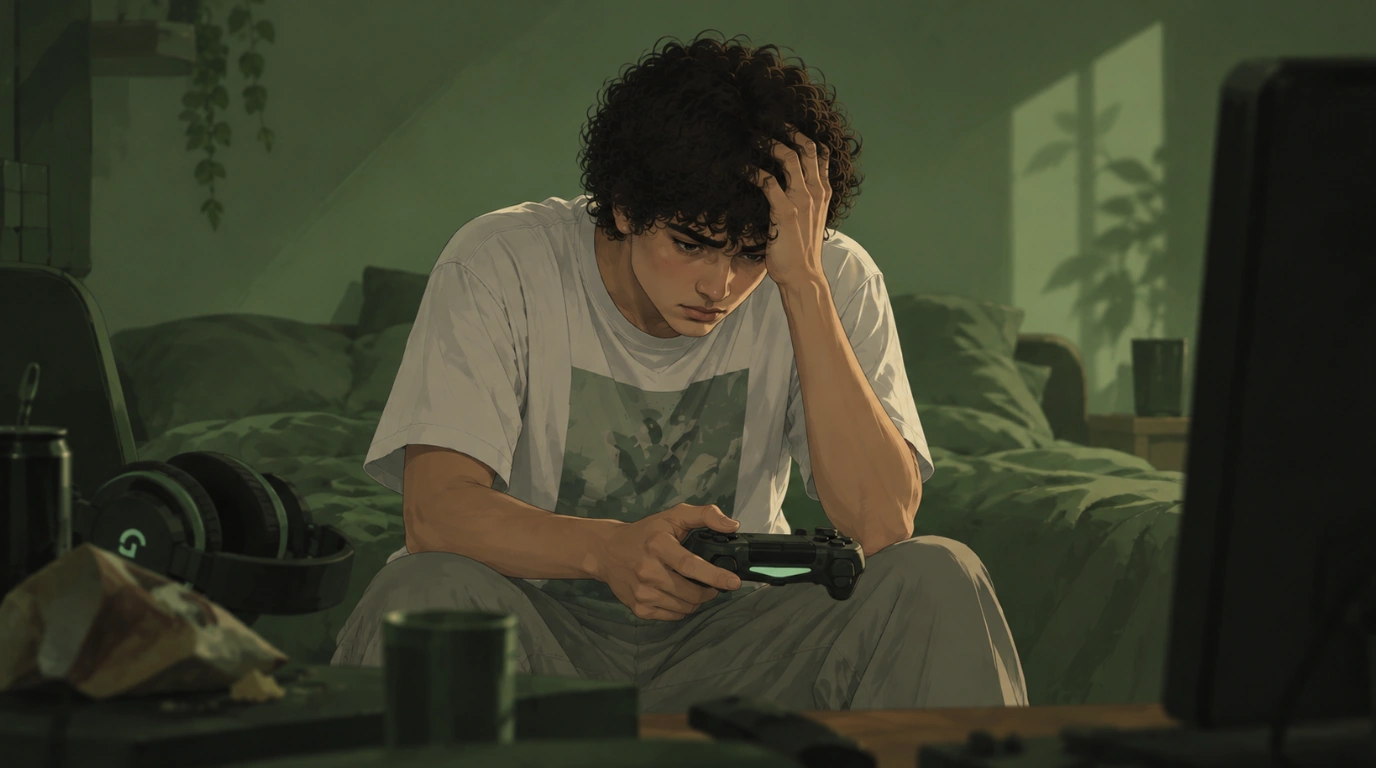
Why Can't I Sleep Even When I'm Completely Exhausted?
Why can't I sleep even when I'm exhausted? Learn how anxiety, stress, and hyperarousal keep you awake at night, plus calm, practical ways to finally fall asleep
Why Can't I Sleep Even When I'm Completely Exhausted?
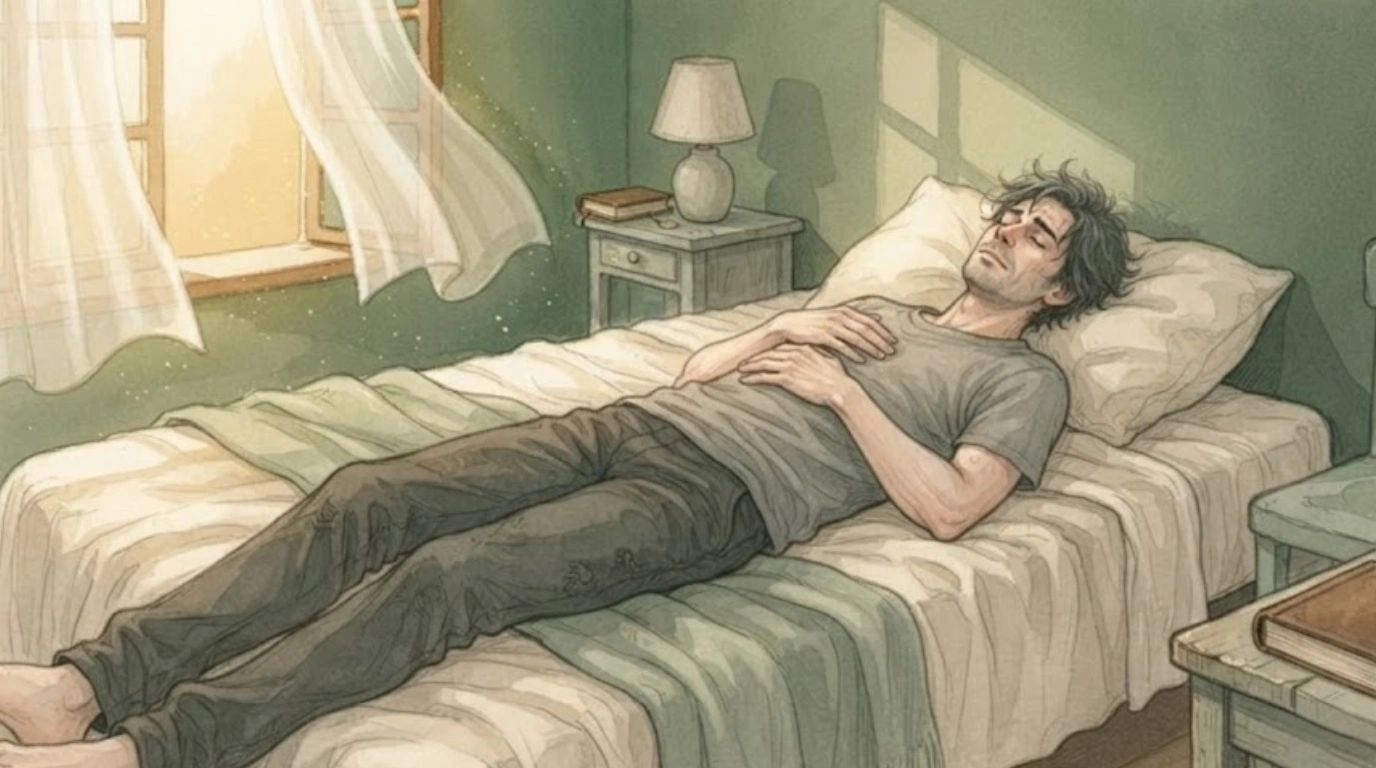
You are drained. Your body aches for rest.
Yet the moment your head hits the pillow, your mind wakes up. The thoughts start. The clock ticks. Sleep stays just out of reach.
If you cant sleep even when tired, you are not broken. You are stuck in a very common trap.
Your body and your brain are out of sync. One is exhausted. The other is still on high alert. That gap is what keeps you awake.
This guide explains why it happens. How stress and anxiety keep you wired. What hyperarousal does to your body at night.
We will also look at the habit of staying up on purpose. And how poor sleep and worry feed each other.
Most of all, you will get practical, calming steps. Ways to signal rest to a body that has forgotten how to switch off.
Let us start with the strange gap between being tired and being able to sleep.
Why Exhaustion and Sleep Don't Always Match
Being tired is not the same as being ready for sleep.
They feel like they should go together. Often they do not. You can be exhausted and wide awake at once.
Sleep needs two things. A tired body, yes. But also a calm, safe-feeling mind.
When you are stressed, the second part breaks down. Your body slows, but your brain stays switched on. So you cant sleep even when tired.
Think of it like a car. The engine is idling hard. You press the brake, but the engine keeps revving.
That revving is your nervous system. It is stuck in "alert" mode when it should be in "rest" mode.
This is why lying still does not always help. Rest for the body is not rest for a racing mind.
The fix is not to try harder to sleep. Trying harder adds pressure. And pressure keeps you awake.
The fix is to calm the system first. We will get to exactly how.
Many people make one mistake here. They lie in bed and wait, tense and frustrated. The frustration itself keeps them awake.
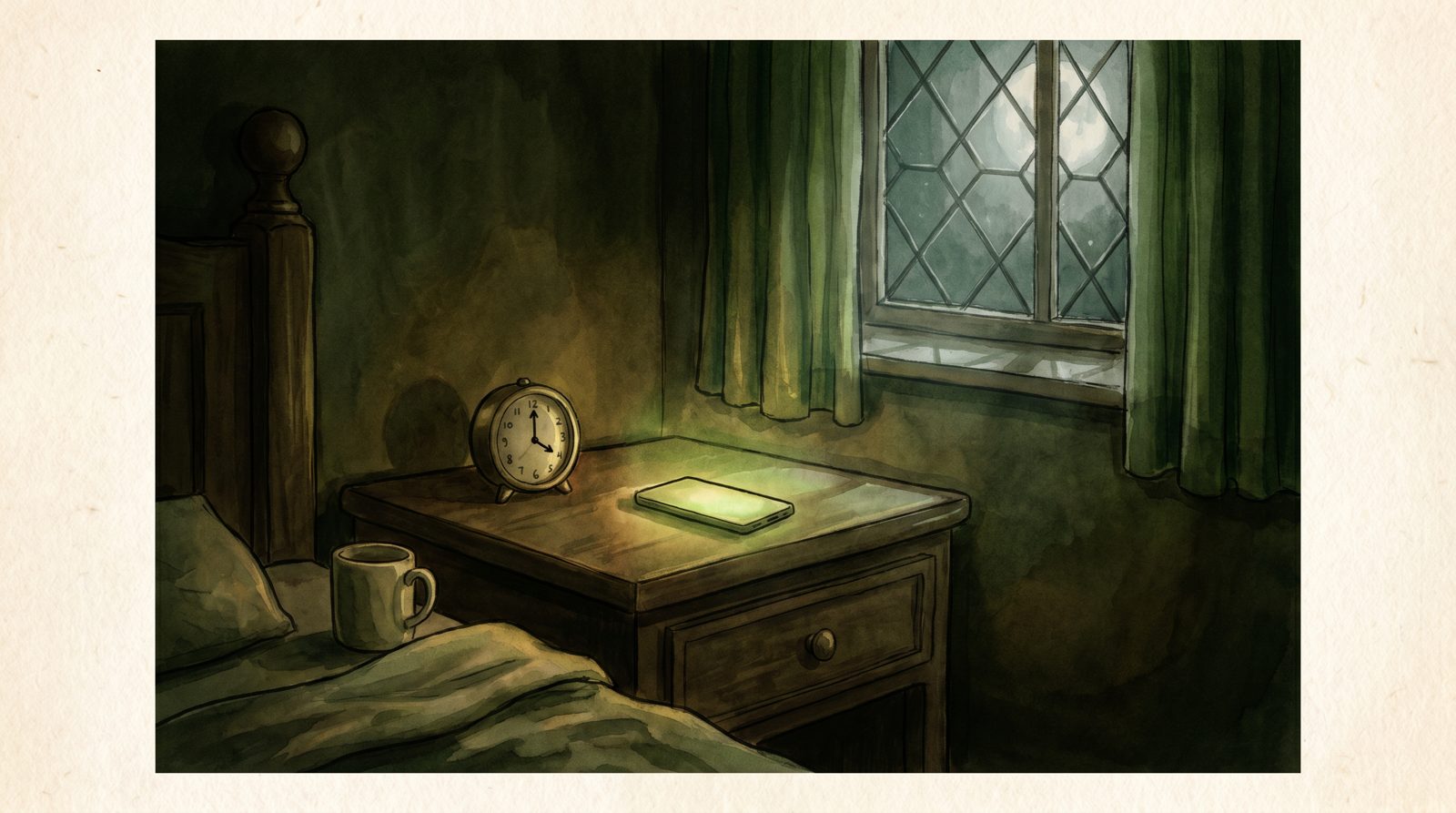
Watching the clock makes it worse. Every passing minute adds pressure. The bed starts to feel like a battleground.
So the goal shifts. Not "make myself sleep now." Instead, "help my body feel safe and calm." Sleep follows a calm body, not a forced one.
Q: Why am I tired but unable to fall asleep? A: Because your body is tired while your mind stays alert. Sleep needs both a tired body and a calm mind. Stress keeps the brain switched on even when you are drained.
When Your Mind Won't Switch Off
For many people, the real problem is the mind.
The body lies down. Then the thoughts arrive. Worries. To-do lists. Replays of the day.
Night removes all your distractions. No work. No noise. Just you and your thoughts in the dark.
So the brain finally has space to process. And it often chooses the worst possible time.
This is common with anxiety. The mind scans for threats. It plans, checks, and worries on a loop.
Overthinking at night has a pattern. One worry leads to another. Soon you are wide awake and tense.
The harder you push the thoughts away, the louder they get. Fighting them keeps you alert.
There is a better approach. You do not have to solve the thoughts. You only have to stop feeding them.
A simple trick helps. Keep a notepad by the bed. Write the worry down. Tell yourself you will handle it tomorrow.
This gives the mind permission to let go. The worry is safe on paper, not lost.
Q: Why does my mind race the moment I lie down? A: Because night removes distractions and gives the brain space to process. Anxiety turns that space into worry. Writing thoughts down can help the mind let go.
What Hyperarousal Does to Your Body
There is a name for being wired but tired. It is called hyperarousal.
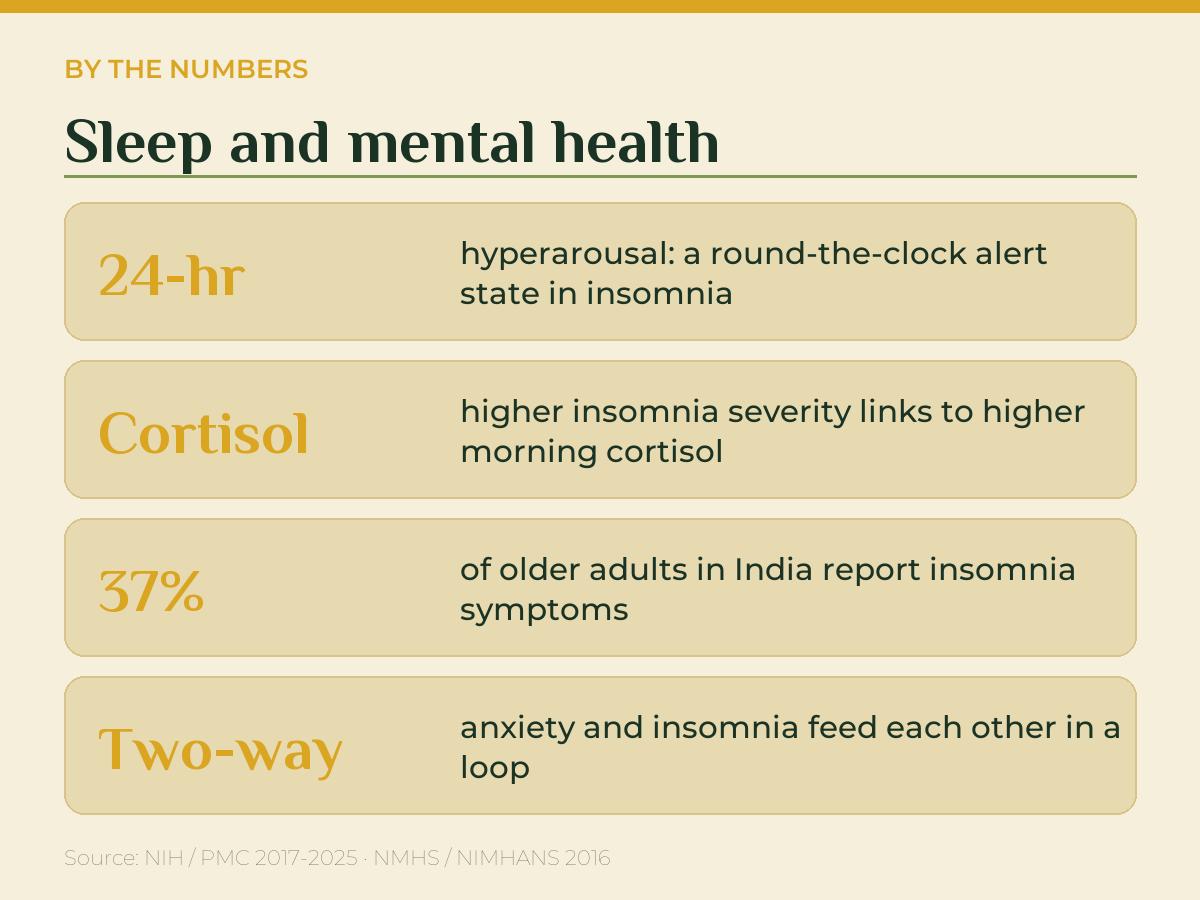
Hyperarousal is a state of raised alertness that runs day and night. It is a core feature of insomnia (Source: NIH / PMC, 2017 — ncbi.nlm.nih.gov).
In this state, your body acts like there is a threat. Even when you are safe in bed.
Stress hormones play a big role. Cortisol is the main one. It is meant to keep you alert and ready.
At night, cortisol should be low. Under chronic stress, it stays high. Higher insomnia severity is linked to higher morning cortisol (Source: NIH / PMC, 2023 — pmc.ncbi.nlm.nih.gov).
So your body stays in fight-or-flight mode. Heart rate up. Muscles tense. Mind scanning.
This is the opposite of what sleep needs. Sleep needs the calm, "rest and digest" state.
You cannot force your body out of alert mode by willpower. But you can coax it out with the right signals.
Slow breathing is one. A steady routine is another. Both tell the body the threat is over.
That is the real goal at bedtime. Not to chase sleep. To lower the alarm so sleep can arrive.
Q: What is keeping my body alert at night? A: A stress state called hyperarousal. Cortisol and other stress signals stay high, keeping you in alert mode. Calming the body helps switch it off.
Revenge Bedtime Procrastination
Sometimes the problem is not that you cannot sleep. It is that you will not.
This has a name too. Revenge bedtime procrastination. It sounds odd, but it is very real.
It means staying up late on purpose. You reclaim personal time you did not get during the day.
You know you should sleep. You choose to scroll, watch, or game instead (Source: Sleep Foundation, 2024 — sleepfoundation.org).
It hits hardest after long, packed days. Work, chores, family, no free minute. Night feels like the only time that is yours.
So you take revenge on a busy schedule. You stay awake to steal back some freedom.
The cost is real. You lose rest you badly need. The next day feels worse, and the cycle repeats.
The pull is strongest when days feel out of your control. The less freedom by day, the more you grab at night.
It often links to burnout too. A drained, over-scheduled mind craves a small reward. Late-night screens become that reward.
Phones make it easier to fall into. One video leads to ten. The bright screen also tells your brain to stay awake.
The fix is gentle, not harsh. Build small pockets of "you time" into the day. Even ten minutes helps.
Then set a soft cut-off for screens. Not a punishment. A kindness to your morning self.
Q: Why do I stay up late even when I am tired? A: You may be reclaiming personal time lost to a busy day. This is revenge bedtime procrastination. Adding small free moments by day reduces the urge.
How Anxiety and Insomnia Feed Each Other
Poor sleep and anxiety are a tightly bound pair.
Each one makes the other worse. Together they form a loop that is hard to break.
Anxiety keeps you awake at night. The racing mind will not settle. Insomnia is more common in people with generalised anxiety (Source: NIH / PMC, 2018 — ncbi.nlm.nih.gov).
Then the lost sleep strikes back. A tired brain handles stress poorly. So the next day feels more anxious.
More anxiety means another restless night. And so the loop turns, night after night.
There is more to it. Chronic insomnia can disturb the sleep stages that steady our emotions. This may open a path toward anxiety and depression (Source: NIH / PMC, 2025 — ncbi.nlm.nih.gov).
So this is not just about feeling tired. It is about mental health over time.
The good news is that loops work both ways. Improve the sleep and the anxiety often eases. Ease the anxiety and the sleep often improves.
That is why the best fixes target both. Better sleep habits, plus real support for the worry underneath.
Q: Does anxiety cause insomnia, or does insomnia cause anxiety? A: Both. They feed each other in a loop. Anxiety keeps you awake, and poor sleep raises next-day anxiety. Treating both together works best.
When Sleeplessness Points to Something Deeper
Sometimes ongoing sleep trouble is a signal, not just a nuisance.
A bad week of sleep is normal. Weeks or months of it may point to something more.
Sleep problems and mental health are closely tied. Insomnia can be an early sign of anxiety or depression.
Watch for other changes alongside the sleep loss. Low mood. Loss of interest. Constant worry that will not stop.
Note the direction too. Trouble falling asleep often links to anxiety. Waking very early and low can link to depression.
Sleep also sits at the centre of many conditions. A sharp drop in sleep can even warn of a coming mood swing in bipolar disorder.
You can read more in our guide to the early signs of bipolar disorder. Sleep is often the very first clue.
In India, much of this goes unaddressed. The national survey found wide treatment gaps across mental health conditions (Source: NMHS / NIMHANS, 2016 — indianmhs.nimhans.ac.in).
So chronic sleeplessness deserves attention, not just a stronger coffee. It may be your mind asking for help.
This does not mean you should panic. It means you should look, and act if the pattern holds.
Q: Can insomnia be a sign of a mental health problem? A: Yes. Ongoing insomnia can be an early sign of anxiety or depression. If poor sleep comes with low mood or heavy worry, it is worth speaking to a doctor.
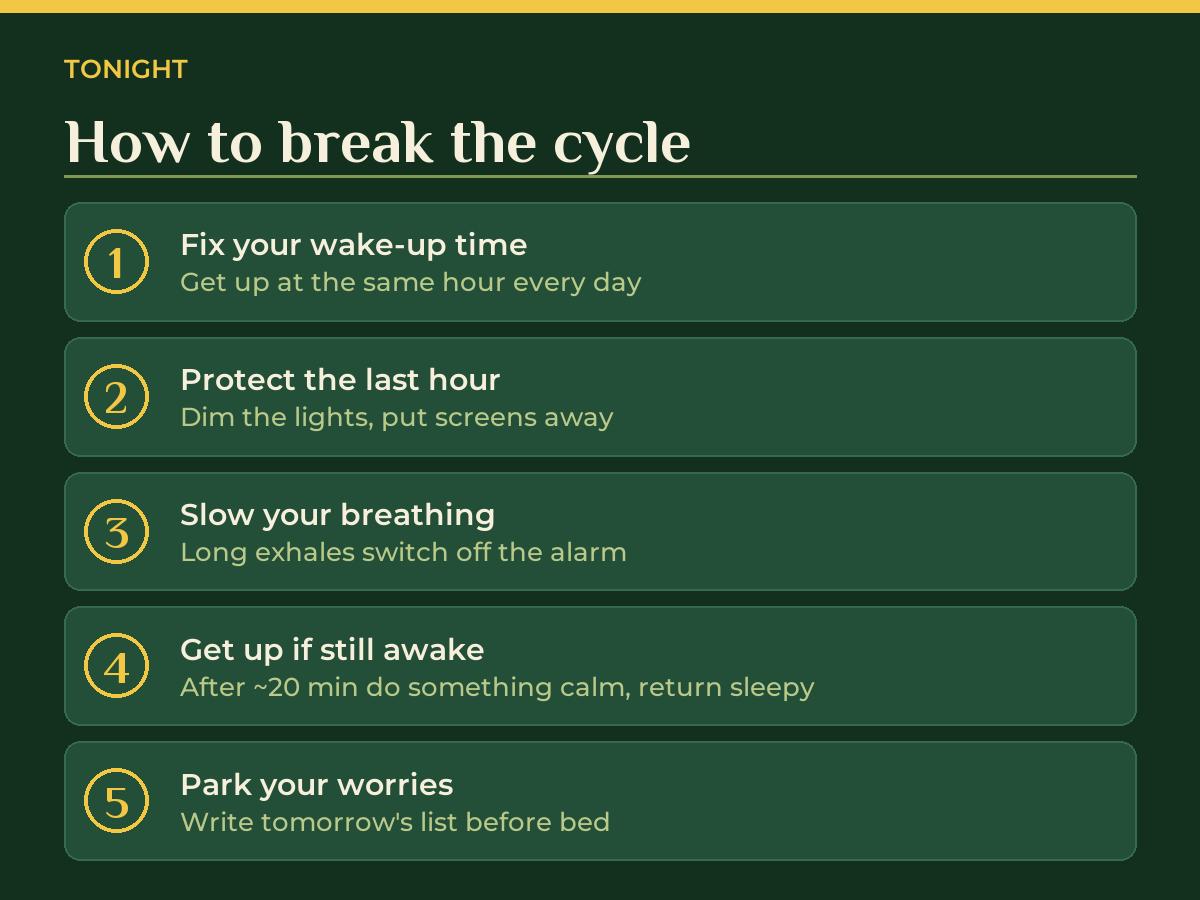
How to Break the Cycle Tonight
You cannot force sleep. But you can build the conditions for it.
Here are practical steps. None is magic alone. Together they lower the alarm and invite rest.
First, fix your wake-up time. Get up at the same hour daily. A steady wake time sets the whole rhythm.
Second, protect the last hour. Dim the lights. Put screens away. Let the body read the signal that night has come.
Third, slow your breathing. Try a long exhale, longer than the inhale. Do this for a few minutes in bed.
This one matters most. Slow breathing switches on the calm, rest state. It directly lowers hyperarousal.
Fourth, get out of bed if awake. If you cant sleep even when tired after about twenty minutes, get up. Do something dull and calm. Return when sleepy.
This breaks the link between bed and frustration. Bed should mean sleep, not struggle.
Fifth, cut caffeine after mid-afternoon. It lingers in the body for hours. It quietly fuels the wired feeling.
Sixth, park your worries on paper. Write tomorrow's list before bed. Give the mind permission to stop holding it.
Do these for two weeks, not two nights. Sleep rebuilds slowly, with steady, kind repetition.
One more rule helps a lot. Keep the bed for sleep only. Not for work, worry, or endless scrolling.
Over time, this trains the brain. Bed becomes a cue for rest. Your body learns to relax the moment you lie down.
And be kind to yourself on bad nights. One rough night is not a failure. The next night is a fresh start.
Q: What is the fastest way to calm down for sleep? A: Slow your breathing, with a long exhale, for a few minutes. This lowers the body's alert state. Pair it with dim lights and no screens before bed.
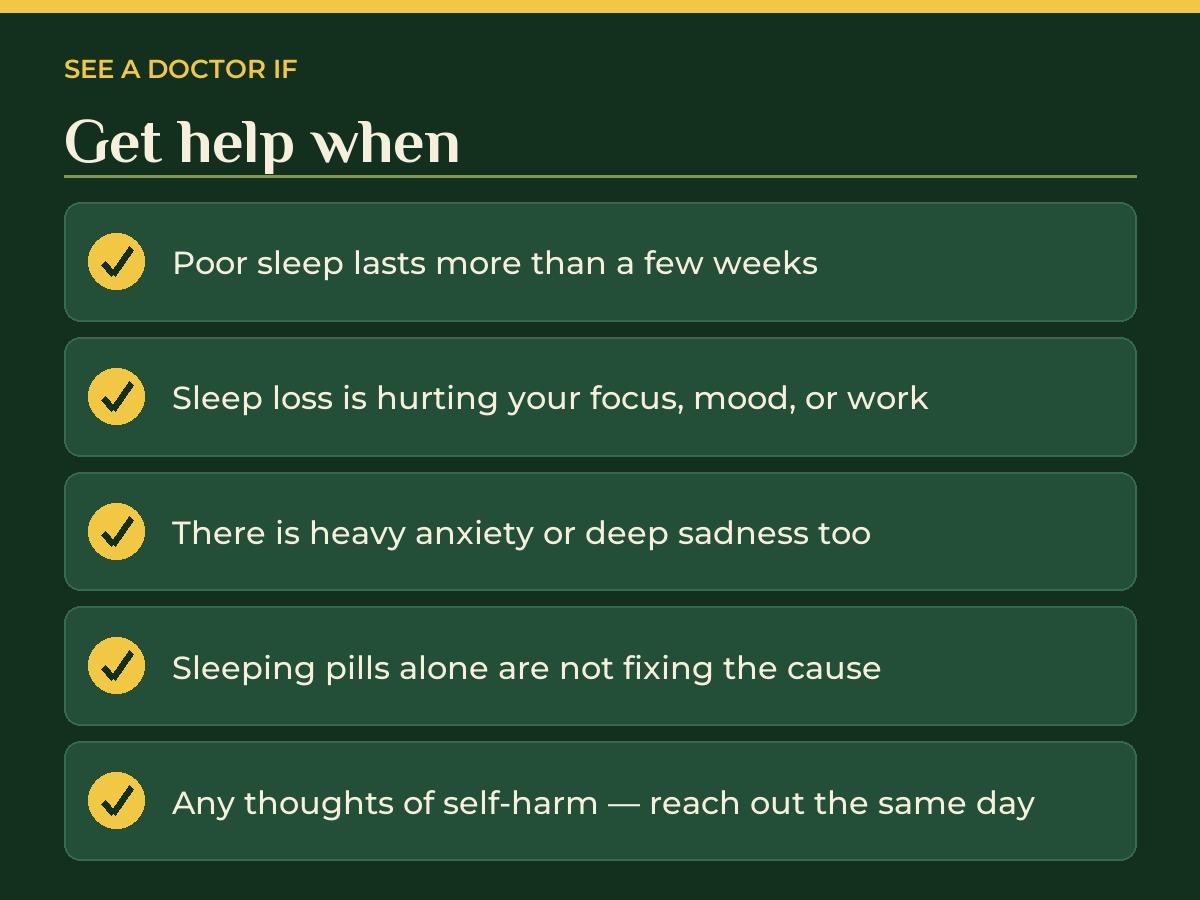
When to See a Doctor About Sleep
Self-help works for many people. But not for everyone, and not forever.
So how do you know when to seek help? A few clear signs point the way.
See a doctor if poor sleep lasts more than a few weeks. Short spells pass. Long ones need support.
See a doctor if sleep loss is hurting your days. Poor focus. Low mood. Struggling at work or home.
Seek help sooner if there are bigger warning signs. Heavy anxiety. Deep sadness. Any thoughts of self-harm.
Do not just reach for sleeping pills alone. They may help briefly. They rarely fix the cause.
A doctor can look deeper. They can check for anxiety, depression, or other conditions behind the insomnia.
Effective care exists. Talking therapy for insomnia works very well. So does treating any anxiety underneath.
This therapy is often called CBT for insomnia. It retrains your sleep habits and your thoughts about sleep. Many people improve without long-term pills.
Asking for help is not weakness. Sleep is basic to health. Protecting it is a smart, strong choice.
You would see a doctor for lasting pain. Lasting sleeplessness deserves the same care.
Q: When is insomnia serious enough to see a doctor? A: When it lasts more than a few weeks or harms daily life. Seek help sooner if it comes with strong anxiety, low mood, or thoughts of self-harm.
- Hyperarousal, a 24-hour state of raised alertness, is a core feature of insomnia — . - Insomnia severity is linked to higher morning cortisol levels — . - Insomnia is more common in people with generalised anxiety disorder — . - Around 37% of older adults in India report insomnia symptoms — . - Mental health conditions in India carry wide treatment gaps — .
How Ganaa Helps With Sleep and Stress
When sleep problems run deep, the cause often runs deeper.
Ganaa is a mental health and rehabilitation brand in India. We help adults facing anxiety, stress, and sleep problems.
We do not just chase the symptom. We look at what keeps the mind wired at night.
Our care blends modern clinical science with calm, restful settings. Therapy, psychiatric support, and steady daily routine work together.
For sleep, routine is powerful. Our residential settings are built around rest, calm, and rhythm. That structure helps the body relearn how to switch off.
Care can include talking therapy for both anxiety and insomnia. It can include mindfulness, yoga, and relaxation training. Each plan is tailored to the person, never generic.
Ganaa runs five residential centres across India, in Delhi, Gurugram, Goa, and Greater Noida. Three OPD clinics offer outpatient support in Faridabad, Greater Kailash, and Greater Noida.
Many people start with outpatient care for stress and sleep. Support can flex around your work and life.
If sleepless nights are wearing you down, reach out. Speak to a Ganaa counsellor, or visit ganaa.in to learn about our programmes.
Conclusion: Your Body Wants to Sleep
You are not failing at sleep. Your system is simply stuck on alert.
When you cant sleep even when tired, the cause is usually clear. A tired body paired with a wired mind.
Stress and anxiety keep the alarm ringing. Hyperarousal holds the body ready for a threat that is not there.
The answer is not to try harder. It is to calm the system and lower the alarm.
Fix your wake-up time. Protect the last hour. Slow your breathing. Park your worries on paper.
Give it two steady weeks, not two nights. Sleep returns with patience, not pressure.
And if the nights stay hard, ask for help. Long-term insomnia is treatable, and so is the anxiety behind it.
Your body knows how to sleep. Sometimes it just needs the right conditions, and a little support, to remember.
Be patient with the whole process. You are not lazy or weak for lying awake at night. You are simply dealing with a wired system, and it can be calmed.
Start tonight with one small change. Slow your breath. Dim the lights. Then let go, and trust that rest will follow.
FAQ
Q: Why can't I sleep even when I am exhausted? A: Often it is because your body is tired but your mind is still switched on. Stress and anxiety keep the nervous system in a wired, alert state called hyperarousal. Your body wants rest, but your brain is scanning for problems. This gap between body tiredness and mental alertness is a common reason you cannot fall asleep.
Q: What is hyperarousal and how does it affect sleep? A: Hyperarousal is a state of raised mental and physical alertness that lasts around the clock. It is a core feature of insomnia. Stress hormones like cortisol stay high, so the body stays ready for action instead of winding down. This keeps you awake even when you feel drained.
Q: Is my sleep problem linked to anxiety? A: Very often, yes. Insomnia and anxiety are closely linked and tend to feed each other. Anxiety keeps the mind racing at night. Poor sleep then makes anxiety worse the next day. Breaking this loop usually needs both better sleep habits and support for the anxiety itself.
Q: What is revenge bedtime procrastination? A: Revenge bedtime procrastination is when you stay up late on purpose to reclaim personal time. It is common in people with long, stressful, low-control days. You know you should sleep, but you scroll or watch shows instead. It steals rest and deepens next-day tiredness.
Q: How can I fall asleep when my mind won't switch off? A: Give your body a wind-down signal. Dim lights, put the phone away, and slow your breathing. Try a long, slow exhale for a few minutes. If you are still awake after about 20 minutes, get up, do something calm, and return when sleepy. Keep wake-up time steady every day.
Q: When should I see a doctor about my sleep? A: See a doctor if poor sleep lasts more than a few weeks or affects your daily life. Get help sooner if it comes with low mood, heavy anxiety, or thoughts of self-harm. Long-term insomnia is treatable. A doctor can check for anxiety, depression, or other causes and guide the right care.
Bipolar misdiagnosed as depression is common, and the delay runs close to nine years. Learn the clues, why hypomania is missed, and how to get a better review.
Adolescent mental health in India is under-treated. Learn 11 warning signs parents miss, what the data shows, how to start the talk, and when to seek help.
Gaming disorder in teens is a real diagnosis, not a phase. Learn the WHO criteria, how common it is, the signs parents miss, and what actually works at home.