What Are the Early Signs of Bipolar Disorder in Adults?
What are the early bipolar disorder symptoms in adults? Learn the warning signs of mania and depression, how it differs from mood swings, and when to get help.
What Are the Early Signs of Bipolar Disorder in Adults?
Bipolar disorder rarely announces itself.
It hides. It gets called stress, or a phase, or just a moody streak. The early bipolar disorder symptoms often look like ordinary ups and downs.
But they are not ordinary. They come in episodes. They shift sleep, energy, and judgement. And they last for days or weeks, not hours.
Many adults live with a mood disorder for years before anyone names it. In India, that delay can stretch across a decade of missed highs and misread lows.
This guide walks through the real warning signs. The highs. The lows. The changes in sleep and thinking that most people overlook.
We will look at how bipolar differs from normal mood swings. Who tends to get it. And when a high or a low is a reason to see a doctor.
If any of this sounds like you or someone you love, that is worth paying attention to. Not with panic. With curiosity, and then a plan.
What Bipolar Disorder Really Means
Bipolar disorder is a mood disorder.
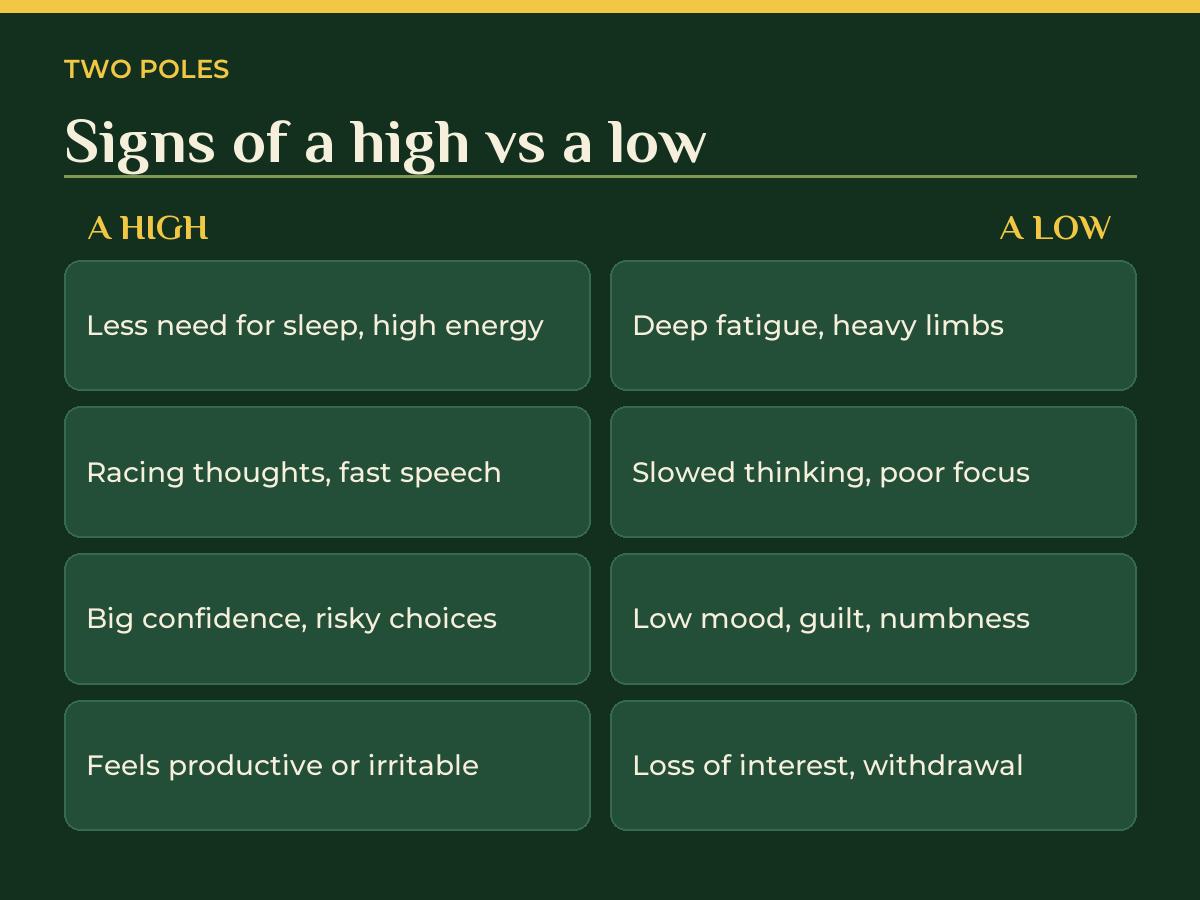
It moves between two poles. One is a high, called mania or hypomania. The other is a low, called depression.
These are not moods that pass by lunch. They are episodes. Each one can last days or weeks.
During a high, energy surges. Sleep drops. Confidence and speed go up. During a low, everything slows and dims.
Between episodes, many people feel completely well. That is part of why the pattern is easy to miss.
This is a brain-based illness, not a weakness. It is not caused by a lack of willpower. It is not a character flaw.
Genes, brain chemistry, and stress all play a part. Nobody chooses it. And nobody can simply snap out of it.
There is more than one type. Bipolar I involves full manic episodes. Bipolar II involves softer highs, called hypomania, plus deep lows. Both are real. Both need care.
A third, milder form is called cyclothymia. It brings smaller ups and downs over a long stretch. It still deserves proper care.
Bipolar affective disorder affects a meaningful share of Indian adults. A multi-site study put the current prevalence near half a percent of the population (Source: Indian Journal of Psychiatry, 2023 — pmc.ncbi.nlm.nih.gov).
The number sounds small. The impact is not. Untreated, it disrupts work, money, and family life for years.
Q: Is bipolar disorder the same as having mood swings? A: No. Mood swings pass quickly and often have a clear cause. Bipolar mood episodes last days or weeks. They change your sleep, energy, and choices, not just your mood.
Why Early Bipolar Signs Get Missed for Years
Most people seek help during a low.
They rarely come in during a high. A high can feel good. Productive. Even like the best version of themselves.
So the high goes unreported. The doctor hears only about the depression. And the diagnosis reads as ordinary depression.
This is the single biggest trap in bipolar care. Research shows people with bipolar often wait years for the right label. A prior diagnosis of unipolar depression is linked to longer delays (Source: NIH / PMC, 2015 — ncbi.nlm.nih.gov).
The cost of this delay is real. Antidepressants given alone, without a mood stabiliser, can make bipolar less stable. They can even trigger a high.
Stigma adds to the silence. In many Indian families, a high-energy phase is praised, not questioned. Big plans and long work nights look like drive.
So the warning signs get reframed as personality. Or ambition. Or a rough patch at work.
The fix is simple to say and hard to do. Report the highs too. Tell your doctor about any past phase of racing thoughts, little sleep, and big risks.
Q: Why is bipolar disorder so often mistaken for depression? A: Because people seek help during lows, not highs. The high phase goes unmentioned. So the record shows only depression, and treatment misses the mark.
The Warning Signs of a High
A high is more than a good mood.
It is a shift in how you sleep, think, and act. It builds over days. Other people usually notice before you do.
Watch for a drop in sleep. You feel rested on three or four hours. You do not crash the way you should.
Watch for speed. Your thoughts race. Your speech gets fast. People struggle to get a word in.
Watch for big confidence. You feel sharp, special, unstoppable. Plans get huge and urgent.
Watch for risk. Spending sprees. Snap decisions. Reckless driving, or sudden business bets with money you do not have.
Irritability counts too. Not every high feels happy. Some feel tense, angry, and easily set off.
These are core early signs of bipolar in adults. One or two on a good day mean little. Several together, for days, mean more.
A softer version is called hypomania. The same signs appear, but milder. Life still functions, so the phase gets waved off.
That is exactly why hypomania is dangerous to ignore. It is a real clue, hiding in plain sight.
There is another warning sign people miss. A high can flip fast into a low. The crash often follows the peak within days.
Friends may notice before you do. They see the sudden plans. The late nights. The person who seems switched on to full volume.
Listen if people say you seem different. That outside view is valuable data.
Q: What does a bipolar high actually look like? A: Less need for sleep, racing thoughts, fast speech, and high confidence. Often risky spending or decisions. It lasts days, not a single evening.
The Warning Signs of Bipolar Depression
The low side of bipolar looks like depression.
But it often runs deeper and returns in cycles. It is the phase that finally drives people to seek help.
The signs are familiar. Low mood most of the day. Loss of interest in things you once enjoyed.
Energy drops hard. Getting out of bed feels like a task. Sleep goes wrong in either direction, too much or too little.
Thinking slows. Focus fades. Simple choices feel heavy and slow.
Some people feel numb rather than sad. Others carry deep guilt or a sense of worthlessness. Thoughts of death or self-harm can appear.
The clue that points to bipolar is the pattern. This depression keeps coming back. And somewhere in the history, there is a phase of highs.
Depression is common in India, and much of it goes untreated. The national survey found large treatment gaps across mood disorders (Source: NMHS / NIMHANS, 2016 — indianmhs.nimhans.ac.in).
So a returning depression deserves a full history. Not just of the lows. Of the highs too.
If you notice thoughts of self-harm, treat it as urgent. Reach out to a doctor or a helpline the same day.
Bipolar depression can also feel physical. Heavy limbs. Slowed movement. A body that will not cooperate.
Appetite often shifts too. Some people eat far more. Others lose all interest in food.
None of this means you are weak. It means an illness is at work. And that illness has a name and a treatment.
Q: How is bipolar depression different from regular depression? A: It looks the same in the moment. The difference is the pattern. Bipolar depression returns in cycles and pairs with past highs.
Changes in Sleep, Energy, and Thinking
Bipolar disorder shows up in your daily rhythm.
Sleep is the clearest signal. It changes before mood often does. A sudden drop in sleep can warn of a coming high.
Track the pattern, not one night. A high shrinks your need for rest. A low floods you with fatigue that sleep does not fix.
Energy swings the same way. Bursts of drive, then flat exhaustion. The change is what matters.
Thinking shifts too. In a high, thoughts race and jump. In a low, they slow and stick.
Speech follows thought. Fast and pressured on the high side. Quiet and effortful on the low.
Concentration takes a hit in both phases. Work suffers. Small tasks pile up.
This is why a mood diary helps so much. Note your sleep, energy, and mood each day. Over weeks, the episodes become visible.
Bring that record to your doctor. Patterns you cannot see in the moment stand out clearly on paper.
Q: Can sleep changes be an early sign of bipolar disorder? A: Yes. Sleep often shifts first. A sharp drop in the need for sleep, with high energy, can flag a coming high.
Bipolar Disorder vs Normal Mood Swings
Everyone has mood swings. That is normal.
So how do you tell the difference? Three tests help: time, trigger, and impact.
Time comes first. Normal moods pass in hours. Bipolar episodes last days or weeks.
Trigger comes next. A normal mood has a cause. A bad day. An argument. A bipolar episode can appear with no clear reason.
Impact seals it. Normal moods do not derail your life. Bipolar episodes change your sleep, spending, work, and relationships.
A good mood after good news is not mania. Feeling low after a loss is not bipolar depression. Context matters.
The concern rises when the shift is out of proportion. When it lasts. When other people notice a real change in you.
Ask a simple question. Has there ever been a stretch of days where you barely slept, felt on top of the world, and acted on it? If yes, that is worth a proper assessment.
Only a psychiatrist can confirm a diagnosis. But knowing these tests helps you decide when to ask.
Trust the people close to you here. If they keep flagging your highs, listen. They often spot the pattern first.
And do not wait for things to fall apart. You can seek help while life still looks fine on the surface.
Q: How long do bipolar mood episodes last? A: Usually days to weeks, sometimes longer. That length is a key difference from ordinary mood swings, which pass within hours.
Who Gets Bipolar Disorder, and When
Bipolar disorder does not pick by success or background.
It affects people across jobs, incomes, and families. Talent and drive do not protect anyone from it.
Age is a useful clue. Bipolar most often begins in the late teens to mid-twenties. The average onset sits around 25 years (Source: NIMH, 2025 — nimh.nih.gov).
So early adulthood is a key window. First episodes often surface during college or the first working years.
Family history raises the risk. Bipolar tends to run in families. A parent or sibling with it is a real risk factor.
Stress can trigger a first episode. So can heavy sleep loss, or drug and alcohol use. These do not cause bipolar, but they can set it off.
In India, onset often collides with major life pressure. Exams. Career starts. Marriage. The early signs get lost in the noise of a busy phase.
That is why age plus pattern matters. A young adult with cycling highs and lows deserves a careful look.
Q: At what age do the first signs of bipolar usually appear? A: Most often in the late teens to mid-twenties, with an average near 25. A family history of bipolar raises the risk.
How to Get an Accurate Diagnosis
There is no blood test for bipolar disorder.
Diagnosis comes from your history and a clinical assessment. That makes the story you tell very important.
Start with a psychiatrist, not just a general check-up. Bipolar needs a specialist eye to separate it from depression.
Share the full picture. Report the lows, yes. But also report any past high. The little sleep. The big plans. The fast weeks.
Bring family in if you can. They often remember highs that you do not see as a problem. Their view fills real gaps.
Keep a mood and sleep diary before the visit. Even two weeks of notes gives your doctor a clearer map.
Be honest about alcohol and drug use. These change the picture and the treatment plan.
Diagnosis can take time. It may need more than one visit. That is normal, not a failure.
Ask questions during the assessment. What type is it? What are the triggers? What is the plan if a high or low returns?
A good clinician will welcome this. Understanding your own illness is part of getting well.
Once named, bipolar is very treatable. Mood stabilisers, therapy, steady sleep, and support work together. Recovery is the norm, not the exception.
- Current prevalence of bipolar disorder is about 0.3%, with a lifetime rate near 0.5% — . - A multi-site Indian study confirms bipolar affective disorder as a real public-health burden — . - The mean delay between onset and diagnosis can run from 5 to over 10 years — . - Bipolar disorder most often begins in the late teens to mid-twenties, average onset near 25 — . - Treatment gaps across mood disorders in India remain very wide — .
Q: Which doctor should I see for a bipolar assessment? A: A psychiatrist. They can separate bipolar from depression, review your history, and start the right treatment plan.
How Ganaa Supports Bipolar Recovery
Getting the right diagnosis is the turning point. What comes next is steady, structured care.
Ganaa is a mental health and rehabilitation brand in India. We support adults living with mood disorders, including bipolar disorder.
Our approach blends modern clinical science with calm, restful settings. Psychiatric care, therapy, and daily structure work side by side.
For bipolar disorder, routine matters. Steady sleep and steady days help hold mood stable. Our residential settings are built around that rhythm.
Care teams include psychiatrists and therapists. Treatment can draw on medication review, CBT, DBT, and family sessions. Plans are tailored to each person, never one-size-fits-all.
Ganaa runs five residential centres across India. These sit in Delhi, Gurugram, Goa, and Greater Noida. Three OPD clinics offer outpatient support in Faridabad, Greater Kailash, and Greater Noida.
Families are part of the work, not bystanders. We help loved ones understand the illness and support recovery at home.
Aftercare keeps the progress going. Bipolar care does not end at discharge. Ongoing support holds mood steady over the long run.
We offer 30, 60, and 90-day residential programmes, plus aftercare. The goal is not just a calmer week. It is a stable, self-managed life.
If you see these signs in yourself or someone you love, reach out. Speak to a Ganaa admissions counsellor, or visit ganaa.in to learn more about our programmes.
Conclusion: Why Catching Bipolar Early Matters
Bipolar disorder is easy to miss and very treatable.
The early bipolar disorder symptoms hide as stress, ambition, or a low patch. But the pattern gives them away.
Watch the highs, not just the lows. Little sleep with big energy is a real clue. So is depression that keeps coming back.
Use the three tests. Time, trigger, and impact. Episodes that last days and derail life deserve a closer look.
Remember the age window. Late teens to mid-twenties is when bipolar most often starts. Family history raises the odds.
If this feels familiar, do not wait for a crisis. See a psychiatrist. Bring your history and, if you can, your family.
An accurate diagnosis changes everything. It swaps years of confusion for a clear plan. And with the right care, a stable life is well within reach.
You do not have to sort this out alone. Help exists, and it works.
Recovery is not about never feeling low again. It is about catching the pattern early. It is about having a plan you trust. With the right support, that plan holds.
FAQ
Q: What are the first signs of bipolar disorder in adults? A: The first signs are often mood episodes that swing between two poles. On the high side, you may need less sleep, talk fast, feel unusually confident, and take risks. On the low side, you may face deep, long depression. The key clue is the pattern of highs and lows over weeks, not the mood on a single day.
Q: At what age does bipolar disorder usually start? A: Bipolar disorder most often begins in the late teens to mid-twenties. The average age of onset is around 25 years. It can start earlier or later. In India, many adults live with symptoms for years before they get the right diagnosis.
Q: How is bipolar disorder different from normal mood swings? A: Normal mood swings pass in hours and usually have a clear trigger. Bipolar mood episodes last days or weeks and change how you sleep, think, and function. A manic or hypomanic high is not just a good mood. It shifts energy, judgement, and behaviour in ways other people notice.
Q: Can bipolar disorder be mistaken for depression? A: Yes. This is one of the most common errors in mental health care. People often seek help during a low, not a high. So the high phase goes unreported and the diagnosis reads as depression. Antidepressants alone can then make the illness less stable. Tell your doctor about any past high-energy phases.
Q: Is bipolar disorder treatable? A: Yes. Bipolar disorder is a long-term condition, but it is very treatable. Most people improve with mood-stabilising medicine, therapy, steady sleep, and support. Many live full, stable lives once the illness is named and managed. Early, accurate diagnosis makes recovery smoother.
Q: When should someone with bipolar signs see a doctor? A: See a psychiatrist if mood highs and lows are disrupting sleep, work, money, or relationships. Seek help sooner if there are risky decisions, spending sprees, or thoughts of self-harm. You do not need to be in crisis to ask for help. An early assessment can change the whole course.
Bipolar misdiagnosed as depression is common, and the delay runs close to nine years. Learn the clues, why hypomania is missed, and how to get a better review.
Adolescent mental health in India is under-treated. Learn 11 warning signs parents miss, what the data shows, how to start the talk, and when to seek help.
Gaming disorder in teens is a real diagnosis, not a phase. Learn the WHO criteria, how common it is, the signs parents miss, and what actually works at home.