Treatment-Resistant Depression: When Antidepressants Stop Working — And What Comes Next
Treatment resistant depression in India is common and treatable. Learn what the label means, what to rule out first, and the steps that follow failed medicine.
Treatment-Resistant Depression: When Antidepressants Stop Working — And What Comes Next
The first tablet ran eight weeks. Nothing moved.
The dose went up. Then a second drug replaced the first.
Six months on, mornings still feel like wading through wet sand.
If that is your story, you are not an outlier.
At least 30% of people with depression do not respond to two proper drug trials (Source: World Psychiatry, 2023 — pmc.ncbi.nlm.nih.gov).
That is the point where doctors reach for a label. Treatment resistant depression in India is rarely named this plainly, but it is just as common here.
The label sounds final. It is not.
It is a signal to change the plan, not a verdict on you.
And it is far more common than most people are told.
Almost no one hears the term from their own doctor. They just hear that the next drug may help.
Years can pass that way.
This guide walks through what the term actually means. It covers why a drug that once worked can fade.
It covers what should be ruled out before anyone accepts the label. It sets out what the evidence says about each further step.
And it covers what all of this looks like on the ground in India.
One note before we start. This is general guidance, not a diagnosis.
Only a psychiatrist who knows your history can make these calls.
What the Label Actually Means
The definition is narrower than most people assume.
Regulators in the US and Europe use the same one. Depression counts as resistant after an inadequate response to at least two antidepressants (Source: World Psychiatry, 2023 — pmc.ncbi.nlm.nih.gov).
But three conditions sit inside that sentence.
Each trial must have used a full therapeutic dose. Not a starter dose held for months.
Each trial must have run long enough. Six to eight weeks at that dose is the usual bar.
And the tablets must have been taken as prescribed. Most days, not most weeks.
Miss any one of those and the label does not apply yet.
That bar is higher than most care reaches.
A lot of people stall on a starting dose for a year.
That is not a failed trial. That is a trial that never began.
That matters more than it sounds. The same review notes that a large share of people called resistant are in fact pseudo-resistant (Source: World Psychiatry, 2023 — pmc.ncbi.nlm.nih.gov).
Pseudo-resistance means the depression was never properly treated. The trial was too short, too low, or never really taken.
So the first job is arithmetic, not new medicine.
Write down every drug you have tried. Add the highest dose you reached.
Add how many weeks you held that dose. Add an honest note on missed days.
Take that list to your next visit.
Many people find they have had four drugs but only one real trial.
That is good news. It means there is still ordinary ground to cover.
Bring a family member if you can. They often recall what you missed.
Old strips of tablets help too. So do chemist bills.
You do not need perfect notes. You need a rough, honest map.
Q: What counts as a failed antidepressant trial?
A: A full dose held for six to eight weeks, taken as prescribed, with no real improvement. A low dose, a short run, or patchy use does not count as a failed trial.
Why a Drug That Worked Can Stop Working
This is a different problem from never responding at all.
You felt better for months. Then the lift faded.
Clinicians call this poop-out, or tachyphylaxis. It is common and it is not your fault.
Several things can cause it.
Sleep is the biggest one. Broken sleep undoes a lot of what medicine does.
Drinking is next. Alcohol is a depressant, and it blunts antidepressants directly.
New physical illness matters too. Thyroid trouble and anaemia both flatten mood.
So does a new load of stress. A job loss, a bereavement, a sick parent at home.
Then there is the possibility nobody likes to raise.
The diagnosis may have been incomplete from the start.
Bipolar disorder hides inside depression for years. Antidepressants often work briefly there, then stop.
If your drug lifted you sharply and then quit, say so plainly. That pattern is worth a closer look.
One more cause is simply the illness itself. Depression can deepen over time.
A dose that held you at a milder stage may not hold a heavier one.
None of these mean the drug failed you. They mean something changed around it.
The fix depends on which cause is at work.
Try to date the change. When did the lift start to fade?
Look at what else shifted that month. A new job, a new city, less sleep.
Write it down. Dates beat memory.
That is why the next section matters more than any new prescription.
Q: Why did my antidepressant stop working after a year?
A: Sleep loss, drinking, thyroid problems, or fresh stress can all blunt a drug that once worked. A missed bipolar pattern is another common cause. Raise it with your psychiatrist before changing anything.
Rule Out False Resistance First
Before adding anything, a good clinician subtracts.
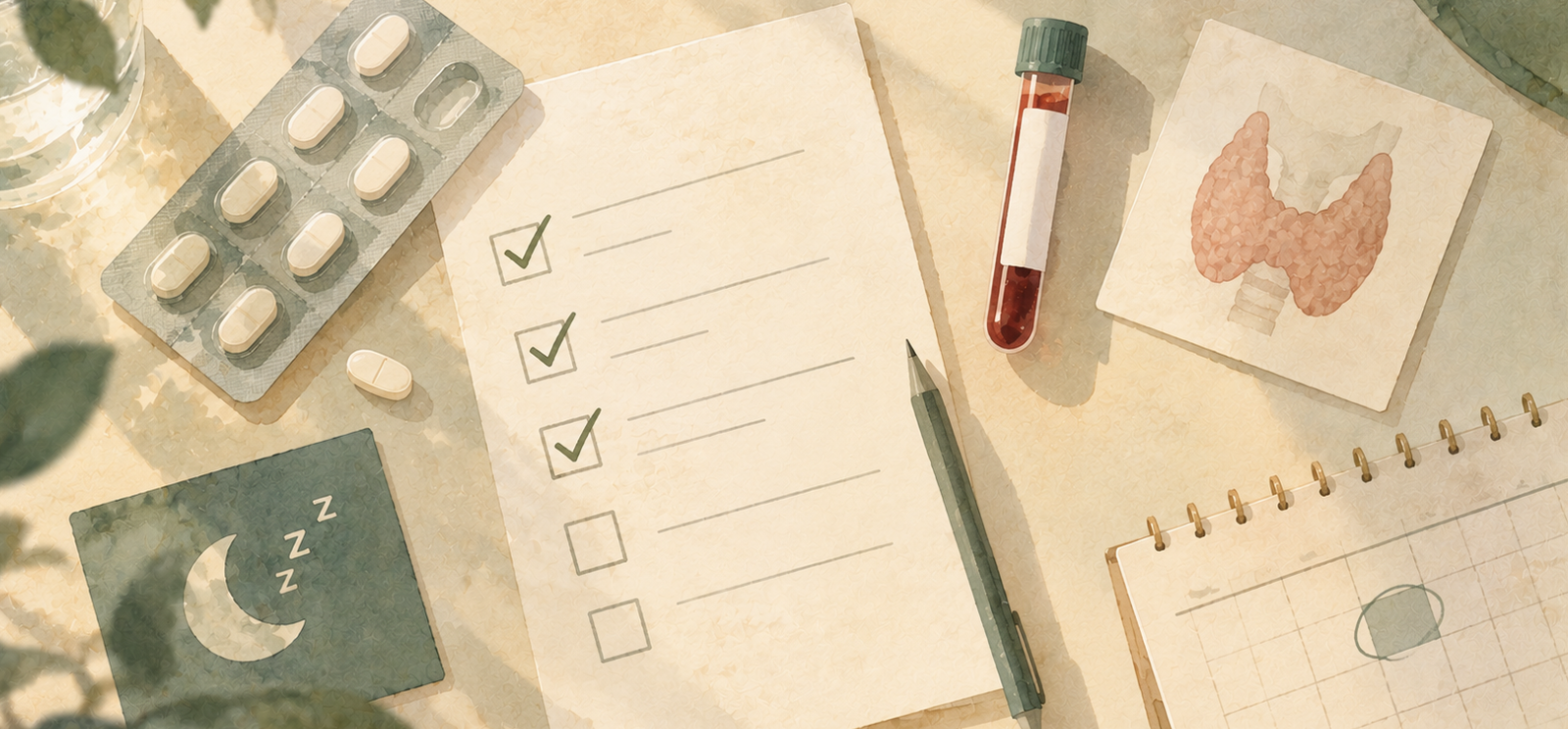
Here is the checklist worth asking for by name.
Dose. Were you ever on a full therapeutic dose, or did you stall at the starting one?
Duration. Did you hold that dose for at least six to eight weeks?
Adherence. How many days a month did you actually miss? Be honest here.
Thyroid. An underactive thyroid mimics depression closely. A simple blood test settles it.
Vitamin B12 and iron. Both are commonly low in India and both drag on mood.
Sleep apnoea. Loud snoring plus daytime exhaustion is worth a sleep study.
Alcohol and cannabis. Regular use makes almost any antidepressant look weak.
Pain and steroids. Chronic pain and some long-term drugs both lower mood.
Bipolar screening. Ask directly whether past highs have been ruled out.
Nine items. Most can be settled in one visit and one blood panel.
Take the list on paper. Hand it over at the start of the visit.
Ask for each one to be ticked off. Not glanced at.
It takes five minutes. It can save a year.
This step is not a delay. It is the step that decides everything after it.
Treating false resistance with stronger medicine rarely works.
Treating the actual cause often does.
The order matters here. Cheap checks come first.
A thyroid test costs little and rules out a lot.
A new drug costs more and may aim at the wrong target.
A caution on the last item. Do not stop any drug on your own to test a theory.
Sudden withdrawal can cause real harm. Every change belongs in a plan.
Q: Can a thyroid problem look like depression that will not lift?
A: Yes. An underactive thyroid causes low mood, fatigue, and slowed thinking. A simple blood test rules it in or out and should be done before any resistant label sticks.
What Happens With Each Further Step
The most useful data here comes from one large trial.
The STAR*D study treated outpatients with depression in ordinary practices. It ran treatment in steps, switching or adding after each failure.
Remission rates for steps one to four were 37%, 31%, 14%, and 13% (Source: Current Psychiatry Reports, 2007 — pubmed.ncbi.nlm.nih.gov).
Read those numbers carefully. They fall, but they never hit zero.
Roughly one in three got well on the first try. Nearly one in three of the rest got well on the second.
Even at step four, one in eight reached remission.
Eight in a hundred is not nothing. It is a real chance.
And it sits at the fourth try, not the first.
Most people quit long before that point.
The trial found one more thing worth knowing. People who needed more steps relapsed more often afterwards, from 40% up to 71% (Source: Current Psychiatry Reports, 2007 — pubmed.ncbi.nlm.nih.gov).
So two lessons come out of this.
First, keep going. Each further step still carries a real chance.
Second, once you are well, stay in care. Relapse risk is highest in exactly this group.
That second point gets ignored constantly.
People reach remission, feel fine, and stop everything at once.
Then the low creeps back in. And the next try starts from scratch.
Plan the taper with your doctor. Months, not days.
Keep one review visit on the books even when you feel well.
Quick Facts: Treatment-Resistant Depression
At least 30% of people with depression meet the two-trial definition of resistance — (Source: World Psychiatry, 2023 — pmc.ncbi.nlm.nih.gov).
Remission rates across four STAR*D steps were 37%, 31%, 14% and 13% — (Source: Current Psychiatry Reports, 2007 — pubmed.ncbi.nlm.nih.gov).
Relapse after remission rose with each extra step, from 40% to 71% — (Source: Current Psychiatry Reports, 2007 — pubmed.ncbi.nlm.nih.gov).
Current depression prevalence in India is 2.7%, and lifetime is 5.2% — (Source: National Mental Health Survey, NIMHANS, 2016 — indianmhs.nimhans.ac.in).
The treatment gap in India runs from 28% to 83% across mental disorders — (Source: National Mental Health Survey, NIMHANS, 2016 — indianmhs.nimhans.ac.in).
Nearly half of people with major depression report trouble with daily tasks — (Source: National Mental Health Survey, NIMHANS, 2016 — indianmhs.nimhans.ac.in).
The Next Moves With Medicine
Three routes open up once a true failure is confirmed.
Raise the dose. The simplest move, and often skipped. Many people never reach the top of the range.
Switch the drug. Usually to a different class. An SSRI to an SNRI, or to bupropion or mirtazapine.
Add a second agent. This is augmentation, and the evidence here is strongest.
Lithium has the longest track record as an add-on. It also lowers suicide risk.
Thyroid hormone is another classic addition, used even when thyroid tests read normal.
Then there are the atypical antipsychotics used at low doses.
Aripiprazole, brexpiprazole, cariprazine and quetiapine XR are all proven add-ons in partial responders (Source: World Psychiatry, 2023 — pmc.ncbi.nlm.nih.gov).
One caution from the same review. Evidence for simply switching drugs or extending a trial is mixed (Source: World Psychiatry, 2023 — pmc.ncbi.nlm.nih.gov).
That is worth knowing if you have been switched five times without any add-on tried.
Ask the direct question. Has augmentation been considered, and why not?
Side effects deserve a frank talk here. Weight gain and sedation are real with several of these.
So is blood monitoring with lithium.
None of that makes them wrong. It makes them a decision you should be part of.
Ask what each add-on is meant to do. Ask how long before you would know.
Ask what would count as a fail. Then fix a date to review it.
A plan with dates beats a plan without one.
Q: Is it better to switch antidepressants or add a second drug?
A: Adding a second agent has stronger evidence than switching alone. Lithium, thyroid hormone, and low-dose atypical antipsychotics are the usual choices. Your psychiatrist weighs this against side effects.
When Tablets Are Not Enough
Some depression does not answer to any tablet combination.
Three options sit beyond the pill bottle. All three are used in India.
Electroconvulsive therapy. ECT is the oldest and still among the strongest.
It is given under anaesthesia, in short courses, usually twice or three times a week.
It is regarded as effective for both acute and ongoing care in resistant depression (Source: World Psychiatry, 2023 — pmc.ncbi.nlm.nih.gov).
Memory effects around the treatment period are the main drawback. Most fade.
Repetitive transcranial magnetic stimulation. rTMS uses magnetic pulses on the scalp.
No anaesthesia. No seizure. You sit in a chair and go home after.
It is established as effective and carries US regulatory approval for this group (Source: World Psychiatry, 2023 — pmc.ncbi.nlm.nih.gov).
Courses run daily on weekdays for several weeks, which is the main practical hurdle.
Ketamine and esketamine. Both are established as effective in resistant depression (Source: World Psychiatry, 2023 — pmc.ncbi.nlm.nih.gov).
They work far faster than tablets, sometimes within days. They are given under supervision, never at home.
That speed matters when risk is high.
Weeks of waiting are not always safe.
Fast relief buys time for the slower work to start.
Choosing between these three is a real decision with real trade-offs. We cover that comparison separately.
What matters here is simpler. These exist, they work, and they are not a last resort reserved for the desperate.
Cost and travel shape the choice as much as the science does.
A daily trip for weeks is hard if you work full time.
Ask about both before you pick. The best plan is the one you can finish.
Q: Is ECT still used for depression in India?
A: Yes, and it remains one of the most effective options for severe or resistant depression. It is given under anaesthesia in short courses. Modern practice looks nothing like its old reputation.
Therapy and Daily Structure Still Count
There is a myth that once medicine fails, talking is pointless.
The evidence says otherwise, with one honest caveat.
Manual-based psychotherapy on its own is not established as effective in resistant depression. But added to medicine, it gives clear symptom relief (Source: World Psychiatry, 2023 — pmc.ncbi.nlm.nih.gov).
So therapy is not a replacement here. It is a multiplier.
Which kinds help most?
Cognitive behavioural therapy remains the best studied. It targets the thinking loops that keep low mood running.
Behavioural activation is simpler and often more useful when energy is gone. You schedule small actions first, and wait for mood to follow.
Family sessions matter more than people expect. Long depression wears out the household too.
Then there is the unglamorous part.
Sleep at fixed hours, even on bad nights. Daylight early in the day. Movement most days, however brief.
Cut alcohol properly, not partly. It is the single change with the fastest return.
Cut late-night screens too. Light at night pushes sleep later.
Eat at set times. Skipped meals drag mood down by evening.
None of this is a cure. All of it clears the way.
None of this cures resistant depression. All of it raises the ceiling on what treatment can reach.
Think of it as clearing the runway. The medicine still has to fly the plane.
Start with one change, not six. Pick the one you can hold for a month.
Sleep is usually the best first pick. Fixed hours beat long hours.
Small and steady wins here. Big and brief does not.
Q: Does therapy help if antidepressants have already failed?
A: On its own it is not established as enough for resistant depression. Added to medicine, it gives real extra relief. CBT and behavioural activation are the usual choices.
What This Looks Like in India
The treatments are the same worldwide. Access is what differs.
Start with scale. Current depression prevalence in India is 2.7%, and lifetime prevalence is 5.2% (Source: National Mental Health Survey, NIMHANS, 2016 — indianmhs.nimhans.ac.in).
Now add the gap. The same survey put the treatment gap between 28% and 83% across mental disorders (Source: National Mental Health Survey, NIMHANS, 2016 — indianmhs.nimhans.ac.in).
So most people never get a first proper trial, let alone a second.
That shapes what resistance means here.
A lot of Indian depression labelled resistant is simply under-treated depression.
Prescriptions get repeated at a chemist for years. Nobody reviews the dose.
Visits run short. A full mood history rarely fits.
And the burden is heavy. Nearly half of people with major depression report trouble with daily tasks (Source: National Mental Health Survey, NIMHANS, 2016 — indianmhs.nimhans.ac.in).
Indian research on this is active, not absent. A decade-long review found 36 Indian studies on depression treatment, including five on brain stimulation (Source: Indian Journal of Psychiatry, 2023 — pubmed.ncbi.nlm.nih.gov).
Practically, here is what helps.
Ask for a written treatment history at every visit. Carry it yourself.
Push for a psychiatrist rather than repeat prescriptions from a general clinic.
A second opinion is not rude. It is normal care.
Most good doctors expect it and welcome it.
If yours does not, that tells you something too.
Ask whether ECT or rTMS is available locally, or at the nearest teaching hospital.
And budget for review visits, not just for drugs. The review is where the plan improves.
Keep all reports in one folder. Blood tests, notes, old strips.
Take it to every visit, even a new one.
A new doctor with your full history is worth more than a famous one without it.
Q: Why is depression often under-treated in India?
A: Most people never reach specialist care at all. Prescriptions get repeated without review, and short visits leave no room for a full history. Under-treatment then gets mistaken for resistance.
How Ganaa Approaches Depression That Has Not Responded
Ganaa has worked in mental health care in India since 2012. We treat psychiatric conditions and substance use across age groups (Source: Ganaa, 2026 — ganaa.in).
When someone arrives after several failed drugs, we do not start by adding another.
We start by rebuilding the history. Every drug, every dose, every honest gap in taking it.
We check the physical ground first. Thyroid, B12, sleep, drinking, pain.
We ask carefully about past highs, because a missed bipolar pattern changes the whole plan.
Only then does the treatment question open up.
Most people are seen as outpatients. Our clinics sit in Faridabad, Greater Kailash, and Greater Noida.
Live-in centres are in Delhi, Gurugram, Greater Noida, and South Goa (Source: Ganaa, 2026 — ganaa.in).
Our Gurugram centre is an acute care premium facility, which matters when depression turns severe (Source: Ganaa, 2026 — ganaa.in).
Care blends psychiatric treatment with psychology sessions, family counselling, and holistic therapy (Source: Ganaa, 2026 — ganaa.in).
Treatment is tailored to the person, not run off a template.
Where a stay is needed, our published guidance puts programme length at 30 to 90 days (Source: Ganaa FAQ, 2026 — ganaa.in).
Aftercare continues once someone goes home. For a condition with high relapse risk, that continuity is the whole point.
Support runs 24 hours a day.
If two or more drugs have not worked for you, a full review is worth having.
Speak to a Ganaa counsellor on +91 8750075006, or write to info@ganaa.in. You can also book a consultation at ganaa.in/booking.
Conclusion: The Label Is a Turning, Not an Ending
Depression that resists two drugs is common. At least three in ten people meet that mark.
It is not a sign that you are broken. It is a sign the plan needs changing.
Start by checking whether the trials were real. Full dose, full length, taken daily.
Then clear the ground. Thyroid, B12, sleep, drinking, pain, and any past highs.
After that, the options open out. Raise, switch, or add. Lithium and low-dose add-ons have the best evidence.
Beyond tablets sit ECT, rTMS, ketamine and esketamine. All three work. All three are available in India.
Keep therapy in the plan throughout. It adds real relief on top of medicine.
And remember what the step data showed. People kept getting well at every further stage.
The odds narrow. They do not close.
Help exists at each stage. It is not all in one place.
Some of it is a blood test. Some of it is a new drug. Some of it is a machine.
And some of it is just sleep, and time, and being asked the right question.
If you are on your third drug and losing hope, that hope is not the evidence talking.
Bring your list. Ask what has not yet been tried.
Then ask why not.
FAQ
Q: What is treatment-resistant depression?
A: It means depression that has not responded to at least two antidepressants. Each trial must have run at a proper dose. It must have run long enough. And it must have been taken as prescribed. Regulators in the US and Europe use this same two-trial definition.
Q: How common is treatment-resistant depression?
A: At least 30% of people with depression meet the two-trial definition. That figure comes from a 2023 World Psychiatry review. So it is a common outcome, not a rare or unusual one.
Q: Why did my antidepressant stop working after it helped at first?
A: This is often called poop-out. Sleep loss, drinking, thyroid problems, and new stress can all blunt a drug that once worked. A missed bipolar pattern is another common cause. Tell your psychiatrist rather than stopping on your own.
Q: What should be checked before accepting a treatment-resistant label?
A: Dose, duration, and whether the tablets were actually taken daily. Then thyroid function, vitamin B12, anaemia, sleep apnoea, and drinking. A missed bipolar pattern should also be ruled out. Many people called resistant are in fact under-treated.
Q: What are the treatment options after two failed antidepressants?
A: Raising the dose, or switching drug class. Or adding a second agent, such as lithium or a low-dose antipsychotic. Beyond tablets, the options are ECT, rTMS, and ketamine or esketamine. Therapy added to medicine gives clear extra relief.
Q: Does treatment-resistant depression ever get better?
A: Yes. In the STAR*D trial, people kept reaching remission at every further step. The odds fall as steps add up, but they do not reach zero. Many people recover on a third or fourth approach.
Q: Is treatment-resistant depression treated differently in India?
A: The treatments are the same ones used worldwide. Access is the difference. ECT and rTMS sit mostly in large cities and teaching hospitals. Getting a proper second opinion is often the harder step.
The cost of mental health rehab in India is rarely published openly. Here is what moves the price, what insurance must cover by law, and what to ask first.
Bipolar misdiagnosed as depression is common, and the delay runs close to nine years. Learn the clues, why hypomania is missed, and how to get a better review.
Adolescent mental health in India is under-treated. Learn 11 warning signs parents miss, what the data shows, how to start the talk, and when to seek help.