What Is Psychosis? Signs, Causes and What Families Can Do
What is psychosis? Learn the signs, causes and treatment in plain words, how it differs from schizophrenia, and what your family can do tonight.
What Is Psychosis? Signs, Causes and What Families Can Do
Psychosis means a person has lost some contact with reality.
That is the plain answer to the question, what is psychosis. Thoughts and senses get disrupted, and it becomes hard to tell what is real (Source: National Institute of Mental Health, 2023 — nimh.nih.gov).
It is a state, not a diagnosis. Think of a fever. A fever tells you something is wrong, but not what.
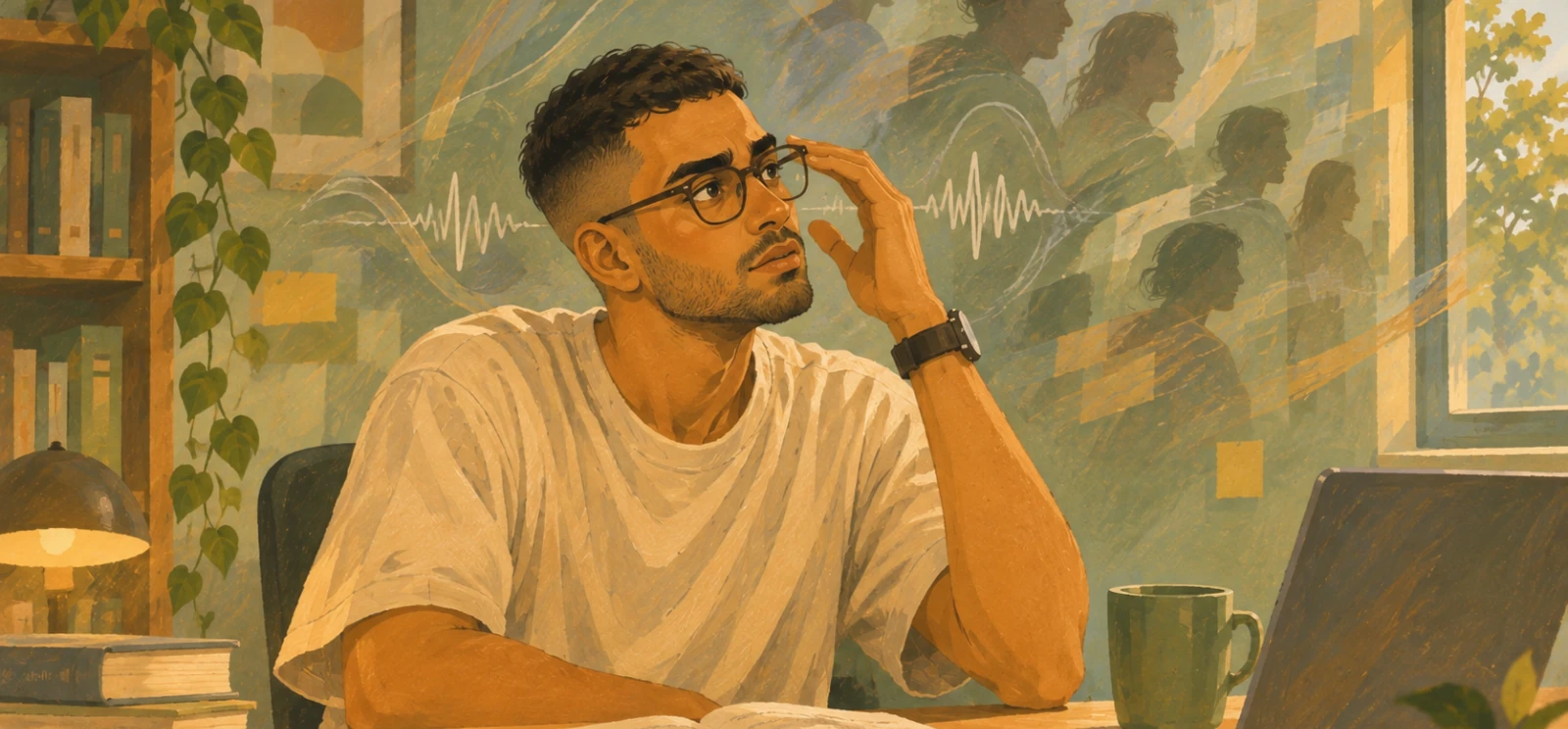
You may have seen it at home without having a word for it.
A son who is sure the neighbours are poisoning the water. A sister who answers a voice nobody else can hear. A father whose sentences suddenly stop making sense.
Families are often frightened, and often ashamed. Many wait, and many try everything else first.
This guide is for those families. It covers the signs, the early warning phase, and the causes doctors check first.
It explains how psychosis differs from neurosis and from schizophrenia. It also covers treatment, and exactly what to do tonight if someone at home is unwell.
One note before we start. This is general guidance, not a diagnosis. Only a psychiatrist or a qualified clinician can assess a person.
What Is Psychosis? The Short, Plain Answer
During psychosis, the brain starts to treat false signals as true.
The person may see or hear things others do not. They may hold beliefs that facts cannot shift. Their speech may stop making sense.
It is not one illness. It is a set of symptoms with many possible causes. So the cause has to be found.
It is also not rare. Studies suggest that 15 to 100 people out of 100,000 develop it each year (Source: National Institute of Mental Health, 2023 — nimh.nih.gov).
It often begins in young adulthood, from the late teens to the mid-20s (Source: National Institute of Mental Health, 2023 — nimh.nih.gov). That is when many people are studying, starting work, or getting married.
Older adults can have it too, sometimes along with a brain or memory illness.
Now for what it is not.
It is not a split personality. It is not weak character. It is not bad parenting, and it is not a punishment.
It does not make a person a danger by default. Often, the person is more scared than scary.
Risk can rise during an episode, and it is right to take that seriously. The good news is that the risk of violence and suicide falls with treatment (Source: National Institute of Mental Health, 2023 — nimh.nih.gov).
One more point may calm you. A single odd moment is not an illness.
A world survey found that 5.8% of people had at least one psychotic experience in their lifetime. Of those, 32.2% had it only once (Source: McGrath et al., JAMA Psychiatry, 2015 — pubmed.ncbi.nlm.nih.gov).
So hearing your name once as you fall asleep is not a reason to panic. A pattern that grows and starts to harm daily life is a reason to act.
Q: Is psychosis a mental illness?
A: It is a set of symptoms, not one illness. It can be part of schizophrenia, bipolar disorder, or severe depression. It can also come from drugs, sleep loss, or a physical illness.
Psychosis Symptoms: What You Will Actually See at Home
Textbooks use long words. Families see small, strange moments.
Here are the main psychosis symptoms, in plain language.
Hallucinations. The person hears, sees, smells, or feels things that are not there. Hearing voices is a common form. The voice may comment, criticise, or give orders.
Delusions. These are fixed false beliefs. Someone may believe people on television are sending them messages, or that others are trying to hurt them.
Disturbed thinking. Speech jumps from topic to topic. Sentences may not connect, and you lose the thread.
Odd behaviour. The person may laugh for no clear reason, or act in ways that do not fit the moment.
Loss of drive. Speech gets shorter. Feeling goes flat. Interest fades, and the person pulls away.
For schizophrenia, the World Health Organization lists one more sign. A person may feel that someone else is putting thoughts into their mind, or taking them out (Source: World Health Organization, 2026 — who.int).
Picture what that is like from the inside. It is hard to think straight when your own mind feels unsafe.
The voice sounds as real as your own mother calling from the next room. The belief feels as certain as your own name.
So the person is not lying, and they are not being stubborn. To them, the danger is real. That is why they may stop eating food at home, or refuse to leave a room.
This leads to the hardest part. Many people in this state do not believe they are ill.
In schizophrenia, estimates of people not aware of having a mental illness range from 50% to 98% (Source: CNS Spectrums, PMC, 2024 — pmc.ncbi.nlm.nih.gov).
That is part of the illness. It is not denial, and it is not disrespect.
It also explains why reasoning rarely works. Your facts cannot beat what their brain is telling them.
Q: Why does my relative insist the voices are real?
A: Because to them, they are real. The brain is producing the experience, and it feels the same as normal hearing. Many people cannot see this during an episode. Treatment often helps that awareness return.
The Early Warning Phase Most Families Miss
It does not always arrive overnight.
Often the person changes slowly for weeks or months first. You may feel something is off, but you cannot name it. Each change looks small, so each one gets an easy excuse.
It is exam stress. It is a bad boss. It is just a phase.
Here are the warning signs that can come before psychosis (Source: National Institute of Mental Health, 2023 — nimh.nih.gov):
Suspicion, or feeling uneasy around other people.
Trouble thinking clearly.
Pulling away and spending much more time alone.
Strange new ideas, or too much or too little feeling.
Less care with bathing and clothes.
Sleep that gets shorter and more broken.
A sudden drop in marks or work.
Here is how that can look in an Indian home.
A college student stops going to class and keeps the door locked. They stop bathing. They sleep through the day, stay up all night, and start asking who is outside.
Each sign alone proves nothing. Together, they deserve attention.
Expert advice is clear. Do not assume it is just a phase, or that the signs will fade alone (Source: Mental Health First Aid Canada, guidelines — mentalhealthcommission.ca).
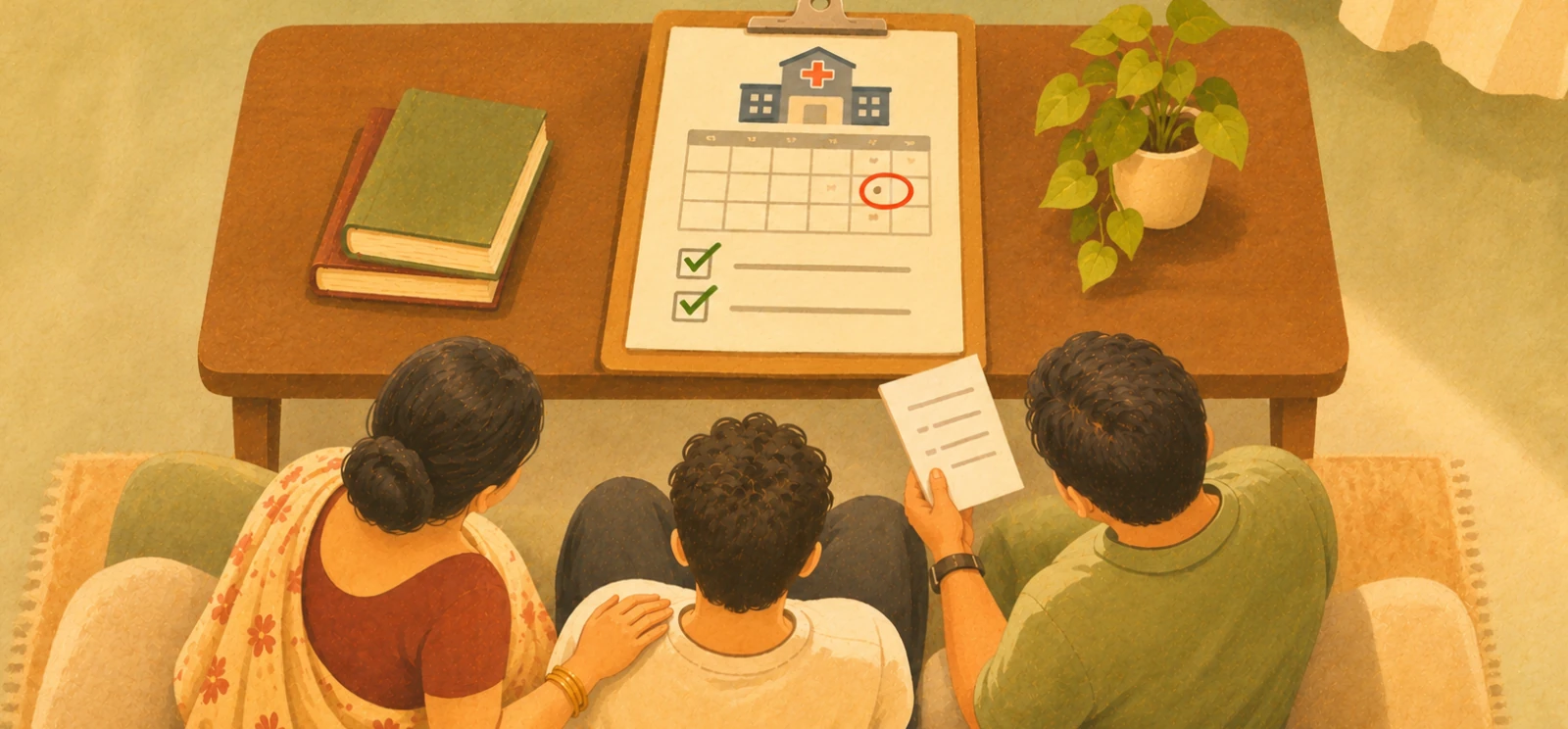
You do not need to be sure before you act. A check-up is not a label.
Start a small diary. Write the date, how they slept, and what they said or did. Note any drinking, cannabis, or new medicine.
Doctors find this a great help. A person who is unwell may not tell them these things.
A: It differs from person to person. Some people change slowly over many months. Others change within days. A sudden change needs faster medical attention, not more time to watch and wait.
What Causes Psychosis? Why a Medical Check Comes First
There is no one cause of psychosis.
Research points to a mix of genes, brain development, and stress or trauma (Source: National Institute of Mental Health, 2023 — nimh.nih.gov).
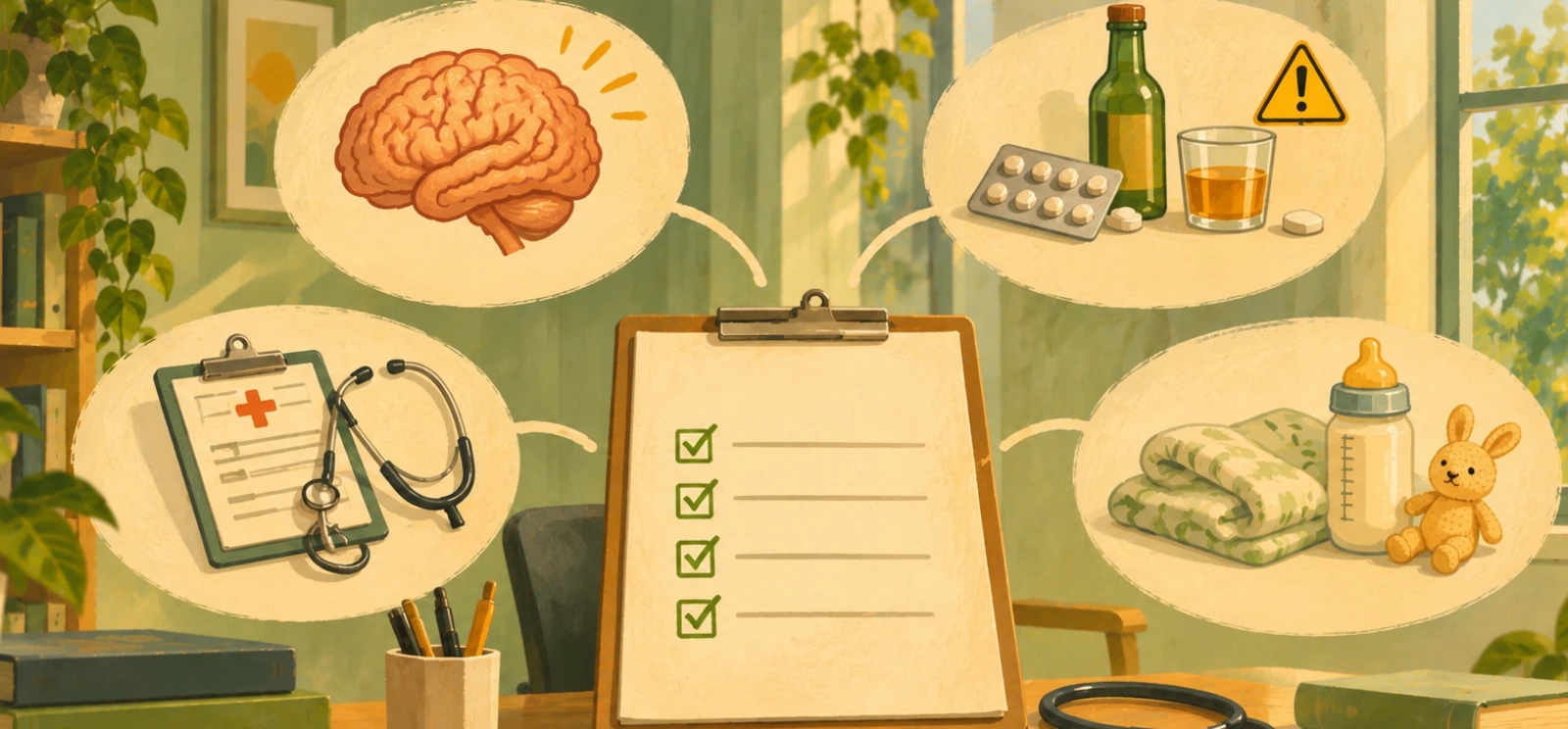
It helps to sort the likely causes into four groups.
Drugs and alcohol. Psychosis can follow the misuse of alcohol or drugs. It can also follow certain prescribed medicines and severe sleep loss (Source: National Institute of Mental Health, 2023 — nimh.nih.gov).
Stopping the drug is not always the end of the story. In one large review, 25% of people with substance-induced psychosis later moved on to schizophrenia. With cannabis, that figure was 34% (Source: Murrie et al., Schizophrenia Bulletin, 2020 — pmc.ncbi.nlm.nih.gov).
So please tell the doctor the truth about any drug use. Nobody is there to judge your child.
Physical illness. Infections, fits, immune problems, and changes in body chemistry can all cause it (Source: Initial physical health assessment for psychosis, PMC, 2026 — pmc.ncbi.nlm.nih.gov).
In older adults, it can come with Parkinson's disease, Alzheimer's disease, or other dementias (Source: National Institute of Mental Health, 2023 — nimh.nih.gov).
Recent advice from Australia and New Zealand covers later onset too. Anyone who first shows signs after age 40 should be checked for delirium and dementia (Source: Initial physical health assessment for psychosis, PMC, 2026 — pmc.ncbi.nlm.nih.gov).
After childbirth. Postpartum psychosis is rare, affecting 1 to 2 of every 1,000 women. It can start suddenly and put mother and baby in danger (Source: Current Psychiatry Reports, PMC, 2023 — pmc.ncbi.nlm.nih.gov).
It is a psychiatric emergency, so please do not wait (Source: Clinical Obstetrics and Gynecology, PMC, 2018 — pmc.ncbi.nlm.nih.gov).
This is why a first episode needs a full check by a doctor. India's health ministry notes that no specific test can confirm psychosis. Tests depend on the possible causes (Source: Ministry of Health & Family Welfare guidelines — clinicalestablishments.mohfw.gov.in).
Your doctor will choose what is needed. Indian guidance says a brain scan may be useful in a first episode (Source: Indian Psychiatric Society guidelines, PMC, 2017 — pmc.ncbi.nlm.nih.gov).
Take every medicine in the house to the first visit, plus your diary. Mention any family history of mental illness. Mention any recent fever or head injury too.
Q: Can cannabis cause psychosis?
A: Yes, it can. Psychosis linked to cannabis is a known problem, and some people go on to develop a longer illness. Tell the doctor honestly about any use. It changes how the person is assessed and treated.
Neurosis vs Psychosis, and Psychosis vs Schizophrenia
Two pairs of words confuse many people. Here is each one, in plain words.
Neurosis vs psychosis. The word neurosis is old, and you may still hear it from elders or in textbooks.
The main American manual of mental illness dropped it from official use in 1980. It was seen as confusing and it carried stigma (Source: Neuropsychiatric Disease and Treatment, PMC, 2007 — pmc.ncbi.nlm.nih.gov).
Its parts got new names. Anxiety neurosis, for one, was split into generalised anxiety disorder and panic disorder (Source: Dialogues in Clinical Neuroscience, PMC, 2017 — pmc.ncbi.nlm.nih.gov).
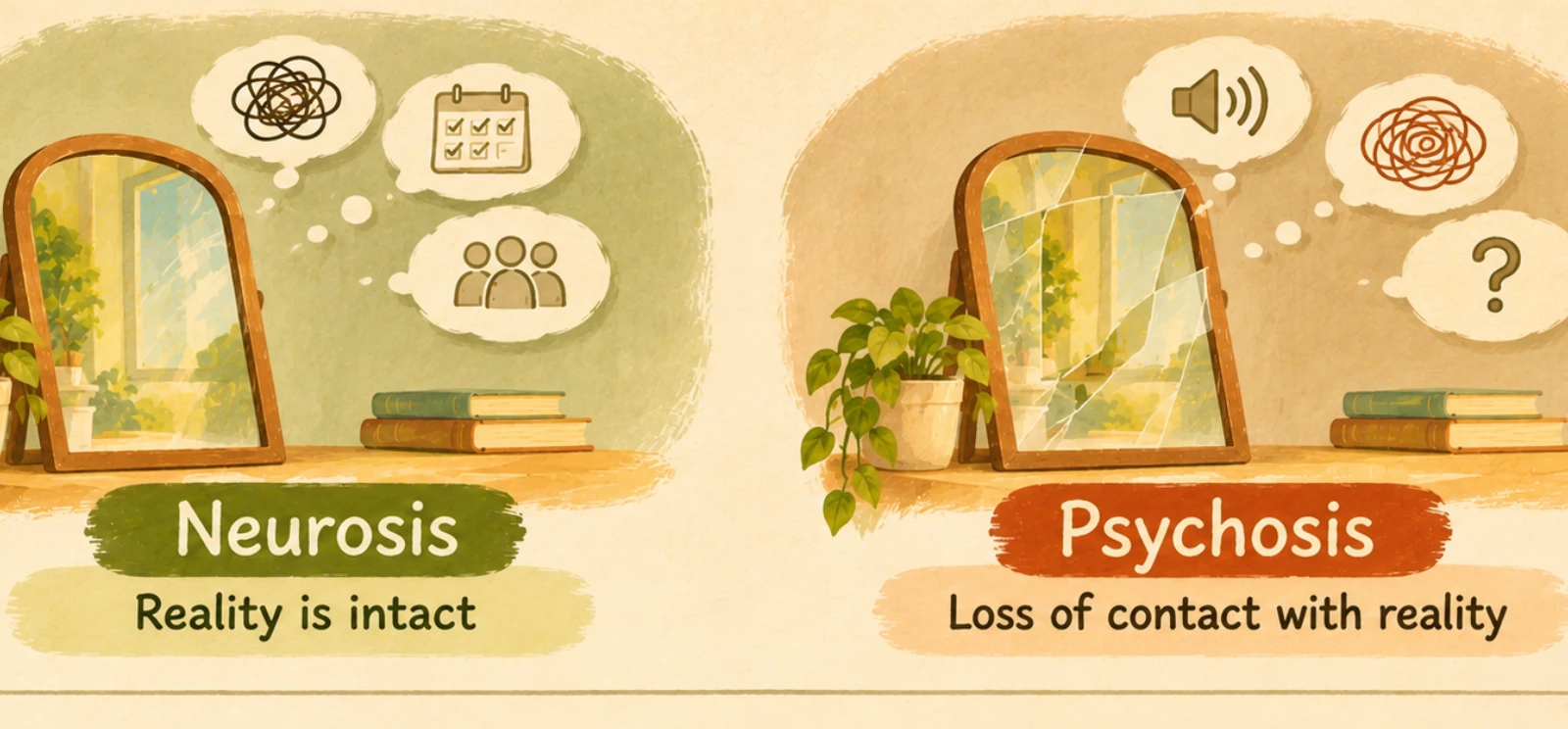
The old split still helps. It comes down to contact with what is real.
QuestionNeurosis (older term)PsychosisContact with realityStays in placePartly lostAwareness of a problemPerson usually knows something is wrongPerson often does notTypical experienceWorry, fear, low mood, repeated checkingVoices, fixed false beliefs, jumbled speechToday's namesAnxiety disorders, OCD and related conditionsPart of schizophrenia, bipolar disorder, or other causes
Someone with anxiety may fear the plane will crash, but they know the fear is too large. Someone with psychosis may be certain the pilot is sending them secret signals.
Psychosis vs schizophrenia. This one matters more, because it causes the most panic.
Psychosis is the symptom state. Schizophrenia is one illness that can cause it.
So the two words do not mean the same thing. A person can have psychosis and never be diagnosed with schizophrenia or any other disorder (Source: National Institute of Mental Health, 2023 — nimh.nih.gov).
Time helps doctors tell them apart. India's health ministry describes acute psychosis as symptoms that appear within 2 weeks. Full improvement often follows within 1 to 3 months (Source: Ministry of Health & Family Welfare guidelines — clinicalestablishments.mohfw.gov.in).
A short episode does not rule out a later illness, though. Regular check-ups keep the person safe.
Q: Does a first psychotic episode mean schizophrenia?
A: No. Many causes can produce a first episode, including drugs, sleep loss, mood illness, and physical illness. A doctor needs time and tests before giving any name. Please do not settle on that word alone at home.
Why Help Arrives Late in India, and Why Time Matters
Most people in India with psychosis do not get care.
The National Mental Health Survey put the treatment gap for psychosis at 75.5% (Source: National Mental Health Survey summary, PMC, 2017 — pmc.ncbi.nlm.nih.gov).
Families are rarely careless. They are usually doing their best with the only map they have.
India's health ministry names a common belief that the illness has a religious or supernatural cause. That belief often delays care. Stigma delays it further (Source: Ministry of Health & Family Welfare guidelines — clinicalestablishments.mohfw.gov.in).
So many people go first to someone they trust. A study of 177 patients in Delhi and Chennai shows this.
A faith healer was the first contact for 45.7% of patients in the north. In the south, it was 23.6%. Time without treatment was about 34 weeks in the north and about 16 weeks in the south (Source: Singh et al., Asian Journal of Psychiatry, 2023 — wrap.warwick.ac.uk).
We are not here to judge that. Faith gives many homes strength, and you will need that strength.
The risk is not in the prayer. The risk is in the months that pass without a doctor.
And those months matter. Worldwide, it is common to have symptoms for more than a year before treatment (Source: National Institute of Mental Health, 2023 — nimh.nih.gov).
A review covering 25,657 patients tested what that delay costs. Longer time without treatment was linked to worse symptoms later and a lower chance of remission (Source: Howes et al., World Psychiatry, 2021 — pmc.ncbi.nlm.nih.gov).
Meanwhile, life moves on without the person. College seats go. Jobs go. Friends drift away. The whole home gets more tired.
If months or years have already passed, please do not punish yourself. Starting late is still far better than not starting. Treatment can help at any stage.
Q: Should we stop our prayers or visits to our place of worship?
A: No. Prayer and medical care can sit side by side. The only thing to avoid is letting anything replace a doctor's visit. Tell the doctor what your family believes. A good clinician will respect it.
How Psychosis Is Treated
Care works best as a team effort, with more than one part.
Medicine. Treatment usually includes antipsychotic medicine. There are several types, with different side effects, so the choice is made with a doctor (Source: National Institute of Mental Health, 2023 — nimh.nih.gov).
For schizophrenia, Indian guidance suggests 1 to 2 years of ongoing treatment after a first episode. It also says any dose cut should be slow (Source: Indian Psychiatric Society guidelines, PMC, 2017 — pmc.ncbi.nlm.nih.gov).
This is the point many families get wrong. The person feels better, so the tablets stop.
Please speak to the psychiatrist first. Never stop or change a dose on your own.
Team care. Early care often uses a team. The team shares choices with the person and their family. It works best when it starts soon (Source: National Institute of Mental Health, 2023 — nimh.nih.gov).
Family work. India has a long tradition of keeping families in care. Family programmes teach what the illness is, how care works, and how to respond (Source: Indian Psychiatric Society guidelines, PMC, 2017 — pmc.ncbi.nlm.nih.gov).
Rebuilding. Once symptoms settle, the work is to rebuild life. That means a daily routine, social skills, and a slow return to study or work.
This takes time. Some days will be good. Some days will not. That is normal, and it does not mean the care has failed.
Hospital care. Most people can be treated as outpatients. The aim is the least restrictive setting that still meets everyone's needs (Source: Indian Psychiatric Society guidelines, PMC, 2017 — pmc.ncbi.nlm.nih.gov).
Ask about hospital care when someone may hurt themselves or others. Ask too when they have stopped eating, or when home is no longer safe.
What can you hope for? The news is better than most families expect.
A review of 79 studies looked at people after a first episode. Over several years, 58% reached remission and 38% reached recovery (Source: Lally et al., British Journal of Psychiatry, 2017 — pubmed.ncbi.nlm.nih.gov).
Remission means the symptoms settle. Recovery goes further, to a working daily life. Those numbers are not a promise for any one person. They do show that a good life after this is possible.
Q: Can psychosis go away completely?
A: For many people, yes. Some have one episode and do well. Others need longer care to stay well. It depends on the cause, how early care starts, and how steadily treatment continues.
What to Do Tonight: A Family Guide
If someone at home seems unwell right now, here is a calm plan. It draws on expert first-aid advice for psychosis (Source: Mental Health First Aid Canada, guidelines — mentalhealthcommission.ca).
You do not have to fix this tonight. You only have to keep things calm and keep people safe.
That is a smaller job, and you can do it.
How to talk to them.
Lower the noise. Send extra people out of the room and turn off the TV.
Speak quietly and slowly. Use short, simple sentences.
Give them space. Do not touch them without permission.
Do not argue about the voices or the belief. Do not agree with it either.
Speak to the feeling instead. Saying "I can see this is scaring you, and I am here" is enough.
Name what you have seen, without guessing a diagnosis. Saying "You have not slept for three nights, and I am worried" stays with the facts.
Answer questions calmly and honestly. Do not make promises you cannot keep.
What not to do.
Do not laugh at, mock, or use sarcasm about what they say.
Do not act shocked or embarrassed.
Do not feed their fear, such as by checking for spies with them.
Do not criticise or blame them.
Do not threaten them with hospital. It breaks trust you will need later.
When it is an emergency. Get help now, even if the person refuses, if any of these are true.
They talk about dying or harming themselves.
They threaten someone, or a voice is telling them to hurt someone.
They have a weapon, or they are breaking things.
They have stopped eating or drinking.
They are confused, feverish, or drowsy.
They are a new mother with any of these signs.
Ask them plainly if they are thinking of suicide. Stay with them. Do not leave them alone if that is not safe.
Move sharp objects, ropes, and medicines out of reach. Keep your own way out of the room clear.
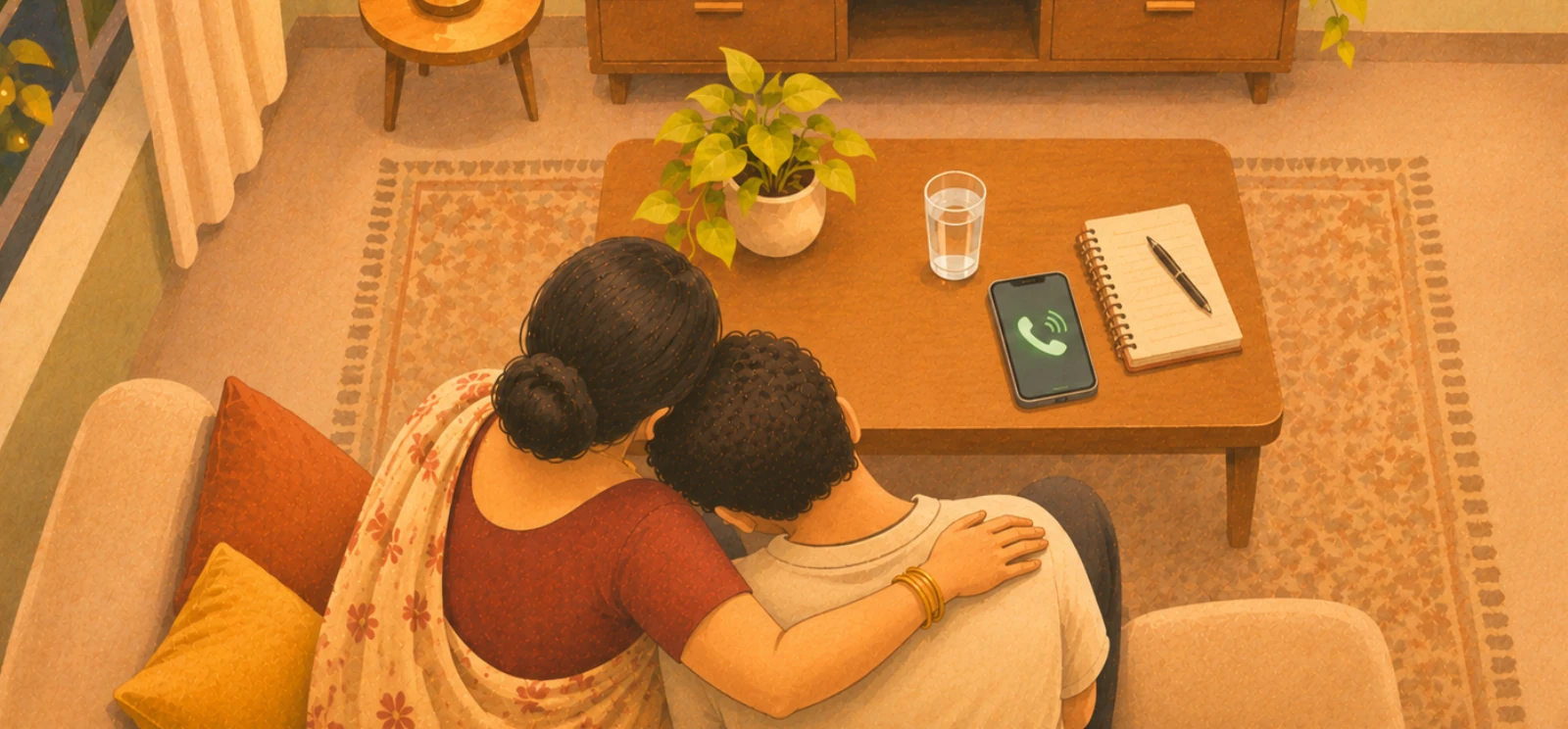
Who to call. Tele-MANAS is the government's mental health helpline. The number is 14416 (Source: Press Information Bureau, 2024 — pib.gov.in). The service runs 24x7 and is free of cost (Source: Press Information Bureau, 2023 — pib.gov.in).
You can also call the 24/7 Ganaa helpline on +91 8750075006. Or go to your nearest hospital emergency room.
When you call, give clear facts. Say what the person is doing and saying, and whether they have a weapon.
If the person refuses help and there is no immediate danger, stay friendly and keep the door open. Insight often takes time.
Then look after yourself too. Eat something. Sleep when you can. Ask one person you trust to share the load.
This may be a long road. A tired carer makes more mistakes, and you matter as well.
Q: Should I play along with what they believe?
A: No need to agree, and no need to argue. You can say you do not see it, while accepting that it feels real to them. Then return to the feeling, and to what would help them feel safe right now.
Quick Facts: Psychosis
Between 15 and 100 people out of 100,000 develop psychosis each year — (Source: National Institute of Mental Health, 2023 — nimh.nih.gov).
In India, the treatment gap for psychosis is 75.5% — (Source: National Mental Health Survey summary, PMC, 2017 — pmc.ncbi.nlm.nih.gov).
About 5.8% of people report a psychotic experience in their life, and 32.2% of those report only one — (Source: McGrath et al., JAMA Psychiatry, 2015 — pubmed.ncbi.nlm.nih.gov).
After a first episode, pooled remission was 58% and recovery was 38% — (Source: Lally et al., British Journal of Psychiatry, 2017 — pubmed.ncbi.nlm.nih.gov).
Longer untreated psychosis is linked to a lower chance of remission — (Source: Howes et al., World Psychiatry, 2021 — pmc.ncbi.nlm.nih.gov).
Tele-MANAS offers free mental health support on 14416 — (Source: Press Information Bureau, 2024 — pib.gov.in).
How Ganaa Supports People With Psychosis
Ganaa has served patients since 2012, across inpatient and outpatient care (Source: Ganaa, 2026 — ganaa.in).
Our name means community in Hindi, and that shapes how we work (Source: Ganaa, 2026 — ganaa.in). Nobody here is meant to face this alone.
A first step does not have to be a big one. Often it is a single talk with a psychiatrist. They will listen, take a full history, and tell you what they think is going on.
We run five outpatient clinics, in Greater Kailash II, Gurugram, Greater Noida, Faridabad and Panaji. We run five hospitals and rehabs, in South Delhi, Chattarpur, Gurugram, Greater Noida and South Goa. A sixth is opening soon in Lonavala (Source: Ganaa, 2026 — ganaa.in).
Our acute care is meant for people with severe mental illness, suicidal thoughts, aggression, or psychotic episodes. It also serves those who cannot care for themselves. The aim is to stabilise the person, keep them safe, and start the right treatment (Source: Ganaa FAQ, 2026 — ganaa.in).
Our residential centres offer a 2:1 staff-to-client ratio and 24/7 medical and psychiatric support. We accept both voluntary and involuntary admissions (Source: Ganaa, 2026 — ganaa.in).
For schizophrenia, our care includes antipsychotic therapy, family education, cognitive remediation, and social skill development (Source: Ganaa, 2026 — ganaa.in). You can read more on our schizophrenia treatment page.
Families stay in the loop. A psychologist gives regular updates, along with daily WhatsApp updates (Source: Ganaa FAQ, 2026 — ganaa.in).
A stay in rehab most often runs 30 to 90 days, based on how severe the condition is. The medical team, the patient, and the family plan discharge together (Source: Ganaa FAQ, 2026 — ganaa.in).
Care does not end at discharge. Post-care includes periodic reviews with a psychiatrist and therapy sessions with a psychologist (Source: Ganaa FAQ, 2026 — ganaa.in).
Speak to a Ganaa counsellor on +91 8750075006, or write to info@ganaa.in. You can also book a visit at ganaa.in/booking.
Conclusion: What Is Psychosis, and What Comes Next
So, what is psychosis? It is a loss of contact with what is real, and it is a sign to see a doctor.
It is not a curse, a character flaw, or a family failure.
The person is not choosing this. What they see, hear, and believe feels fully real to them.
The cause can differ from one person to the next. That is why a medical check comes first. No family should settle on a label at home.
Time is the part you can control. Long delays are linked to worse results. Steady care gives the person a real chance to get well.
You have seen the signs to watch for. You know why a doctor should check the body as well as the mind. You know what to say, and what not to say, on a hard night.
Keep your faith, your family, and your love. Add a doctor to that circle.
If today is a bad day, do three things. Stay calm. Do not argue. Make one call.
If today is a quiet day, write down what you have noticed. Then book the appointment before the next episode decides for you.
You do not need the right words, and you do not need to be certain. You only need to take the first step.
That one step can give someone their life back, one small day at a time.
FAQ
Q: What is psychosis in simple words?
A: Psychosis means losing some contact with reality. A person may hear or see things others do not, or hold false beliefs firmly. It is a set of symptoms, not one illness, and it can have many causes.
Q: What are the first signs of psychosis?
A: Early signs include suspicion, pulling away from others, and poor sleep. Watch too for less self-care, muddled thinking, and a sudden drop in work or marks. These can build slowly. A doctor should see any pattern that grows or does not go away.
Q: What is the difference between neurosis and psychosis?
A: Neurosis is an older term for conditions such as anxiety, where contact with reality stays in place. In psychosis, that contact is partly lost. The person may hear voices or hold fixed false beliefs. They often do not see that anything is wrong.
Q: Is psychosis the same as schizophrenia?
A: No. Psychosis is a symptom state, and schizophrenia is one illness that can cause it. People can also have psychosis because of bipolar disorder, severe depression, drugs, sleep loss, or a physical illness.
Q: Can a person recover from psychosis?
A: Yes, many people do. Research shows that a large share reach remission after a first episode, and many go on to recover. Early care and steady follow-up improve the chances. Results differ from person to person.
Q: Can stress cause psychosis?
A: Stress and trauma can play a part, usually along with genes and brain development. Severe sleep loss can also trigger symptoms. A doctor should still look for other causes, since physical illness and drugs can look very similar.
Q: What should I do if someone is having a psychotic episode?
A: Stay calm and speak in short, quiet sentences. Do not argue about what they believe. If there is any risk of harm, get urgent help. Go to a hospital emergency room, or call Tele-MANAS on 14416.
What is a mental hospital? Learn what asylums were, how Indian law changed, who the patients are, what a day inside looks like, and how to check standards.
Psychologist price in India, checked: what 139 public listings show, why fees differ, what a full course costs, and the free and low-cost routes to try first.
Psychologist kya hai? Learn the meaning, what a psychologist does, how to check RCI registration, what a first session is like, and when to see one in India.