What is a Psychologist? Meaning, Work and When to See One
Psychologist kya hai? Learn the meaning, what a psychologist does, how to check RCI registration, what a first session is like, and when to see one in India.
Psychologist Kya Hai? Meaning, Work and When to See One
Psychologist kya hai? Seedha jawab yeh hai.
Psychologist woh trained professional hote hain jo aapki soch, feelings aur behaviour ko samajhte hain. Hindi mein unhe मनोवैज्ञानिक (manovaigyanik) kehte hain.
Woh baat-cheet, yaani talk therapy, se aapki madad karte hain. India mein woh dawai nahi likhte.
Now here is the same answer in simple English.
A psychologist is a trained expert in how the mind works. They help you understand your thoughts, feelings, and habits.
Then they help you change the parts that are hurting you.
Many people in India feel unsure about this word. Some think it means a doctor for people who have lost their minds.
It does not. Many people go for everyday pain. Worry. Sadness. Fights at home. Stress at work.
This guide covers what this expert does all day. It covers how the job differs from a psychiatrist, and how to check that someone is qualified.
It also covers when to go, and what your first session feels like.
One note before we start. This is general guidance, not a diagnosis. Only a trained professional can assess you.
Psychologist Kya Hai, in Simple Words
Start with the word itself. Psychology is the study of the mind and of how people behave.
This person has studied the subject in depth. They use it to help people, or to do research that helps people later.
So what is psychologist ka matlab in daily life? Think of a physiotherapist.
You do not visit a physiotherapist for a pill. You go to learn how to move without pain.
Therapy works in a similar way. The difference is that the work is on your thoughts and feelings, not your knee.
Many people also ask, psychologist ko hindi mein kya kahate hain? The word is मनोवैज्ञानिक, which you can read as manovaigyanik.
Break it into two parts. Mano points to the mind. Vaigyanik means scientist.
So the Hindi word means a scientist of the mind. That is a fair way to hold it.
The main tool is talk therapy. It is a group of treatments that help you spot and change troubling emotions, thoughts, and behaviours (Source: National Institute of Mental Health, 2024 — nimh.nih.gov).
The goals are practical. Relief from symptoms. Better daily functioning. A better quality of life (Source: National Institute of Mental Health, 2024 — nimh.nih.gov).
It also helps to know what they are not.
They are not a mind reader. They cannot look at you and know your secrets.
They are not a judge. Your story will not shock them, and it is not their job to blame you.
They are not an elder giving advice. Good therapy helps you find your own answers, and it does not hand you a lecture.
They are also not a friend. A friend takes your side. A trained expert helps you see the full picture.
That is why the work can feel different from a long talk with someone you love. Both matter. They do different jobs.
Q: Psychologist ka matlab kya hota hai?
A: Psychologist ka matlab hai mind aur behaviour ka trained expert. They listen, assess the problem, and use talk therapy to help you feel and cope better.
What a Psychologist Does on a Normal Work Day
Most of the day is careful listening. That surprises people.
A typical day has several kinds of work. Each one has a clear purpose.
Therapy sessions. This is the main part. They meet people one to one, or in a group, and work on a set problem.
Assessment. They ask questions and may use tests. These can look at mood, memory, attention, or personality.
Family work. Many problems live inside a home. So parents, partners, or children may join a session.
Teamwork. In a hospital or clinic, they work beside psychiatrists, nurses, and social workers. Each person holds one part of the plan.
Notes and planning. After a session, they record what came up. Then they plan what to work on next time.
Not all of them see patients. Some work in schools. Some work in companies. Some teach or do research.
Take a simple example. A young man stops going to office because crowded lifts make his chest feel tight.
First, the expert listens and asks when this began. They check that a doctor has ruled out a heart problem.
Next, they help him see the thought behind the fear. Perhaps it is, "I will faint and everyone will stare."
Then they build small steps. One floor with a friend. Then one floor alone. Then a full ride at a quiet hour.
Nothing magic happens here. He learns a skill and tests it. Slowly, he gets his routine back.
That is what the work looks like in real life. It is slow, practical, and built around your own goals.
Think of it as steady help. You talk. They listen. You try a new step at home. You come back and say what went well.
You say what went badly too. Then you try again. Week by week, the old fear loses its hold.
There are many named methods. For depression, the World Health Organization (WHO) lists behavioural activation, cognitive behavioural therapy, interpersonal psychotherapy, and problem-solving therapy (Source: World Health Organization, 2026 — who.int).
A: Most of the day goes into therapy sessions, assessment, and family meetings. Some also work in schools, companies, or research. Listening is the biggest part of the job.
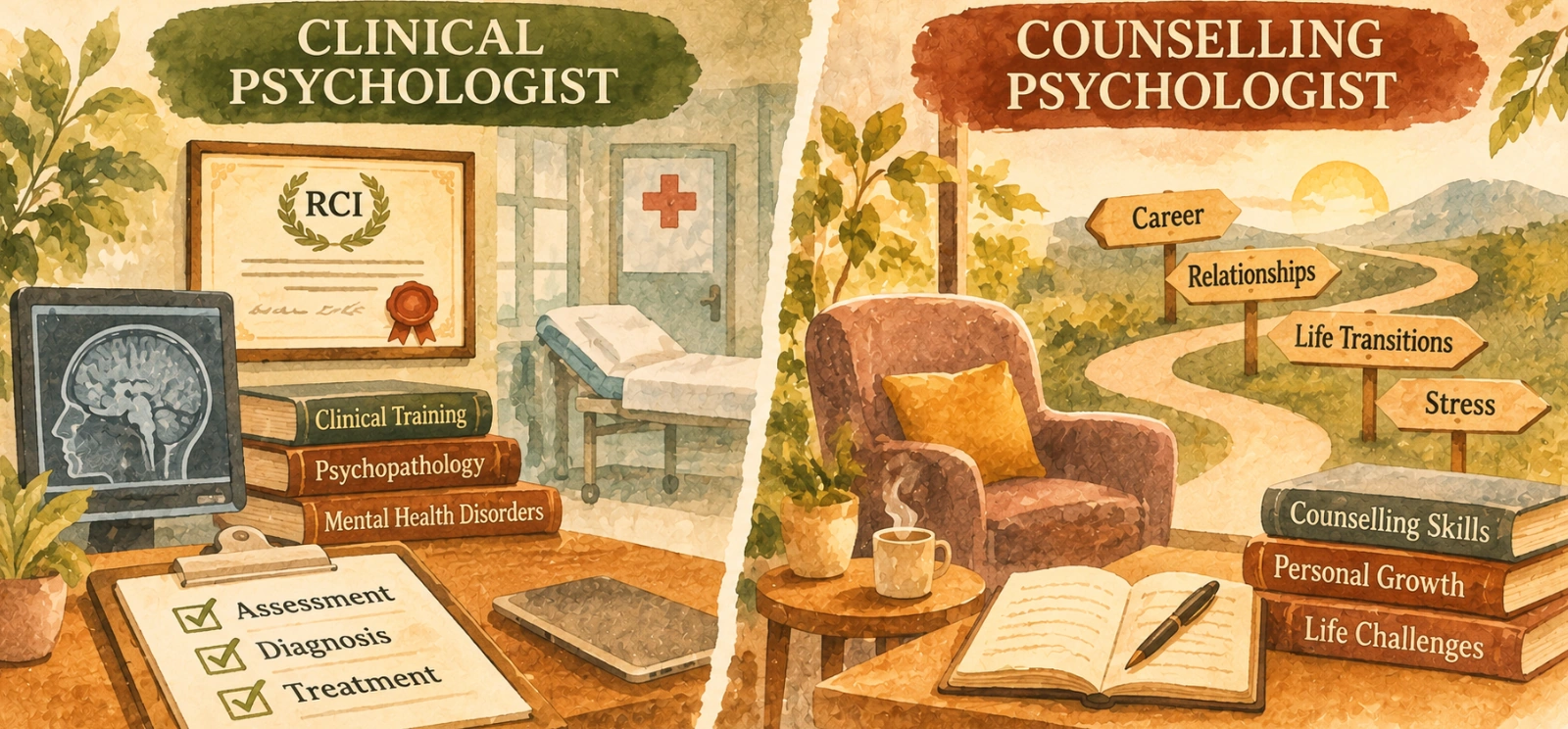
Clinical Psychologist vs Counselling Psychologist: What Is the Difference?
Two titles confuse almost everyone. They sound the same, but they are not.
A clinical psychologist has a legal definition in India.
The Mental Healthcare Act says this person holds a recognised qualification in clinical psychology. It must come from an institution approved by the Rehabilitation Council of India, or RCI (Source: Mental Healthcare Act, 2017 — cdnbbsr.s3waas.gov.in).
The Act also gives a second route. That route is a postgraduate degree plus a full-time, two-year M.Phil. with supervised clinical training (Source: Mental Healthcare Act, 2017 — cdnbbsr.s3waas.gov.in).
The key words there are supervised clinical training. It means they learned by treating real patients, with a senior watching.
A counselling psychologist usually holds a postgraduate degree in psychology. Their rules are less clear.
One recent report names RCI as the only body now offering protected titles for psychologists (Source: Careers360, 2026 — news.careers360.com).
The same report calls counselling psychology a fluid category (Source: Careers360, 2026 — news.careers360.com).
The law is still catching up. In September 2026, the Kerala High Court heard a case about regulating counselling. It asked the Centre to explain how the allied healthcare law is being applied (Source: LiveLaw, 2026 — livelaw.in).
An Indian paper offers a simple way to split the roles. Clinical psychologists should focus on assessing, diagnosing, and treating mental health disorders.
Counselling psychologists should focus on support for life issues, through counselling and guidance (Source: PLOS Mental Health, 2024 — ncbi.nlm.nih.gov).
Here is what that means for you.
Choose a counselling psychologist when the problem is a life issue. Career stress. A break-up. A hard phase in a marriage. Feeling lost.
Choose a clinical psychologist when the problem is heavier. Panic. Deep depression. OCD. Trauma. A need for formal testing.
Neither is better as a person. A kind, skilled counsellor can change your life.
But the problem should match the training. A heavy condition needs someone trained to treat it.
Q: Clinical ya counselling psychologist, kisse milna chahiye?
A: If daily life is still working but feels hard, a counselling psychologist may be enough. If symptoms are stopping your work, sleep, or study, start with a clinical psychologist or a psychiatrist.
Psychologist Kya Hai Under Indian Rules? How to Check One
Anyone can print a nice visiting card. So it is fair to check. Do not feel shy about it.
Clinical psychologists fall under RCI.
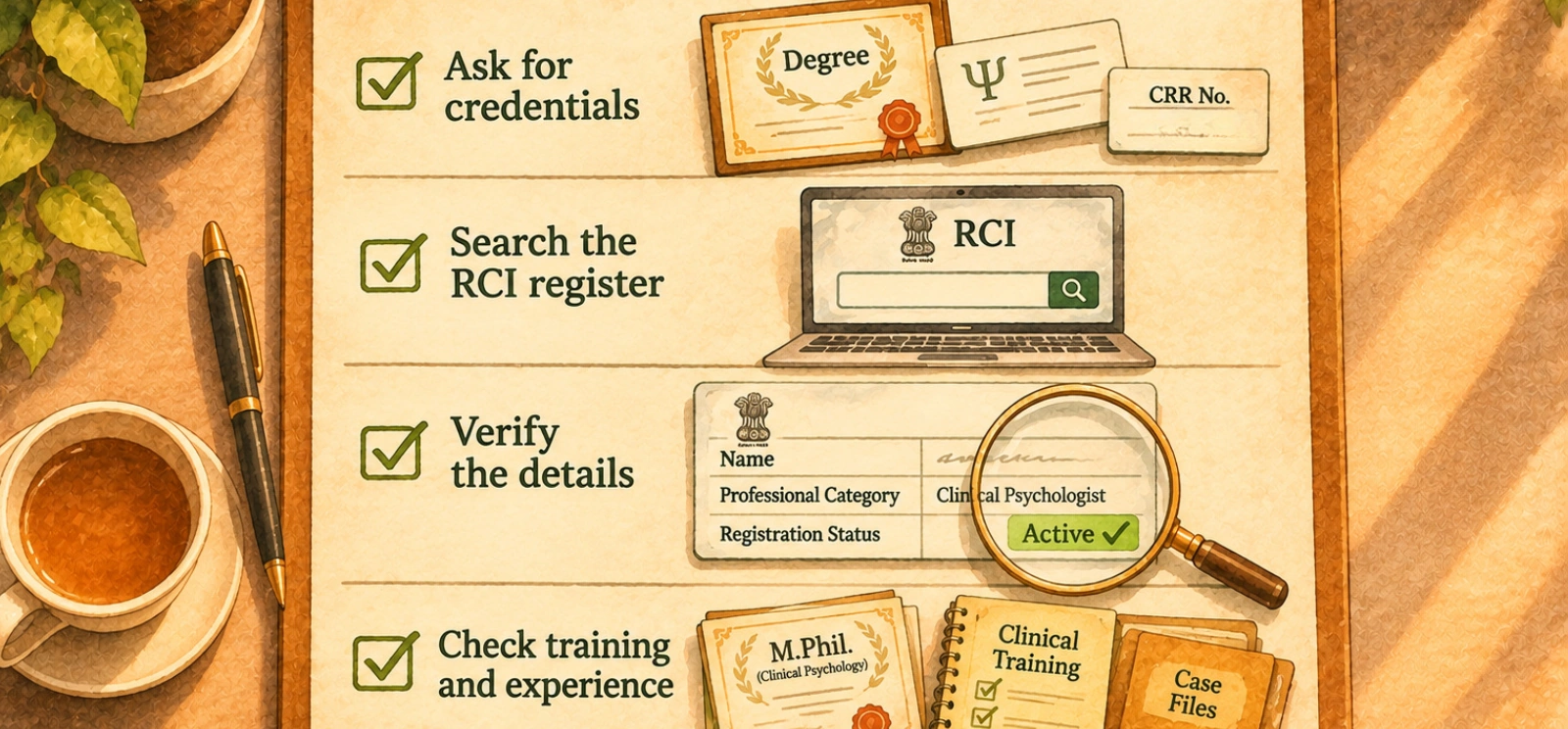
Section 13 of the RCI Act sets the rule. To practise as a rehabilitation professional, a person needs a recognised qualification. They must also be on the Central Rehabilitation Register (Source: Rehabilitation Council of India, 2025 — rehabcouncil.nic.in).
Both clinical and rehabilitation psychologists are on the RCI list of categories (Source: Rehabilitation Council of India, 2025 — rehabcouncil.nic.in).
That register is often called the CRR. It gives each person a number, and that number is your best check.
Here is a simple way to use it.
Ask for the full name and CRR number. A real expert will share it without any fuss.
Match the details. Check that the name and category are what you were told.
Check that it is active. RCI says only people with valid and active registration may practise (Source: Rehabilitation Council of India, 2025 — rehabcouncil.nic.in).
Ask about their training. Ask which problems they treat most, and whom they refer to when a case is severe.
One thing may confuse you here. Degree names are changing.
An Indian Journal of Psychiatry paper describes the M.Phil. as a requirement for licensure in clinical psychology (Source: Indian Journal of Psychiatry, 2024 — pmc.ncbi.nlm.nih.gov).
But in April 2026, a report said RCI plans to replace that name with a Master's title, the M.Clin.Psy. (Source: Outlook India, 2026 — outlookindia.com).
So do not reject someone over the degree name alone. The CRR number is the cleaner check.
Why does all this matter? Because trained people are few.
A 2024 paper puts India at 0.47 clinical psychologists per 100,000 people (Source: PLOS Mental Health, 2024 — ncbi.nlm.nih.gov).
It reports RCI figures of 3,890 clinical psychologists and 2,896 rehabilitation psychologists (Source: PLOS Mental Health, 2024 — ncbi.nlm.nih.gov).
When demand is high and trained people are few, others step in. Some are honest but untrained. A few are not honest.
Watch for these warning signs.
They promise a cure in a fixed number of sessions.
They tell you to stop your medicine.
They will not share their degree or registration.
They talk about other clients by name.
They push you to buy a long package on day one.
If you see even one of these, it is fine to walk away. A good one will never mind being checked.
Q: Counsellor ka bhi CRR number hota hai?
A: Not always. Many counsellors and counselling psychologists are not on this register. For them, ask about the degree, supervised training, and who supervises their work now.
Kya Psychologist Dawai De Sakte Hain?
Can psychologist prescribe drugs? In India, the answer is no.
A WHO brief on India states it plainly. At present, only medical practitioners can prescribe medicines in India (Source: World Health Organization, 2021 — cdn.who.int).
They are not medical doctors. So writing a prescription is not part of their role.
A psychiatrist is different. The Mental Healthcare Act defines one as a medical practitioner with a postgraduate degree or diploma in psychiatry (Source: Mental Healthcare Act, 2017 — cdnbbsr.s3waas.gov.in).
This holds online as well. During a teleconsultation, the psychiatrist carries the responsibility of prescribing (Source: Indian Journal of Psychological Medicine, 2020 — pmc.ncbi.nlm.nih.gov).
Here is the short version, side by side.
PointPsychologistPsychiatristTrainingPsychology, plus clinical trainingMedicine, then psychiatryMain toolsTalk therapy and testsDiagnosis, medicine, some therapyWrites prescriptionsNoYesGood first stop forThoughts, habits, relationshipsSevere symptoms or a possible need for medicine
The bigger point is simple. You often do not have to choose.
Many people do best with both. The psychiatrist looks after medicine. The therapist works on skills, patterns, and old pain.
WHO notes that psychological treatments are the first treatments for depression. They can be combined with antidepressant medicines in moderate and severe depression (Source: World Health Organization, 2026 — who.int).
So do not fear being sent from one to the other. If they think you need medicine, a good one will tell you and refer you.
That is good care, not a sign that the problem is hopeless.
If you already take medicine, keep taking it. Talk to the doctor who prescribed it before you change anything.
Q: Psychologist ne dawai likhi hai, kya yeh sahi hai?
A: That should raise a question. In India, only medical practitioners can prescribe. Ask to see the person's medical registration, or get the prescription reviewed by a psychiatrist.
Psychologist Ke Paas Kab Jaana Chahiye?
Many people wait until they break. You really do not have to.
A US health agency gives a useful rule of thumb. Mild symptoms for less than two weeks may ease with simple self-care.
Severe symptoms for two weeks or more mean you should seek professional help (Source: National Institute of Mental Health, 2025 — nimh.nih.gov).
That is a guide, not a strict line. You can go sooner if life feels heavy.
Here are signs that it is time to book a session.
You feel sad, empty, or worried on most days.
Your sleep or appetite has changed and is not settling.
Work or study keeps slipping, and you cannot say why.
The same fights keep repeating at home.
Panic or fear makes you avoid places or people.
Certain thoughts or rituals eat up your day.
Grief is not easing with time.
An old trauma keeps coming back in memories or dreams.
You lean on alcohol, your phone, or food to get through the day.
They also help with exam stress, self-esteem, anger, and parenting. Children and teenagers can see one too.
The evidence is on your side here. WHO says effective psychological treatment exists for anxiety disorders (Source: World Health Organization, 2026 — who.int).
If you are still unsure, try one session. It is an assessment, not a life sentence.
If all is well, you will learn that too. That is useful to know.
Some situations need more than talk therapy, and they need it soon.
Go to a psychiatrist or hospital if someone hears voices, stops sleeping for days, or talks about ending their life. The same applies to severe shaking after stopping alcohol.
In India, you can also call Tele-MANAS on 14416. This government helpline offers free, 24/7 counselling (Source: Asianet News, 2026 — newsable.asianetnews.com).
Q: Kya sirf stress ke liye psychologist ke paas jaa sakte hain?
A: Yes. You do not need a diagnosis or a crisis to go. Stress that keeps hurting your sleep, work, or relationships is a good enough reason to book a session.
What Happens in Your First Session?
The first visit worries people the most. It is usually much gentler than they fear.
You do not need to prepare. If you like, write down what has been bothering you. It helps when nerves make you forget.
The start. They will explain how sessions work. They may ask what brings you here today.
You can answer in Hindi, in English, or in a mix of both. Say it badly if you must. Nobody is marking you.
The middle. They will ask about your sleep, mood, family, work, and health. They may ask what you have already tried.
Some questions may feel personal. You can say, "I am not ready to talk about that." That is allowed.
The end. They will share a first view of what may be going on. Then you agree on goals and on what comes next.
You might not get a final answer in one visit. That is normal. Good assessment takes time.
You will not be called mad. You will not be forced to talk. You can stop when you want. You can come back when you want.
Many people worry about privacy. The law helps here.
The Mental Healthcare Act gives a person with mental illness the right to confidentiality. This covers their mental health and treatment (Source: Mental Healthcare Act, 2017 — cdnbbsr.s3waas.gov.in).
There are limits. The Act allows information to be shared in some cases. Two examples are to protect another person from harm, or to prevent a threat to life (Source: Mental Healthcare Act, 2017 — cdnbbsr.s3waas.gov.in).
So ask about this in your first session. It is a normal question, and a good one will answer it clearly.
Use your first visit to ask your own questions too. One US health body suggests a few (Source: National Institute of Mental Health, 2024 — nimh.nih.gov).
What are the goals of this therapy?
Do you suggest a time frame or number of sessions?
How will we know if it is working?
What happens if I do not start to improve?
How is my information kept private?
Many people also ask how many sessions they will need. There is no single number. It depends on the problem, how long it has run, and your goals.
So ask, and ask again as you go. If you have been in therapy for a fair time and feel no better, raise it with your therapist. You may want to try another approach (Source: National Institute of Mental Health, 2024 — nimh.nih.gov).
Fit matters as well. If you do not feel safe with one person after a few visits, you can change.
You can also meet online. Talk therapy can happen in person or online (Source: World Health Organization, 2026 — who.int).
Q: Pehli baar psychologist se milne par kya bolna chahiye?
A: Start with one honest line, such as "I have not been sleeping" or "I do not feel like myself." You do not need the right words. Asking the next question is their job.
Why So Many People in India Never See One
The need is large. The care reaches few.
India's National Mental Health Survey found a lifetime prevalence of 13.7% for any mental morbidity (Source: Indian Journal of Psychiatry, 2017 — pmc.ncbi.nlm.nih.gov).
The same survey found a treatment gap of between 70% and 92% across different disorders (Source: Indian Journal of Psychiatry, 2017 — pmc.ncbi.nlm.nih.gov).
In plain words, most people who need care do not get it.
Several things stand in the way, and you may recognise a few.
Fear of what people will say. Log kya kahenge is a heavy sentence. It stops families from taking even a first step.
Not knowing whom to see. Psychologist, psychiatrist, counsellor. The titles blur, so people see nobody.
Thinking it must be serious first. Many wait for a crisis. By then, the problem has grown and the work is harder.
Too few trained people. As we saw, the numbers are thin, more so outside big cities.
Worry about money. This one is real. Fees vary by city, training, and setting. You can read more in our guide, Psychologist Price in India.
There are ways around each of these.
You can see someone privately, and nobody needs to know. You can start with a free call. Tele-MANAS has received over 47 lakh calls, so you would not be alone (Source: Asianet News, 2026 — newsable.asianetnews.com).
If you are worried about someone at home, keep it small. Do not say, "You need help."
Try a softer line instead. Say, ek baar baat karke dekhte hain, hum saath chalenge. Then offer to go along.
Going together takes away much of the fear. For some people, it is the only reason they go at all.
Quick Facts: Psychologists in India
In India, only 0.47 clinical psychologists are available per 100,000 people — (Source: PLOS Mental Health, 2024 — ncbi.nlm.nih.gov).
RCI figures show 3,890 clinical psychologists and 2,896 rehabilitation psychologists — (Source: PLOS Mental Health, 2024 — ncbi.nlm.nih.gov).
The treatment gap in India's national survey ranged from 70% to 92% across disorders — (Source: Indian Journal of Psychiatry, 2017 — pmc.ncbi.nlm.nih.gov).
Only medical practitioners can prescribe medicines in India, so a psychologist cannot — (Source: World Health Organization, 2021 — cdn.who.int).
Psychological treatments are the first treatments for depression — (Source: World Health Organization, 2026 — who.int).
How Ganaa Psychologists Support You and Your Family
Ganaa has served patients since 2012 (Source: Ganaa, 2026 — ganaa.in).
Our treatment team brings together psychiatrists, psychologists, and holistic therapists (Source: Ganaa, 2026 — ganaa.in).
That mix matters. You do not have to work out alone who you need.
Our psychologists offer psychotherapy and counselling to patients and their families (Source: Ganaa FAQ, 2026 — ganaa.in).
They work closely with our psychiatrists on a treatment plan built for each person (Source: Ganaa FAQ, 2026 — ganaa.in).
If you want to start small, start at a clinic. We run five, in Greater Kailash II, Gurugram, Greater Noida, Faridabad, and Panaji (Source: Ganaa, 2026 — ganaa.in).
You can see all of them on our clinics page. If travel is hard, or you want more privacy, you can book an online consultation.
Sometimes clinic visits are not enough. For those times, we run five hospitals and rehabs, in South Delhi, Chattarpur, Gurugram, Greater Noida, and South Goa. A sixth is opening soon in Lonavala (Source: Ganaa, 2026 — ganaa.in).
These centres have a 2:1 staff-to-client ratio, with 24/7 medical and psychiatric support (Source: Ganaa, 2026 — ganaa.in).
Families stay informed too. During a stay, we assign a psychologist who gives regular updates (Source: Ganaa FAQ, 2026 — ganaa.in).
Care does not stop at discharge. Post-care includes periodic reviews with a psychiatrist and therapy sessions with a psychologist (Source: Ganaa FAQ, 2026 — ganaa.in).
If you are unsure where to begin, that is fine. It is what the first call is for.
Speak to a Ganaa counsellor on +91 8750075006, or write to info@ganaa.in. You can also book a consultation at ganaa.in/booking.
Conclusion: A Psychologist Is a Guide, Not a Judge
So, psychologist kya hai? A psychologist is a trained expert in the mind and behaviour.
They listen, assess, and use talk therapy to help you change what hurts. They do not read minds, and they do not judge.
In India, they also do not prescribe medicine. That is a psychiatrist's role, and many people do best with both.
A clinical psychologist has a legal definition and an RCI register you can check. A counselling psychologist can be a great help for life issues.
Either way, ask for training details. A good one will be glad you asked.
You do not need a crisis to go. If sadness, worry, or conflict has been sitting with you for weeks, that is enough.
Your first session is only a conversation. You can use your own words, in your own language.
Most people who need care in India never reach it. You have already read this far, which puts you ahead of where many people stop.
Take one small step this week. Note down what is hurting. Then book one session, or call someone who can guide you.
Ek baar baat karke dekhiye. That one talk can change more than you expect.
FAQ
Q: Psychologist kya hai, simple words mein?
A: A psychologist is a trained expert in the mind and behaviour. They use talk therapy and assessment to help you with stress, sadness, fear, habits, and relationships. In India, they do not prescribe medicine.
Q: Psychologist ko Hindi mein kya kahate hain?
A: Psychologist ko Hindi mein मनोवैज्ञानिक kehte hain, which is read as manovaigyanik. It means a scientist of the mind. The word for the subject, psychology, is manovigyan.
Q: Can a psychologist prescribe drugs in India?
A: No. In India, only medical practitioners can prescribe medicines. If you may need medicine, they will refer you to a psychiatrist. The two can then work together on your care.
Q: Psychologist aur psychiatrist mein kya fark hai?
A: A psychiatrist is a medical doctor who can diagnose and prescribe medicine. A psychologist is trained in psychology and works mainly through talk therapy and tests. Many people benefit from seeing both.
Q: How do I check if a psychologist is qualified in India?
A: Ask for their full name and CRR number. Then search for them on the Rehabilitation Council of India website, and check that the registration is active. For counsellors, ask about their degree and supervised training.
Q: What happens in the first session with a psychologist?
A: You talk about what is troubling you, and they ask about your sleep, mood, family, work, and health. You can skip any question. Together you then agree on goals and next steps.
Q: Is what I tell a psychologist kept private?
A: Yes, with limits. Indian law gives a person with mental illness the right to confidentiality. Information can still be shared in some cases, such as to protect someone from harm. Ask about this in your first session.
What is a mental hospital? Learn what asylums were, how Indian law changed, who the patients are, what a day inside looks like, and how to check standards.
Psychologist price in India, checked: what 139 public listings show, why fees differ, what a full course costs, and the free and low-cost routes to try first.