Combining Yoga and CBT: An Integrated Approach to Anxiety
Yoga and CBT for anxiety work on different parts of the problem. See what the research shows, how the two fit together, and how to build a weekly plan.
Combining Yoga and CBT: An Integrated Approach to Anxiety
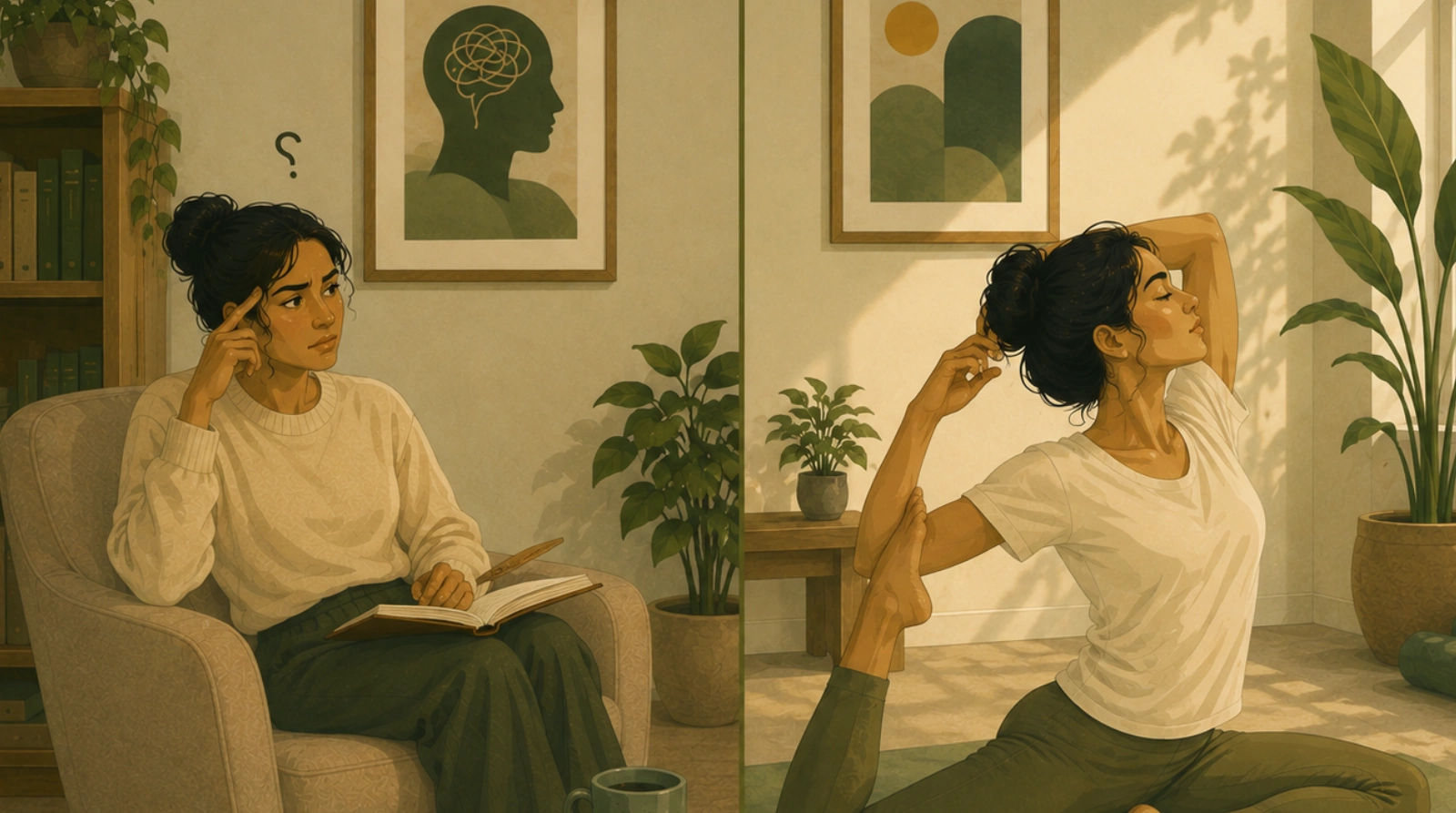
Anxiety lives in two places at once. In the mind, as thought. In the body, as alarm.
Most treatment picks one and hopes the other follows.
That is the gap this article fills. Yoga and CBT for anxiety attack different halves of the same problem.
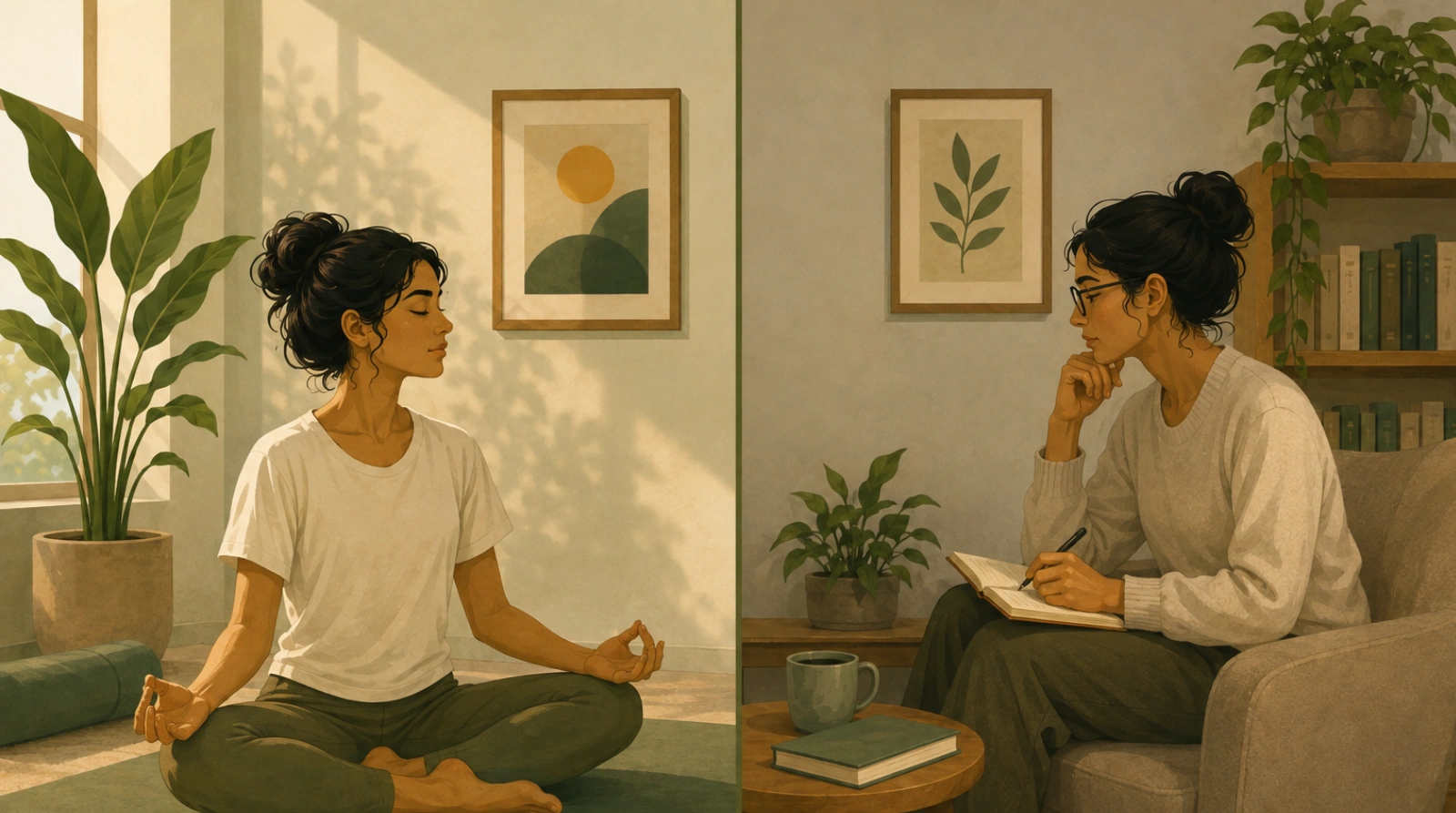
CBT works on the thinking. Yoga works on the wiring underneath.
The problem is not rare, and it is not small. Around 359 million people worldwide live with an anxiety disorder (Source: World Health Organization, 2025 — who.int).
In India, about 10.6% of adults live with a mental disorder. Most never get care (Source: National Mental Health Survey, NIMHANS, 2016 — indianmhs.nimhans.ac.in).
So the question matters. What actually helps, and in what order?
This guide gives you a straight answer. It covers what each method does.
It covers what the best head-to-head trial found. It covers how to blend them week by week.
And it covers who should not start with yoga alone.
One note before we begin. This is general guidance. A psychiatrist or clinical psychologist must assess your own case.
Why Anxiety Needs More Than One Tool
Fear is a loop, not a mood.
A trigger appears. The body fires. The mind reads that firing as proof of danger.
Then the body fires harder. Round and round.
Break the loop at one point only, and it often builds back.
So hit it in two places at once.
That is the whole idea behind an integrated plan.
Think of a fire alarm in a building. The alarm is the body. The wiring is the thought pattern.
You can silence the bell. You can also fix the faulty sensor. Doing both is faster.
This is why single-tool plans stall. Breathing alone can calm a bad hour.
It rarely changes the belief that drives the next one.
Therapy alone can change beliefs. But a body stuck in high alert makes that work slow and tiring.
There is a practical problem too. People in high anxiety struggle to think clearly.
Asking someone mid-panic to challenge a thought is like asking them to read in a storm.
Lower the storm first. Then the thinking work lands.
This is why order matters so much.
Same two tools, wrong order, half the result.
Body first. Head second.
Hold that rule and most of the plan writes itself.
That order is the heart of an integrated plan.
Indian families often reach for yoga first. It is familiar, cheap, and close to home.
That instinct is not wrong. It is just incomplete.
Used well, yoga is the on-ramp. It makes the harder therapy work possible.
Q: Why is anxiety so hard to shake with one method?
A: Because it runs as a loop between body and mind. Calming the body helps for hours. Changing the thoughts helps for years. Most people need both parts worked at once.
What CBT Actually Does to Anxiety
Cognitive behavioural therapy is not advice. It is training.
The core idea is simple. Thoughts, feelings, and actions pull on each other.
Change one on purpose, and the others shift.
A CBT course for anxiety usually runs 12 to 20 sessions. Each one has a task.
You start by tracking. When did fear spike? What went through your mind?
Patterns show up fast. Most people run three or four scripts on repeat.
One script says something bad is about to happen.
Another says you will not cope.
A third says everyone can tell you are anxious.
Next comes testing. You treat the thought as a guess, not a fact.
What is the evidence? What happened the last twenty times you felt this?
Then comes the part that does the heavy lifting. Facing the thing you avoid.
Avoidance feels like safety. It is actually fuel.
Every time you dodge a feared situation, the brain logs it as genuinely dangerous.
CBT reverses that, in small graded steps. Ride one stop. Then two. Then the full route.
You also learn to stop safety behaviours. Rehearsing every sentence. Checking your pulse. Sitting near the exit.
These feel protective. They keep the fear alive.
The evidence base here is strong. CBT is a first-line treatment for anxiety disorders (Source: National Institute of Mental Health, 2024 — nimh.nih.gov).
The catch is effort. CBT asks you to do uncomfortable things on purpose.
That is exactly where a calmer body helps.
Q: How long does CBT for anxiety take to work?
A: Many people notice change by session six to eight. A full course usually runs 12 to 20 sessions. Homework between sessions drives most of the gain.
What Yoga Actually Does to the Anxious Body
Yoga is not stretching with music. For anxiety, the active part is breath.
Slow breathing shifts the nervous system. The out-breath is the lever.
Lengthen it, and heart rate drops. The body reads that as safety.
Add slow movement and held postures. Muscles unclench. Attention comes back to the room.
That is the whole mechanism, stripped of mysticism.
Worried people breathe fast and shallow, high in the chest. This keeps the alarm ringing.
You can feel it if you check. Put a hand on your belly.
If only the chest moves, the body is still braced.
Slow the out-breath. Count to six on the way out.
Do that ten times. Then check the hand again.
That is the whole skill. It is small on purpose.
Yoga trains the opposite pattern. Low, slow, and even.
Over weeks, resting arousal falls. The baseline drops.
That is why yoga therapy for mental health shows up in trials for anxiety, stress. Trauma (Source: van der Kolk et al., Journal of Clinical Psychiatry / PMC, 2014 — ncbi.nlm.nih.gov).
Style matters. Slow, breath-led practice suits anxiety best.
Kundalini yoga has the strongest trial record for generalised anxiety. Hatha and restorative styles also work well.
Fast, heated, competitive classes are usually a poor fit early on.
Dose matters too. Trials use one guided class a week plus short daily home practice.
Twenty minutes a day is a fair floor. Daily beats long.
A randomised trial of online Kundalini yoga found gains in student mental health, which matters for access in India (Source: Randomised controlled trial, PMC, 2024 — pmc.ncbi.nlm.nih.gov).
One caution. Yoga can backfire if handled badly.
Fast breathwork can trigger panic. Long silent stillness can distress trauma survivors.
Tell your teacher. Keep your eyes open if closing them feels unsafe.
Q: Does yoga actually change anxiety or just distract from it?
A: It changes it. Slow breathing and held postures lower physical arousal over weeks. That is a real shift in baseline, not a distraction from the feeling.
What the Best Trial Comparing Them Found
Opinions are cheap here. So look at the numbers.
The largest head-to-head trial randomised 226 adults with generalised anxiety disorder (Source: Simon et al., JAMA Psychiatry, 2021 — pmc.ncbi.nlm.nih.gov).
Three arms ran for 12 weeks. Kundalini yoga took 93 people. CBT took 90. Stress education took 43.
Read that table twice. Both real treatments beat the control clearly.
Yoga worked. More than half responded.
But CBT worked better. The gap is about sixteen points.
The authors were blunt about it. Kundalini yoga was efficacious for the disorder, yet the results support CBT remaining first-line treatment (Source: Simon et al., JAMA Psychiatry, 2021 — pmc.ncbi.nlm.nih.gov).
So what does that mean for you?
It means yoga is not a swap for therapy. Anyone selling it as one is overreaching.
It also means yoga is far from useless. A 54% response rate is a real treatment effect.
For someone who cannot access a CBT therapist, that number matters a great deal.
India has few trained therapists and a wide treatment gap. Between 70% and 92% of people needing mental health care never receive it (Source: National Mental Health Survey, NIMHANS, 2016 — indianmhs.nimhans.ac.in).
In that setting, a low-cost method that helps half of users is not a consolation prize.
The smart reading is simple. Lead with CBT where you can. Add yoga either way.
Q: Is yoga as good as CBT for anxiety?
A: No. In the leading trial, CBT reached a 70.8% response rate versus 54.2% for yoga. Yoga clearly beat the control arm, so it helps, but CBT remains the stronger first choice.
Why the Two Work Well Together
The trial compared them. Real care does not have to.
They target different layers, so they stack.
Yoga lowers the alarm. CBT rewires the trigger.
Think of it as brakes and steering. Brakes alone will not get you home.
Here is how the pairing plays out in practice.
Yoga makes exposure work possible. Facing a feared situation is the core of CBT.
A body already at eight out of ten cannot tolerate that step. Bring it to five, and the step becomes doable.
Breath gives you a portable tool. CBT skills need thinking time. Panic removes it.
A slow out-breath works when thinking has gone offline.
Yoga builds body awareness. CBT asks you to notice early signs of anxiety.
Regular practice teaches you to feel the jaw tighten before the thought arrives.
Early warning buys you time. Time is what CBT skills need.
Routine transfers. Daily practice trains showing up. CBT homework needs the same muscle.
Sleep improves. Anxiety wrecks sleep, and poor sleep worsens anxiety.
Evening practice often breaks that loop within a fortnight.
Better sleep then makes the next day's therapy work easier. The gains compound.
There is one more benefit, and it is cultural. Many Indian clients accept yoga readily.
The word therapy still carries stigma in some homes. The word yoga does not.
Starting with breath can open a door that talk therapy alone would not.
That is not a trick. It is meeting people where they already stand.
Good integrative therapy in India uses this openly. The two traditions are not rivals here.
Q: Should I start yoga and CBT at the same time?
A: Usually yes. Many clinicians start breath and movement in week one, since it makes the harder CBT steps easier. Severe cases may need medicine settled first.
What an Integrated Week Looks Like
Plans fail when they stay abstract. So here is a concrete week.
Adjust it with your clinician. Do not treat it as a prescription.
Monday. CBT session, 50 minutes. Set the week's homework.
Evening: 15 minutes slow breathing. Longer out-breath than in-breath.
Evening: thought record. Write the trigger, the thought, the evidence.
Wednesday. Morning: 20 minutes yoga.
Afternoon: one small exposure step. Ten minutes only. Note the fear score before and after.
Thursday. Guided yoga class, 60 to 90 minutes. Group setting if possible.
Evening: rest. No homework.
Friday. Morning: 20 minutes yoga.
Afternoon: repeat Wednesday's exposure step. Same task, one notch harder.
Saturday. Longer practice, 45 minutes. Add relaxation at the end.
Evening: review the week's thought records. Look for repeated scripts.
Sunday. Rest, or 10 minutes breathing only.
Plan next week's exposure step with a family member.
Two rules make this work.
First, never skip exposure to do more yoga. That turns calm into a new avoidance.
Second, keep daily practice short and fixed. Same time, same mat, same spot.
Track three numbers weekly. Average fear score. Hours slept. Exposure steps completed.
Numbers stop the mind from rewriting your progress.
A bad Tuesday will feel like a bad month by Friday.
The log will tell you it was one day.
Review the whole plan with your therapist every four weeks.
Q: How much time does an integrated plan need each day?
A: About 20 to 30 minutes on most days, plus one weekly therapy session and one longer class. Short and daily beats long and occasional.
Who Should Not Start With Yoga Alone
Yoga is safe for most people. It is not the right first step for everyone.
Start with clinical care, not a mat, if any of these apply.
The reason is simple. These need assessment, and some need medicine.
Delaying that to try breathwork first can cost months.
Trauma deserves a special note. Stillness and eye-closing can raise distress, not lower it.
Trauma-aware teaching matters here. Choices, open eyes, and no hands-on adjustment.
There is also a medical check to clear first. Thyroid problems, anaemia, and heart rhythm issues can mimic anxiety.
Rule those out before deciding the problem is purely psychological.
One more caution. Never lower or stop medicine because yoga is helping.
Tell your psychiatrist what you have added. Let them adjust the dose.
And be honest about what is not working. If fear has not shifted in eight weeks, change the plan.
Persisting with a method that is not helping is not discipline. It is delay.
Q: Can I stop my anxiety medicine if yoga is working?
A: Never on your own. Stopping suddenly can cause withdrawal and relapse. Tell your psychiatrist that yoga is helping and let them plan any change in dose.
Common Mistakes People Make When Combining Them
Most integrated plans fail for the same handful of reasons. All of them are fixable.
Using yoga to dodge the hard part. This is the big one.
Exposure work is uncomfortable. A calming practice is not.
So people quietly swap one for the other. They do more yoga and fewer feared tasks.
Fear scores drop for a week. Then everything slides back.
Rule: yoga prepares you for exposure. It never replaces it.
Practising only when anxious. Breathwork used as rescue is useful.
But rescue-only practice never lowers the baseline. The gain comes from daily reps on calm days.
Do it when you feel fine. That is when it builds.
Picking the wrong class. A fast, heated, crowded class can raise arousal.
Early on, choose slow and breath-led. Save the vigorous styles for later, if at all.
Chasing intensity. Longer sessions are not better sessions.
Twenty minutes daily beats ninety minutes on Sunday. The nervous system learns by repetition.
Hiding the anxiety from the teacher. Teachers cannot adapt what they do not know.
Say it plainly before class. Ask to keep your eyes open. Ask to skip fast breathwork.
Dropping therapy once mood lifts. People often stop CBT at the first good fortnight.
That is the point where relapse risk climbs. Finish the course.
Stopping medicine without telling anyone. Never do this. Withdrawal can look exactly like relapse.
Measuring nothing. Without numbers, memory rewrites the month.
Track fear scores, sleep hours, and exposure steps. Three numbers, once a week.
Going it alone. Anxiety shrinks the world quietly.
Tell one person what you are working on. Ask them to check in weekly.
Expecting a straight line. Bad weeks happen inside good recoveries.
One rough fortnight is not failure. It is data for the next session.
Fix these and the plan usually holds. Most people who stall are not lacking willpower.
They are running a plan with a hole in it.
Q: What is the most common mistake in an integrated anxiety plan?
A: Using yoga to avoid exposure work. Calm feels like progress, so people skip the uncomfortable steps. Fear scores dip briefly, then return.
- In a 12-week trial of 226 adults, CBT reached a 70.8% response rate and yoga 54.2% —
- The control arm in that same trial reached only 33.0% —
- The authors concluded that yoga was efficacious, but that CBT should remain first-line treatment —
- About 359 million people worldwide live with an anxiety disorder —
- About 10.6% of Indian adults live with a mental disorder —
- Between 70% and 92% of Indians who need mental health care do not receive it —
- CBT is listed as a first-line psychological treatment for anxiety disorders —
How Ganaa Blends Yoga and Clinical Therapy
Ganaa has worked in mental health care in India since 2012. We treat psychiatric conditions and substance use across all age groups.
Our model was built around this exact pairing. Modern clinical science sits beside older practices.
CBT, DBT, and neurofeedback run alongside yoga, meditation, and creative therapy (Source: Ganaa, 2026 — ganaa.in).
That is not decoration. The two sides are timetabled together.
For anxiety, most people begin with an outpatient consultation. A psychiatrist assesses severity and rules out physical causes.
A clinical psychologist then builds the therapy plan. Yoga is added from week one in most cases.
Care is tailored to the person, not to a template.
Our outpatient clinics sit in Faridabad, Greater Kailash, and Greater Noida. Live-in centres are in Delhi, Gurugram, Greater Noida, and South Goa.
Live-in care is reserved for severe cases. Think anxiety with panic that has stopped daily life, or anxiety alongside substance use.
Where a stay is needed, our published guidance notes that programmes usually run 30 to 90 days (Source: Ganaa FAQ, 2026 — ganaa.in).
Families are part of the work. With consent, we teach relatives what helps and what fuels the fear.
Support runs 24 hours a day.
If anxiety has narrowed your life, one call is a fair first step. You do not need a diagnosis to ask a question.
Speak to a Ganaa counsellor on +91 8750075006, or write to info@ganaa.in. You can also book a consultation at ganaa.in/booking.
Conclusion: Calm the Body, Then Change the Thought
Anxiety runs on two tracks. Treating one track leaves the other free to restart the loop.
CBT is the stronger single tool. The evidence is clear and it should lead.
Yoga is a real treatment in its own right. It helped more than half of trial participants.
Together they cover more ground than either does alone.
Use yoga to bring arousal down. Use CBT to face what you avoid.
Keep daily practice short and fixed. Keep exposure steps small and regular.
Never let calm become a new form of avoidance.
And know when yoga is the wrong first move. Severe anxiety, panic, trauma, and risk need clinical care first.
Give the plan a fair run. Eight weeks is a sensible first review point.
If nothing has shifted by then, change the plan rather than trying harder at the same one.
Bring a family member into it early. Anxiety shrinks a person's world quietly.
One steady check-in a week keeps that from happening.
Track your numbers. Fear score, sleep, and steps taken.
Memory is a poor judge of progress. Numbers are not.
Anxiety responds to treatment. Most people get meaningfully better.
The step that cannot be skipped is asking for help in the first place.
Start with one call, not a whole plan.
A clinician will tell you which half to work on first.
That single answer saves months of guessing.
And bring both halves up in the room.
Say what your body does. Then say what your head does.
Good care needs to hear both.
Many people only report one half.
They talk about the racing heart, but not the thoughts.
Or they talk about the worry, but not the tight chest.
Say both out loud, and the plan gets better.
FAQ
Q: Can yoga replace CBT for anxiety?
A: No. In the largest trial to date, CBT produced a 70.8% response rate against 54.2% for Kundalini yoga. Yoga helped, but the authors concluded that CBT should remain first-line care. Yoga works best as a partner to therapy, not a swap.
Q: How do yoga and CBT for anxiety work together?
A: Yoga lowers body arousal through breath and movement. CBT changes the thoughts and habits that keep fear going. One calms the alarm, the other rewires the trigger. Used together, each makes the other easier to do.
Q: How much yoga do I need for anxiety to improve?
A: Trials typically use one weekly guided class of about two hours plus short daily home practice. Twenty minutes a day is a realistic floor. Consistency matters far more than the length of any single session.
Q: Which type of yoga is best for anxiety?
A: Slow, breath-led styles suit anxiety best. Kundalini yoga has the strongest trial evidence for generalised anxiety. Hatha and restorative styles also work well. Fast, heated, competitive classes are usually the wrong fit early on.
Q: Is it safe to do yoga if I take anxiety medication?
A: Yes, in almost all cases. Yoga does not interact with medicine the way another drug would. Never stop or lower a dose because yoga is helping. Tell your psychiatrist what you have added so they can track it.
Q: Can yoga make anxiety worse?
A: It can for some people. Fast breathwork may trigger panic. Long silent stillness can raise distress in trauma survivors. Tell your teacher before class. Keep your eyes open if closing them feels unsafe. Skip any method that spikes fear.
Q: Who should not start with yoga alone?
A: Anyone with severe anxiety, panic disorder with frequent attacks, active suicidal thoughts, untreated trauma, or a substance problem. These need clinical assessment first. Yoga can be added once care is in place.
Online therapy matches in-person results for most conditions. Here is what the trials found, where each format wins, and how to choose for your own situation.
Mindfulness-based therapy cuts depression relapse risk in recurrent cases. Here is what MBCT is, what the trials found, and how the eight weeks actually run.
Eating disorders in India hide behind praise for discipline and thinness. Learn the early warning signs, what to say, and how treatment actually works.