What causes anxiety? A clear look at the brain's alarm system, genes, early years, sleep, hidden medical causes and the triggers that keep it going.
What Causes Anxiety in the First Place?
Anxiety rarely arrives with a note explaining itself.
One day your chest feels tight. Your sleep breaks at three. Your mind loops on the same worry.
So you go looking for a reason. You ask what causes anxiety, and you hope for one clean answer.
Here is the honest version. There is no single cause. Anxiety grows where biology, early learning and daily pressure meet.
Your body carries an alarm system. It was built to keep you alive. Sometimes it fires when nothing is truly wrong.
Some people inherit a louder alarm. Some learn fear early, at home or at school. Many carry both.
Then life adds weight. Exams. Rent. A job that feels unsafe. A city that never slows down.
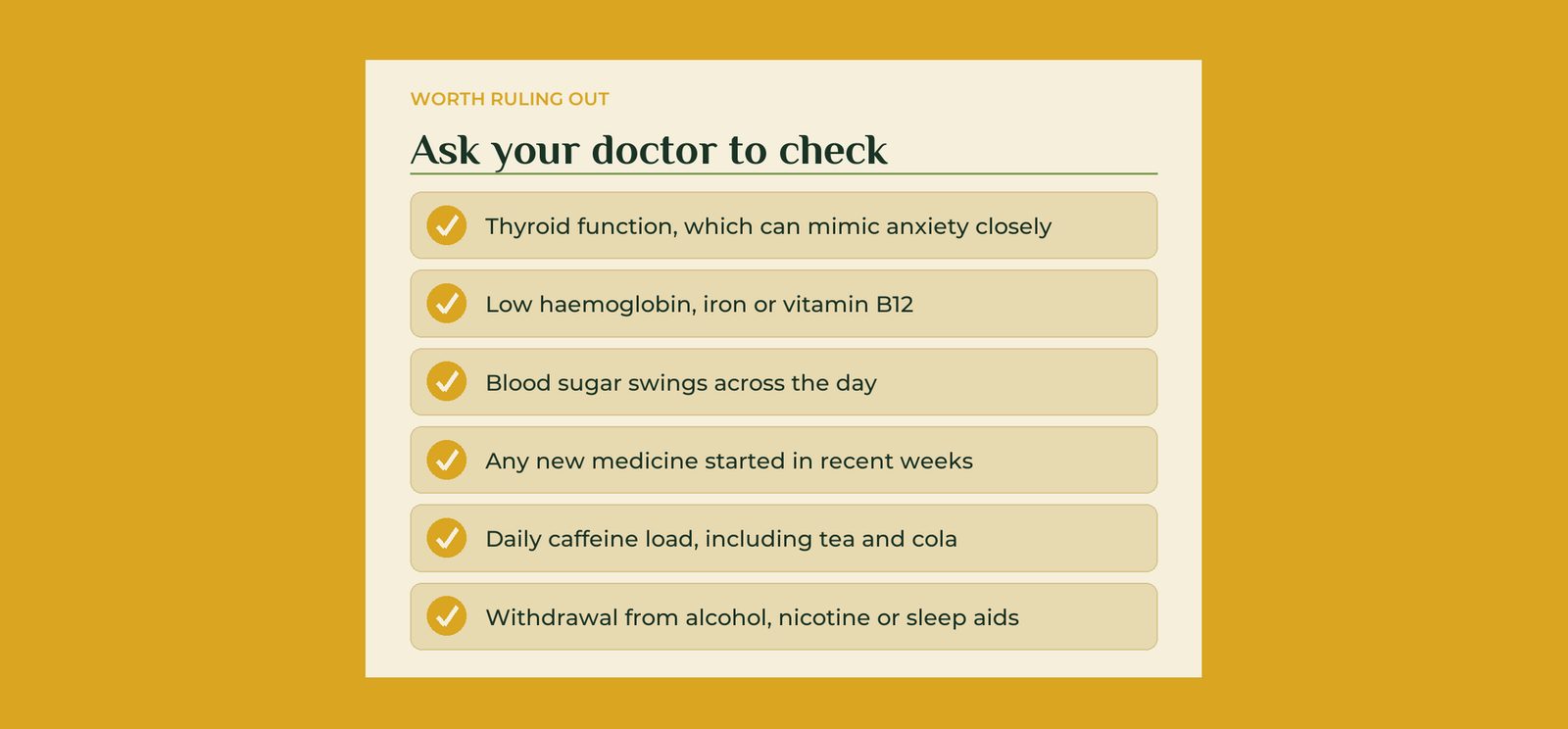
And some causes sit purely in the body. A thyroid problem. Low iron. Broken sleep. A medicine you started last month.
We will look at the brain's threat detector. The stress-hormone loop. Why your body reacts before your thought arrives.
We will cover genes, family and the early years. Medical causes of anxiety that get missed. Sleep debt. Substances that quietly make things worse.
We will name the pressures that shape anxiety in India. And we will end with the part nobody says out loud.
The cause you find will rarely explain everything. That is normal. It does not block your recovery.
Let us start with the short answer.
What Causes Anxiety: The Short Answer
Anxiety is not one thing with one switch.
It is a pattern. Many small pushes build it over time.
Picture three layers stacked on each other.
Layer one is your body. Your genes shape how fast your alarm fires.
Layer two is what you learned young. A tense home. A harsh classroom. A loss nobody helped you name.
Layer three is right now. Deadlines. Debt. A sick parent. A move to a new city.
Most people carry a piece of each. That mix is the real answer to what causes anxiety.
You are far from alone in asking. Anxiety disorders are the most common of all mental disorders (Source: WHO, 2025 — who.int).
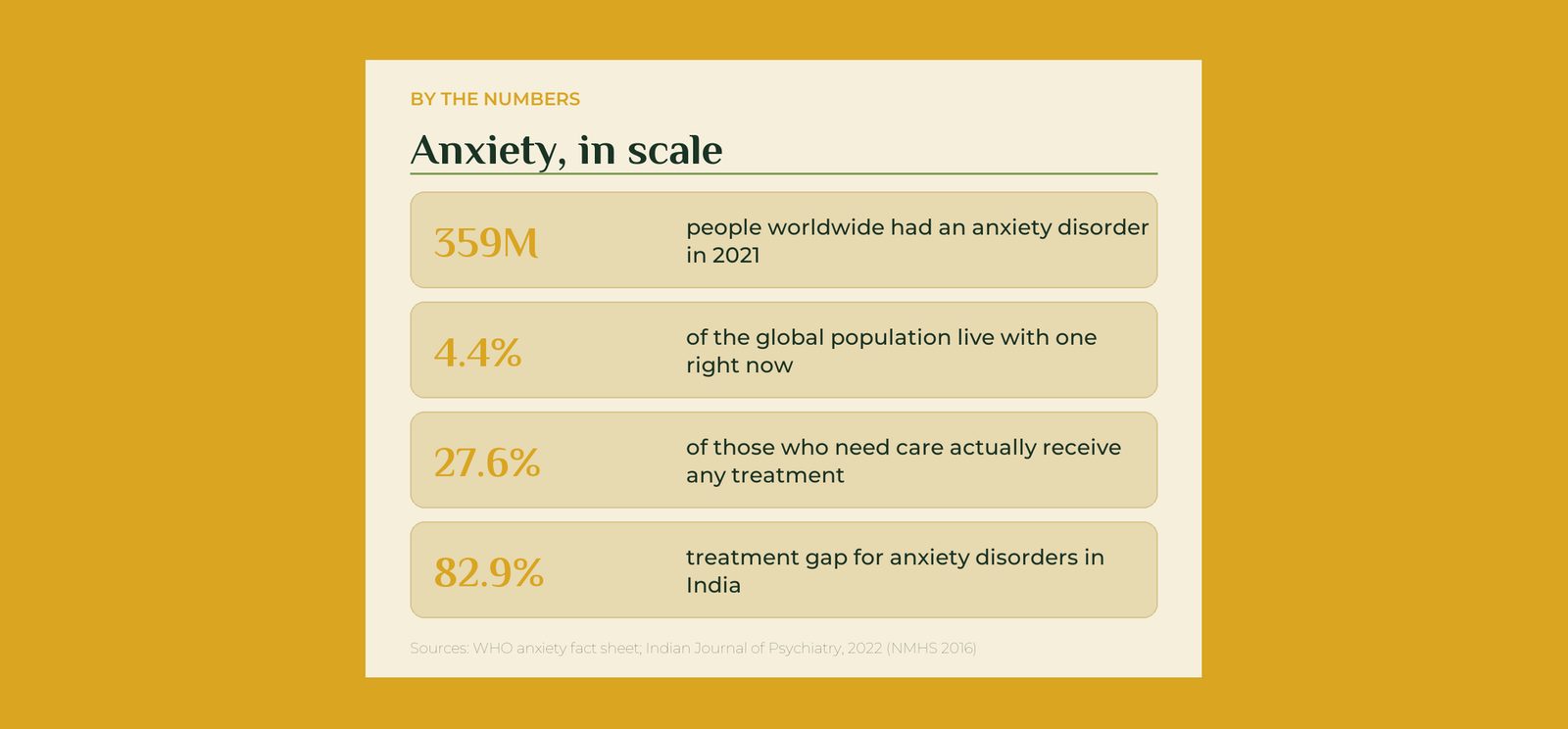
About 4.4% of people worldwide live with one (Source: WHO, 2025 — who.int).
In India the current rate is 2.57% (Source: Indian Journal of Psychiatry, 2022 — pubmed.ncbi.nlm.nih.gov).
There is a fourth layer people forget. The body itself can manufacture anxiety.
An overactive thyroid can do it. So can low iron. So can a sharp drop in blood sugar.
That is why a careful assessment starts with a physical check, not a lecture on stress.
Notice what is missing from this list. Weakness. Bad character. Not trying hard enough.
None of those cause anxiety. They never have.
Anxiety is a body-and-brain response that has drifted off calibration. It can be brought back.
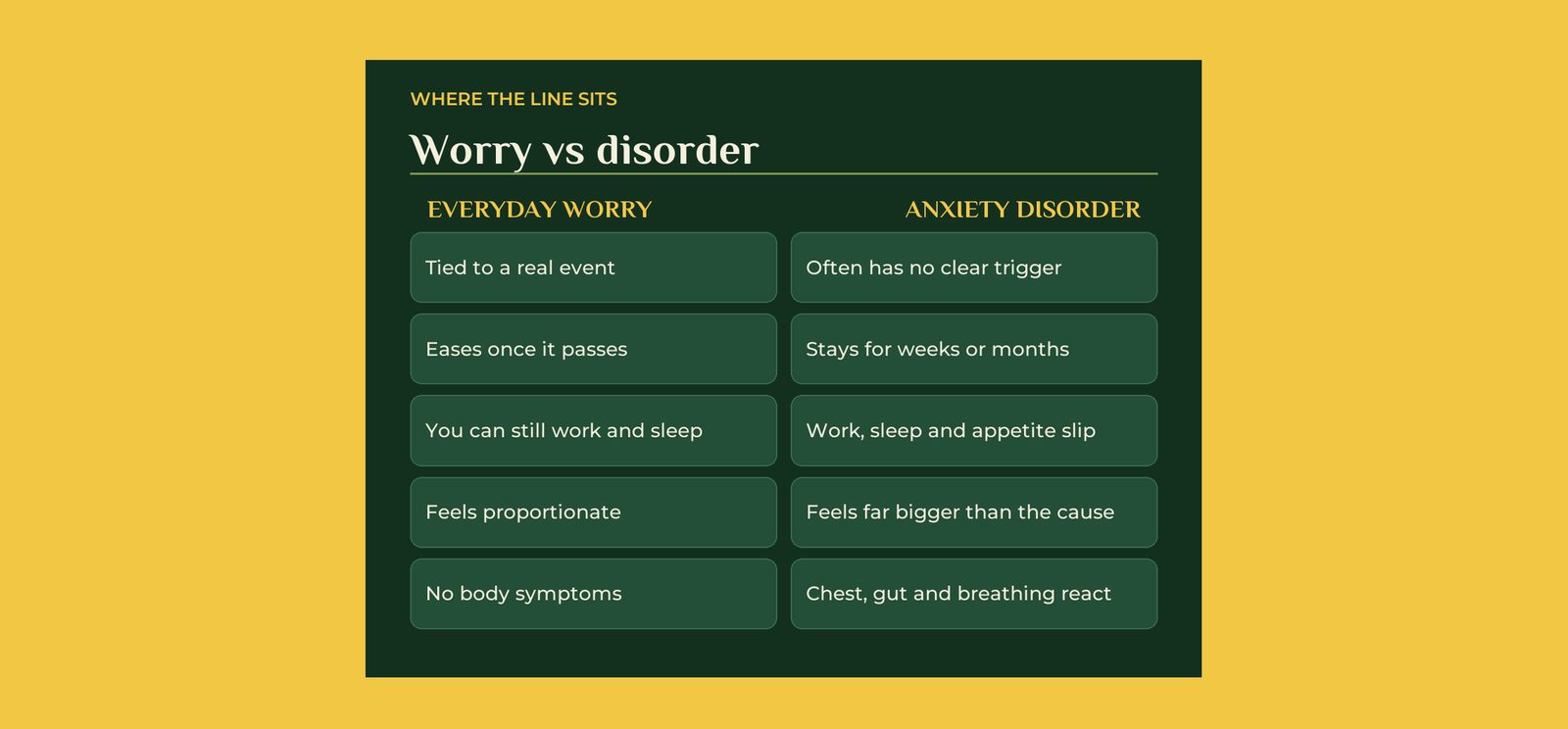
One more thing before we go deeper. Causes of anxiety are not the same as causes of an anxious moment.
Q: Is there one main cause of anxiety?
A: No single cause explains anxiety on its own. It usually grows from a mix of inherited biology, early life experience, current stress and physical health. Most people carry a little of each layer rather than one dramatic reason.
Your Brain's Alarm System and the Stress Loop
Your body reacts before you finish the thought.
That is not a flaw. That is the design.
Deep in your brain sits a small threat detector. It is often called the amygdala.
Its job is speed, not accuracy. It scans everything you see and hear for danger.
When it spots something risky, it does not wait for the thinking brain. It pulls the alarm at once.
Adrenaline floods your system in seconds. Your heart speeds up. Your breathing goes shallow.
Blood moves to your large muscles. Your hands may go cold or shake.
This is why anxiety feels physical first. The body has already moved before you know why.
Then a second, slower system joins in. Your brain signals the release of cortisol, the main stress hormone.
Cortisol keeps the body in a ready state.
The trouble starts when the burst never ends.
Under long stress, the loop stops resetting. The alarm stays half-pulled all day.
Now small things set it off. A phone buzz. A raised voice. An unread message from your boss.
Your threat detector has learned to be quick and loud. And it keeps practising.
This is the stress loop at the heart of an anxiety disorder. It feeds itself.
Here is the hopeful part. Loops can be retrained.
Therapy, steady routine, breathing work and sometimes medication all act on this loop. They lower the baseline.
You are not fighting your own nature. You are re-tuning a system that got stuck on high.
Q: Why does my body react to anxiety before I even think?
A: Your brain's threat detector fires faster than your thinking brain. It sends out adrenaline within seconds of spotting a possible risk. That is why the racing heart and tight chest often arrive before you can explain what scared you.
A Cause Is Not the Same as a Trigger
This is the distinction most articles skip.
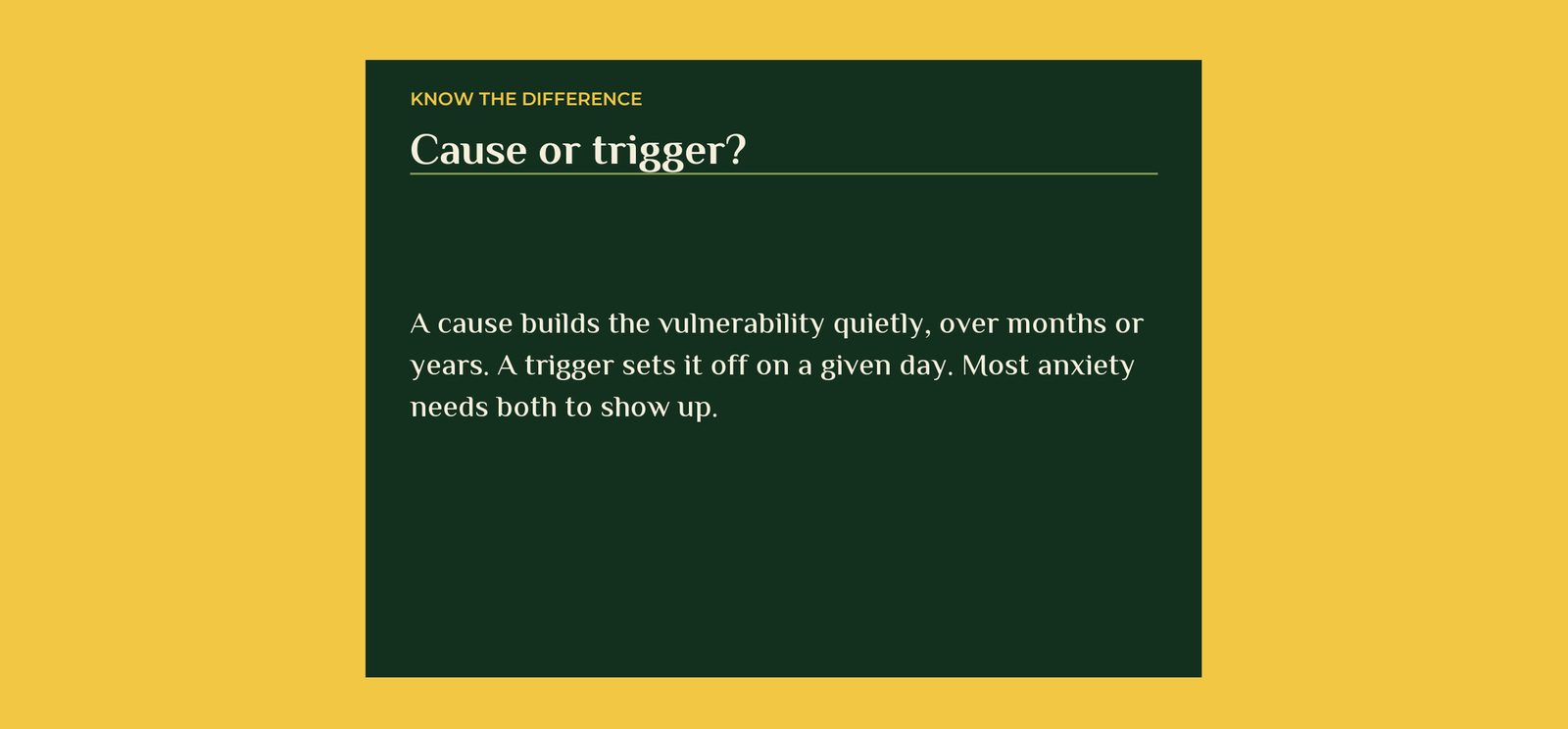
A cause builds the ground. A trigger lights the match.
Causes work slowly. They stack up over months and years.
Inherited biology is a cause. A harsh childhood is a cause. Untreated thyroid trouble is a cause.
Anxiety triggers are different. They act in the moment.
A crowded metro. A phone call from a hospital. A missed meal. A third cup of coffee.
The trigger did not create your anxiety. It found what was already there.
That is why removing triggers alone rarely works.
You can avoid the lift. You can skip the party. You can stop opening the bank app.
The relief is real, but it is short. And the world of safe places keeps shrinking.
Many people spend years fighting anxiety triggers and wonder why nothing changes.
They are treating the match while the ground stays dry.
Real treatment works on both levels at once.
At the trigger level, you learn skills. Slow breathing. Grounding. Facing avoided places in small steps.
At the cause level, you go deeper. Old beliefs. Family patterns. Sleep. Health. Substance use.
There is a third piece too, called a maintainer.
Maintainers keep anxiety alive after the original cause has faded. Avoidance is the biggest one.
Every time you dodge a feared thing, your brain learns it was truly dangerous. The fear grows a little.
Reassurance-seeking works the same way.
So ask three questions, not one. What built this? What sets it off? What keeps it going?
That last question is often where recovery actually starts.
Q: What is the difference between a cause and a trigger?
A: A cause builds your vulnerability over a long period, such as genes, early trauma or poor sleep. A trigger sets off a single episode on a given day, like a crowd or bad news. Treatment needs to address both, plus the habits that keep anxiety going.
Genes, Family and Your Early Years
Anxiety often runs in families. That much is clear.
But what gets passed down is more subtle than people assume.
You do not inherit an anxiety disorder like eye colour. You inherit a tendency.
Think of it as a lower threshold. Your alarm may fire sooner and settle slower.
That tendency is a risk, not a sentence. It decides how much stress you can absorb before symptoms show.
Two siblings can share the same risk and land in very different places. Life fills in the rest.
Family passes down more than genes. It passes down a way of reading the world.
If a parent treated every delay as a disaster, you learned that. Children copy the nervous systems around them.
If worry was the family love language, caution felt like care.
Early years matter for another reason. The threat system is still forming.
A home with shouting, illness or money panic teaches the brain that the world is unstable.
So does a home where feelings were never discussed. Silence can be as loud as conflict.
Loss, bullying and long separation from a parent all leave marks.
None of this means your family failed you. Most parents did their best with what they had.
It simply explains why your alarm was set the way it was.
Timing matters too. Anxiety symptoms often begin in childhood or adolescence (Source: WHO, 2025 — who.int).
More women are affected than men (Source: WHO, 2025 — who.int).
In India, risk runs higher among women and among urban metro dwellers. Ages 40 to 59 carry more risk too (Source: IJP, 2022 — pubmed.ncbi.nlm.nih.gov).
Q: Is anxiety inherited from parents?
A: You can inherit a more reactive alarm system, which raises your risk of anxiety. You do not inherit the disorder itself. Family habits and early home life shape it further, and both learned patterns and stress responses can change with treatment.
Medical Causes of Anxiety That Get Missed
Some anxiety does not start in the mind at all.
It starts in the body. And it is missed often.
The thyroid is the classic example. An overactive thyroid speeds everything up.
It can bring a racing heart, tremor, heat, weight loss and restless sleep. That feels exactly like anxiety.
People are sometimes treated for panic for months before a simple blood test is run.
Low iron is another quiet one. Anaemia can cause breathlessness, palpitations and a jittery, weak feeling.
Blood sugar swings do the same. A long gap without food can drop your sugar sharply.
The body responds with adrenaline. You get shaky, sweaty and suddenly afraid.
Many people mistake that for a panic attack. Sometimes it is simply a skipped lunch.
Heart rhythm problems belong on the list too. An irregular or fast rhythm feels frightening from the inside.
Then there are medicines. Some asthma inhalers, steroids, thyroid tablets and decongestants can raise arousal.
Certain weight-loss aids and some antidepressants can do it early in treatment. Never stop a prescribed medicine on your own.
Caffeine deserves its own line. It acts on the same arousal system that anxiety uses.
Strong coffee, energy drinks and several cups of tea can push a sensitive system over the edge.
None of this means your anxiety is imaginary. It means the cause may be treatable in a very direct way.
So ask for a proper check. A doctor can review thyroid function, iron levels, blood sugar and your medicine list.
If a physical cause is found, treating it can change everything.
Q: Can a thyroid problem cause anxiety?
A: Yes. An overactive thyroid can cause a racing heart, tremor, heat and restless sleep, which closely resemble anxiety. A simple blood test can check for it. Low iron, blood sugar swings and some medicines can create similar symptoms and deserve the same review.
Sleep Debt, Caffeine and Substances
Sleep is usually treated as a symptom of anxiety. That is only half the story.
Poor sleep is also a cause.
Short sleep leaves the threat detector more reactive the next day. Small problems feel large.
Your patience drops. Your body stays wired. Worry finds an easy hold.
Then that worry damages the next night. The loop tightens.
A run of late nights can build anxious symptoms in someone who had none before.
Shift work does this. So do newborns and late-night scrolling.
If you fix nothing else, protecting sleep is worth the effort. Sleep and anxiety are tightly linked (Source: Sleep Foundation — sleepfoundation.org).
Substances belong in the same conversation.
Alcohol is the most misunderstood. It calms you for an hour, then rebounds.
As it clears, the nervous system swings the other way. Anxiety returns stronger, often at dawn.
Many people then drink earlier to stop the feeling. The trap closes quietly.
This is common in India. About 14.6% of Indians aged 10 to 75 are current alcohol users (Source: AIIMS NDDTC, 2019 — aiims.edu).
About 5.2% are affected by harmful or dependent alcohol use (Source: AIIMS NDDTC, 2019 — aiims.edu).
Nicotine works in a similar way. The calm lasts minutes, then withdrawal raises tension again.
Cannabis is not the safe option many assume. For some people it clearly raises panic and paranoia.
Stimulants push the alarm system hard and directly.
Sleeping tablets can help briefly, then create rebound anxiety when stopped. That is a doctor's decision, not a personal one.
None of this is a moral verdict. It is simply how these substances act.
If you drink or use to manage anxiety, that is worth naming out loud. It is treatable, and treating it early is far kinder.
Q: Does alcohol make anxiety worse?
A: Alcohol calms you briefly, then the nervous system rebounds as it clears. That rebound often brings sharper anxiety, poor sleep and early-morning dread. Drinking to settle anxiety usually deepens it over time, so speak to a doctor about safe ways to cut down.
The Indian Pressure Set
Some causes of anxiety are shaped by where you live.
India has its own pressure set. It is worth naming plainly.
Start with exams. Board results, entrance tests and coaching cities carry huge weight.
A teenager can feel that one paper decides the rest of life. That belief alone is fuel for anxiety.
Then comes work. Contract roles, delayed salaries and layoffs create a steady low hum of threat.
Family expectation is next. In many joint families, your choices belong to everyone.
Career, marriage, money and even sleep habits get reviewed openly. Privacy can be thin.
That closeness is a real strength in hard times. It can also be relentless.
Migration adds another layer. Millions move to metro cities for work.
You gain a job and lose your support network. New city, new language, no one to call at midnight.
Risk of anxiety disorders runs higher among urban metro dwellers in India (Source: Indian Journal of Psychiatry, 2022 — pubmed.ncbi.nlm.nih.gov).
Then there is the shame loop. Log kya kahenge. What will people say.
That single question delays help more than cost or distance does.
People fear being called mad. They fear it will affect a sibling's marriage prospects.
So symptoms get hidden for years. And hidden anxiety grows.
The numbers show it. The treatment gap for anxiety disorders in India is 82.9% (Source: Indian Journal of Psychiatry, 2022 — pubmed.ncbi.nlm.nih.gov).
Around 60% of people with anxiety disorders had disability of varying severity (Source: Indian Journal of Psychiatry, 2022 — pubmed.ncbi.nlm.nih.gov).
Globally, only about 1 in 4 people who need care receive any treatment (Source: WHO, 2025 — who.int).
Silence is not protection. Getting help early is the shorter road.
Q: Why is anxiety often ignored in Indian families?
A: Stigma and fear of judgement keep many people quiet about symptoms. Worry about marriage prospects or reputation delays the first appointment for years. This is one reason India's treatment gap for anxiety disorders stays so wide, even though good care exists.
Why the Cause You Find Rarely Explains Everything
Now for the part that surprises people.
You may find a clear cause. And your anxiety may still not make full sense.
That is normal. It is not a failure of insight.
Anxiety is layered. By the time you seek help, several causes have blended together.
Genes set the threshold. Childhood shaped the beliefs. Work stress lit the fuse.
Poor sleep kept it burning. Avoidance made your world smaller.
Pulling one thread out does not undo the whole knot.
Some people find no clear cause at all. Life looks fine on paper.
They still wake at four with a pounding heart. This is common, and it is not made up.
Here is the freeing part. Treatment does not depend on finding the origin.
Anxiety is treated by how it works today, not only by where it began.
You can lower the alarm without a full origin story.
That does not make causes useless. They guide where to start.
A thyroid cause points to a doctor and a blood test. Childhood trauma points to trauma-focused therapy. Alcohol points to a different plan again.
So use causes as a map. Do not use them as a verdict.
And be careful with one common trap. Endless searching for the reason can become a symptom itself.
If every session circles back to why, the searching may be a form of checking.
The better question is often forward-facing. What keeps this alive now, and what shall we change first?
Recovery starts there. Not in a perfect explanation.
Q: What if I cannot find any cause for my anxiety?
A: Many people never find one clear reason, and that is common rather than strange. Anxiety usually grows from several small factors layered together. Treatment works on how anxiety runs today, so you can recover fully without a complete origin story.
- 359 million people worldwide had an anxiety disorder in 2021 — . - About 4.4% of the global population currently live with an anxiety disorder — . - Only about 1 in 4 people who need care for anxiety receive any treatment — . - India's current weighted prevalence of anxiety disorders is 2.57% — . - India's treatment gap for anxiety disorders is 82.9% — . - Nearly 150 million Indians live with one or another mental morbidity — .
How Ganaa Helps You Find the Cause
Finding the cause is easier with someone beside you.
Ganaa is a mental health and rehabilitation brand in India. We work with adults living with anxiety, panic and related conditions.
We begin with a full picture, not a label.
That means your history, your sleep, your work and your home. It also means your body.
A physical review comes early, because thyroid, iron and blood sugar matter here.
Our psychiatrists then look at the pattern with you. Where did this start? What sets it off? What keeps it running?
Therapy sits at the centre of care. Cognitive behavioural therapy is well proven for anxiety.
Where alcohol or other substances have crept in, we treat that alongside the anxiety. The two rarely improve apart.
Medication is discussed openly, never rushed. That choice belongs to you and your psychiatrist.
Daily structure supports all of it. Steady sleep, movement, mindfulness and yoga help settle a wired system.
Every plan is tailored to the person in front of us. Nothing is copy-pasted.
Ganaa runs five residential centres in India. They are Ganaa South Delhi, Ganaa Chattarpur, Ganaa Gurgaon, Ganaa Goa and Ganaa Greater Noida.
We also run three OPD clinics for outpatient care. These are in Faridabad, Greater Kailash and Greater Noida.
Many people with anxiety start as outpatients. Care can flex around your job and your family.
If anxiety has been running your days, please reach out. Speak to a Ganaa counsellor, or visit ganaa.in to learn about our programmes.
You do not have to solve the cause alone before asking for help.
Conclusion: Causes Are a Map, Not a Verdict
Anxiety is built, not chosen.
Your brain carries a fast alarm system. It fires before your thinking catches up.
Genes may have set that alarm a little louder. Early years taught it what to watch for.
Daily pressure keeps it busy. Poor sleep sharpens it. Alcohol and caffeine feed it.
Some causes of anxiety sit quietly in the body, in a thyroid gland or an iron level.
And in India, exams, work worry, family expectation and the fear of judgement add their own weight.
Hold on to the difference between a cause and a trigger. One built the ground. The other lit the match.
Then look at what keeps the fire going today. Avoidance. Checking. Sleepless nights.
That is where change begins, and it begins faster than most people expect.
You may never map every cause. You do not need to.
Anxiety responds to good care, whatever its starting point.
Speak to a doctor about the physical checks. Speak to a mental health professional about the rest.
The alarm can be turned down. Life can feel steady again.
Take the first step this week. You deserve the calm on the other side.
FAQ
Q: What causes anxiety in the first place?
A: Anxiety comes from a mix, not one single cause. Your brain has a threat alarm that can fire too fast or too often. Genes, early family life, sleep, health problems and daily stress all shape how loud that alarm gets. Most people carry a bit of each layer.
Q: Is anxiety genetic or caused by life events?
A: It is usually both. Genes can hand you a more reactive alarm system, which raises your risk. Life events then decide whether that risk turns into an anxiety disorder. Two people with the same family history can end up in very different places.
Q: Can a medical problem cause anxiety?
A: Yes. An overactive thyroid, low iron, blood-sugar swings and some heart rhythm problems can all create anxious feelings. Certain medicines and heavy caffeine use can do the same. This is why a doctor should check your body before anxiety is treated as purely psychological.
Q: What is the difference between a cause and an anxiety trigger?
A: A cause builds the vulnerability over months or years. A trigger sets off a single episode on a given day. Exams, crowds, bad news or a missed meal are triggers. Removing a trigger calms the moment, but the underlying cause still needs care.
Q: Can poor sleep cause anxiety?
A: Poor sleep is both a symptom and a driver. Short or broken sleep leaves the brain's threat alarm more reactive the next day. That raises worry, which then damages the next night's sleep. Fixing sleep is often one of the first real steps in treatment.
Q: Does knowing the cause of my anxiety help treatment?
A: It helps, but it is not required. Knowing the cause guides where to start, such as a thyroid test or trauma-focused therapy. Many people never find one clean reason, and they still recover fully. Treatment works on how anxiety runs today, not only on where it began.
Eating disorders in India hide behind praise for discipline and thinness. Learn the early warning signs, what to say, and how treatment actually works.
High functioning anxiety hides behind good work and a calm face. Learn the hidden signs, what the body does, and when coping turns into the problem itself.
The cost of mental health rehab in India is rarely published openly. Here is what moves the price, what insurance must cover by law, and what to ask first.