Postpartum Depression in India: Why Indian Mothers Stay Silent
Postpartum depression in India affects about 1 in 5 new mothers. Learn the real signs, how it differs from baby blues, and where a family can find help.
Postpartum Depression in India: Why Indian Mothers Stay Silent
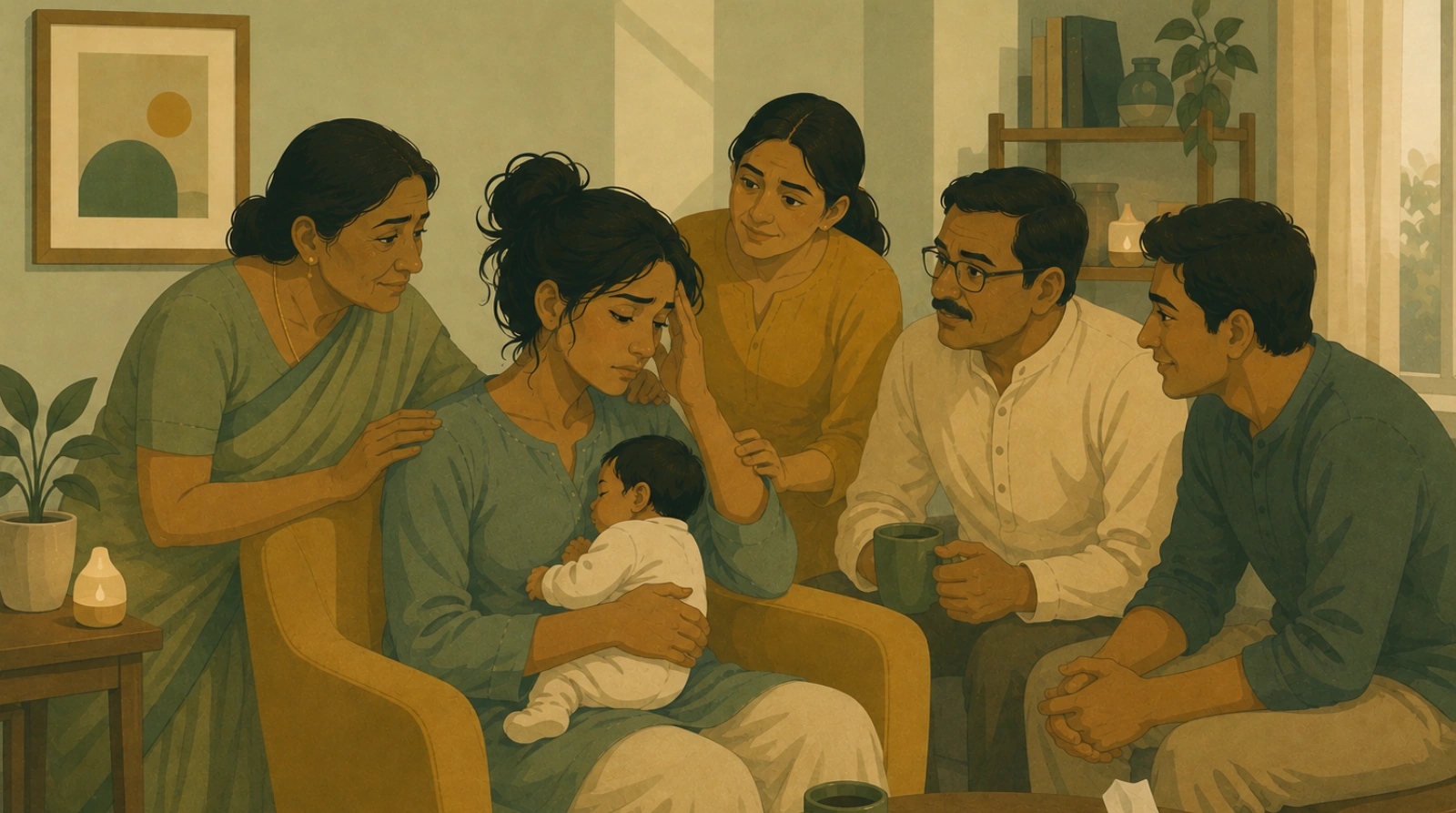
A new mother is handed a baby and a script. Be grateful. Be glowing. Be fine.
Many are not fine. And most say nothing.
Postpartum depression in India is common. It is also badly missed. Roughly 22% of Indian mothers show signs of it (Source: Upadhyay et al., Bulletin of the World Health Organization, 2017 — pmc.ncbi.nlm.nih.gov).
That is about one in five women. In a family WhatsApp group of ten new mothers, two are struggling.
Yet the topic barely comes up. Not at the paediatrician. Not at the naming ceremony. Not at home.
This guide changes that. It explains what postpartum depression looks like in real Indian homes.
You will learn how it differs from baby blues. You will learn the signs families miss. You will learn what raises the risk here.
You will also learn what treatment involves. And what a husband, mother, or mother-in-law can do this week.
A quick note first. This article is general guidance, not a diagnosis. A trained psychiatrist or clinical psychologist must assess each case.
What Postpartum Depression Actually Is
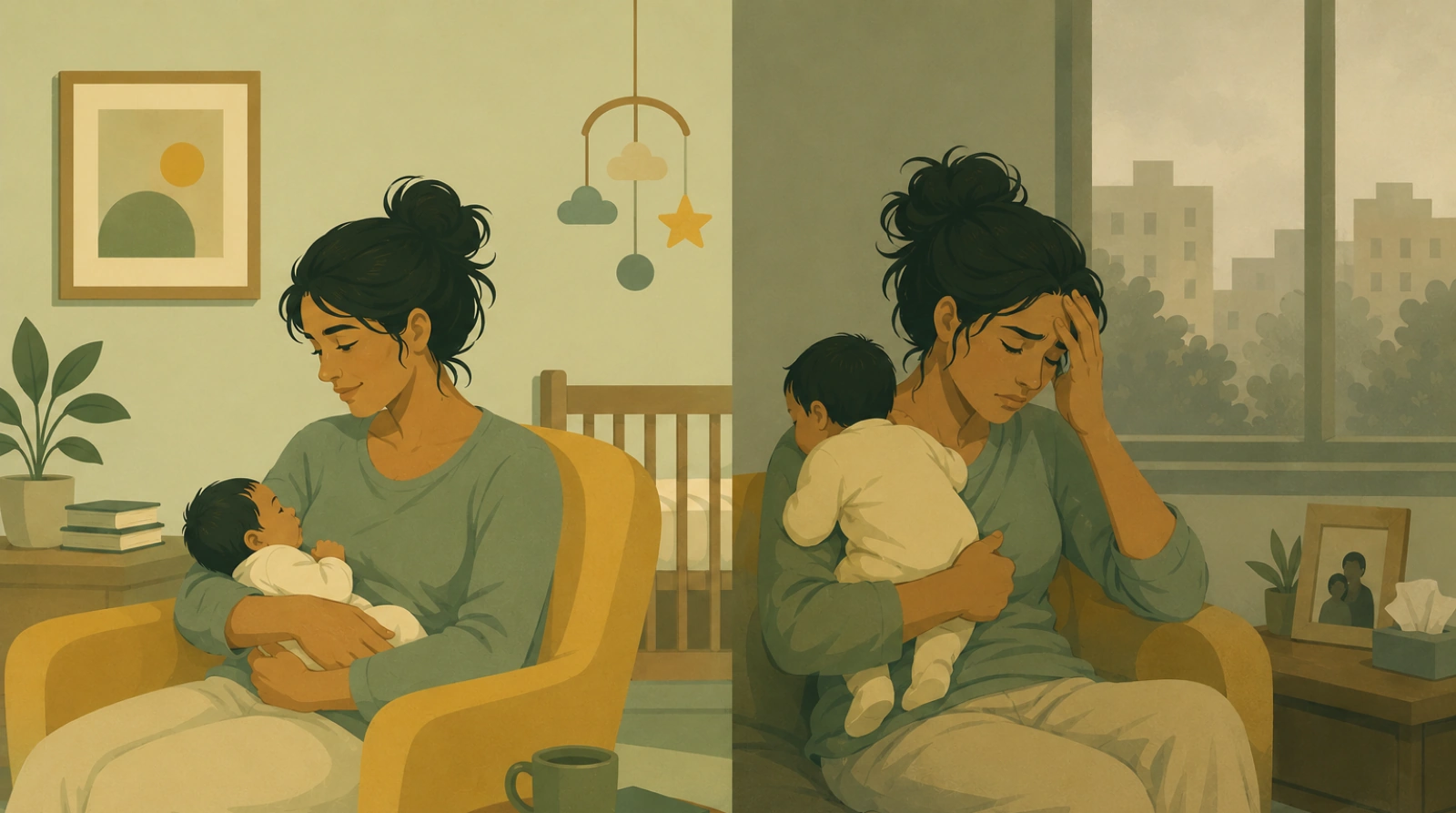
Postpartum depression is a medical illness. It is not weakness. It is not poor character.
It is a mood disorder that begins around childbirth. Doctors often call the wider window perinatal depression, because it can start during pregnancy too (Source: National Institute of Mental Health, 2024 — nimh.nih.gov).
The body goes through a hard reset after birth. Hormones drop fast. Sleep breaks into fragments. Blood loss, pain, and feeding demands stack up.
For some women the brain adjusts. For others it does not.
That is the whole story. Nothing about it is a failure of love.
Many mothers with new mother depression still care for the baby well. They feed. They change. They rock the child to sleep.
Inside, they feel flat. Or frightened. Or strangely absent from their own life.
This is why it hides so well. Function is not proof of wellness.
The illness also shows up in the body. Chest tightness. Headaches. Appetite that vanishes or doubles.
In India, those physical complaints are often the first thing a woman reports. She may describe weakness rather than sadness.
A good clinician listens for that. A rushed one hears anaemia and moves on.
Duration is the other clue. Postpartum depression does not lift after a few days.
It settles in. It grows heavier week by week.
Q: Is postpartum depression the mother's fault?
A: No. It is an illness driven by hormonal, physical, and social stress after birth. It responds to treatment. Blame delays care and makes recovery slower.
Baby Blues vs PPD: How to Tell Them Apart
Most new mothers feel wobbly in the first week. That is normal.
Baby blues are common and short. Tears come easily. Mood swings fast. Sleep is poor.
Then it fades. Usually within two weeks.
Postpartum depression behaves differently. It lasts longer than two weeks. It gets worse, not better.
Here is the practical split for baby blues vs PPD.
SignalBaby bluesPostpartum depressionStartFirst 2 to 5 daysAny point in the first yearLengthUnder 2 weeksWeeks to monthsDirectionEases on its ownStays flat or deepensFunctionDaily tasks still happenTasks feel impossibleSleepBroken by the babyBroken even when the baby sleepsBondingWarmth still presentNumbness or guilt about the baby
That last row matters most. Many mothers describe a strange blankness.
They look at the baby and feel nothing. Then they feel guilty for feeling nothing.
That loop is a red flag. It is not a character flaw.
The sleep row matters too. Exhaustion is expected after birth.
But a mother who cannot sleep even when the baby finally sleeps is signalling something else.
Use the two-week rule as your simple test. If low mood is still heavy after fourteen days, get an assessment.
Do not wait for the six-week visit. Six weeks is a long time inside this illness.
Q: How long do baby blues last?
A: Usually under two weeks. If low mood, crying, or numbness continue past that point, treat it as possible postpartum depression and seek an assessment.
Why So Many Indian Mothers Stay Silent
Silence here is not an accident. It is built.
Start with the script. Motherhood is framed as blessing and duty. Sadness inside that frame reads as ingratitude.
So women edit themselves. They say they are tired. They rarely say they are unwell.
Stigma does the rest. Mental illness still carries fear of judgement in many Indian families.
The treatment gap shows the scale of it. Across mental disorders in India, between 70% and 92% of people who need care never get it (Source: National Mental Health Survey, NIMHANS, 2016 — indianmhs.nimhans.ac.in).
New mothers sit inside that gap. Often deeper inside it.
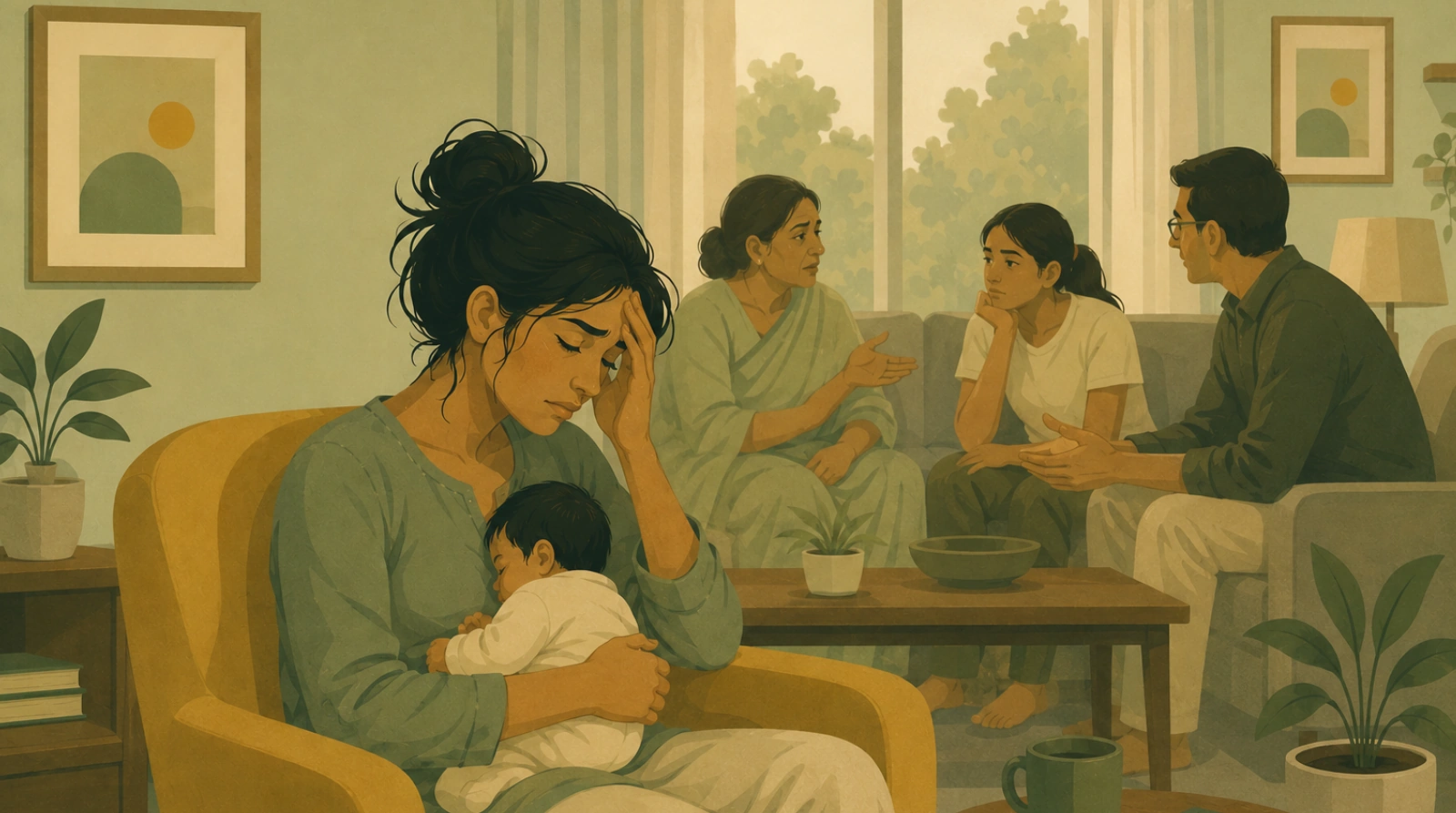
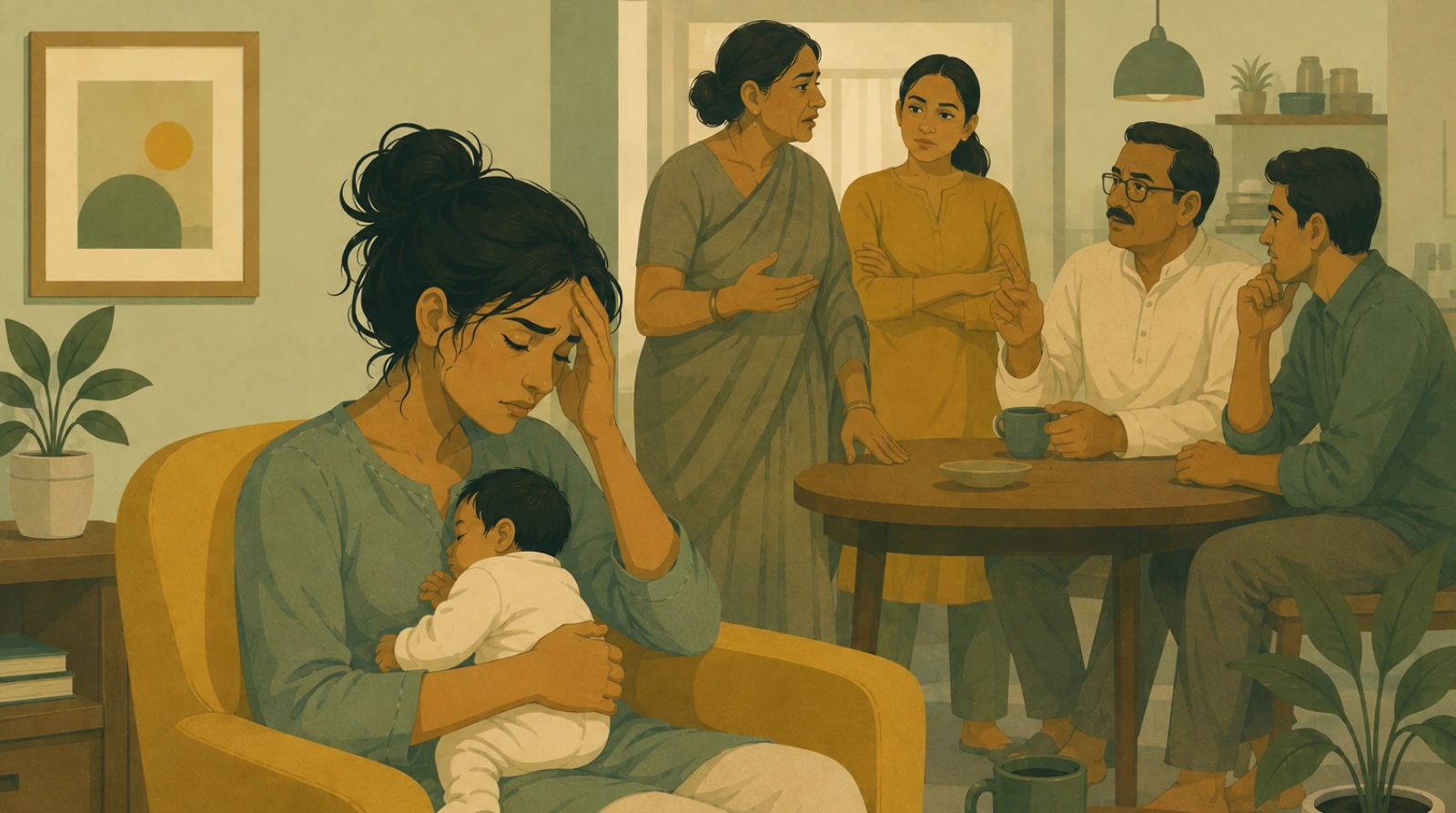
There is also the audience problem. The postnatal period in India is rarely private.
Relatives visit. Opinions arrive. Everyone has advice about feeding and weight.
In that crowd, a mother has almost no space to say she is drowning.
Marriage adds another layer. A woman may fear being called a bad wife.
She may fear the in-laws taking over the baby. She may fear being sent back to her parents' home.
Those fears are not made up. They reflect real family power.
Then comes the medical funnel. After delivery, every appointment is about the infant.
Weight. Feeds. Vaccines. Nobody asks the mother a single question about her mind.
If she is never asked, she rarely volunteers it.
Barriers to postnatal mental health care in India have been mapped in research. They are practical as much as cultural (Source: Systematic review, ScienceDirect / Journal of Affective Disorders, 2025 — pubmed.ncbi.nlm.nih.gov).
Cost. Distance. No childcare. No quiet moment to speak freely.
Q: Why do Indian mothers hide postpartum depression?
A: Stigma, family pressure, and a care system focused only on the baby. Most postnatal visits never ask about the mother's mood, so the illness stays unnamed.
The Signs Families Miss
Families usually watch for tears. That is the wrong marker.
Many mothers with postpartum depression do not cry much. They go quiet instead.
Watch for these shifts. They are easy to explain away as tiredness.
Any two of these, running past two weeks, deserve a talk.
Anxiety often travels with it. Postnatal anxiety can look like constant checking or racing fear.
She may imagine harm coming to the baby. Those thoughts frighten her deeply.
Such thoughts are common, and they respond to care. They are not intent.
But some signs need action the same day.
Talk of ending her life. Talk of harming the baby. Hearing voices. Fixed strange beliefs.
Those point toward postpartum psychosis, which is rare and urgent. Go to a hospital immediately.
Do not handle that at home. Do not wait until morning.
The rest of the time, soft asking beats testing. Sit down. Ask twice.
The first answer is usually the script. The second one is often the truth.
Q: What is the most missed sign of postpartum depression?
A: Flat silence. Families expect crying, so they miss the quiet version. A mother who withdraws and stops talking about herself is often read as simply tired. One-word answers get taken at face value.
What Raises the Risk in Indian Homes
Some pressures are shared by all. Others are shaped by how Indian families live.
Research on Indian mothers points to a clear cluster of risk factors (Source: Upadhyay et al., Bulletin of the World Health Organization, 2017 — pmc.ncbi.nlm.nih.gov).
Money trouble ranks high. So does violence at home.
A past history of mental illness raises risk. So does conflict in the marriage.
Weak support from the husband is a strong factor on its own.
And one finding is uncomfortable but important. The birth of a female baby was linked to higher rates of postpartum depression in Indian studies.
That is not biology. That is social pressure landing on a new mother.
Layer on the daily strain. Joint-family friction. Constant advice. No say over her own routine.
Add feeding trouble. Sore nipples, low supply, or a baby who will not latch can crush her fast.
Add sleep. A mother woken every ninety minutes for weeks is running on empty.
Sleep loss alone can push a tired brain into illness.
Then there is the disappearing act. Support is often intense for forty days, then gone.
The visitors leave. The cook leaves. The mother is alone with a two-month-old and no structure.
Month three is when many women crash. Nobody expects it, so nobody watches for it.
Migration matters too. A woman living far from her parents has thinner support.
City flats can be lonely in ways a village home is not.
None of these mean illness will follow. They stack the odds.
Knowing your stack helps. It tells a family where to put help.
Q: Does a difficult delivery cause postpartum depression?
A: It can contribute. Traumatic birth, emergency surgery, and NICU stays all raise stress. But most cases come from several factors together, not one event alone.
What Treatment Actually Looks Like
Treatment is not dramatic. It has a shape, and it works.
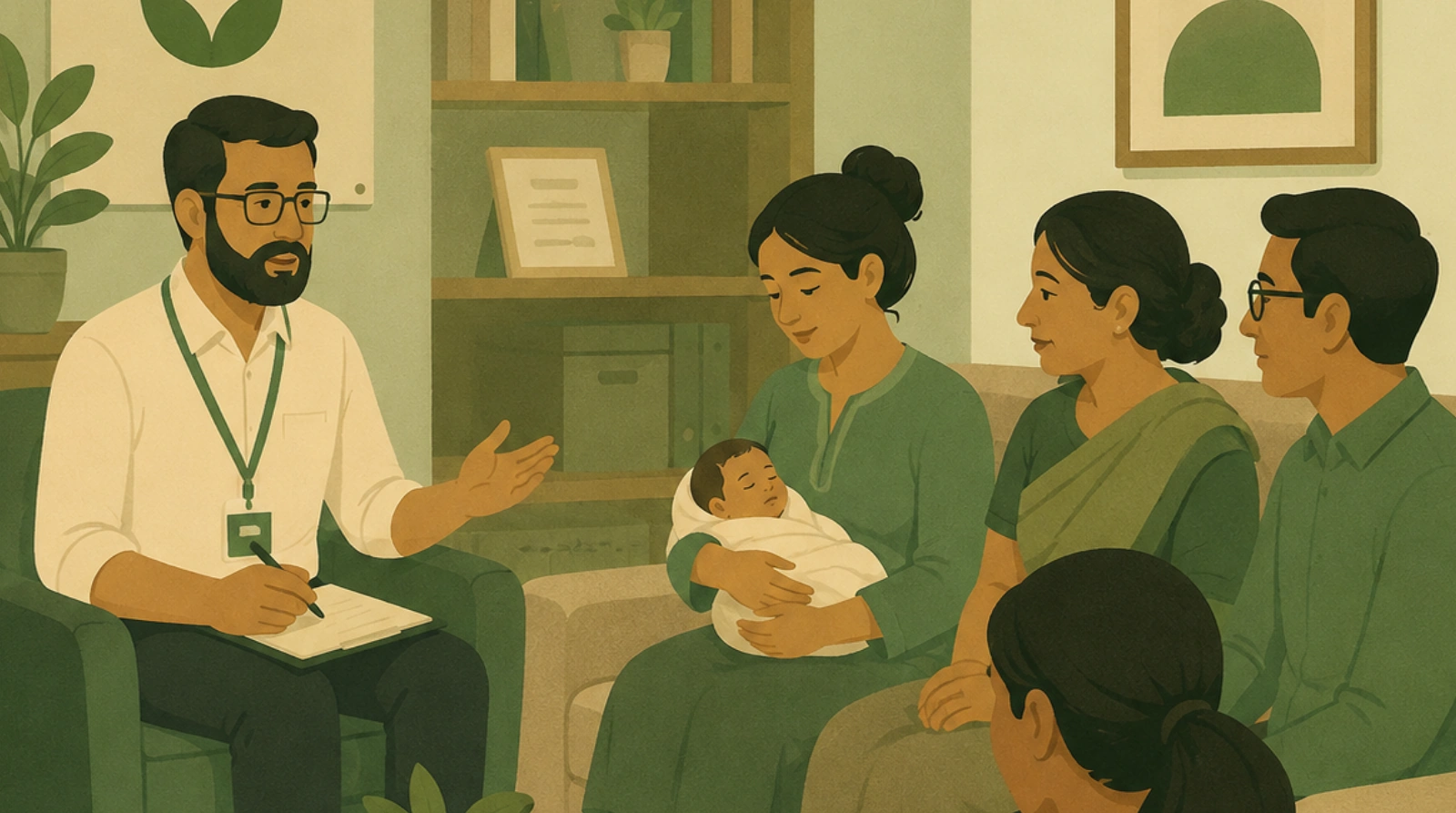
The first step is a check-up. A psychiatrist or clinical psychologist takes a full history.
They ask about mood, sleep, food, and thoughts. They screen for anxiety, thyroid, and low iron.
That last part matters. Physical causes must be ruled out first.
For mild to moderate cases, talking therapy is usually first line. Cognitive behavioural therapy is well studied for depression (Source: National Institute of Mental Health, 2024 — nimh.nih.gov).
CBT works on the loop between thought, feeling, and action. Sessions are practical.
You track thoughts. You test them. You rebuild small routines.
Interpersonal therapy is another strong option. It focuses on role change and relationships.
That fits this illness well. Becoming a mother is a role change.
Medicine is added when symptoms are heavy. Or when therapy alone has not shifted things.
Some antidepressants are used while breastfeeding. A psychiatrist picks the drug and dose with feeding in mind.
Never self-prescribe. Never stop suddenly because you feel better.
Sleep repair sits alongside both. Protecting one solid four-hour block can change a week.
That usually needs another adult to take a shift. It is a treatment step, not a luxury.
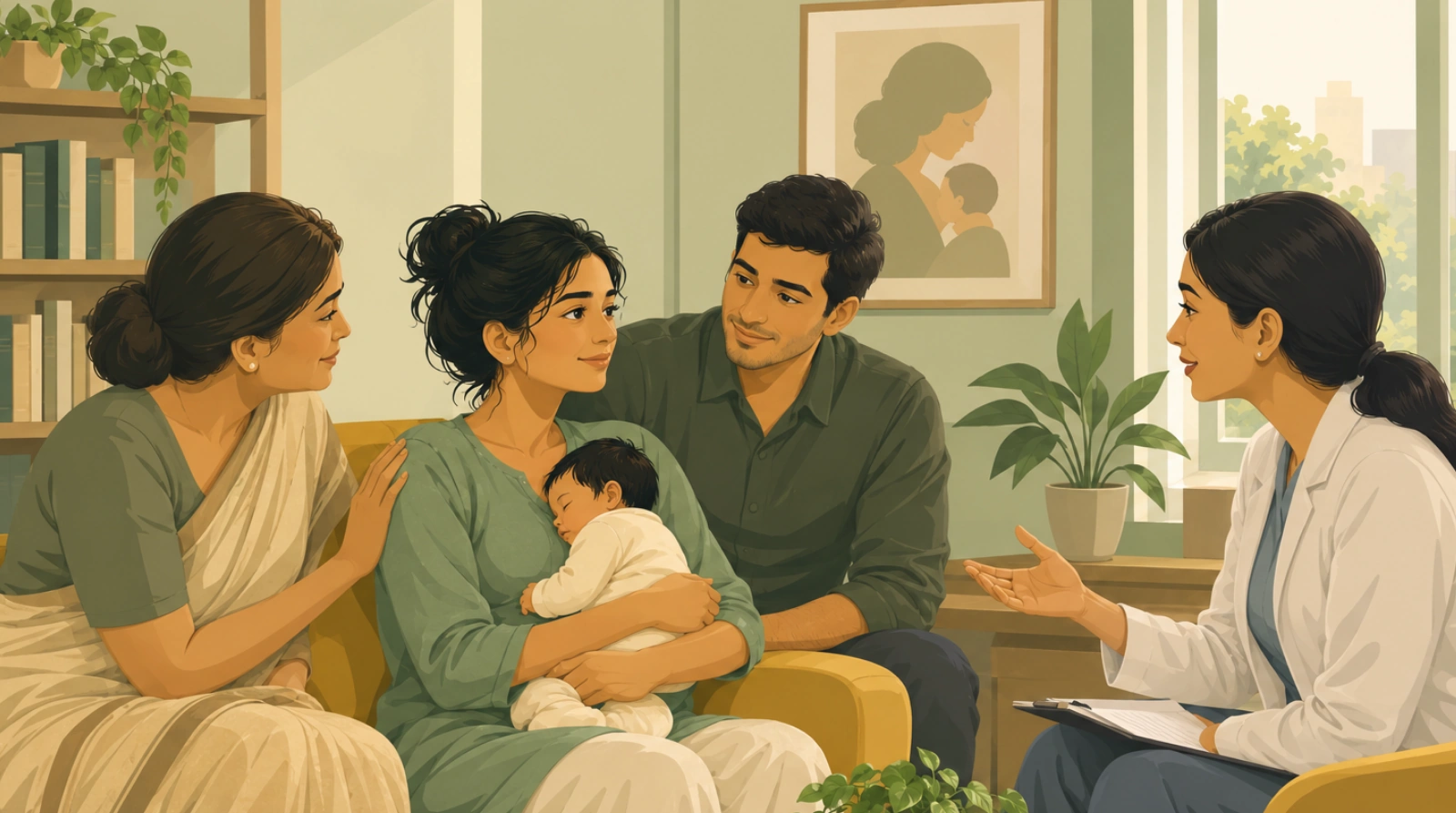
Family sessions help more than people expect. When a husband gets the illness, pressure drops.
When a mother-in-law gets it, the household shifts.
Follow-up is the part most people skip. Recovery is tracked over weeks, not days.
Most women get meaningfully better with the right care. That is the honest headline.
Q: How long does postpartum depression treatment take?
A: Many women feel real change within six to twelve weeks of starting proper treatment. Full recovery often takes longer, and follow-up continues after symptoms ease.
How Families Can Help in the First Year
Advice is cheap. Real relief is not.
Here is what truly cuts the load, in order of impact.
Guard her sleep. Pick one night shift and own it. Same nights each week, so she can plan around it.
Take the visitors. Screen calls. Delay guests. Say no on her behalf.
Do the unseen work. Bottles, laundry, medicines, visits. Do not ask what needs doing. Look and act.
Ask twice, judge never. Ask how she is. Wait. Ask again in a softer way.
Drop the comparisons. No stories about cousins who managed better. Those land as accusations.
Say the sentence out loud. Tell her this is an illness, not a failing. Repeat it often.
Book the visit. Do not just suggest care. Find the doctor, fix the time, sort the travel.
Go with her. Sit in the waiting room. Hold the baby during the session.
Watch your own language too. Small phrases carry weight.
"You wanted this baby" is a wound. "Everyone goes through this" is a door closing.
Try different lines instead. "I can see this is hard." "Tell me what today felt like."
Then keep showing up. Week eight matters as much as week one.
Set a simple family rule. Someone checks on the mother, not just the baby, every single day.
That habit alone catches many cases early.
And keep watching through the first year. Postpartum depression can start late.
A mother who was fine at three months can struggle at eight months. That is still postpartum depression.
Q: What should you never say to a new mother who is struggling?
A: Avoid "be grateful", "everyone manages", and "it is just hormones". These shut down disclosure. Ask what today felt like instead, then listen without fixing.
What Recovery Looks Like Month by Month
Recovery is rarely a straight line. It moves in steps.
Knowing the shape of it helps a family stay patient.
Weeks one and two after starting care. Not much changes yet. Sleep may improve a little.
This stage tests faith. Many families quit here. Do not.
Weeks three to six. The first real shift usually lands now.
Crying spells space out. Appetite returns. She answers questions in full lines again.
Medicine, where used, often starts to bite in this window.
Weeks six to twelve. Mood lifts in a steadier way.
She starts to want things again. A shower. A walk. A phone call with a friend.
Bonding often warms here too. Guilt about the early weeks may surface.
That guilt is normal. It is worth naming in therapy.
Month four and beyond. Function comes back before joy does.
She may look fine to guests and still feel hollow at night. Keep asking.
This is where follow-up matters most. Many women stop care once they seem fine.
Stopping early is the single biggest cause of relapse.
A few honest notes about the road.
Bad days will still happen. One bad day is not a return to square one.
Progress often shows in small things first. She laughs at something. She picks up her phone.
Track those, not just mood ratings.
Setbacks cluster around change. A new job, weaning, illness, or travel can all knock her back.
Plan extra support around those weeks.
And watch the second year quietly. Some mothers relapse when the child turns one.
Birthdays can stir up the hardest memories of the early months.
Keep one habit alive through all of it. Ask her how she is, and wait for the real answer.
Q: How long does it take to recover from postpartum depression?
A: Many women feel a clear shift within six to twelve weeks of proper care. Full recovery often takes several months. Stopping treatment early is the main cause of relapse.
- About 22% of Indian mothers show signs of postpartum depression, pooled across 38 studies and 20,043 women —
- Listed risk factors include money trouble, domestic violence, marital conflict, and the birth of a female baby —
- Depression can begin during pregnancy, not only after birth, which is why clinicians use the term perinatal depression —
- Across mental disorders in India, 70% to 92% of people who need treatment do not receive it —
- Mental morbidity among Indian adults runs at about 10.6% —
- Globally, depressive disorder affects an estimated 5% of adults —
How Ganaa Supports New Mothers and Their Families
Ganaa has worked in mental health care in India since 2012. We treat psychiatric conditions and substance use across all age groups.
Care is delivered through outpatient clinics and residential centres. Our clinics sit in Faridabad, Greater Kailash, and Greater Noida.
Our residential centres are in Delhi, Gurugram, Greater Noida, and South Goa.
For postnatal mental health, most families start with an outpatient consultation. That is usually the right door.
A psychiatrist assesses mood, sleep, and risk. A clinical psychologist maps the home setting.
Care is then tailored to the mother, not to a template. Therapy, medicine where needed, and family sessions are combined.
Family work matters here. We involve husbands and in-laws directly, with the mother's consent.
Much of the load on a new mother comes from the home. So the home is part of the plan.
Our approach blends modern clinical science with calmer, older practices. CBT, DBT, and neurofeedback sit alongside yoga and meditation (Source: Ganaa, 2026 — ganaa.in).
Live-in care is kept for severe cases. Think deep depression with risk, or postpartum psychosis.
Where a stay is needed, our teams plan it around the mother and baby. Our published guidance notes that programme length usually ranges from 30 to 90 days, depending on severity (Source: Ganaa FAQ, 2026 — ganaa.in).
Support runs 24 hours a day. Families get regular updates from the care team.
If you are worried about a new mother in your family, start with one call. You do not need a diagnosis to ask a question.
Speak to a Ganaa counsellor on +91 8750075006, or write to info@ganaa.in. You can also book a consultation at ganaa.in/booking.
Conclusion: Silence Is the Symptom Nobody Treats
Postpartum depression in India is common, treatable, and routinely missed.
About one in five Indian mothers carries it. Most carry it alone.
The illness is not caused by weak character. It is driven by hormones, sleep loss, money stress, and family pressure.
Baby blues fade in two weeks. Postpartum depression does not. That single rule catches most cases.
Watch for flat silence rather than tears. Watch for numbness toward the baby.
Watch through the whole first year, not just the first month.
If you are the mother reading this, you are not failing. You are unwell, and this responds to care.
If you are the family, do the real things. Guard her sleep. Take the visitors. Book the visit. Go with her.
And ask her how she is, every day, until the answer changes.
Help exists. It works.
The only step that cannot be skipped is the first one.
Make the call while she is still saying she is fine.
That is exactly when it helps most.
FAQ
Q: How common is postpartum depression in India?
A: About 22% of Indian mothers show signs of postpartum depression. That is roughly one in five. The figure comes from a review of 38 studies covering more than 20,000 Indian women. Most of those mothers never receive care.
Q: What is the difference between baby blues and PPD?
A: Baby blues start in the first few days and fade within two weeks. Mood is low but daily life still works. Postpartum depression lasts longer than two weeks and gets heavier. It blocks sleep, appetite, bonding, and basic function.
Q: When does postpartum depression usually start?
A: It often begins within the first six weeks after birth. It can also appear later in the first year. Some mothers notice symptoms during pregnancy itself. Clinicians call this wider window perinatal depression.
Q: Can postpartum depression go away on its own?
A: Sometimes mild symptoms lift on their own. Many cases do not. Untreated postpartum depression can run for months or longer. Treatment shortens it and lowers the risk to both mother and baby, so waiting is rarely the safer choice.
Q: Is medication safe while breastfeeding?
A: Several antidepressants are widely used during breastfeeding. A psychiatrist weighs the dose, the drug, and your feeding plan. Never start or stop medicine on your own. Ask your doctor to explain the specific risk for your case.
Q: What can a husband or family member actually do?
A: Take over night feeds where possible. Guard her sleep in solid blocks. Handle visitors and household demands. Ask how she feels without judging the answer. Then help her book a real clinical appointment.
Q: When is postpartum depression an emergency?
A: Seek help the same day if she talks about ending her life. Do the same for thoughts of harming the baby. Confusion, hearing voices, or strange beliefs also need urgent care. These signs point to postpartum psychosis, which is a medical emergency.
Online therapy matches in-person results for most conditions. Here is what the trials found, where each format wins, and how to choose for your own situation.
Mindfulness-based therapy cuts depression relapse risk in recurrent cases. Here is what MBCT is, what the trials found, and how the eight weeks actually run.