Are My Intrusive Thoughts OCD or Just Overthinking?
Are your intrusive thoughts OCD or just overthinking? Learn the real difference, spot key OCD symptoms, try a simple self-check, and know when to seek help.
Are My Intrusive Thoughts OCD or Just Overthinking?
A thought lands in your mind, uninvited. It is dark, strange, or just plain scary.
You push it away. It comes back. So you start asking: are my intrusive thoughts OCD, or am I just overthinking?
Here is the short answer. Almost everyone has intrusive thoughts. The thought itself is not the problem. The difference lies in what your brain does next. Overthinking loops through real worries and then fades. OCD grabs a thought, marks it as danger, and demands rituals to feel safe.
That difference matters. One needs better stress habits. The other needs proper treatment, and treatment works.
In India, this question often goes unasked. People hide odd thoughts for years out of shame. Yet 1 in 7 Indians lives with a mental health condition (Source: The Lancet Psychiatry, 2020 — pmc.ncbi.nlm.nih.gov).
This guide walks you through the real difference. You will learn what intrusive thoughts are and what overthinking looks like. You will see clear OCD symptoms, try a six-question self-check, and learn what actually helps. By the end, you will know your next step.
What Are Intrusive Thoughts?
Intrusive thoughts are uninvited guests. They are thoughts, images, or urges that pop up on their own.
They often clash with your values. A kind person imagines pushing someone. A devout person has a blasphemous image mid-prayer. A new parent pictures dropping the baby.
The content feels shocking. That is exactly why it sticks.
Here is the fact that changes everything. Intrusive thoughts are near-universal. In a study of 777 students across 13 countries, 93.6% reported at least one intrusive thought in the past three months (Source: Concordia University, 2014 — concordia.ca).
So the thought itself proves nothing. Dark thoughts visit almost every brain on earth.
What differs is the response. Most brains note the thought and let it drift off. Some brains sound an alarm instead.
Common themes include:
None of these themes is rare. None of them means you secretly want those things.
Intrusive thoughts come in three flavours. Thoughts are words — "what if" sentences. Images are pictures — a flash of an accident. Urges are body-feelings — a pull to shout in a silent room.
All three are normal brain noise. Your mind makes thousands of thoughts a day. A few will always be junk.
Think of them as mental spam. Spam in the inbox says nothing about the owner. Trouble starts only when you treat spam as urgent mail.
A: No. Research shows almost everyone has them, across every culture studied. They clash with your values, which is why they upset you. Upsetting content is not intent.
What Is Overthinking, Really?
Overthinking is different. It starts with a real situation, not a random image.
You replay the meeting where you spoke too bluntly. You rehearse tomorrow's phone call five times. You weigh one decision for days.
Psychologists split it into two habits. Rumination chews on the past. Worry rehearses the future.
Both feel productive. Neither is. You are not solving; you are circling.
But notice three things about overthinking.
First, the topic feels like yours. It matches your real life and your real concerns. It does not feel alien or shocking.
Second, there is no ritual. You do not wash, check, count, or pray a fixed number of times. The loop is heavy, but it asks for no ceremony.
Third, it responds to change. A walk, a talk, a deadline passing — the loop loosens. OCD does not loosen that way.
Sound familiar? Indian life offers rich fuel for this habit. Exam results, job security, marriage timelines, parents' health, EMIs. The mind treats each one as a puzzle it must solve tonight.
Perfectionism makes it worse. If every choice must be the best choice, no choice ever closes.
Overthinking still deserves care. Chronic rumination feeds low mood and poor sleep. Stress and anxiety already touch about 3.5% of Indians (Source: Indian Journal of Psychiatry, 2022 — pmc.ncbi.nlm.nih.gov).
So "just overthinking" is not "nothing". It is simply a different problem with a different fix.
A: On its own, no. It is a thinking habit, though a costly one. But heavy rumination can feed anxiety and depression over time. If it rules your day, talk to a mental health expert.
When Are Intrusive Thoughts OCD? The Key Differences
So when are intrusive thoughts OCD? When three elements lock together: obsession, distress, and compulsion.
An obsession is an intrusive thought that your brain flags as urgent danger. It repeats. It refuses to be dismissed.
The distress is intense. Not mild unease — real fear, guilt, or disgust.
Then comes the compulsion. A ritual, visible or mental, that briefly calms the fear. Wash again. Check again. Pray again. Ask again.
Relief lasts minutes. The doubt returns stronger. That loop is OCD's engine.
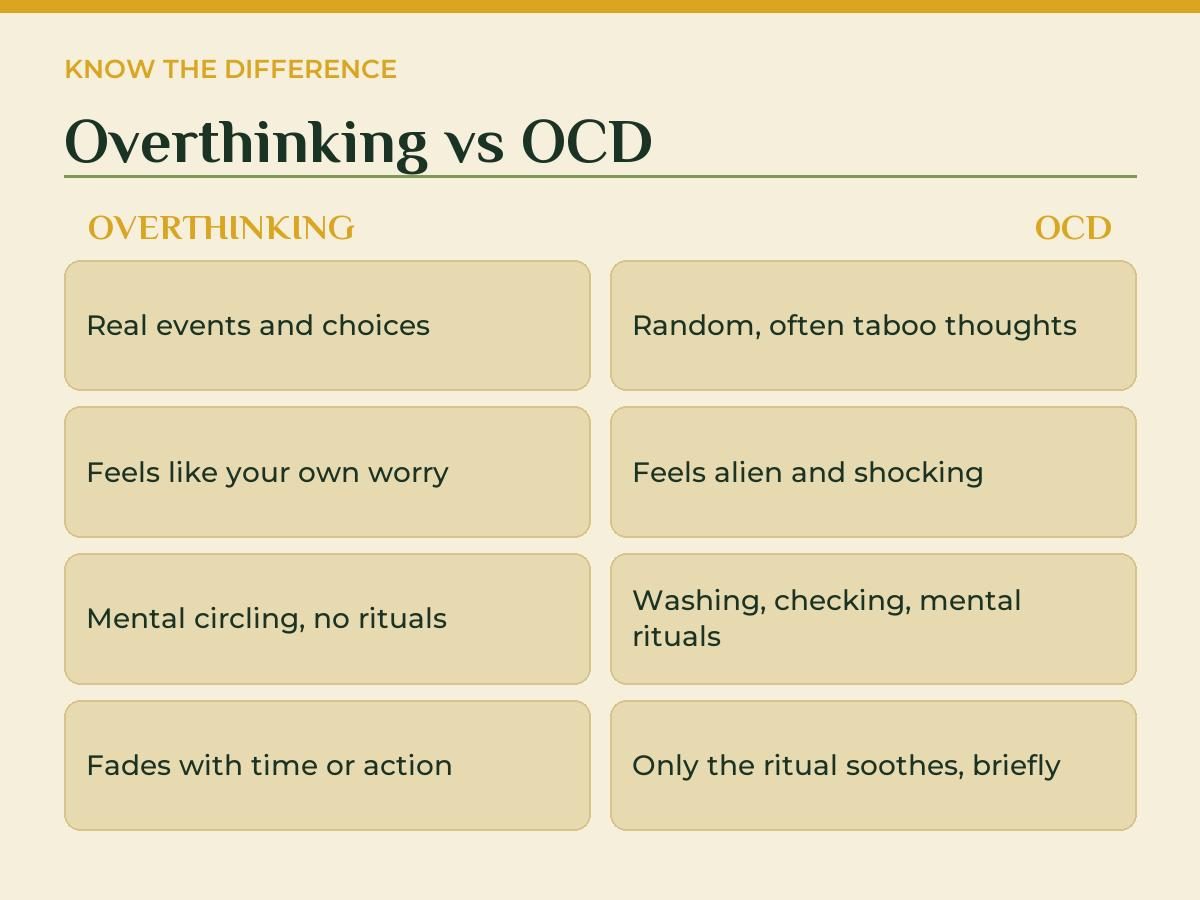
Compare the two side by side:
FeatureOverthinkingOCDTriggerReal events and choicesRandom, often taboo thoughtsFeel"My worry""Not me" — alien and shockingEmotionStress, mild dreadSharp fear, guilt, disgustResponseMental circlingRituals — washing, checking, mental prayersReliefFades with time or actionOnly the ritual soothes, brieflyTime lostScattered through the dayOften more than an hour a dayInsight"I stress too much""These thoughts scare me"
The OCD vs overthinking question often comes down to one word: rituals. Overthinkers circle. OCD demands a toll.
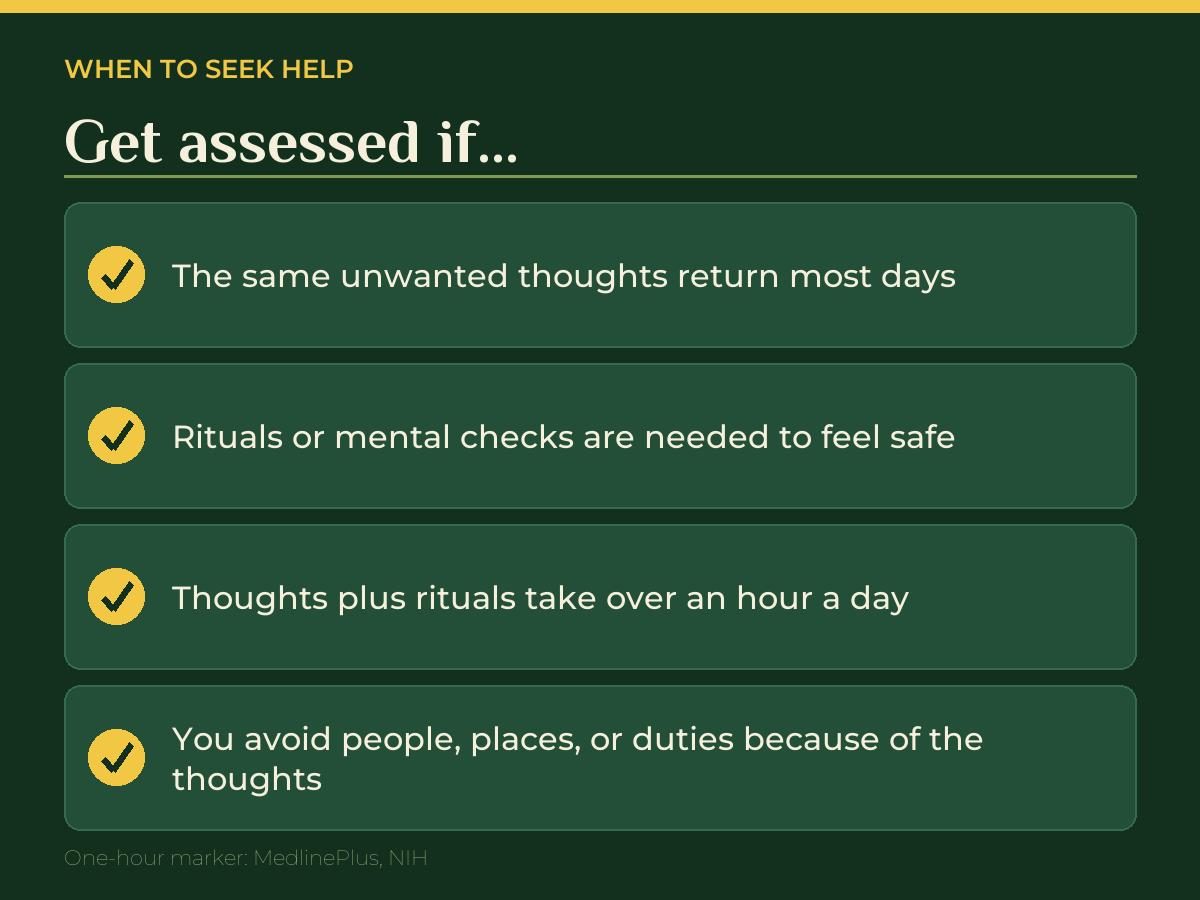
Doctors also weigh time. A key clinical marker is spending at least one hour a day on these thoughts or rituals (Source: MedlinePlus, NIH — medlineplus.gov).
There is one more clue: how the thought feels. Overthinkers agree with their worries. They sound sensible, even when they are endless.
OCD thoughts feel absurd and shameful at the same time. Most people with OCD know the fear is extreme. They ritualise anyway, because the doubt will not let go.
That gap between knowing and feeling is exhausting. It is also a hallmark doctors listen for.
A: Yes. Many people perform hidden mental rituals — counting, silent prayers, replaying events, or self-checks. Clinicians sometimes call this "Pure O". The rituals are real; they are just invisible.
OCD Symptoms: How Obsessions and Compulsions Work
OCD symptoms come in pairs. An obsession raises the alarm. A compulsion answers it.
Common obsessions include:
Common compulsions include:
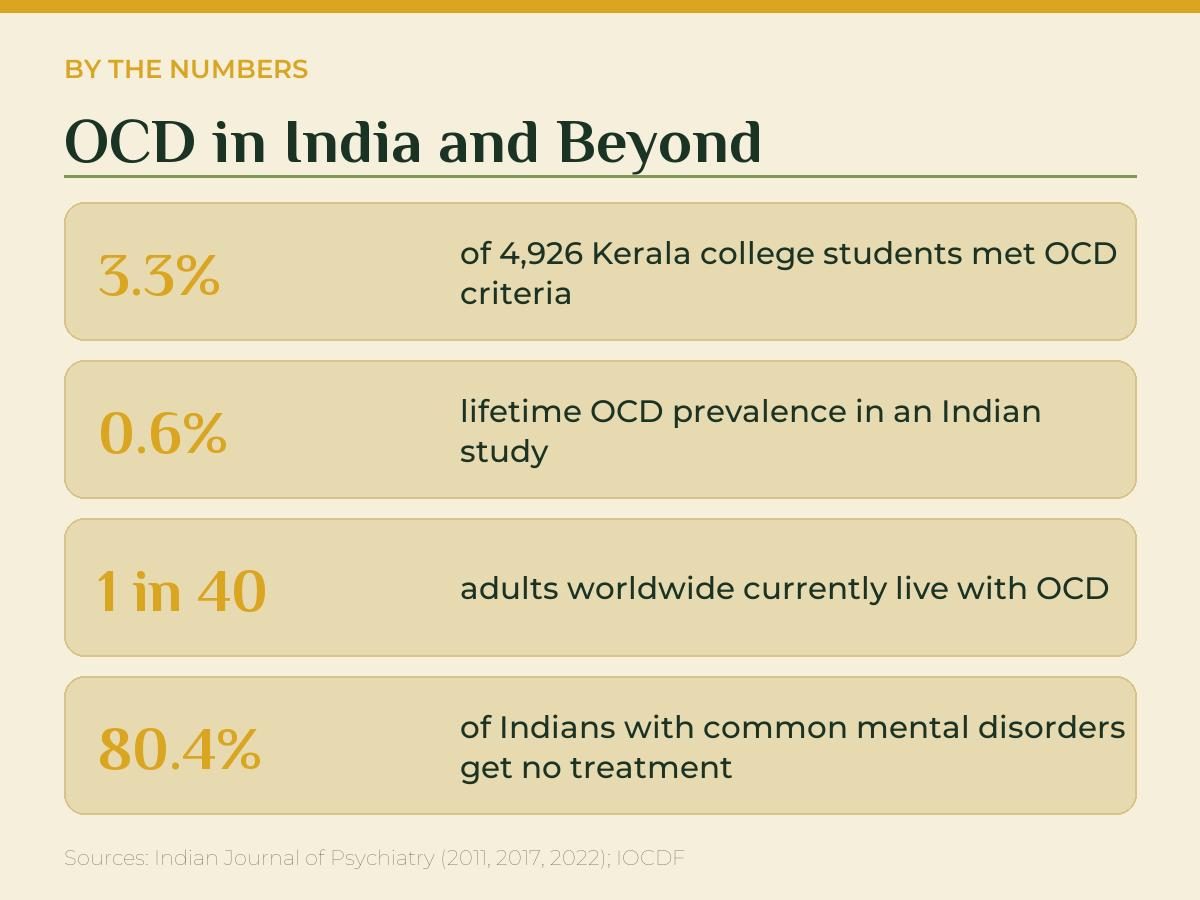
OCD symptoms are more common than most Indians assume. An Indian study found a lifetime rate of 0.6% (Source: Indian Journal of Psychiatry, 2011 — pmc.ncbi.nlm.nih.gov).
Younger groups show higher numbers. Among 4,926 college students in Kerala, 3.3% met OCD criteria at the time of the survey (Source: Indian Journal of Psychiatry, 2017 — pmc.ncbi.nlm.nih.gov). Another 8.5% had milder, subthreshold signs.
Globally the picture is similar. About 1 in 40 adults currently lives with OCD (Source: IOCDF — iocdf.org).
The illness usually starts young. Symptoms often begin between late childhood and young adulthood (Source: NIMH — nimh.nih.gov).
And it bites hard. Among US adults with OCD in the past year, 50.6% had serious impairment (Source: NIMH — nimh.nih.gov).
Notice the gap between those Indian numbers. Low reported rates in India partly reflect silence, not safety. People hide rituals for years. They fear being called mad, or being blamed for weak faith.
If that is you, hear this clearly. OCD is a medical condition. It has a name, a science, and a treatment path. Hiding it only gives it more room.
A: No. Obsessive thoughts in OCD run against your wishes — that is why they torment you. People with OCD do not want their thoughts. Fear of acting is a symptom, not a forecast.
Are My Intrusive Thoughts OCD Symptoms? A Self-Check
You cannot diagnose yourself with a list. But you can decide whether to seek an assessment.
Ask yourself these six questions. Answer honestly, for the past month.
Now read your answers.
Mostly no, with heavy mental circling about real problems? That points to overthinking. Stress habits and therapy for worry will serve you well.
Yes to questions 1 and 2 only? You may have sticky intrusive thoughts without full OCD. Watch the trend; learn to let thoughts pass.
Yes to question 3, 4, 5, or 6? Talk to a mental health expert soon. Rituals, lost time, and avoidance are the strongest OCD signals.
One more honest question helps: who is paying the price? Maybe rituals now rule the home. Maybe your family answers the same fear ten times a night. That cost is already too high.
Write your answers down. A doctor can use them. Screening tools like the Y-BOCS interview will go deeper, but your notes speed up the process.
A: Yes, and many people do. OCD handles the alien thoughts and rituals; rumination handles daily worries. A good clinician will map both and treat them together.
OCD vs Overthinking in the Clinic: What a Diagnosis Looks Like
Worried about what an assessment involves? Here is what actually happens. No scans, no shocks, no locked doors.
A psychiatrist or psychologist talks with you. They ask what the thoughts say, how often they come, and what you do next.
They will ask about rituals directly. Washing, checking, counting, praying, confessing, seeking reassurance. Say the honest number, not the polite one.
Many clinicians use a structured interview called the Y-BOCS. It rates the time obsessions take, the distress they cause, and how hard they resist. The score guides both diagnosis and progress checks.
The doctor also rules out look-alikes. This is where the OCD vs overthinking call gets made properly.
Generalised anxiety centres on real-life themes — money, health, family. The worry shifts topic but never demands rituals.
Depressive rumination replays failures and losses. It is heavy and past-focused, without the alien quality.
OCD stands apart by its engine: alien thought, spike of fear, ritual, brief relief.
Mixed pictures are common, and that is fine. Anxiety, depression, and OCD often travel together. Naming each part means each part gets treated.
Bring a family member if you can. They see the rituals and the reassurance loops you may not count.
One visit will not label you for life. It will give you a map. Most people leave an assessment relieved — the monster finally has a name and a plan.
A: Start with a psychiatrist or a clinical psychologist. Both can assess OCD; psychiatrists can also prescribe medicines. If you are unsure, a general physician can refer you to one.
Why Your Brain Gets Stuck: The Science of Sticky Thoughts
Why does one brain shrug a thought off while another sounds every alarm? Three habits of mind do most of the damage.
The first is thought-action fusion. This is the belief that thinking something is close to doing it. "I imagined harm. I must be dangerous." The thought gains false weight.
The second is over-responsibility. The sense that you alone must prevent every harm. So you check the gas five times for the whole family.
The third is thought suppression. Trying hard not to think something. Brains rebound: push a thought down and it pops up stronger. Try not to think of a white bear — you just did.
OCD adds a hardware layer. Brain circuits that flag errors fire too readily, so "maybe unsafe" never switches off.
Culture shapes the content too. Faith, purity, and family duty are dear to many Indian hearts. So Indian obsessions often wear those clothes — sin, dirt, ritual purity, harm to elders.
The theme follows what you love. That is worth repeating: obsessive thoughts attack what you value most.
Stress turns the volume up. Poor sleep, exam season, a new baby, grief — all make thoughts stickier. Many people notice their first bad spell during a life change.
None of this is choice or weakness. Sticky thoughts are a brain pattern, not a character flaw. And patterns can be retrained.
A: Because your brain flags what you care about. A loving parent gets harm thoughts; a devout person gets blasphemous ones. The alarm targets your values. That is a signature of OCD, not of evil.
What Actually Helps: Treatments That Work
Here is the hopeful part. Both overthinking and OCD respond well to the right help.
For overthinking, therapy teaches you to exit the loop. Set a daily "worry window" of 15 minutes. Postpone worries to that slot. Swap "why did this happen" for "what is one next step". Move your body; rumination hates a brisk walk.
For OCD, the gold standard is a therapy called ERP — exposure and response prevention. You face the feared thought in small, planned steps. You then resist the ritual, with a therapist's support. The fear rises, peaks, and falls on its own. Each round teaches your brain the alarm was false. ERP is a structured form of cognitive behavioural therapy, or CBT (Source: IOCDF — iocdf.org).
Here is a sample ERP ladder for a contamination fear.
Each rung feels hard, then boring. Boring is the goal. When the brain stops flagging danger, the ritual loses its job.
Medication helps too. Doctors often prescribe SSRIs, which calm the obsession-compulsion loop. Speak to a psychiatrist about options and doses. Never start or stop medicines on your own.
While you wait for help, three habits soften the loop.
First, name the visitor. When a dark thought lands, say to yourself: "That is an intrusive thought." Labels create distance.
Second, let it sit. Do not argue with the thought, and do not push it away. Both moves feed it. Let it hum in the background while you carry on.
Third, delay the ritual. If you must check, wait five minutes first. Stretch the gap a little each day. Every delay teaches your brain the alarm can pass unanswered.
Families can help the same way. Answer a repeated fear once, with love, then gently decline the tenth round. Endless reassurance feels kind, but it feeds the loop.
Some people need more support. Severe OCD with depression or substance use may need residential care for a time. Daily therapy, routine, and rest can reset what weekly sessions cannot.
Now the hard truth for India. Around 80.4% of Indians with common mental disorders get no treatment at all (Source: Indian Journal of Psychiatry, 2022 — pmc.ncbi.nlm.nih.gov).
Shame and stigma drive that gap. People fear the label more than the illness. Yet untreated OCD can grind on for years, while treated OCD often lifts.
- Across 13 countries, 93.6% of people reported intrusive thoughts within three months — . - Among 4,926 Kerala college students, 3.3% met OCD criteria and 8.5% had subthreshold signs — . - In 2017, 197.3 million Indians — 1 in 7 — lived with a mental disorder — . - About 80.4% of Indians with common mental disorders receive no treatment — . - Some 2.3% of US adults meet OCD criteria in their lifetime — .
Q: How long does OCD treatment take to work?
A: Many people feel real change within 12 to 20 ERP sessions. Medicines can take 8 to 12 weeks to show full effect. Severe cases may need longer or residential support. A clinician will set honest timelines with you.
How Ganaa Can Help
If this article felt personal, you do not have to carry it alone. We are Ganaa, and this is the work we do every day.
Ganaa began in 2012. Today we run residential mental health and rehab centres across Delhi NCR, Greater Noida, and Goa. We also run outpatient clinics for therapy and psychiatry. Our teams treat OCD, anxiety, depression, and dual diagnosis — mental illness alongside substance use.
What does that look like for sticky thoughts and rituals?
It starts with a full assessment. A psychiatrist maps your obsessions, rituals, mood, and sleep. You get a clear diagnosis, not a guess.
Then a tailored treatment plan. Therapy sits at the centre — including CBT-based work for obsessions and compulsions. Medication is added when a psychiatrist judges it will help.
Our centres blend two worlds. Modern clinical science — CBT, DBT, and structured therapy — meets yoga, meditation, and calm, nature-based settings. Healing needs both a plan and a peaceful place.
For severe or long-standing OCD, residential care changes the game. Our programs run in 30, 60, and 90-day formats, with round-the-clock support. Families are part of the process, because rituals and reassurance loops involve the whole home.
And aftercare continues once you leave. Recovery is a path, and we stay on it with you.
You do not need to be in crisis to reach out. A single conversation can turn months of silent worry into a plan.
Speak to a Ganaa admissions counsellor today, or visit ganaa.in to learn more about our programs.
The Bottom Line
So, are your intrusive thoughts OCD or just overthinking? Come back to the three markers.
Overthinking circles real problems, feels like your own worry, and fades without rituals. Intrusive thoughts visit nearly every human brain and pass when you let them. OCD is different: alien thoughts, sharp fear, and rituals that steal your time.
The thought is never the verdict. The loop is what counts.
If rituals, reassurance, and avoidance now shape your day, take the self-check seriously. An hour a day lost to thoughts and rituals is a clear line. Cross it, and it is time for an assessment — not more willpower.
Remember the treatment gap: most Indians with these conditions never get help. Do not join that statistic. ERP therapy and medication work, and earlier help means a shorter fight.
Your thoughts do not define you. Your next step does. Whether you need a stress reset or a full OCD plan, that step is available in India today. And Ganaa is ready when you are.
FAQ
Q: How do I know if my intrusive thoughts are OCD or just overthinking?
A: Look at three things: distress, time, and rituals. OCD thoughts feel alien, cause sharp fear, and push you to repeat actions or mental checks. Overthinking feels like your own worry and fades without rituals. If thoughts plus rituals eat more than an hour a day, get assessed.
Q: Can people without OCD have violent or strange intrusive thoughts?
A: Yes, and it is very common. In a 13-country study, 93.6% of people reported at least one intrusive thought in three months. A strange thought does not mean you are dangerous or ill. What matters is how much you fear it and how you respond.
Q: What are the most common OCD symptoms?
A: Common obsessions involve dirt and germs, doubt, order, religion, and fear of harming others. Common compulsions include washing, checking, counting, repeating prayers, and asking for reassurance. Many people also have hidden mental rituals with no visible actions.
Q: Does overthinking turn into OCD over time?
A: Plain overthinking does not usually become OCD. OCD needs a different loop: an alien thought, sharp fear, and a ritual that relieves it. But heavy rumination can raise stress and hide early OCD signs. If your worry now needs rituals to settle, get a proper assessment.
Q: What is Pure O OCD?
A: Pure O means obsessions with rituals that stay hidden in the mind. People replay events, pray silently, count, or argue with the thought for hours. The compulsions are real but invisible, so it is often mistaken for overthinking. It responds to the same therapy as other OCD types.
Q: When should I see a doctor about obsessive thoughts?
A: See a psychiatrist or psychologist if thoughts and rituals take over an hour a day. Also seek help if you avoid people, places, or duties because of the thoughts. Distress that affects sleep, work, or family life is reason enough. Early help shortens the illness and improves results.
Eating disorders in India hide behind praise for discipline and thinness. Learn the early warning signs, what to say, and how treatment actually works.
High functioning anxiety hides behind good work and a calm face. Learn the hidden signs, what the body does, and when coping turns into the problem itself.
The cost of mental health rehab in India is rarely published openly. Here is what moves the price, what insurance must cover by law, and what to ask first.