How Long Does Someone Need to Stay in Rehab to Recover?
How long is rehab, really? Evidence points to 90 days or more. Compare 30, 60 and 90 day stays, and see what decides recovery after discharge.
How Long Does Someone Need to Stay in Rehab to Recover?
Families ask this the moment a bed is offered. How long is rehab, and will thirty days be enough?
Here is the direct answer. Thirty days is a start, not a finish.
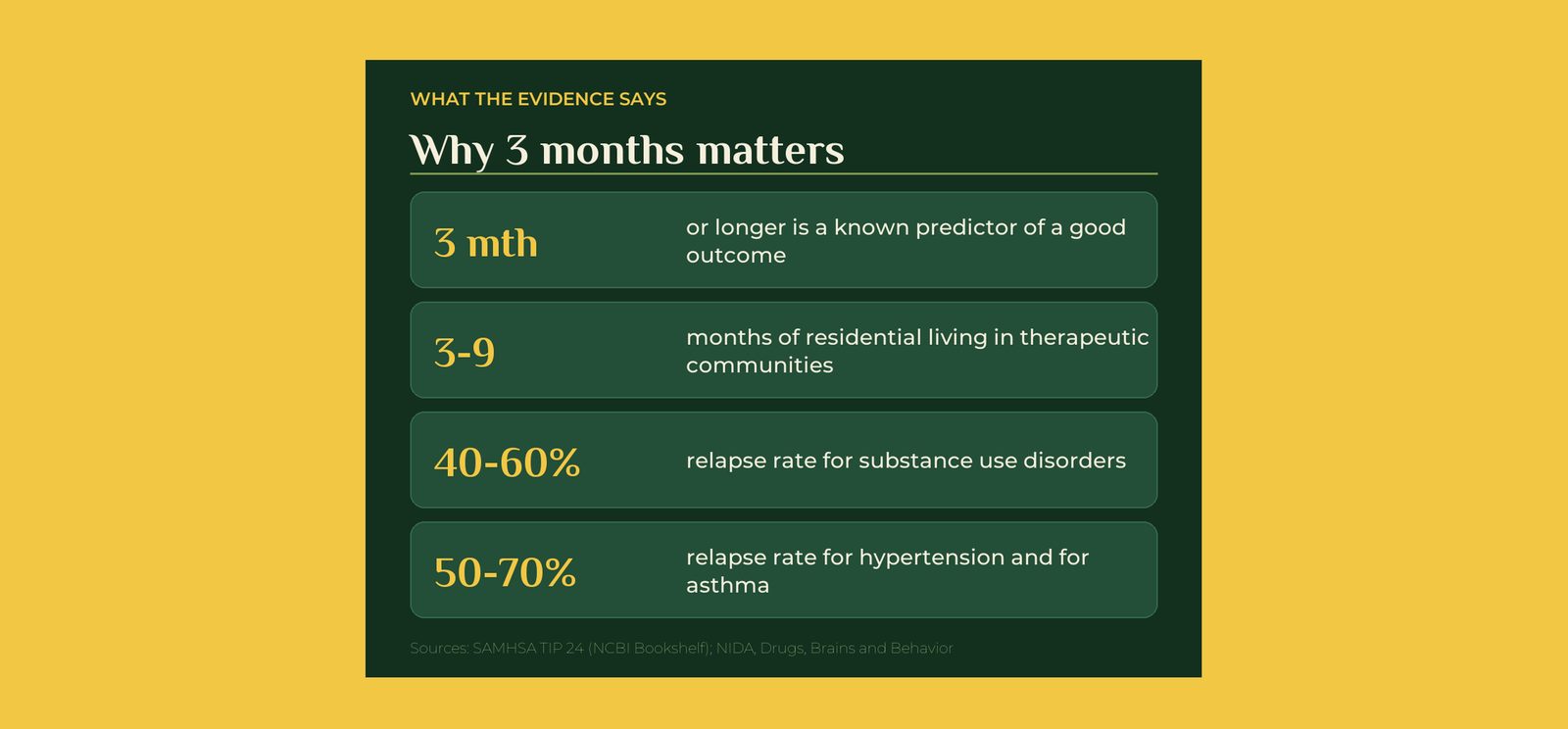
The research points one way. A treatment episode of three months or longer often predicts a better outcome (Source: SAMHSA TIP 24 — ncbi.nlm.nih.gov).
Longer stays are not about punishment. They are about time for the body and the habits to settle.
Shorter stays still help. They simply do a different job.
We know what is really on your mind. Cost. Leave from work. A business that cannot pause.
Those worries are fair. You deserve straight answers, not a sales pitch.
This guide walks through the whole picture. What each phase of a stay actually does.
How thirty, sixty and ninety day programmes really compare. Who each one suits.
Why length alone does not decide recovery. What makes a stay run longer.
What happens after discharge, and why leaving early costs the most. And the exact questions to ask before you admit someone.
Let us start with the short answer.
The Short Answer on How Long Rehab Takes
Most centres offer three lengths. Thirty days, sixty days, or ninety days.
That menu is built around billing cycles and leave policies. It is not built around your loved one's brain.
Research uses a different measure. What counts is time spent in treatment, not the label on the package.
A treatment episode of three months or longer often predicts a better outcome (Source: SAMHSA TIP 24 — ncbi.nlm.nih.gov).
Therapeutic communities ask for even more. They run a minimum of three to nine months of residential living, then a staged return home (Source: SAMHSA TIP 24 — ncbi.nlm.nih.gov).
So here is the plain answer to "how long is rehab". Plan for ninety days.
Hope you need less. Be ready to need more.
That answer frustrates people. It can sound like an upsell. It is not.
Think about what has to happen inside a stay. The body has to clear the substance. Sleep has to return. Mood has to settle.
Only then can therapy land. A brain in withdrawal cannot do trauma work.
That sequence takes weeks, not days. You cannot rush it by paying more.
There is a second reason. Habits are rebuilt by repetition.
Ninety days of steady routine builds a new default. Thirty days rarely does.
None of this means a short stay is wasted. A thirty day stay can save a life.
It simply does a smaller job. It is a strong beginning, not a finished course.
Treat the number as a plan, not a promise. Good centres review that plan every two weeks.
Your loved one may step down early. Or they may need another month. Both outcomes are normal.
Q: How long is rehab for most people?
A: Most centres offer thirty, sixty or ninety day residential programmes. The evidence favours the longer end, because a treatment episode of three months or more often predicts a better outcome. A good centre reviews progress every few weeks rather than fixing the date at admission.
Inside a Rehab Stay: The Four Phases
A rehab stay is not one long block of time. It moves through phases.
Knowing those phases makes the length of rehab stay make sense.
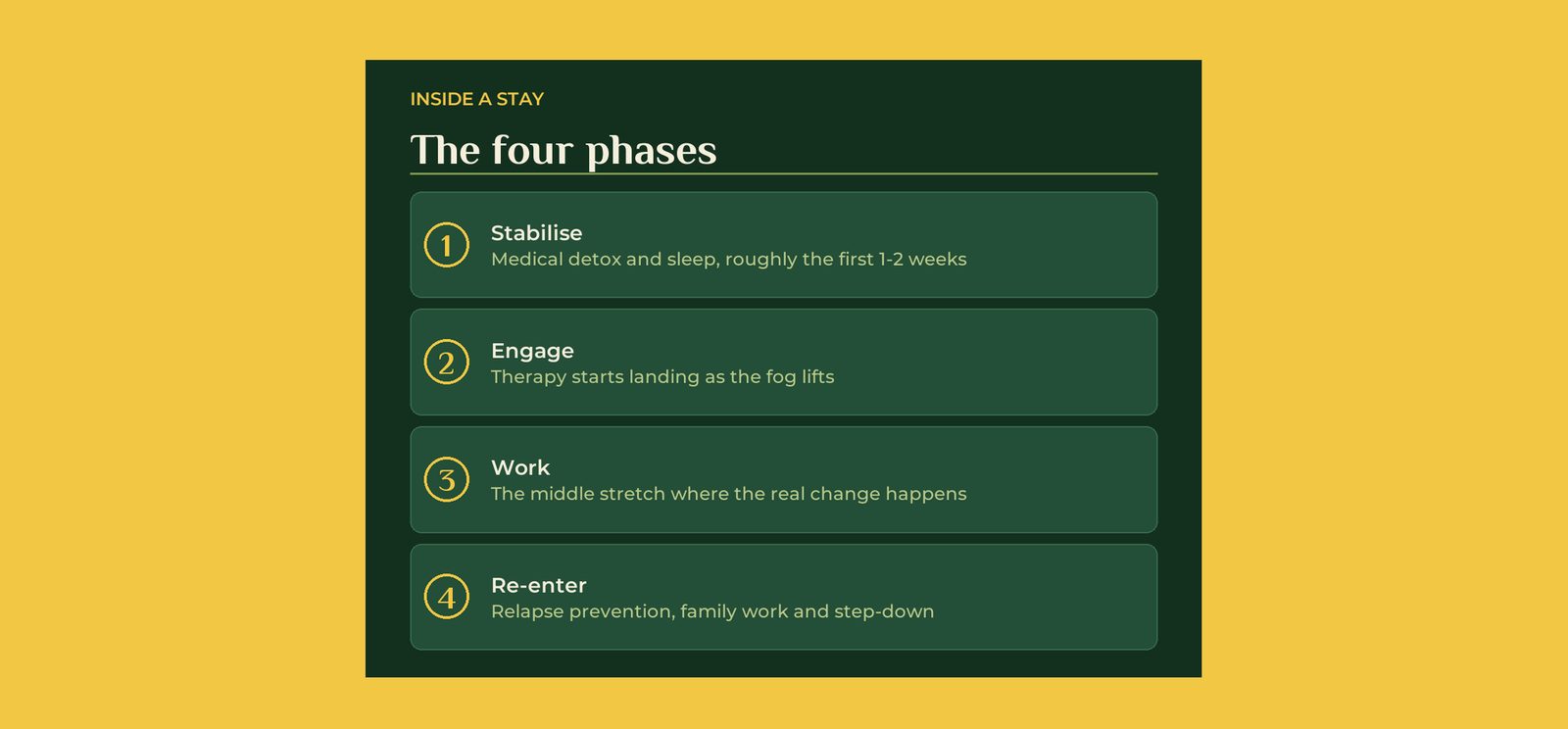
Phase one: detox and stabilisation. This usually runs five to ten days.
The focus is medical safety. Withdrawal is managed. Sleep, food and fluids are restored.
This is not therapy yet. It is the ground being cleared.
Withdrawal from alcohol and sedatives can be dangerous. It needs a doctor, not willpower.
Phase two: the early weeks. Roughly week two to week four.
The fog starts to lift. Sleep improves. Appetite returns.
Assessment happens here. A full psychiatric review. A careful look for depression, trauma or bipolar illness.
Motivation is fragile in this phase. Many people ask to go home in week three.
They feel better, so they decide they are done. That feeling is the illness talking.
Phase three: the middle stretch. Around week five to week ten.
This is where the real work lands. Cognitive behavioural therapy. Dialectical behaviour therapy. Trauma work. Group sessions.
Family therapy usually starts here too. Old patterns get named out loud.
This phase is uncomfortable. It is also where change actually happens.
A thirty day stay ends before this phase begins. That is the honest trade-off.
Phase four: relapse prevention and re-entry. The last few weeks.
Triggers are mapped. Craving plans are written. Refusal skills are practised.
Home is prepared. Work is discussed. An aftercare plan is signed.
Some centres add short home visits near the end. A weekend out, then back to the unit.
That rehearsal matters. Recovery has to survive contact with real life.
Q: What actually happens during a rehab stay?
A: A stay moves through detox, early stabilisation, the main therapy phase, and then relapse prevention and re-entry planning. Detox usually takes five to ten days and is medical, not therapeutic. The deeper therapy work tends to land from week five onward, which is why very short stays cover less ground.
Thirty, Sixty and Ninety Day Rehab Compared
Now the question you came for. What does each length actually buy?
Here is an honest view of the 30 60 90 day rehab choice.
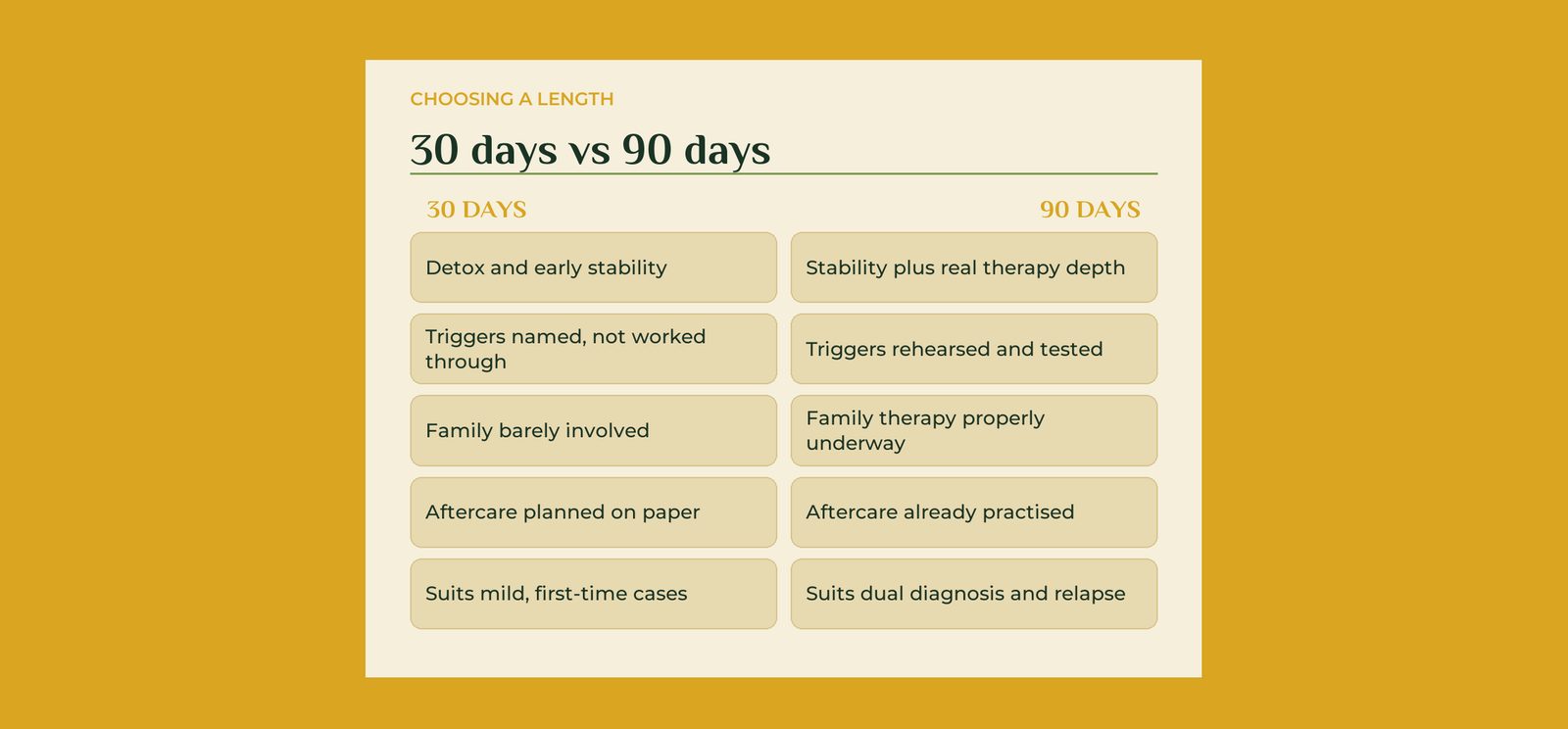
ProgrammeWhat it realistically achievesWho it suitsThirty daysDetox, medical safety, a first routineShort use history, strong home supportSixty daysAdds real therapy time and family workLonger use, one or two past slipsNinety daysFull therapy arc plus relapse rehearsalDual diagnosis, repeat relapse, unsafe home
A thirty day stay is mostly repair. The body steadies. Sleep returns. A daily rhythm forms.
Therapy begins, but it stays shallow. There is no time to go deep and still land safely.
Thirty days suits a narrow group. A first episode. A short history. A calm home to return to.
It also suits someone who cannot take longer leave. In that case, treat it as step one.
A sixty day stay changes the picture. Detox is behind you by week two.
That leaves six clear weeks of therapy. Enough to name the drivers. Enough for family sessions to start working.
Sixty days suits many people with a few years of heavy use. It also suits those with one or two past relapses.
A ninety day stay is the one the research keeps pointing at. It gives you the full arc.
Detox, stabilise, treat, then rehearse going home. Nothing gets skipped.
Ninety days suits dual diagnosis. It suits repeat relapse. It suits an unsafe or triggering home.
Do not let anyone tell you these three are equivalent. They are not.
They are different doses of the same medicine. You would not treat pneumonia with two days of antibiotics.
Q: Is a 30 day rehab programme enough?
A: For some people it is a safe and useful start, especially with a short use history and strong support at home. For most, it ends just as the deeper therapy work would begin. Thirty days is best treated as the first stage of a longer plan, followed by structured outpatient care.
Why Length Is Not the Real Variable
Here is what most rehab pages will not tell you. The calendar is not the active ingredient.
Time only helps if it is used well. Four things matter as much as the discharge date.
The first is engagement. A person who takes part changes. A person waiting out a sentence does not.
Motivation work matters early. Good teams keep at it well past week one.
The second is dual diagnosis. Many people in rehab also live with depression, anxiety, trauma or bipolar illness.
Treat the substance alone and the untreated illness pulls them back. Both need care at the same time.
The third is family involvement. Recovery happens at home, not in the unit.
If the home stays the same, the risk stays the same. Family therapy is not an optional extra.
The fourth is aftercare. What follows discharge often decides the outcome.
Now for the part families fear most. Relapse.
Between forty and sixty per cent of people with a substance use disorder relapse (Source: NIDA — nida.nih.gov).
That number sounds like failure. It is not.
Compare it with other long-term illnesses. Relapse rates for high blood pressure and asthma run between fifty and seventy per cent (Source: NIDA — nida.nih.gov).
Nobody calls an asthma flare-up a moral failure. Nobody says the inhaler was a waste of money.
A relapse means the plan needs review. It does not mean the person is beyond help.
Some people need more than one episode of care. That is a known pattern, not a scandal (Source: NIDA — nida.nih.gov).
Hold that framing gently at home. Shame drives people straight back to use.
Q: Does a longer stay guarantee recovery?
A: No. Length raises the odds, but engagement, treatment of any other mental illness, family involvement and aftercare matter just as much. A shorter stay with strong follow-up can beat a longer stay with none.
What Makes a Rehab Stay Run Longer
Some stays stretch past the plan. That is not a sign of failure.
These factors lengthen rehab duration most often.
Dual diagnosis. A second condition needs its own treatment arc.
Medication for depression or bipolar illness takes weeks to settle. Rushing discharge wastes that work.
Severity and length of use. Ten years of daily drinking is not a thirty day problem.
Heavy, long use changes sleep, mood and thinking for months. Give it time.
Use of more than one substance. Two substances mean two withdrawal patterns and two sets of triggers.
Past relapses. Each earlier relapse tells you something useful. The last plan was too short or too thin.
Repeat episodes usually need a longer stay and a firmer aftercare plan.
An unstable home. Some homes are not safe to return to yet.
Active use in the house. Violence. A dealer two doors away. These are real barriers.
A longer stay buys time to build a safer landing.
Legal or work pressure to leave early. This one is common in India.
A court date. A job that will not hold. A shop that needs the owner back.
Those pressures are real. They still push people out before the work is done.
Weak family engagement. If nobody attends family sessions, the plan has no anchor at home.
Poor physical health. Liver damage, infections and poor nutrition all slow things down.
Here is how to use this list. Do not read it as bad news.
Read it as a planning tool. Ask the team which items apply.
Then build the timeline around the answer. A stay planned honestly beats a stay cut short.
Q: What makes a rehab stay longer than planned?
A: A second mental illness, heavy or long-term use and past relapses all extend the timeline. So do an unsafe home and poor physical health. Pressure from work or a court case often pushes in the other direction. A good team will review the plan every two weeks and tell you why.
What Happens After Discharge
Discharge day feels like the finish line. It is closer to the starting line.
The first three months at home carry the highest risk. Old cues come back all at once.
The same street. The same friends. The same stress that started it.
So aftercare is not a bonus. It is the second half of the treatment.
Here is what strong aftercare looks like.
Structured therapy often runs on a weekly rhythm. Twelve-step facilitation, for example, is typically delivered in twelve weekly sessions (Source: NIDA — nida.nih.gov).
Now the hard part. Leaving early is the most common way people lose their gains.
It rarely looks dramatic. It looks like a phone call in week three.
The words are always similar. "I feel fine now. Please come and get me."
Families often agree, out of love and guilt. The person sounds clear-headed for the first time in years.
That clarity is early recovery, not finished recovery. The therapy that protects it has not happened yet.
Agree on one rule before admission. No discharge decision gets made on a bad day.
Any request to leave gets a forty-eight hour pause. The team, the family and the person talk it through.
Write that rule down. Sign it. It has saved more stays than any speech.
Q: What happens after someone leaves rehab?
A: The plan should include outpatient therapy, psychiatric follow-up, family sessions, self-help meetings and a written relapse plan. Where home is unsafe, sober living can bridge the gap. The first three months after discharge carry the highest risk, so support needs to be at its strongest then.
Rehab Duration in the Indian Context
Indian families face a different set of pressures. The clinical answer does not change. The practical one does.
Start with the scale of the problem. About 14.6 per cent of Indians aged ten to seventy-five are current alcohol users.
That is roughly sixteen crore people (Source: AIIMS NDDTC, 2019 — aiims.edu).
More than 5.7 crore Indians live with harmful or dependent drinking. That is about 5.2 per cent of the population (Source: AIIMS NDDTC, 2019 — aiims.edu).
Most of them never reach care. The treatment gap for mental morbidity in India is 84.5 per cent (Source: NMHS 2016, Int J Social Psychiatry, 2020 — pubmed.ncbi.nlm.nih.gov).
Nearly 150 million Indians live with some form of mental morbidity (Source: NMHS 2016, Int J Social Psychiatry, 2020 — pubmed.ncbi.nlm.nih.gov).
Now the pattern we see every week. Most Indian admissions are arranged by family.
A brother calls. A wife calls. A father books the bed.
The person often arrives reluctant, or fully against it. That shapes the first two weeks.
Reluctant admissions need more time, not less. Motivation has to be built inside the unit first.
Cost sits on top of all this. Residential care is a real expense for most households.
Leave from work is the other squeeze. Ninety days away is hard to explain to an employer.
Both worries are valid. Here is a fairer way to weigh them.
Count the cost of the last five years. Lost income. Medical bills. Damage paid for. Chances missed.
Then set that against one longer stay. The maths usually shifts.
Stigma adds pressure to hurry. Families want the person home before neighbours ask questions.
That instinct is human. It is also why many stays end on day twenty-eight.
Q: Why do Indian families often cut a rehab stay short?
A: Cost, leave from work and stigma all push toward an early exit. Most admissions here are arranged by family rather than chosen by the person. Naming those pressures with the treatment team at admission helps. A staged plan with clear review points is easier to hold than a vague promise.
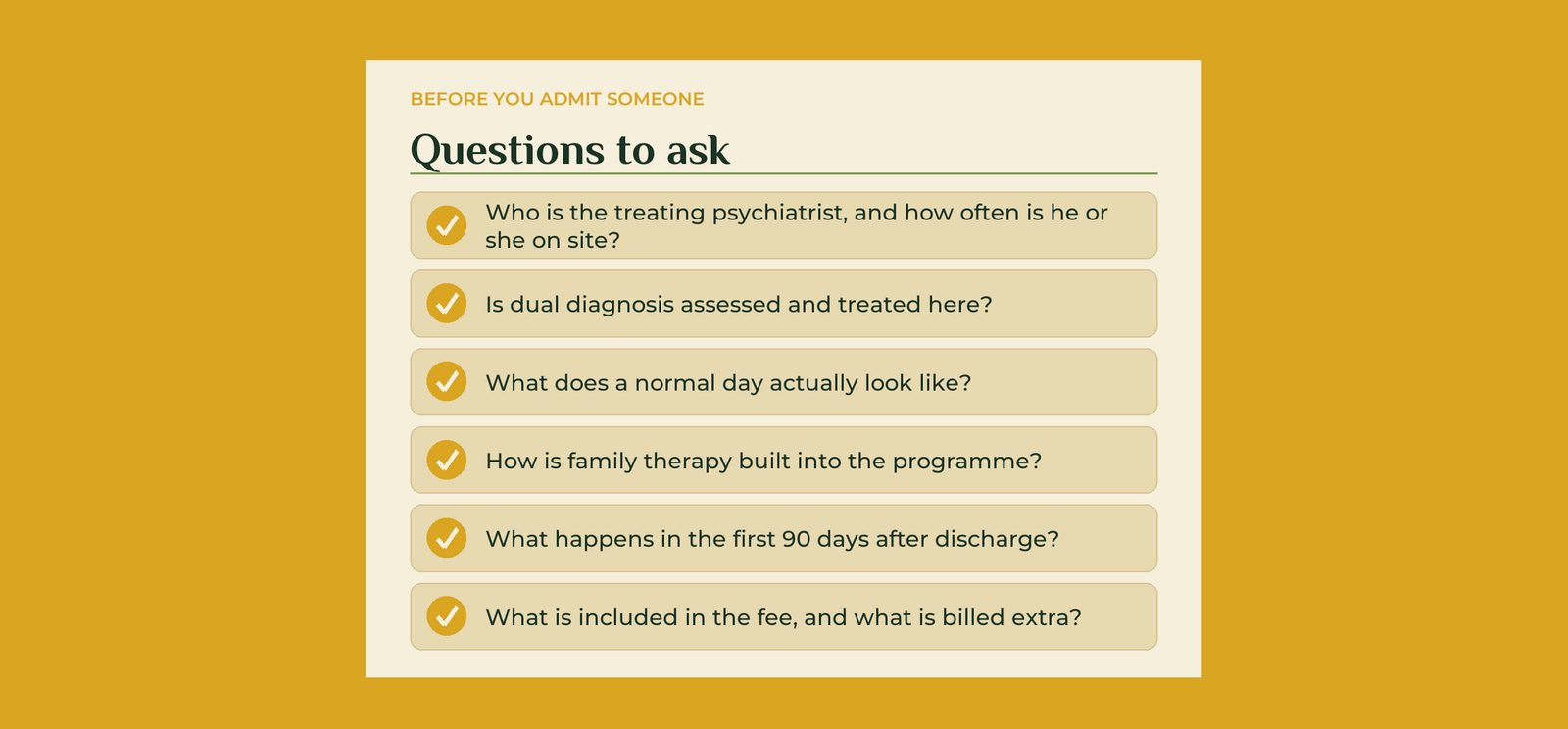
Questions to Ask Before You Admit Someone
You are allowed to interview a facility. Good centres expect it.
Ask these before you pay a deposit.
Then listen closely to how they answer.
A good centre gives ranges, not guarantees. It talks about review points, not miracles.
Be careful with any place that promises a cure. Or quotes a success rate it cannot show you.
Be careful if nobody names a psychiatrist. Detox without medical cover is a risk, not a saving.
Ask to see the daily timetable. A real programme has structure from morning to night.
Ask how the person will spend Sunday. Empty weekends are where motivation leaks away.
One more question is worth asking. What happens if we need more time than we planned?
The answer tells you a lot. A clinical team will discuss it calmly.
Q: What should families ask a rehab centre before admission?
A: Ask how the length of stay is decided and reviewed. Ask whether detox is medically covered overnight. Ask how mental illness is screened at intake. Ask what family therapy involves and what aftercare is included. Any promise of a guaranteed cure is a warning sign.
- A treatment episode of three months or longer often predicts a better outcome — . - Therapeutic communities ask for three to nine months of residential living, plus a staged return home — . - Relapse rates for substance use disorders run between forty and sixty per cent — . - Relapse rates for high blood pressure and asthma run between fifty and seventy per cent — . - About 5.2 per cent of Indians, more than 5.7 crore people, live with harmful or dependent drinking — . - The treatment gap for mental morbidity in India is 84.5 per cent — .
How Ganaa Approaches Length of Rehab Stay
If you are weighing options right now, here is how we work.
Ganaa is a mental health and rehabilitation brand in India. We treat psychiatric conditions, substance use and dual diagnosis.
We run thirty, sixty and ninety day residential programmes, plus aftercare.
The number is chosen with you, not handed to you. It follows a full assessment at intake.
We look at the use history. Any other mental illness. Physical health. The home you will return to.
Then we review the plan as the stay goes on. If the pace needs to change, we say so early.
Our care blends modern clinical work with calm, restful settings. Therapy, psychiatric review, yoga and mindfulness sit side by side.
Each treatment plan is tailored to the person. Family sessions are built in, not bolted on.
We have five residential centres. Ganaa South Delhi and Ganaa Chattarpur sit in South Delhi.
Ganaa Gurgaon in Haryana includes a women-only wing. Ganaa Goa is in South Goa. Ganaa Greater Noida is in Uttar Pradesh.
We also run three outpatient clinics. They are in Faridabad, Greater Kailash and Greater Noida.
Those clinics matter for the step-down phase. Many families move from residential care to outpatient care with the same team.
We will not promise you a cure. No honest centre can.
What we can offer is a clear plan, a named clinician and an honest review date.
Still torn between thirty and ninety days? Talk it through with someone clinical.
Speak to a Ganaa admissions counsellor, or visit ganaa.in to read about our programmes.
Choosing a Length You Can Actually Hold
Let us bring this back to your decision.
How long is rehab, in the end? Long enough to finish the work, not just start it.
The evidence favours ninety days or more. Three months keeps showing up as the useful threshold.
Thirty days still helps. It steadies the body and starts the routine. It simply stops short of the deeper work.
Sixty days buys real therapy time. Ninety days buys the full arc, including the rehearsal for going home.
Read the 30 60 90 day rehab menu as three doses, not three equal choices.
Length matters, yet it is not the whole answer. Engagement, dual diagnosis care, family work and aftercare carry as much weight.
Relapse is common in every long-term illness. It calls for a plan review, not a verdict on the person.
Whatever length you choose, protect the exit. Agree the no-early-discharge rule before admission.
And build the aftercare before discharge day, never after it.
If you are still unsure, use the questions in this guide. A centre that answers them plainly is worth your trust.
Recovery is slower than anyone wants. It is also more possible than most families believe.
Take the next step this week. One honest talk with a clinician can change the whole plan.
FAQ
Q: How long is rehab for most people?
A: Most centres offer thirty, sixty or ninety day residential programmes. The evidence favours the longer end, because a treatment episode of three months or more often predicts a better outcome. A good centre reviews progress every few weeks rather than fixing the date at admission.
Q: Is a 30 day rehab programme enough?
A: For some people it is a safe and useful start, especially with a short use history and strong support at home. For most, it ends just as the deeper therapy work would begin. Thirty days is best treated as the first stage of a longer plan, followed by structured outpatient care.
Q: What is the difference between 30, 60 and 90 day rehab?
A: Thirty days covers detox, medical safety and a first routine. Sixty days adds real therapy time and family work. Ninety days allows the full arc, including relapse prevention and a rehearsed return home. They are different doses of the same treatment, not equal options.
Q: What makes a rehab stay longer than planned?
A: A second mental illness, heavy or long-term use and past relapses all extend the timeline. So do an unsafe home and poor physical health. Pressure from work or a court case often pushes in the other direction. A good team will review the plan every two weeks and tell you why.
Q: What happens after someone leaves rehab?
A: The plan should include outpatient therapy, psychiatric follow-up, family sessions, self-help meetings and a written relapse plan. Where home is unsafe, sober living can bridge the gap. The first three months after discharge carry the highest risk, so support needs to be at its strongest then.
Q: Does a relapse mean rehab failed?
A: No. Between forty and sixty per cent of people with a substance use disorder relapse. That is close to the rates seen in high blood pressure and asthma. A relapse signals that the treatment plan needs review, not that the person is beyond help. Some people need more than one episode of care.
Eating disorders in India hide behind praise for discipline and thinness. Learn the early warning signs, what to say, and how treatment actually works.
High functioning anxiety hides behind good work and a calm face. Learn the hidden signs, what the body does, and when coping turns into the problem itself.
The cost of mental health rehab in India is rarely published openly. Here is what moves the price, what insurance must cover by law, and what to ask first.