What Is the 3-3-3 Rule for Anxiety, and Does It Work?
The 3-3-3 rule for anxiety asks you to name 3 things you see, 3 sounds you hear, and 3 body parts you can move. Here is how it works, plus what research says.
What Is the 3-3-3 Rule for Anxiety, and Does It Work?
Anxiety hits fast. One minute you feel fine. The next, your chest is tight and your thoughts race.
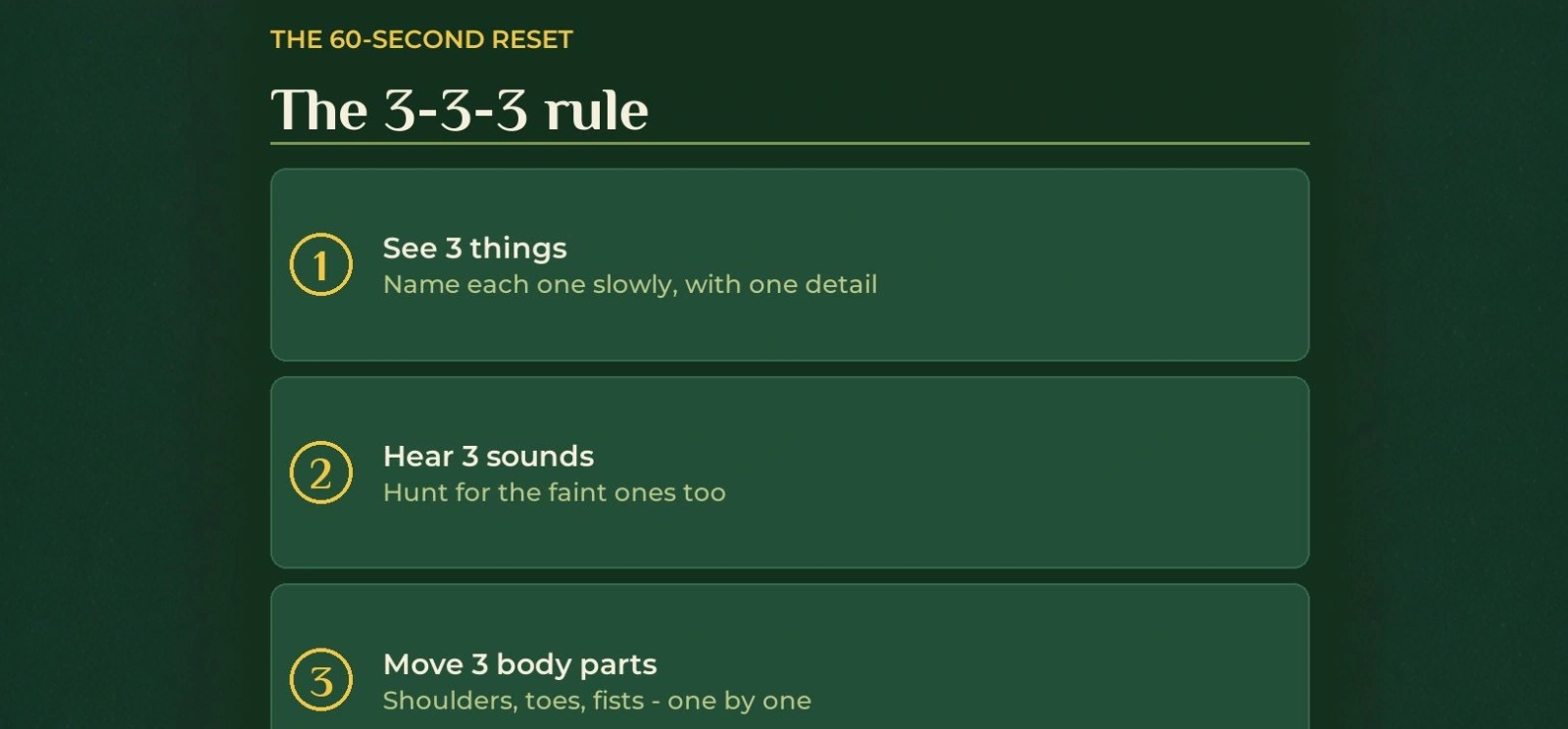
The 3-3-3 rule for anxiety is a quick grounding trick for those moments. You name 3 things you can see. You name 3 sounds you can hear. Then you move 3 parts of your body.
That is the whole rule. It takes under a minute. It needs no app, no mat, and no training.
Does it work? Here is the honest answer. It can calm a spike in the moment. It is not a cure, and no large trial has tested this exact rule. The science behind it, attention shifting and slow sensing, is real and growing.
You are not alone in needing it. One in seven Indians lived with a mental health condition in 2017 (Source: The Lancet Psychiatry, 2020 — GBD India study). Anxiety is one of the biggest parts of that number.
This guide walks you through the exact 3-3-3 steps. It adds three more tools you can copy today. It looks at what research really says, without hype. And it shows you when grounding is not enough, and what real help looks like.
What Is the 3-3-3 Rule for Anxiety?
The 3-3-3 rule is a short grounding exercise for anxious moments. It uses your senses to pull your mind back to the present.
Anxious thoughts live in the future or the past. What if I fail? Why did I say that? The 3-3-3 rule interrupts that loop with three small tasks.
Here are the exact steps.
Some versions swap the third step. They ask you to touch 3 objects instead. Both work the same way. Pick the version you will remember under stress.
The order does not matter much either. What matters is going slow. Rushing through the list defeats the point.
Use it anywhere. In a meeting. On a crowded metro. In bed at 3 a.m. Nobody around you will even notice.
The rule is popular because it is easy to recall. Under stress, memory shrinks. A three-step rule survives that shrinkage. A ten-step routine does not.
One more thing sets it apart. It asks nothing of you. No belief, no practice history, no quiet room. That makes it a fair first tool for anyone.
Teachers use it with exam-stressed students. Managers use it before hard meetings. Parents teach it to anxious children. The rule bends to fit almost any life.
A: You name 3 things you can see, 3 sounds you can hear, and then move 3 parts of your body. Some versions replace movement with touching 3 objects. Both forms count as grounding.
Why the 3-3-3 Rule Calms Your Brain
Anxiety is a threat response. Your brain's alarm system fires, and your body gets ready to run. Heart rate climbs. Breathing gets shallow. Thoughts narrow to danger.
The problem is simple. The alarm often fires when there is no real threat. An email. A memory. A vague worry about money.
Grounding works because attention is limited. Your brain cannot fully track a fan, a door, and a sound while also spinning worry stories. The senses crowd out the spiral.
Naming things helps in a second way. Putting feelings and objects into words engages the thinking parts of the brain. One brain-imaging study found that labelling feelings lowered activity in the amygdala, the brain's alarm centre (Source: Psychological Science, 2007 — affect labeling study).
That is why the 3-3-3 rule asks you to name, not just glance. Words do quiet work.
Movement adds a third layer. Rolling your shoulders or unclenching your jaw sends a safety signal back to the brain. Tense muscles say danger. Loose muscles say safe.
So the rule is not magic. It is a small stack of known effects. Shift attention outward. Label what you sense. Loosen the body.
Clinicians group tools like this under one name: an anxiety grounding technique. Therapists teach grounding in many forms, from sensory lists to cold water on the wrists.
The 3-3-3 rule is simply the easiest one to carry with you.
Think of it like a fire drill for your mind. You do not build new exits during a fire. You use the ones you practised. Grounding works the same way.
One caution belongs here. Grounding is a coping skill, not an escape hatch. If you use it to avoid every hard feeling, anxiety can grow in the background. Use it to steady yourself, then face the day.
A: Grounding pulls limited attention away from worry and onto your senses. Naming what you see and hear engages thinking regions and quiets the brain's alarm centre. Gentle movement releases the tension that keeps the alarm going.
How to Use the 3-3-3 Rule: A Script You Can Copy
If you searched how to calm anxiety, you want steps, not theory. Here is a full script. Copy it into your phone notes.
The 60-second version:
Three tips make it work better.
Go slow on purpose. Each item deserves 5 to 10 seconds. Speed keeps you in alarm mode. Slowness signals safety.
Add detail. Not just "a chair". Try "a brown chair with a torn seat". Detail forces real attention, and real attention breaks the loop.
Repeat if needed. One round may not settle a strong spike. Run it two or three times. Fresh items each round.
Practise when you are calm. Twice a day for a week builds the habit. Then the rule shows up on its own when panic hits.
Here is a simple 7-day starter plan.
Keep a small note of what shifted each time. Even one line helps. Over a week, you build proof that your attention is trainable.
A: One round takes about a minute. Many people feel a shift within two to three rounds. If nothing shifts after a few tries, switch to slow breathing or a longer grounding tool.
Does the 3-3-3 Rule Actually Work? An Honest Look
Here is the truth. No large clinical trial has tested the 3-3-3 rule by itself. You may read claims of proven results. Treat those with care.
So why do clinicians still teach it? Because its parts rest on better-studied ground.
First, attention. Grounding borrows from mindfulness, which asks you to anchor on the present. Mindfulness-based programmes have a wide research base for stress and anxious distress.
Second, labelling. As we saw above, naming feelings and objects dials down amygdala activity (Source: Psychological Science, 2007 — affect labeling study).
Third, the body. Slow-breathing tools, often paired with grounding, have trial evidence. A meta-analysis pooled 12 randomised trials with 785 adults. Breathwork lowered self-reported stress and anxiety versus control groups (Source: Scientific Reports, 2023 — breathwork meta-analysis).
What does that mean for you? Three fair conclusions.
The 3-3-3 rule is good first aid. It can take the edge off a spike, right now, at zero cost.
It is not a treatment. It does not touch the causes of an anxiety disorder. Nobody should manage daily panic with a one-minute list alone.
And it works best inside a bigger plan. Grounding plus breathing plus therapy beats grounding alone.
Be wary of any page that calls this rule a proven cure. Anxiety care deserves the same honesty as any other health care.
Why does the hype spread anyway? Because the rule photographs well. It fits a single social media tile. Real anxiety care is slower and less shareable, so it gets fewer posts.
That does not make the rule useless. It makes the rule a doorway. Walk through it, then keep going toward care that fits your needs.
A: The exact rule has not been tested in large trials. Its building blocks, attention shifting, labelling, and slow movement, have real research support. Use it as a helpful tool, not a proven therapy.
The 5-4-3-2-1 Grounding Technique
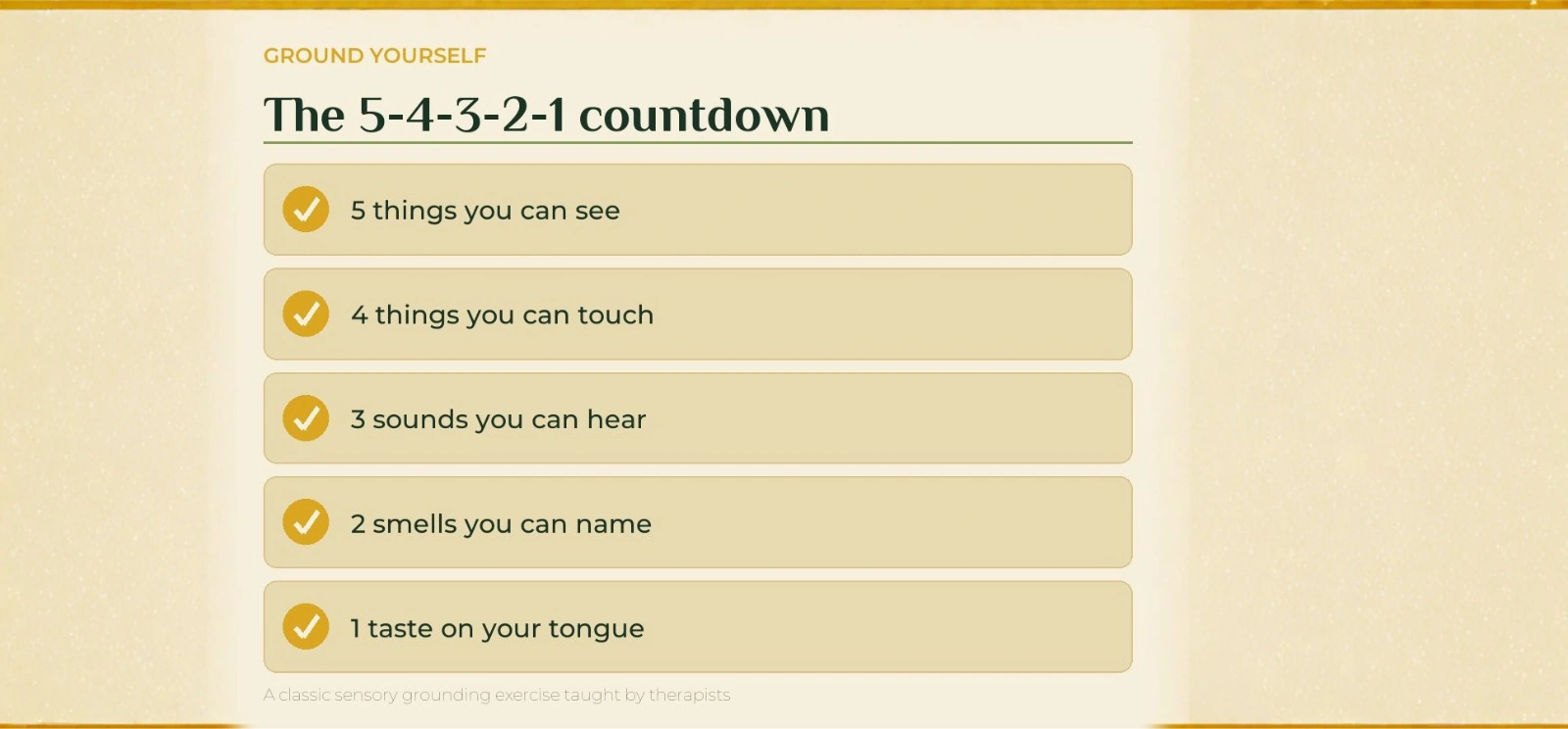
Sometimes three items are not enough. The spiral is too loud. For those moments, therapists teach a longer anxiety grounding technique: 5-4-3-2-1.
It walks through all five senses. The extra length is the point. It gives a racing mind a longer job.
Copy this script:
End with one slow breath out. Then look around. Most people find the room feels closer and the worry feels smaller.
When should you pick 5-4-3-2-1 over the 3-3-3 rule? Use the longer tool when you have privacy and a few minutes. Use 3-3-3 when you are mid-meeting and need something fast.
Both tools share one engine. Senses in, stories out.
A small caution. Grounding can feel odd during a strong panic wave. That is normal. Keep going gently, and let the wave pass through.
You can also adapt the tool for children. Make it a game. Ask them to find five red things in the room. A playful list grounds a child faster than a clinical one.
For night-time worry, do the touch step under the blanket. The sheet's texture, the pillow's weight, your own heartbeat. Quiet senses work fine in the dark.
A: Neither is better for everyone. The 3-3-3 rule is faster and easier to recall in public. The 5-4-3-2-1 method runs longer and suits deeper spirals at home. Learn both and match the tool to the moment.
Box Breathing and the Cyclic Sigh: Two Breath Tools
Grounding shifts your attention. Breathing shifts your body. Together they answer how to calm anxiety from both ends.
Here are two protocols worth learning.
Protocol 1 — Box breathing (4-4-4-4).
Slow, even breathing calms the body's alarm branch. The JIPMER institute in Puducherry ran a randomised trial with 140 people with anxiety disorders. Eight weeks of daily slow yogic breathing improved heart-rate variability and other calm-system markers (Source: Annals of Neurosciences, 2024. JIPMER slow breathing trial).
Protocol 2 — The cyclic sigh.
A Stanford team tested this in a month-long study of about 100 adults. Five minutes of daily cyclic sighing improved mood and lowered breathing rate more than mindfulness meditation (Source: Cell Reports Medicine, 2023 — cyclic sighing study).
The long exhale is the active part. Breathing out slowly nudges the heart to slow down.
Stack the tools. Run one cyclic sigh, then the 3-3-3 rule, then box breathing if you need more. The whole stack takes under five minutes.
A few pointers keep breathing tools safe and useful.
Sit down for your first tries. Slow breathing can make some people feel light-headed at the start. That fades with practice.
Do not force the holds. If a 4-count hold feels tight, drop to 2 or skip it. The slow exhale matters more than the numbers.
And keep sessions short at first. Two minutes done daily beats ten minutes done once.
None of this needs equipment. All of it is free. That makes these tools ideal first steps while you arrange deeper support.
A: Try the cyclic sigh. Breathe in through your nose, sip in a second short breath, then exhale long and slow through your mouth. Even one or two sighs can ease a spike, and five minutes daily showed mood benefits in research.
How Common Is Anxiety in India?
If anxiety visits you often, you are far from alone. The numbers in India are large, and the care gap is larger.
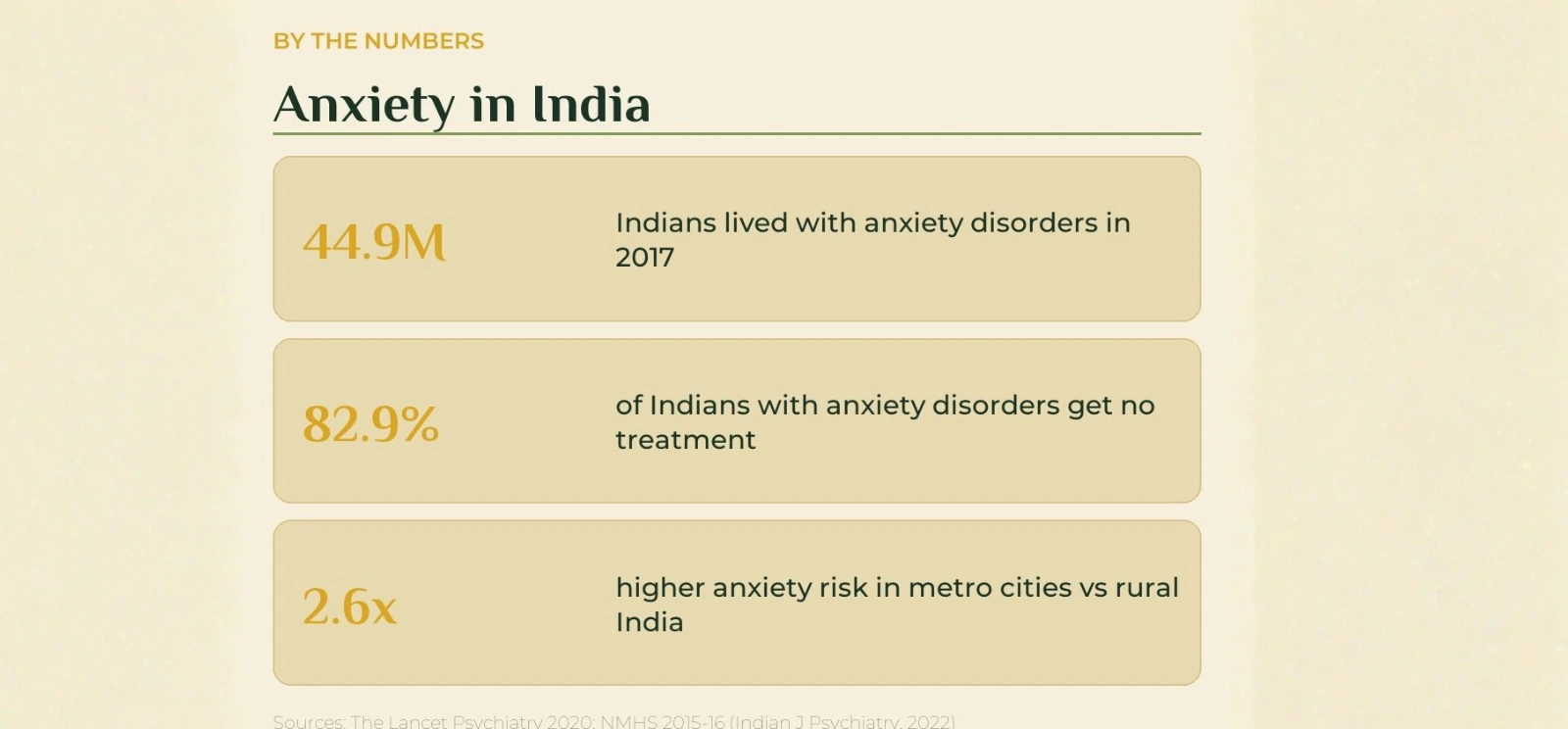
India's National Mental Health Survey screened 39,532 people across 12 states. It found that 2.57% of adults had an anxiety disorder at the time of the survey (Source: NMHS 2015–16, Indian Journal of Psychiatry, 2022 — NMHS anxiety analysis).
That sounds small. It is not. Scaled to India's adult population, it means crores of people.
The same analysis found a hard truth. 82.9% of Indians with anxiety disorders were getting no treatment at all (Source: NMHS 2015–16, Indian Journal of Psychiatry, 2022 — NMHS anxiety analysis).
City life raises the risk. People in metro cities were 2.6 times more likely to have an anxiety disorder than rural residents (Source: NMHS 2015–16, Indian Journal of Psychiatry, 2022 — NMHS anxiety analysis).
- 44.9 million Indians had anxiety disorders in 2017. — . - 82.9% of Indians with anxiety get no treatment. — . - Indian women: 3.01% face anxiety. Men: 1.8%. — . - Pooled Indian studies flag anxiety in about 23% of adolescents. — . - 301 million people worldwide had an anxiety disorder in 2019. — .
Read that treatment gap again. More than 8 in 10 people get no care. Stigma, cost, and distance all play a part.
The gender gap deserves a note too. Women in India face anxiety at nearly double the male rate. Yet many women reach care last in the family, if at all.
Adolescents carry a heavy share as well. Exams, screens, and social pressure stack up early. Early support changes that path.
Tools like the 3-3-3 rule matter here. They are free and always available. But they should be a bridge to care, not a substitute for it.
When Grounding Is Not Enough: Signs You Need More Help
Many people call the 3-3-3 rule a panic attack rule. That name captures both its power and its limit. It helps you ride out a panic wave. It cannot stop the waves from coming.
So how do you know when to seek more help? Watch for these signs.
Any one of these deserves attention. Two or more deserve a proper assessment.
What does real help look like? Talk therapy comes first for most people. CBT, short for cognitive behavioural therapy, has the strongest track record for anxiety. It teaches you to test anxious thoughts and face avoided things step by step.
Medicines help many people too. A psychiatrist can walk you through the options and what fits your case. Never start or stop such medicines on your own.
Lifestyle work supports both. Sleep, movement, sunlight, and less caffeine all lower the baseline. Yoga and slow breathing add to that base, as the trials above show.
Cost worry stops many families. Know that government hospitals and district mental health programmes offer low-cost care. Teleconsultation services now reach small towns too. Options exist at every budget.
Worried about the first appointment? Here is what usually happens. The clinician asks about your worry, sleep, health, and daily life. You talk. Nothing is forced on you.
Together you agree on a plan and a review date. That is it. Most people say the first session felt far easier than the months of waiting before it.
If a panic attack rule is your only tool, you are working too hard alone. Help exists, and it works.
A: A panic attack feels terrifying, but it is not a heart attack and it passes. The real risk is the fear and avoidance that grow around repeated attacks. If attacks recur, get assessed by a mental health professional.
How Ganaa Supports People With Anxiety
Sometimes anxiety needs more than tips. When worry starts running your days, structured care changes the story. That is where we come in.
Ganaa has worked in mental health care since 2012. We run five residential centres across Delhi NCR, Greater Noida, and Goa. We also run outpatient mental health clinics in Faridabad, Greater Kailash, and Greater Noida.
Our centres sit in calm, green settings. Care runs round the clock. Psychiatrists, psychologists, and trained support staff work as one team.
We blend two worlds on purpose. Modern clinical care, including CBT and DBT. And older practices that steady the nervous system, like yoga, meditation, and mindful breathing. The grounding tools in this guide are part of daily life at our centres.
Anxiety rarely travels alone. It often arrives with low mood, sleep trouble, or substance use. Our teams assess the whole picture and build a tailored plan. For some, that means outpatient sessions. For others, a 30, 60, or 90-day residential programme fits better.
Families are part of the work too. We help parents, partners, and children understand anxiety and support recovery at home. Aftercare continues once a residential stay ends.
If your worry, or a loved one's, has crossed from stressful to unmanageable, do not wait for a crisis. Speak to a Ganaa admissions counsellor, or visit ganaa.in to learn about our programmes and centres.
One conversation can be the first grounded step.
The Bottom Line
The 3-3-3 rule for anxiety is simple on purpose. See 3 things. Hear 3 sounds. Move 3 body parts. It costs nothing and travels everywhere with you.
Does it work? As first aid, yes, for many people. It shifts attention, engages words, and loosens the body. Those parts rest on real research, even though the rule itself lacks big trials.
Keep the honest frame. Grounding calms a moment. It does not treat an anxiety disorder. India's own data shows how many people stay stuck without care, with an 82.9% treatment gap (Source: NMHS 2015–16, Indian Journal of Psychiatry, 2022 — NMHS anxiety analysis).
So learn the stack. The 3-3-3 rule for fast moments. The 5-4-3-2-1 method for deeper spirals. Box breathing and the cyclic sigh for the body.
Then take the bigger step if you need it. Therapy works. Treatment works. Support exists in India, closer than you think.
Your anxious brain is not broken. It is an alarm that needs retuning. Start with three things you can see, and go from there.
FAQ
Q: What is the 3-3-3 rule for anxiety?
A: The 3-3-3 rule is a quick anxiety grounding technique. You name 3 things you can see, 3 sounds you can hear, and then move 3 parts of your body. It pulls your attention out of anxious thoughts and back to the present moment.
Q: Does the 3-3-3 rule actually work?
A: It can ease an anxiety spike in the moment. The rule itself has not been tested in large clinical trials. But the ideas behind it, attention shifting and slow sensing, are supported by research on grounding and breathing. Treat it as first aid, not as a treatment.
Q: Is the 3-3-3 rule good for panic attacks?
A: Many people use it as a panic attack rule. It gives your mind a simple job while the wave of panic peaks and passes. Pair it with slow breathing for a stronger effect. If panic attacks keep coming back, see a mental health professional.
Q: How is the 5-4-3-2-1 method different from the 3-3-3 rule?
A: The 5-4-3-2-1 method uses all five senses. You name 5 things you see, 4 you can touch, 3 you hear, 2 you smell, and 1 you taste. It takes longer than the 3-3-3 rule, which makes it useful for deeper spirals. The 3-3-3 rule is faster and easier to recall under stress.
Q: How many times a day can I use the 3-3-3 rule?
A: There is no limit. It is safe, free, and needs no tools. Use it whenever anxiety spikes, at work, at home, or while travelling. If you need it many times every day, that is a sign to speak to a professional about deeper care.
Q: When should I see a doctor about anxiety?
A: Seek help if worry fills most days for weeks, sleep breaks down, or you start avoiding work, study, or people. Repeated panic attacks are another clear sign. A psychiatrist or psychologist can assess you and suggest therapy, medicines, or both.
Q: Can breathing exercises replace therapy for anxiety?
A: No. Breathing tools calm the body in the moment, and research supports that effect. But an anxiety disorder usually needs structured care, such as talk therapy and sometimes medicines. Use breathing tools alongside professional treatment, not instead of it.
Eating disorders in India hide behind praise for discipline and thinness. Learn the early warning signs, what to say, and how treatment actually works.
High functioning anxiety hides behind good work and a calm face. Learn the hidden signs, what the body does, and when coping turns into the problem itself.
The cost of mental health rehab in India is rarely published openly. Here is what moves the price, what insurance must cover by law, and what to ask first.