Why do I relapse when I really want to quit? Because wanting is not the mechanism. The brain science, the three stages of a relapse, and how to catch it early.
Why Do I Relapse Even When I Really Want to Quit?
You meant it. That is what makes it so confusing.
You were not pretending on day one. You wanted this more than you had wanted anything.
And then, weeks or months later, there you are again. Holding the thing you swore off.
The explanation almost everyone reaches for is the wrong one. Weak will.
If that were true, relapse would be rare among determined people. It is not.
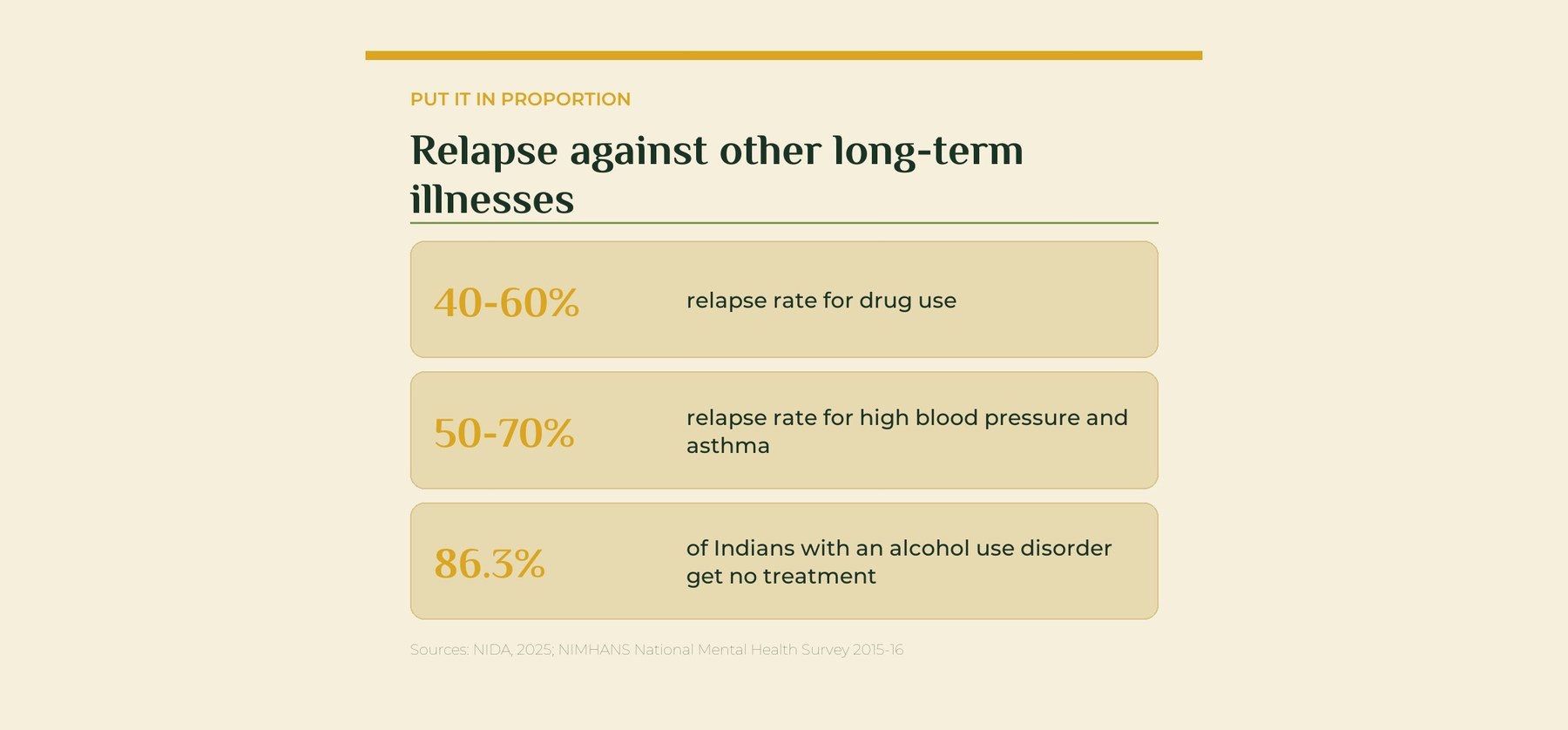
Relapse rates for drug use sit at 40 to 60% (Source: NIDA, 2025 — nida.nih.gov).
That is not far off the numbers for hypertension and asthma, which run at 50 to 70% (Source: NIDA, 2025 — nida.nih.gov).
Nobody calls an asthma flare-up a character defect. The comparison is not there to comfort you.
It is there because it points at the real explanation. This is a long-term condition with a relapsing pattern.
Wanting to quit is necessary. It is not the mechanism that keeps you stopped.
This article explains what the mechanism actually is.
We will look at what long use does to the brain's reward and habit systems.
We will walk through the three stages of a relapse, because it starts weeks before the drink or the dose.
We will name the triggers people underestimate. And the specific traps in Indian family and work life.
Then we will build a plan that does not rely on being strong at the worst possible moment.
Let us start with what is really happening.
Wanting to Quit and Staying Quit Use Different Systems
Here is the piece that clears up most of the confusion.
Deciding to quit uses the thinking part of the brain. It weighs the future against the present.
Using is driven by an older, faster system. Reward, habit and cue.
Those two systems do not share a switch. That is why a genuine decision can be overrun in seconds.
Think about how the habit was built. Repeated use taught your brain a shortcut.
Cue, then craving, then use, then relief. Hundreds of times. Sometimes thousands.
The brain does not store that as a choice. It stores it as a route.
Then it makes that route fast, so it can run before you have finished thinking.
This is why people describe relapse in a strange way. They say they watched themselves do it.
That description is accurate. The thinking system arrived late.
There is a second layer, and it is just as important.
Stopping does not delete the route. It just stops using it.
The wiring stays intact for a long time, sometimes for years. That is why old cues still bite.
Walking past a familiar shop. A specific song. The smell of a bar. A face you used with.
None of that is nostalgia. It is a stored route being switched on by its cue.
A: No. Wanting is handled by one brain system and using by another, older one. A cue can trigger a craving before any decision happens. That is a wiring problem, not a wanting problem.
The Numbers That Should Change How You See This
Statistics rarely help emotionally. These ones do.
- Relapse rates for drug use are 40 to 60% — . - Hypertension and asthma each have relapse rates of 50 to 70% — . - Relapse does not mean treatment has failed. It is a sign to resume, change or replace the treatment — . - In India, 4.6% of adults have an alcohol use disorder, rising to 9% among men — . - India's treatment gap for alcohol use disorder is the highest of any condition surveyed, at 86.3% — .
Sit with the first two lines for a moment.
Your relapse rate is lower than the rate for asthma.
Nobody tells someone with asthma that they lacked commitment. They adjust the inhaler.
That is exactly the correct response here too. A relapse is information about the plan.
The Indian numbers add a second point. Most people here relapse without ever having had real treatment.
With an 86.3% treatment gap, most attempts to stop are made alone, at home, with nothing but resolve.
Then the failure gets blamed on the person rather than on the missing treatment.
The Three Stages of a Relapse
This is the single most useful idea in the whole field.
A relapse is not a moment. It is a process with three stages.
By the time you are holding a drink, you are in stage three.
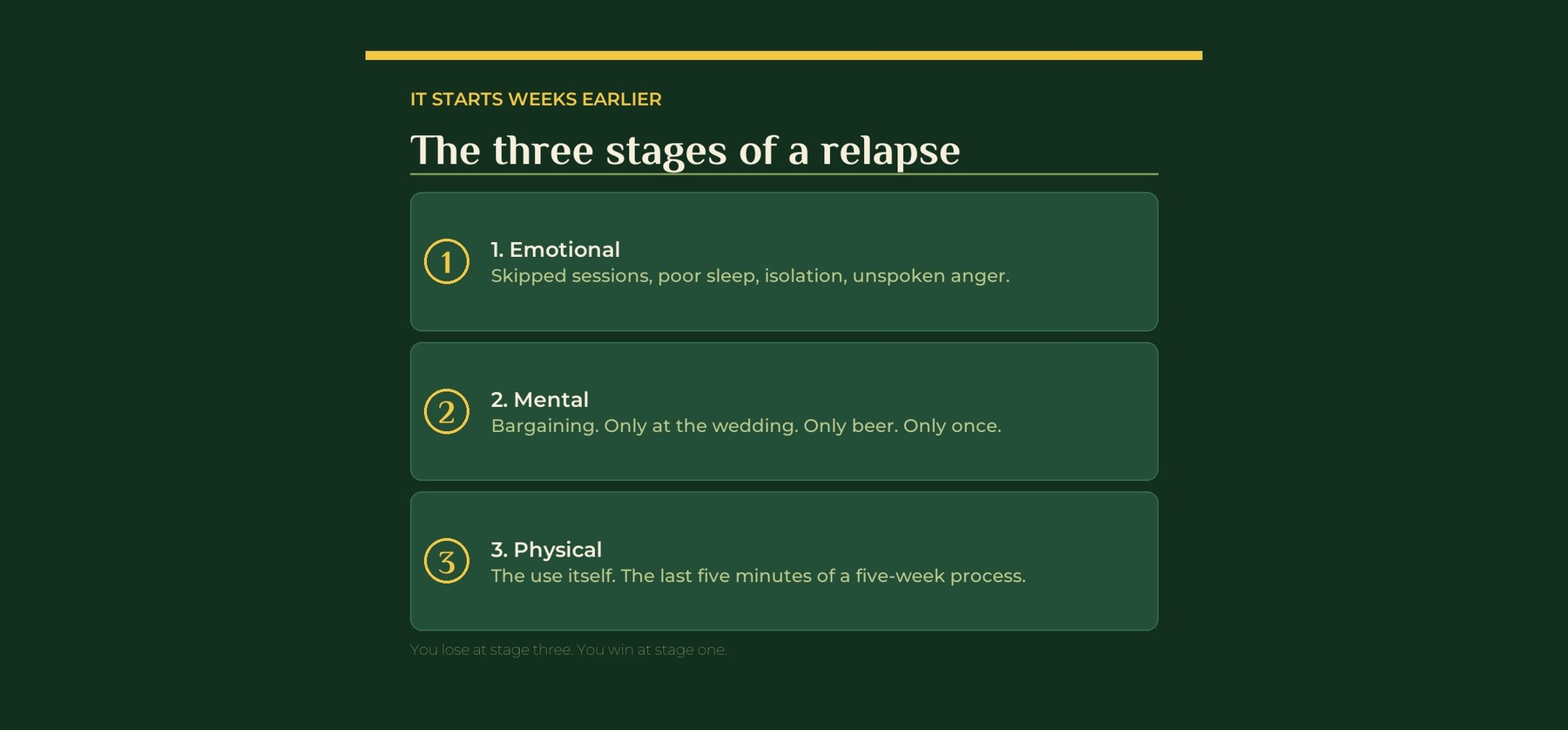
Stage one is emotional. It starts weeks before, and it does not involve thinking about using at all.
You stop going to meetings or sessions. You sleep badly. You skip meals.
You bottle up a frustration instead of saying it. You pull away from people.
You get irritable, then tired, then quietly resentful.
Nothing here looks like a relapse. That is precisely why it works.
Stage two is mental. Now the mind starts negotiating, and it is very good at it.
You remember the good parts and forget the hospital. You think about old friends.
You start planning a situation where it could happen without being your fault.
You tell yourself you can handle one. You look for someone who agrees.
Then the bargaining gets specific. Only at the wedding. Only beer. Only this once.
Stage three is physical. The use itself. The last five minutes of a process that took five weeks.
Almost everyone tries to fight stage three. It is the hardest place to win.
The whole skill of recovery is learning to intervene in stage one.
That is where change is easy. It costs one phone call and an early night.
A: Usually weeks before the first use. It starts with skipped sessions, poor sleep, isolation and unspoken resentment. The mental bargaining comes next. If you only watch for the drink, you will always be too late.
The Triggers People Underestimate
Everyone knows about the obvious triggers. The bar, the dealer, the old crowd.
These are the ones that catch people out.
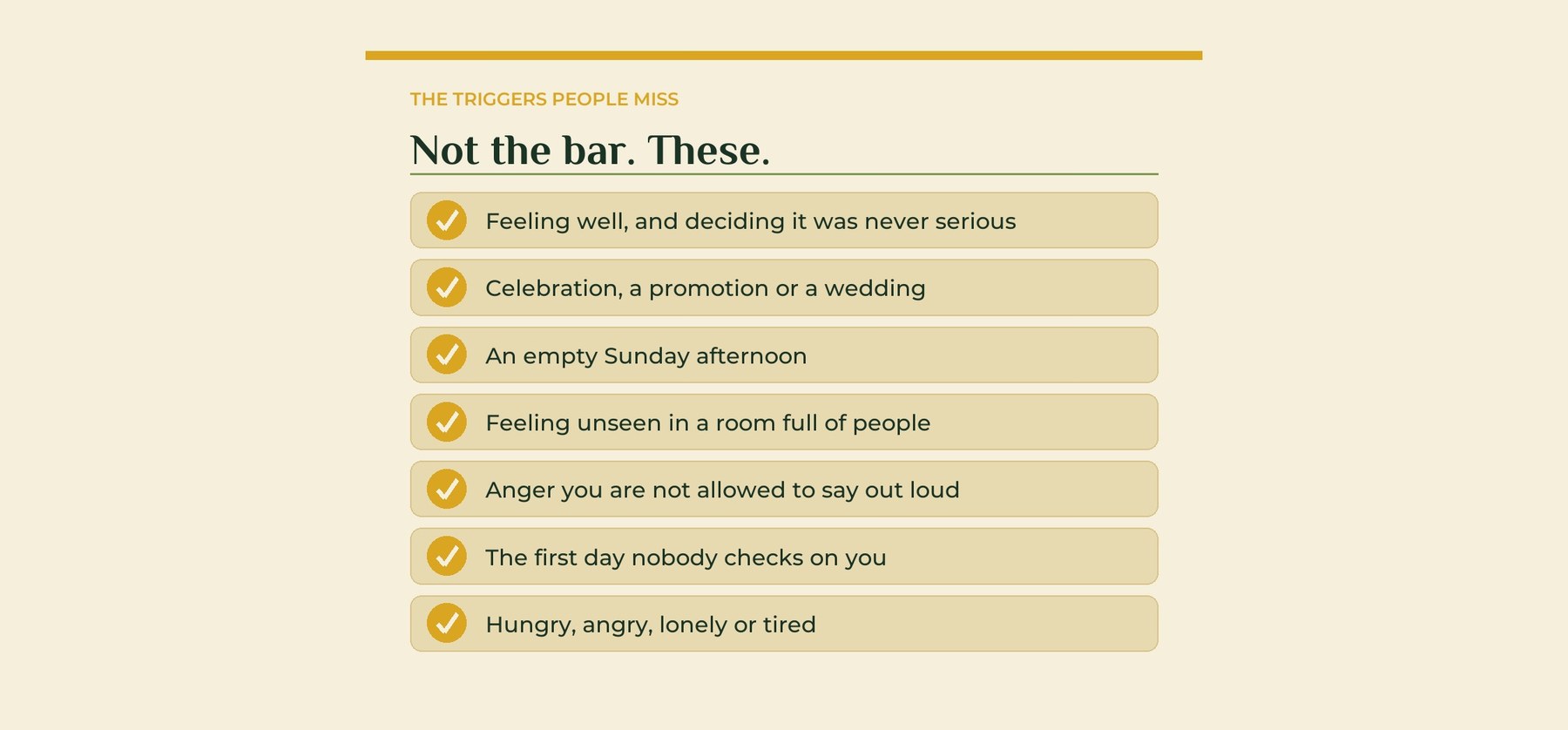
Feeling well. This is the biggest trap of all.
Three months in, you feel fine. Sleep is good, work is going well, the family has relaxed.
And the mind concludes it was never that serious. That conclusion has ended more recoveries than any bad day.
Celebration. Everyone plans for grief. Almost nobody plans for a promotion or a wedding.
Good news is a trigger too, because it comes with an urge to mark the occasion.
Boredom. An empty Sunday afternoon is more dangerous than a hard Monday.
Use takes up time. Recovery leaves a hole where it used to be.
Loneliness. Not being alone, which can be fine. Feeling unseen while surrounded by people.
Unspoken anger. This one drives more relapses in Indian families than almost anything else.
Many people are not allowed to say they are angry at home. So it sits, and it grows, and it needs an exit.
Being trusted again. The first day nobody checks on you can be surprisingly hard.
Physical states. Hunger, exhaustion and pain all lower your defences.
There is an old shorthand worth memorising here. Hungry, angry, lonely, tired.
Check those four before you check your motivation. They explain most bad afternoons.
There are three more that deserve their own line.
Medication stopped without advice. Many people quietly stop the tablets that were helping.
Antidepressants, mood medicine, or medicine that reduces craving. The relapse follows weeks later.
A single sleepless week. Sleep loss lowers the brain's ability to hold a decision.
Watch what happens after a run of late nights. Most people are not at their best on day five.
A big anniversary. A death, a divorce, the date it all began.
The mind marks these dates even when you do not. Put them in your own calendar first.
Notice a pattern across this whole list. Almost none of these are about the substance.
They are about your state, your time, and the people around you.
Which is exactly why a plan built only on avoiding alcohol tends to fail.
The Indian Context Nobody Plans For
Recovery advice often assumes a life that many Indians do not have.
Weddings and festivals. They last days. Drinking is expected, and refusing is treated as an insult.
Plan an exit before you arrive. Have a driver, a time and a reason to leave.
Joint families. Privacy is limited and pressure is constant. Everyone has an opinion about you.
Well-meant supervision can also feel like surveillance. That feeling itself becomes a trigger.
Work and drink culture. In many industries, the deal is done over a bottle.
Skipping it can look like refusing the team. That is a real cost, and it needs a real strategy.
Shame as the family plan. Many families believe that shaming someone will motivate them.
It does the opposite. Shame drives secrecy, and secrecy is what relapse needs to grow.
Treatment kept secret. People often hide that they are getting help.
Then they cannot explain a missed evening or a weekly appointment. So they skip the appointment.
None of this means recovery is harder in India. It means the plan has to be built for the life you actually live.
A plan that only works when you are alone at home is not a plan.
Two more Indian realities are worth planning around.
Money handled by the family. Many people in recovery have their spending watched closely.
That can help. It can also feel humiliating, and humiliation is a trigger.
Agree the rules openly, with an end date. A control with no end date breeds resentment.
Servants, drivers and shopkeepers who know. In many households, someone has always fetched the bottle.
Tell them the arrangement has ended. Do not leave that job to willpower at nine at night.
Small logistics like these decide more outcomes than big speeches do.
A: Decide before you go, and keep it short. I am off it, thanks, is enough. Hold a glass of something else so nobody offers again. Arrange your own transport so you can leave the moment it gets hard.
What a Real Relapse-Prevention Plan Looks Like
Good plans are boring, specific and written down. Vague intentions collapse under pressure.
One: name your three earliest warning signs. Not cravings. The stage-one signals.
Skipping sessions. Sleeping badly. Going quiet with people. Yours may differ.
Two: name two people you will call. Ask them in advance. Give them permission to ask you.
Make one of them someone who will not panic. Panic makes people hide things.
Three: write your high-risk list. Places, days, people, times.
Then decide the plan for each one before it arrives. Not during.
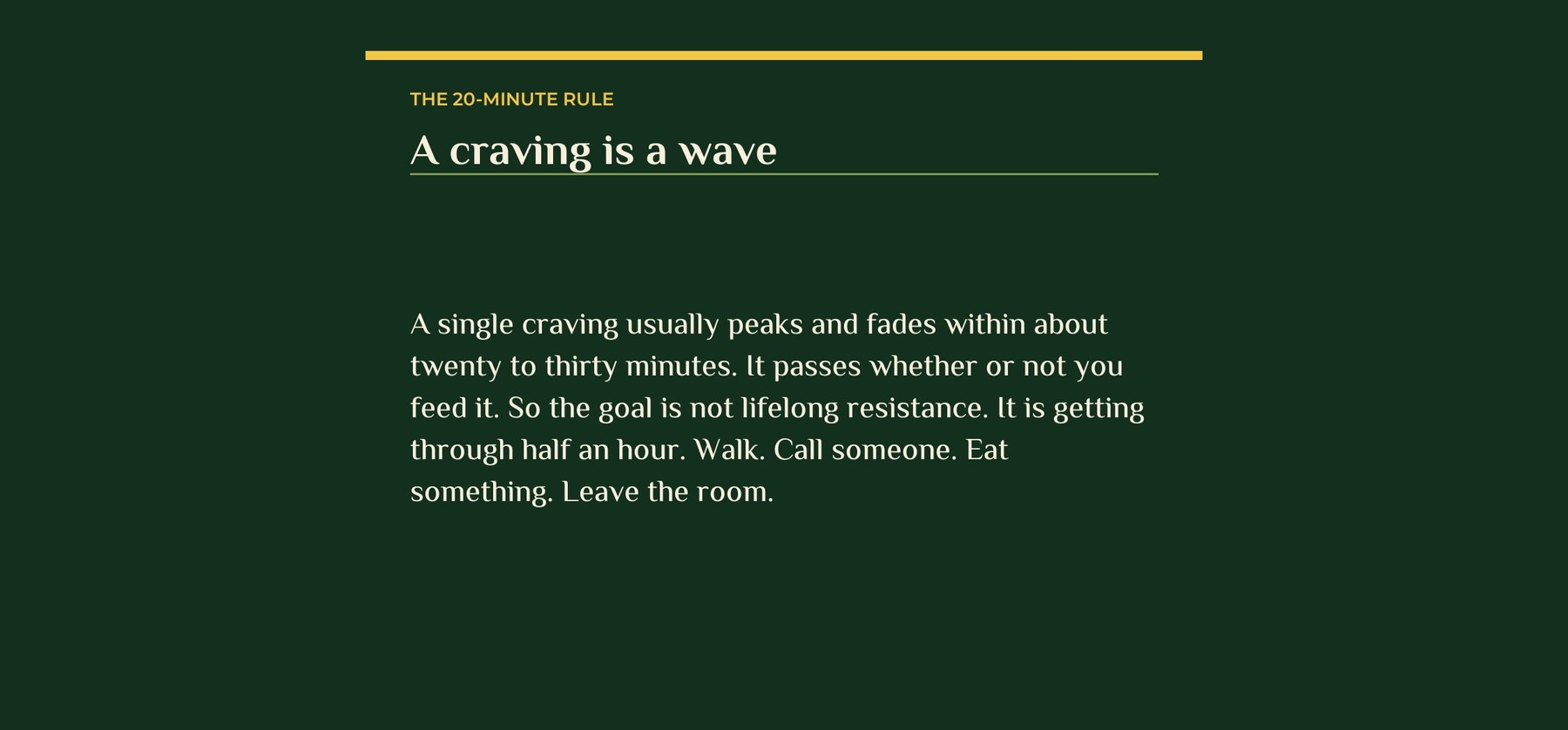
Four: build the twenty-minute rule. A craving usually peaks and fades within about twenty to thirty minutes.
So the goal is not lifelong resistance. It is getting through half an hour.
Walk. Call someone. Have a cold shower. Eat something. Leave the room.
The craving loses most of its power once you stop feeding it with attention.
Five: fill the empty time. Recovery leaves hours where use used to be.
Put something real in them. Work, exercise, a class, a group, a responsibility.
An unplanned evening is the most common setting for a relapse.
Six: treat what sits underneath. Depression, anxiety and trauma drive a huge share of relapses.
If those go untreated, staying stopped means fighting your own nervous system every day.
Seven: write your slip protocol now. Not after.
Who you tell, how fast, and what you do next. Decide it while you are well.
Eight: keep the treatment going after you feel better. This is the step people drop first.
Feeling well is the reward for the treatment, not a reason to stop it.
Two more things make a plan hold, and both are unglamorous.
Write it on paper. A plan in your head changes shape under pressure.
A page in a drawer does not. Give a copy to the person you named.
Review it monthly. Ten minutes, on a fixed date.
Ask what has changed. New job, new city, new stress, new friends.
A plan written for January does not fit October. Most plans fail because they went stale, not because they were wrong.
One last point on structure. Recovery works better inside a rhythm.
Fixed wake time. Meals at the same hours. Exercise on named days. One session a week.
That scaffolding is doing quiet work every single day.
You will not feel it holding you up. You will feel it when it goes.
What to Do in the First 24 Hours After a Relapse
If it has already happened, this section matters more than the rest.
Stop the count. One drink is not the same as a week of them. Do not let all-or-nothing thinking do the rest of the damage.
Be careful with the amount. Tolerance drops fast after time away.
Your old quantity is now much stronger. This is when overdoses and accidents happen.
Tell someone today. Not tomorrow. Not once you have fixed it.
A slip you tell someone about stays a slip. A slip you hide becomes a return.
Call your doctor or counsellor within a day. Relapse is a signal to resume, change or try a different treatment (Source: NIDA, 2025 — nida.nih.gov).
Do the review, not the trial. Ask two questions and stop there.
What changed in the weeks before? Which stage-one sign did I miss?
Guilt feels productive. It is not. It just makes the next disclosure harder.
Get back to the routine the same week. Sleep times, meals, sessions, exercise.
Structure carries you when motivation is flat, which it will be for a while.
And treat the shame carefully. Shame keeps people out of treatment far longer than the substance does.
A: No. Six months of change does not vanish in one night. Your sleep, your health and your skills are all still there. What you have lost is time, not the learning. Restarting from month six is very different from restarting from zero.
How Ganaa Helps You Stay Stopped
Staying stopped is a skill, and skills are taught rather than willed.
Ganaa is a mental health and rehabilitation brand in India. We work with adults facing alcohol and substance use, including those who have relapsed more than once.
We treat a relapse as information, not as a failed attempt. The plan gets changed, not abandoned.
Care starts with a full picture. Use pattern, past attempts, what triggered each one, sleep, mood and family life.
Where withdrawal is a risk, medically supervised detox comes first, safely and with monitoring.
Then the real work begins. Cognitive behavioural therapy, motivational work and structured relapse-prevention planning.
That includes the practical drills. Refusal scripts, high-risk mapping and a written slip protocol.
Dual diagnosis is treated in parallel. Depression, anxiety and trauma sit underneath a great many relapses.
Medication that supports staying off alcohol or opioids is discussed openly with a psychiatrist where it fits.
Families are included by design, because shame at home undoes good clinical work.
Aftercare matters most of all here. The months after discharge are when plans get quietly dropped.
Every plan is tailored to the person in front of us. Nothing is copy-pasted from a template.
Ganaa runs five residential centres in India. These are Ganaa South Delhi, Ganaa Chattarpur, Ganaa Gurgaon, Ganaa Goa and Ganaa Greater Noida.
We also run three OPD clinics for outpatient care, in Faridabad, Greater Kailash and Greater Noida.
If you have stopped and started more than once, that is a reason to get help, not a reason to give up. Speak to a Ganaa counsellor, or visit ganaa.in to learn about our programmes.
The next attempt does not have to look like the last one.
Conclusion: You Did Not Fail, the Plan Was Too Thin
Relapse is not evidence that you did not want it.
Wanting sits in one brain system. Using runs on an older, faster one.
A cue can start a craving before your decision arrives. That is wiring, not weakness.
The numbers back this up. Relapse rates for drug use run at 40 to 60%, against 50 to 70% for asthma (Source: NIDA, 2025 — nida.nih.gov).
Remember the three stages. Emotional, then mental, then physical.
You will lose most fights at stage three. You can win almost all of them at stage one.
So watch for the quiet signs. Skipped sessions. Broken sleep. Silence with the people who care.
Plan for the triggers nobody warns you about. Feeling well. Celebration. Boredom. Unspoken anger.
Build the plan for the life you actually have, including weddings, joint families and work drinks.
Learn the twenty-minute rule, because a craving is a wave and not a wall.
Treat what sits underneath, or you will be fighting your own nervous system forever.
And if it happens again, tell someone that same day. Speed matters far more than explanation.
A relapse is a signal to change the plan (Source: NIDA, 2025 — nida.nih.gov).
So change it, get help with it, and start again from where you actually are.
FAQ
Q: Why do I relapse even when I really want to quit?
A: Because wanting is not the mechanism that drives use. Long use rewires the brain's reward and habit systems, so cues can trigger a craving before any decision is made. Motivation matters, but it does not overwrite that wiring on its own.
Q: How common is relapse in addiction recovery?
A: Relapse rates for drug use are 40 to 60%, which is similar to other long-term illnesses. Hypertension and asthma each sit at 50 to 70%. That comparison matters, because nobody calls an asthma flare-up a moral failure.
Q: Does a relapse mean the treatment failed?
A: No. Relapse is a signal to resume, change or try a different treatment, not proof that treatment does not work. The useful response is a phone call to your doctor, not a decision to give up.
Q: What are the warning signs before a relapse?
A: It usually starts emotionally, weeks earlier. Skipped meetings, poor sleep, bottled-up frustration and pulling away from people come first. Then the mind starts bargaining. The physical relapse is the last step, not the first.
Q: How long do cravings last?
A: A single craving usually peaks and fades within about twenty to thirty minutes. It passes whether or not you act on it. Knowing that changes the goal from resisting forever to getting through half an hour.
Q: What should I do immediately after a relapse?
A: Tell someone the same day, and be careful about the amount if your tolerance has dropped. Then contact your doctor or counsellor within twenty-four hours. Speed matters far more than explanation, because a hidden slip is what turns into a return.
Mindfulness-based therapy cuts depression relapse risk in recurrent cases. Here is what MBCT is, what the trials found, and how the eight weeks actually run.
Eating disorders in India hide behind praise for discipline and thinness. Learn the early warning signs, what to say, and how treatment actually works.
High functioning anxiety hides behind good work and a calm face. Learn the hidden signs, what the body does, and when coping turns into the problem itself.