How Long Does Alcohol Stay in Your System? When Is It Safe to Drive?
How long does alcohol stay in your system, and when is it safe to drive? See real metabolism times, detection windows, and India's legal limit.
How Long Does Alcohol Stay in Your System? When Is It Safe to Drive?
You had a few drinks last night. You feel fine now.
But are you actually clear?
This is one of the most searched health questions in India. And the honest answer surprises most people. How long does alcohol stay in your system depends on the test, the dose, and your own body.
It is not a single number. It is a range.
Here is the short version. Your blood clears alcohol at a fixed rate. About one standard drink per hour. Your blood alcohol drops by roughly 0.015 percent each hour (Source: NIAAA — niaaa.nih.gov).
That rate cannot be rushed.
So a big night does not clear by morning just because you slept. The numbers do not care how you feel.
This guide walks you through it step by step. Real alcohol metabolism time. Each alcohol detection window. India's legal limit. And the one rule that keeps you safe when you are not sure.
We will keep it simple and clear. No jargon. No scare tactics. Just facts you can use tonight.
By the end, you will know how to count your own clearing time. And you will know when to call it a night.
What Happens to Alcohol Inside Your Body
Alcohol does not just sit in your stomach.
It moves fast. Within minutes it enters your blood. From there it reaches your brain, heart, and every organ.
This is why the first drink hits so quickly. You feel it before you finish the glass.
Your liver does the hard work. It breaks down about 90 percent of the alcohol you drink. The rest leaves through breath, sweat, and urine (Source: NIAAA — niaaa.nih.gov).
Think of the liver as a small machine. It has one fixed speed.
The liver works at a steady pace. It does not speed up when you are in a hurry.
It cannot be told to work faster. Stress, panic, and worry change nothing. The pace stays the same all night.
This is the key fact most people miss. You cannot sweat it out. You cannot sleep it off faster. The clock runs at one speed.
So time is the only thing that clears alcohol. Not effort. Not tricks. Just hours.
That is why alcohol metabolism time matters so much. It is biology, not willpower.
Knowing this changes how you plan a night out. You stop guessing. You start counting.
A: No. Coffee makes you feel more alert. It does not lower your blood alcohol. The liver still clears alcohol at the same fixed rate. A wide-awake person can still be over the limit.
How Long Does Alcohol Stay in Your System by Test
Different tests catch alcohol for different lengths of time.
This trips up a lot of people. They think one number fits all. It does not.
Each test works in its own way. Each has its own reach.
Here is what each common alcohol detection window looks like (Source: Healthline — healthline.com).
Test typeTypical detection windowBloodUp to 12 hours.Breath12 to 24 hours.SalivaUp to 12 hours.Urine (standard)12 to 24 hours.Urine (EtG)24 to 72 hours.HairUp to 90 days.
Notice the spread. A breath test clears in a day. A hair test can flag use months later.
So one drinking night has many possible answers. It all rides on which test you face.
Most people only ever meet a breath test. That is the one used on the road.
So the real answer to how long does alcohol stay in your system is this. It depends on what is testing you.
It also depends on how much you drank. A single beer clears fast. A long, heavy night clears slowly.
And it depends on your body. Two people can drink the same and test very differently.
So treat these windows as a guide. They are not a promise. Your own clearing time may run longer.
A: A standard urine test looks for alcohol itself. An EtG test looks for a by-product the body makes after drinking. That by-product lingers, so the alcohol detection window stretches to 72 hours or more.
Alcohol Metabolism Time: The One-Drink-Per-Hour Rule
Let us make this concrete.
Your body clears about one standard drink each hour (Source: NIAAA — niaaa.nih.gov).
A standard drink holds about 14 grams of pure alcohol. That is roughly one regular beer. Or one small glass of wine. Or one 30 ml peg of spirits (Source: NIAAA — niaaa.nih.gov).
So the maths is simple. Four drinks take about four hours to clear. Six drinks take about six hours.
This is alcohol metabolism time in plain numbers.
Try counting your own night this way. Each drink adds about an hour. The total adds up fast.
Say you finish at midnight. You had five drinks. You are not clear until about 5 am.
But there is a catch. People rarely pour a clean standard drink. A large peg or a strong cocktail can be two drinks in one glass. So your real clearing time is often longer than you think.
Home pours are the biggest trap. Nobody measures a 30 ml peg at a party. Most pours run double.
Round up, not down. Always.
Here is a simple way to track it. Count each drink as you go. Note the time of your last one.
Then add one hour per drink to that time. That is your rough clearing point. Give it a buffer on top.
This small habit saves trouble. It turns a guess into a plan. And it keeps you off the road too early.
A: Only a little. Age, weight, and sex shift the rate slightly. But the core pace stays close to one drink per hour for almost everyone. Fitness does not give you a free pass.
When Is It Safe to Drive After Drinking?
This is the question that matters most. And it needs an honest answer.
We cannot tell you that you are safe to drive. No blog can. No app can. Your own body changes night to night.
So please do not read a guarantee into any number here. We will not give you one. Your safety is too important for a guess.
What we can give you is the law and the science.
From there, the choice is yours to make with a clear head.
In India, the legal limit is 30 mg of alcohol per 100 ml of blood. That is 0.03 percent. This sits in Section 185 of the Motor Vehicles Act (Source: The Motor Vehicles Act, 1988 — indiankanoon.org).
Drive above that limit and it is an offence.
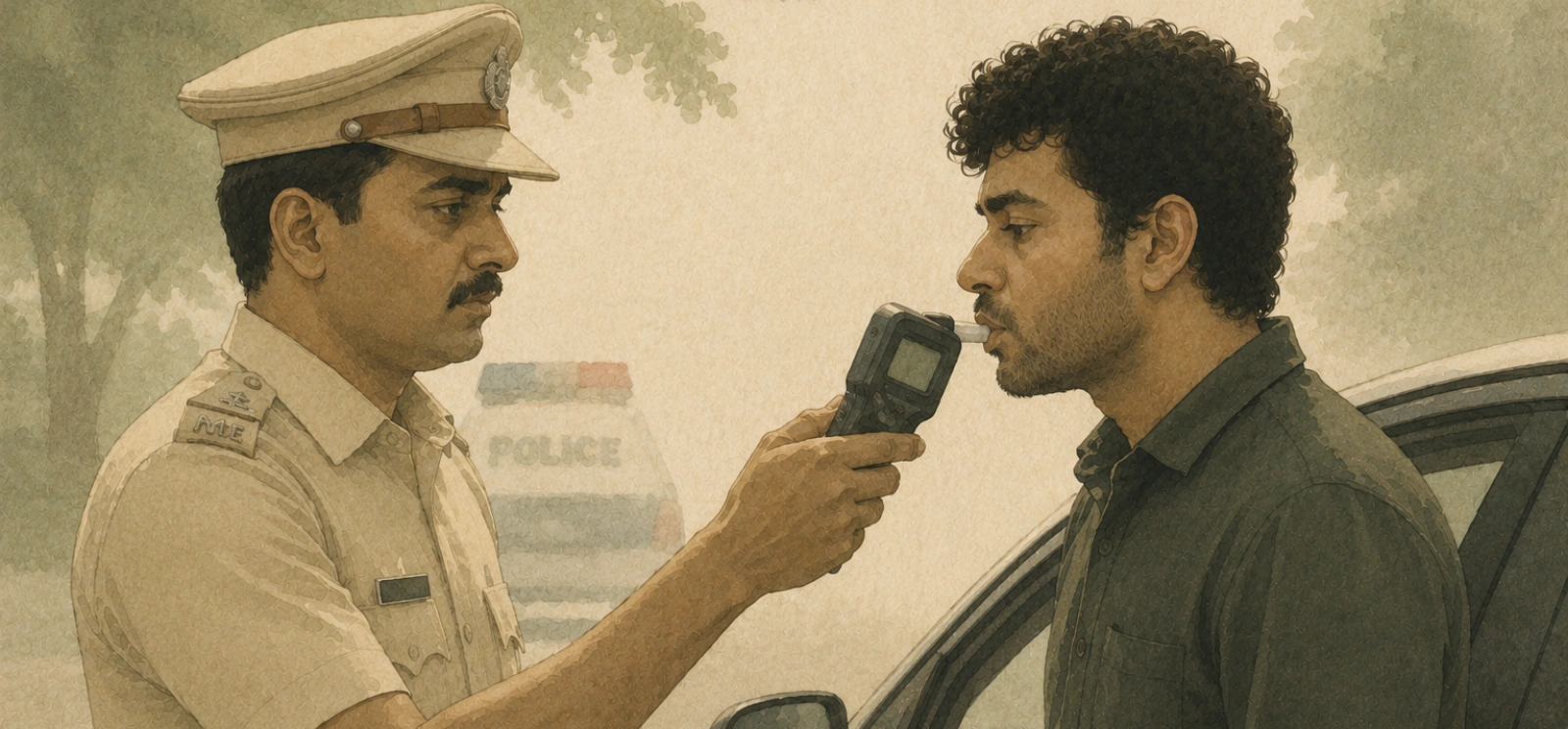
Police check this with a breath analyser. It happens at roadside checkpoints. A reading over the limit can mean arrest.
A first offence can bring a fine up to 10,000 rupees. And jail up to six months (Source: The Motor Vehicles Act, 1988 — indiankanoon.org).
A repeat offence is worse. The fine and the jail term both go up. A licence can be suspended too.
Here is the hard truth. Even small amounts of alcohol slow your reactions. So the safest rule is not about the limit at all.
Your judgement dips before you feel drunk. You may think you are fine. The road tells a different story.
If you have been drinking, do not drive.
Wait it out. Take a cab. Hand the keys to a sober friend. The cost of a ride is nothing next to a crash or a case.
Plan the ride home before you start drinking. Book a cab in advance. Pick a sober driver early.
A clear plan beats a fuzzy judgement call at midnight. Decide while you are still sharp.
A: You cannot know it precisely without a test. So treat the question with care. If you are asking it, you are not sure. When in doubt, do not drive.
The Morning-After Trap
Many people get caught the next morning.
They wake up. They feel rested. They drive to work.
But the alcohol has not finished clearing.
Picture this. You drink six standard drinks by midnight. Your body needs about six hours to clear them. That puts you near zero around 6 am. If you drank later or drank more, you are still over the limit at breakfast.
Breath and blood tests will still read positive (Source: Healthline — healthline.com).
This is the morning-after trap. It is one of the most common ways drivers fail a test.
The danger is the false sense of calm. You feel rested. You assume the night is behind you.
But your blood may not agree. The numbers can still be over the line at 8 am.
So plan ahead. If you drink heavily at night, do not assume the morning is clear. The alcohol detection window can stretch well into the next day.
If you have an early drive, drink less the night before. Or arrange another way to work. Do not gamble on feeling fine.
A: Maybe not. Sleep does not speed up clearing. Your liver worked at the same pace while you slept. If you drank a lot late, you can still test positive after a full night's rest.
What Slows Down or Speeds Up Clearing
People love quick fixes. None of them work.
Let us be clear about that.
No food, drink, or trick speeds up how fast your liver clears alcohol. The rate is fixed at about 0.015 percent per hour (Source: NIAAA — niaaa.nih.gov).
Coffee does not help. A cold shower does not help. Greasy food does not help.
Energy drinks are worse. They mask how drunk you feel. But your blood alcohol stays exactly the same.
So you feel alert and act impaired. That mix is dangerous behind the wheel.
But some things do change how alcohol affects you.
Food before drinking slows how fast alcohol hits your blood. It softens the peak. It does not cut the total you took in.
Body size matters too. A smaller person reaches a higher blood level from the same drink.
Sex plays a role. Women often process alcohol differently, partly due to body water and enzyme differences.
Liver health is central. A tired or damaged liver clears alcohol slower. This is why heavy drinkers should never gauge their own clearing time.
Age matters too. The body clears alcohol a little slower as you get older. The same drink lingers longer at 50 than at 25.
So the rule holds for all of us. Time clears alcohol. Tricks do not.
A: No. Water helps you stay hydrated and may ease a hangover. It does not lower your blood alcohol any faster. Only time clears alcohol from your system.
How Each Alcohol Detection Test Works
It helps to know what each test is looking for.
The numbers above make more sense once you see this.
A breath test measures alcohol in the air from your lungs. It gives a fast estimate of blood alcohol. Traffic police use this at roadside checks.
It is quick and non-invasive. That is why it is the first tool at a checkpoint.
A blood test is more direct. It measures alcohol in the blood itself. Courts often treat it as the gold standard.
A standard urine test checks for alcohol that has passed through your system. It is common in workplaces.
An EtG urine test is different. It looks for ethyl glucuronide, a marker the body makes after drinking. This marker lingers. In heavy drinkers it can show up for around 80 hours after the last drink (Source: Helander et al., PMC — ncbi.nlm.nih.gov).
That long alcohol detection window is why EtG tests are used in recovery programmes and some workplaces.
Hair tests reach back furthest. They can flag a pattern of heavy use over weeks. But they do not pin down a single night.
Each test answers a different question. A breath test asks if you are drunk now. A hair test asks about your habits over time.
So the right test depends on the goal. Police want the moment. A clinic may want the pattern.
So the test type changes everything. The same drinking night can look clear on one test and positive on another.
This is worth remembering before any test. The window you face depends on the method used.
A: Usually not. EtG is most reliable for moderate to heavy drinking. One or two drinks days earlier often fall below the level the test reads. Heavy use is what shows up at 72 hours and beyond.
When Drinking Stops Being Social
Sometimes the question changes.
It stops being "how long does alcohol stay in your system." It becomes "why can't I stop."
That shift matters.
When you start counting hours every day, take note. Steady, heavy drinking is its own warning sign. The clearing time is no longer the real issue.
Alcohol is one of the most used substances in India. Around 77 million people in the country drink. Use has been rising for years (Source: Alcohol consumption in India, an epidemiological review, PMC — pmc.ncbi.nlm.nih.gov).
And the health risk is real. There is no fully safe level of drinking. Alcohol is linked to millions of deaths worldwide each year (Source: WHO — who.int).
So the question is no longer just about clearing time. It is about control.
So watch for the warning signs in yourself or someone you love.
You need more to feel the same effect. You cannot stop once you start. You drink to calm your nerves or steady your hands. You keep drinking even when it hurts your work or family.
You hide how much you drink. You feel low or shaky when you skip a day. You make rules, then break them.
These point to dependence, not just a habit.
Dependence is not a moral failing. It is a health condition. And it responds to proper care.
If this sounds familiar, you are not alone. And help works. The first step is simply talking to a psychiatrist or a trained clinician.
A: It can be. Relying on alcohol to unwind, sleep, or face stress is a common early sign of dependence. If you notice this pattern, it is worth speaking to a clinician sooner rather than later.
Getting Support: How Ganaa Can Help
If your drinking has started to worry you or your family, you do not have to face it alone.
Ganaa is a residential mental health and rehabilitation brand in India. We treat alcohol use, substance use, and mental health conditions together.
We care for the whole person, not just the drinking. Mood, sleep, and stress all get attention.
Our care blends modern clinical science with calm, nature-based settings. Think CBT, DBT, and medical support alongside yoga and meditation.
Recovery is not about willpower alone. It needs the right setting and the right team. We try to give both.
We run residential centres across the country:
We also run three outpatient clinics. In Faridabad, Greater Kailash, and Greater Noida.
Our programmes run as 30, 60, or 90-day residential stays, with aftercare to support the road home. Care is tailored to each person, with 24/7 clinical support throughout.
Families are part of the plan too. We guide loved ones on how to help. Recovery is easier with support at home.
We never push. We simply meet you where you are.
There is no shame in asking. Reaching out is a sign of strength, not weakness.
If alcohol has stopped feeling like a choice, that is a sign worth acting on. Speak to a Ganaa admissions counsellor, or visit ganaa.in to learn about our programmes.
The next step does not have to be big. It just has to be a step.
Conclusion: Time Is the Only Cure
Before the wrap-up, here are the numbers in one place.
- The body clears about one standard drink per hour, dropping blood alcohol by roughly 0.015 percent hourly — . - A standard drink holds about 14 grams of pure alcohol, roughly one beer or one small peg — . - Alcohol shows in blood up to 12 hours and on breath for 12 to 24 hours — . - An EtG urine test can detect heavy drinking for around 80 hours — . - India's legal driving limit is 30 mg per 100 ml of blood, under Section 185 — . - There is no fully safe level of alcohol use — .
Let us bring it together.
Your body clears alcohol at a fixed pace. About one drink per hour. Nothing speeds it up.
How long does alcohol stay in your system depends on the test. Breath and blood clear in a day. EtG urine tests can flag heavy use for around 80 hours.
The morning after is the trap most people fall into. You can feel fine and still test positive.
Different tests reach back different lengths. Breath clears fast. EtG and hair tests reach back furthest.
On driving, the rule is simple. India's limit is 30 mg per 100 ml. But the safest choice is to not drive at all after drinking. When in doubt, do not drive. Route the decision to the law and a clear head, not a guess.
And if alcohol has started to feel bigger than a choice, that is worth acting on. Help is real, and it works.
You do not have to wait for a crisis. You can ask for help today. Earlier support is always easier.
Talk to a psychiatrist or a Ganaa clinician. The first step is always the hardest. It is also the most important.
Your health is worth that one phone call.
FAQ
Q: How long does alcohol stay in your system?
A: It depends on the test. Alcohol shows in blood for up to 12 hours and on the breath for 12 to 24 hours. A standard urine test catches it for about 12 to 24 hours. An EtG urine test can catch it for 24 to 72 hours, and longer in heavy drinkers.
Q: How fast does the body remove alcohol?
A: The body clears about one standard drink per hour. Blood alcohol drops by roughly 0.015 percent each hour. This rate is fixed. Coffee, food, and cold showers do not speed it up.
Q: When is it safe to drive after drinking?
A: There is no first-person guarantee anyone can give you. India's legal limit is 30 mg of alcohol per 100 ml of blood. The safest rule is simple. If you have been drinking, do not drive. Wait, or use another way home.
Q: Does a big meal stop you from getting drunk?
A: Food slows how fast alcohol enters the blood. It does not lower how much alcohol you took in. The liver still has to clear every gram at the same rate. Food softens the peak, not the total.
Q: What is the legal alcohol limit for driving in India?
A: Under Section 185 of the Motor Vehicles Act, the limit is 30 mg of alcohol per 100 ml of blood, or 0.03 percent. Driving above this is an offence. A first offence can mean a fine up to 10,000 rupees and jail up to six months.
Q: Can you fail an alcohol test the morning after?
A: Yes. Heavy evening drinking can leave alcohol in your blood the next morning. A breath or blood test can still read positive at breakfast. Many drink-driving cases happen the morning after, not the same night.
Q: When should you seek help for your drinking?
A: Watch for warning signs. You need more to feel the same effect. You cannot stop once you start. You drink to steady your hands or nerves. These point to dependence. A psychiatrist or a Ganaa clinician can guide the next step.
Eating disorders in India hide behind praise for discipline and thinness. Learn the early warning signs, what to say, and how treatment actually works.
High functioning anxiety hides behind good work and a calm face. Learn the hidden signs, what the body does, and when coping turns into the problem itself.
The cost of mental health rehab in India is rarely published openly. Here is what moves the price, what insurance must cover by law, and what to ask first.


.webp)
.webp)