Can a Person With Bipolar Disorder Live a Normal Life?
Can bipolar live a normal life? Yes, with steady treatment. What that really takes at work, at home and after a setback, explained without the sugar-coating.
Can a Person With Bipolar Disorder Live a Normal Life?
Someone asks this question within about a week of the diagnosis.
Sometimes it is the patient. Often it is a parent, sitting very still, waiting for the real answer.
So here it is, without softening. Yes.
A person with bipolar disorder can live a normal life. Most do. They work, study, marry and raise children.
But the honest version has a second half. That life takes structure.
It takes medication you do not stop when you feel fine. It takes sleep you protect like a bank balance.
It takes someone close to you who is allowed to say that you are talking faster this week.
Bipolar disorder does not go away. That is the part nobody enjoys reading.
What it does do is settle. Episodes get rarer. They get shorter. They stop taking whole years from you.
The question "can bipolar live a normal life" hides a better question underneath.
Not will I be normal. But what does a good life look like from here?
That is the question this article answers.
We will look at what recovery actually means. What the numbers say in India. The five things that decide how well people do.
We will cover medication, sleep, work, marriage and money. And we will be plain about relapse.
Let us start with the short answer.
The Short Answer: Yes, With Treatment That Stays Steady
Bipolar disorder is a mood condition, not a personality.
It brings episodes of mania or hypomania, and episodes of depression. Between them, many people feel completely well.
That in-between space is the real prize. Treatment is what makes it longer.
Here is the pattern doctors see again and again.
Untreated, episodes tend to arrive closer together as the years pass. Each one costs a job, a relationship or a semester.
Treated steadily, the opposite happens. Gaps stretch out. Episodes get milder. Life gets its shape back.
Bipolar disorder is treatable. Mood stabilisers such as lithium, along with some anticonvulsants and antipsychotics, are first-line care (Source: NIMH, 2025 — nimh.nih.gov).
So the answer is yes. With one condition attached.
The treatment has to stay steady when you feel well. That is the hard part, and we will come back to it.
A: No, and that word does not fit the condition. Bipolar disorder is manageable, in the way asthma or diabetes is manageable. Many people go years without an episode while staying on treatment. The goal is a full life, not a cure certificate.
What "Normal Life" Really Means Here
Let us define the word, because it does a lot of quiet harm.
Normal does not mean a life with no mood at all. Nobody has that.
It does not mean you will never need a leave day. Plenty of people without bipolar disorder need those too.
And it does not mean going back to exactly who you were at twenty. Nobody does that either.
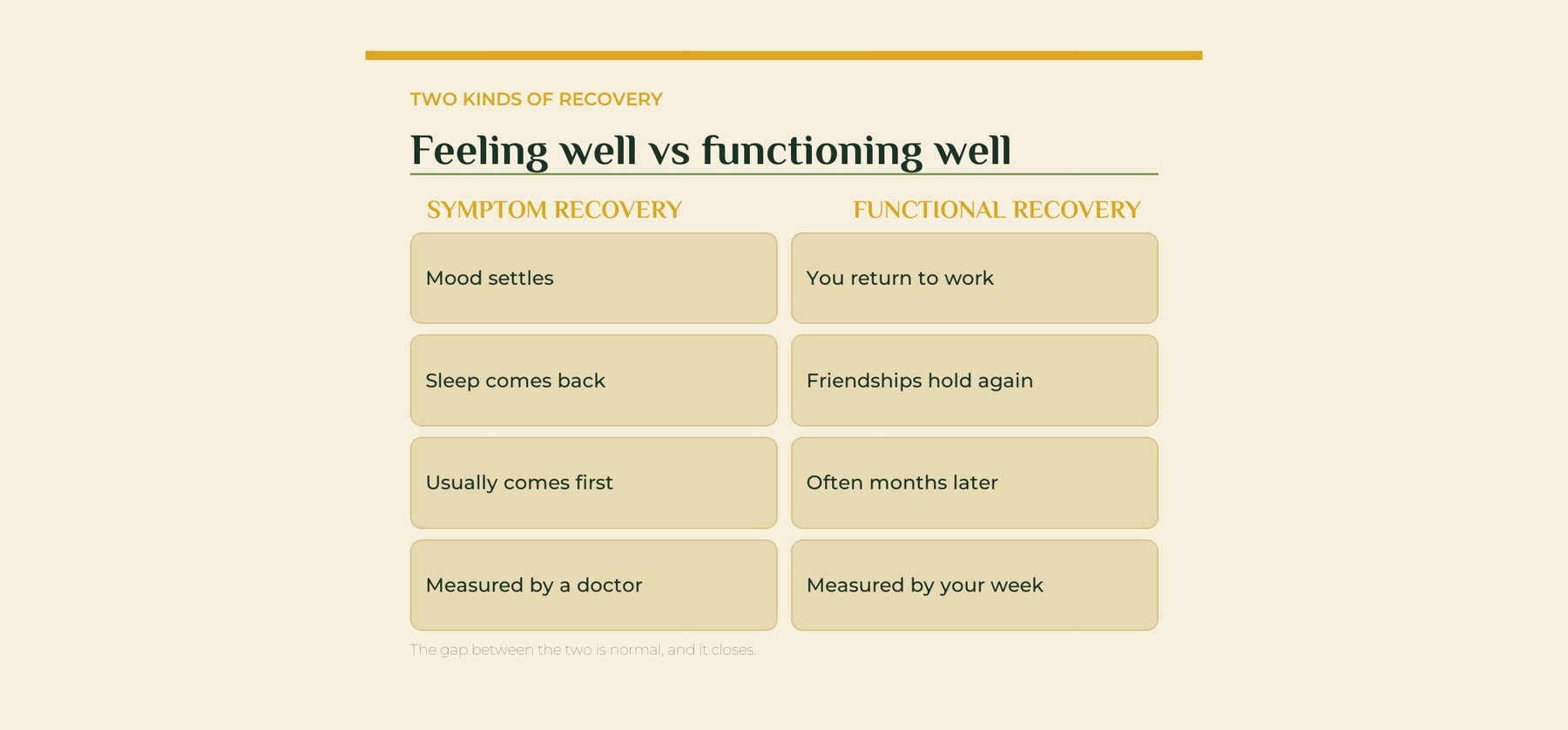
Doctors talk about two kinds of recovery. The difference matters more than most people realise.
The first is symptom recovery. Your mood settles. Sleep returns. The racing or the heaviness lifts.
The second is functional recovery. You go back to work. You hold your friendships. You enjoy things again.
Symptom recovery usually comes first. Functional recovery often takes a few months longer.
Many people panic in that gap. They feel well but not yet able, and assume something is wrong.
Nothing is wrong. That gap is expected, and it closes.
Think of a broken leg. The bone knits long before you trust it on stairs.
Mood works the same way. The chemistry settles first. Confidence takes its own time.
Families often struggle here more than patients do. They see a well person and expect a full week at once.
Say the timeline out loud at home. It saves months of quiet blame on both sides.
A normal life with bipolar disorder looks like this. You take a daily tablet. You sleep at roughly the same time.
You see a psychiatrist a few times a year. You know your own warning signs.
And around all of that, you have an ordinary, full, unremarkable life. That is the target.
Not a heroic life. Not a fragile one. An ordinary one.
Bipolar Disorder in India: The Numbers Behind the Question
Numbers help, because this condition feels rare and lonely from the inside.
It is not rare. It is under-treated, which is a very different problem.
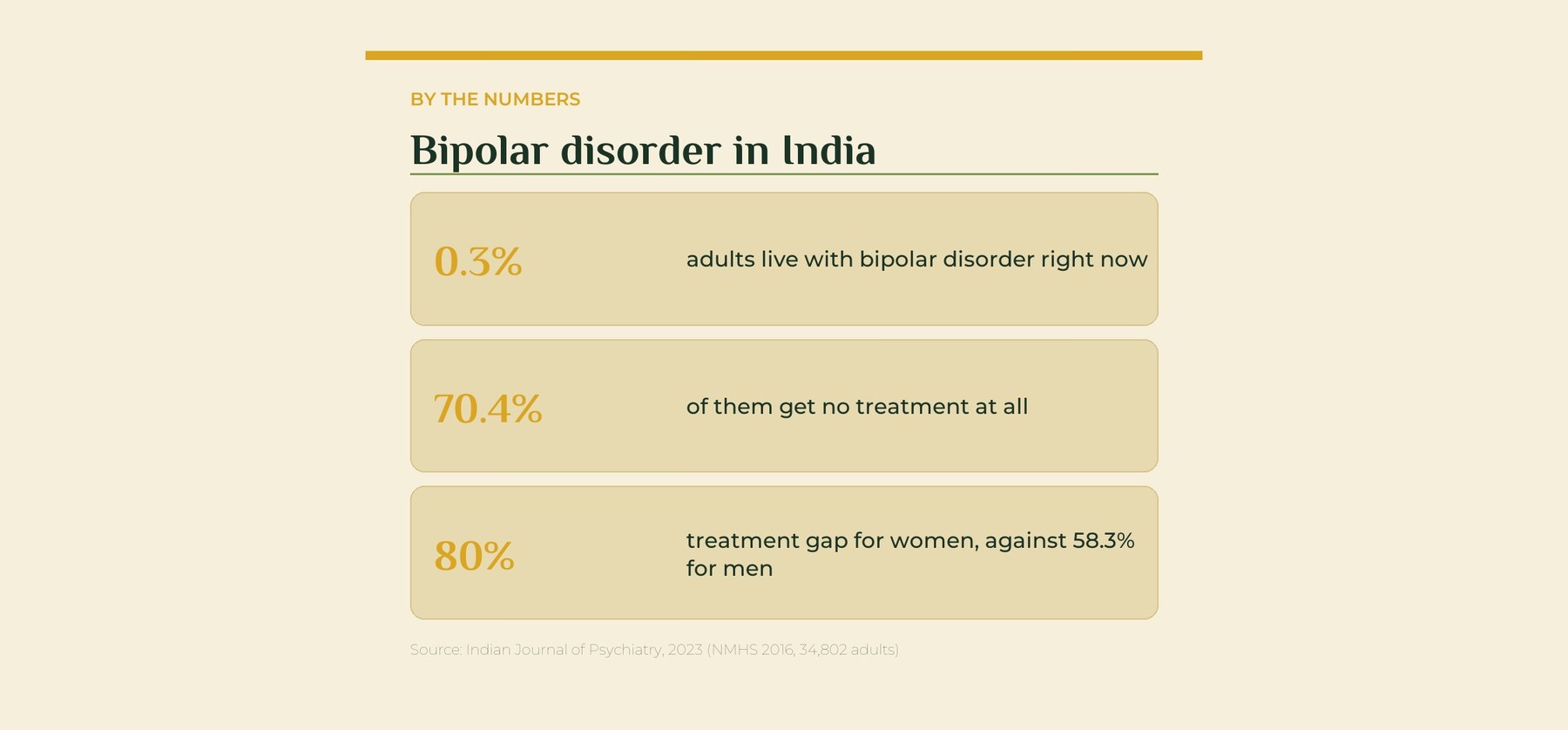
- India's current weighted prevalence of bipolar affective disorder is 0.3%, with a lifetime prevalence of 0.5% — . - India's treatment gap for bipolar disorder is 70.4% — so 7 in 10 people who need care are not getting it — . - That gap is far worse for women, at 80%, against 58.3% for men — . - The findings come from 34,802 adults surveyed across 12 Indian states — . - India's current prevalence of any psychiatric disorder is 10.56%, and lifetime prevalence is 13.67% — . - About 40 million people worldwide live with bipolar disorder — .
Read that treatment gap again. It is the real story here.
Most Indians with bipolar disorder are not doing badly because the condition is untreatable.
They are doing badly because they were never treated. Those are not the same thing.
The gender split is worth sitting with too. Four in five women with bipolar disorder in India get no care.
That is a family decision as much as a medical one. It usually comes down to who is taken seriously at home.
A: Because most never reach a psychiatrist. India's treatment gap for bipolar disorder is 70.4% (Source: Indian Journal of Psychiatry, 2023 — pmc.ncbi.nlm.nih.gov). Cost, distance, stigma and misdiagnosis all play a part. Untreated bipolar disorder is a very different condition from treated bipolar disorder.
The Five Things That Decide How Well You Live
Two people can share the same diagnosis and end up in very different places.
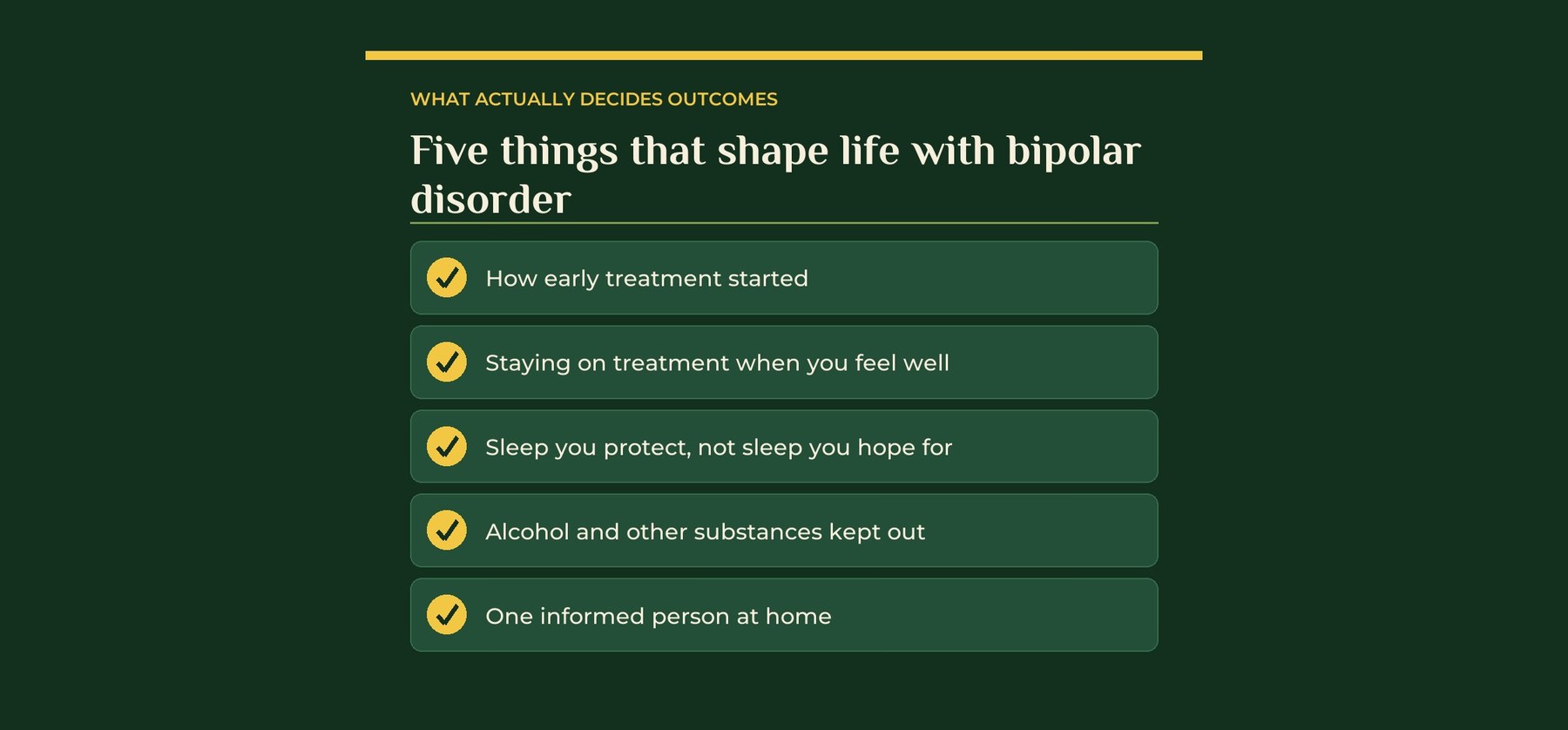
The difference is rarely luck. It usually comes down to five things.
One: how early you started treatment. Years of untreated episodes leave a mark on work and relationships.
Starting sooner protects more of your life. This is the single strongest factor.
Two: whether you stay on treatment when you feel well. Feeling well is the reward for the tablet, not a reason to stop it.
Three: your sleep. Broken sleep is both an early warning and a trigger. It works in both directions.
Four: alcohol and other substances. They destabilise mood and interact with medication. This one is not negotiable.
Five: who is around you. One informed person at home changes the course of an episode.
They notice the shift days before you do. That head start is worth more than any app.
Notice what is not on this list. Willpower. Character. How much you want it.
Bipolar disorder does not respond to effort alone. It responds to structure, and structure can be built.
A: Stopping medication after a good spell. It usually happens quietly, over weeks, and often without telling anyone. Sleep loss and alcohol come next. A relapse rarely arrives out of nowhere.
Medication, Sleep and the Boring Parts That Work
Nobody wants this section to be the answer. It usually is.
Mood stabilisers are the foundation of long-term care. Lithium remains one of the best-studied options (Source: NIMH, 2025 — nimh.nih.gov).
Some people take a mood stabiliser alone. Others need an antipsychotic alongside it.
Antidepressants are used with caution here, because they can tip mood upward in bipolar disorder.
This is exactly why self-medicating with a friend's prescription is dangerous. The right drug depends on your pattern.
Side effects are real and worth naming. Weight change, thirst, tremor and dulled feeling all come up.
Say them out loud to your psychiatrist. Most are manageable with a dose change or a switch.
Silently stopping is what causes the damage. Speaking up almost never does.
Then there is sleep, which is treatment in its own right.
For many people, a short night is the first sign of a manic phase arriving. Losing sleep also makes that phase more likely.
So a fixed wake-up time is not a wellness tip here. It is clinical care.
Keep it steady on weekends too. Late nights, night shifts and long-haul travel deserve real planning.
Alcohol belongs in this same paragraph. It wrecks the deep stages of sleep and unsettles mood.
If drinking has become a way to manage a low, that needs treating alongside the bipolar disorder.
Cannabis deserves a line of its own. It is common, it feels harmless, and it raises relapse risk.
So does a stack of energy drinks before an exam. Anything that steals sleep is in scope here.
Now for the part that sounds too simple to matter. Take the tablet at the same time each day.
Link it to something you already do. Brushing your teeth. Locking the front door.
Missed doses are rarely a choice. They are usually a gap in the routine.
A weekly pill box costs almost nothing. It removes the daily guesswork.
One more thing. Keep a rough note of your sleep and mood.
Two words a day is enough. Over three months, a pattern shows up that memory alone would miss.
That page is often the most useful thing you bring to a review.
Work, Study and Money With Bipolar Disorder
Most people with bipolar disorder work. That deserves saying plainly.
The job market myth is that the condition rules out serious careers. It does not.
What matters is fit, not ambition. Some jobs suit the condition better than others.
Predictable hours help. So does a manager who does not need a diagnosis to grant a leave day.
Night shifts are the hardest fit, because they attack the one thing you most need to protect.
Constant time-zone travel comes a close second. Neither is impossible, but both need a plan.
Money deserves its own honesty. Spending during a high is a symptom, not a character flaw.
Many families learn this the expensive way. A shared card limit or a second signatory can help.
Set that up while you are well. It is far easier to agree to a guardrail before you need it.
Study works the same way. Students with bipolar disorder finish degrees every year in India.
They usually do it with a lighter semester after an episode. Not with a dropped year.
Exam season needs a plan of its own. All-night study is the worst possible fit here.
Spread the work. Protect the nights. Tell one teacher or hostel warden if you can.
There is also the question of gaps on a CV. Many people fear that more than the condition.
A gap is common and easy to explain. Illness, family reasons, a break. You owe no more than that.
What employers notice is the last two years, not the worst one.
Return to work slowly where you can. Three days, then four, then five.
A staged return protects the gain. A hero's return often ends in another leave.
A: There is no single right answer. Many people share the practical need, such as leave for appointments, without naming the condition. Others find that telling one trusted manager makes life easier. Decide it when you are well, not mid-episode.
Marriage, Family and Who You Tell
This is the question families ask when the door closes.
Can my son marry? Should we tell them? Will she be able to have children?
The short answers are yes, usually yes, and yes with planning.
Hiding a diagnosis from a partner rarely holds. It also removes your best early-warning system.
A partner who understands the pattern is an asset. A partner who is kept in the dark becomes frightened later.
Tell them what you need, not just what you have. Name your early signs. Name what helps.
Pregnancy needs a proper conversation with a psychiatrist, ideally before conception. Some medicines need changing early.
That is a planning problem, not a barrier. Many women with bipolar disorder have healthy pregnancies.
Families need support too, and rarely ask for it. Living with someone's mood cycles is tiring.
Family therapy is not a soft extra here. It teaches everyone what an early sign looks like.
It also stops the whole household from watching the person like a hawk. That helps nobody.
Children ask questions too, and they notice more than adults think.
Keep the answer short and true. Amma is unwell in her mood, and the doctor is helping.
Silence scares children more than facts do. They tend to blame themselves in the gaps.
Arranged marriage brings its own version of this question in India. Families ask what to disclose.
The practical answer is simple. A partner who will share your home deserves the truth before the wedding, not after.
That conversation goes better with a clinician in the room. Facts land differently in a doctor's voice.
There is one rule worth holding on to. You are not your diagnosis, and neither is your marriage.
What a Relapse Means, and What It Does Not
At some point, most people have another episode. Let us take the sting out of that now.
Bipolar disorder is a relapsing condition. So are asthma and high blood pressure.
A returning episode is not proof that treatment failed. It is information about the current plan.
Something usually changed first. A missed dose. A run of short nights. A new job. A loss.
Sometimes the medication simply needs a review. Bodies and lives change over years.
The people who do best treat setbacks as data. They call their psychiatrist early rather than waiting.
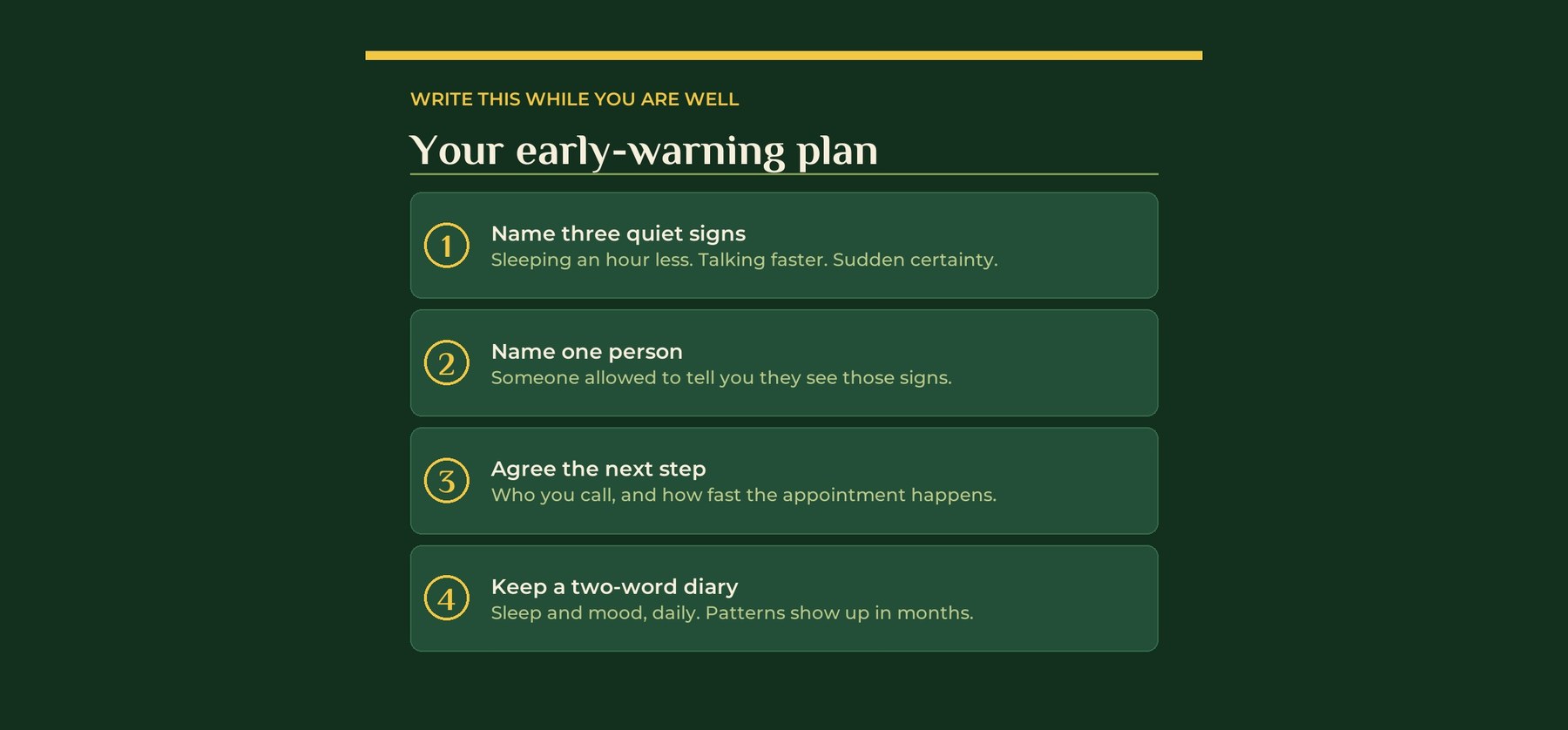
Here is a plan worth writing down while you are well.
List your three earliest warning signs. Not the dramatic ones. The quiet ones.
Sleeping an hour less. Talking faster. Feeling unusually certain about a new plan.
Then name one person who is allowed to tell you they see those signs. Give them permission in advance.
Finally, agree what happens next. Who you call. How fast an appointment gets made.
That single page has saved more hospital admissions than any inspirational quote ever will.
There is one more thing worth deciding early. What you want done if you are unwell and say no.
Many people write a short note while well. It names who may act, and what care they accept.
It is not a legal contract. It is a message from your steady self to your unwell self.
Families find it a relief. It takes the guesswork out of a frightening week.
And after an episode passes, hold back on the post-mortem. Blame does not prevent the next one.
Ask two questions instead. What changed first? What would catch it sooner next time?
A: It varies widely, and treatment shortens it. Untreated highs and lows can run for weeks or months. With care, many people see mood settle far sooner. Track your own pattern, because your history predicts you better than an average does.
How Ganaa Supports a Full Life With Bipolar Disorder
Living well with bipolar disorder is easier with a team behind you.
Ganaa is a mental health and rehabilitation brand in India. We work with adults living with bipolar disorder and related conditions.
Care starts with getting the diagnosis right. Bipolar disorder is often first treated as depression alone.
Our psychiatrists look at the full mood history, not only how you feel this month. Family accounts matter here.
Medication is reviewed openly with you. Benefits, side effects and long-term choices are discussed, never rushed.
Therapy runs alongside it. Cognitive behavioural therapy and family-focused work both have strong evidence in mood disorders.
Daily rhythm is treated as real treatment. Sleep times, meals, movement and yoga are built into the day.
Where alcohol or other substances are in the picture, we treat both together. They rarely improve apart.
Families are included by design. We teach relatives what an early sign looks like and what to do about it.
Every plan is tailored to the person in front of us. Nothing is copy-pasted from a template.
Ganaa runs five residential centres in India. These are Ganaa South Delhi, Ganaa Chattarpur, Ganaa Gurgaon, Ganaa Goa and Ganaa Greater Noida.
We also run three OPD clinics for outpatient care, in Faridabad, Greater Kailash and Greater Noida.
Many people with bipolar disorder never need admission. Outpatient care can flex around a job and a family.
If mood has been running your life, please reach out. Speak to a Ganaa counsellor, or visit ganaa.in to learn about our programmes.
The goal is not a smaller life. It is your life, made steady.
Conclusion: A Normal Life Is Not a Smaller Life
So, can bipolar live a normal life? Yes.
Not a life free of mood. A life where mood no longer makes the decisions.
That takes treatment that continues when you feel well. It takes sleep you defend.
It takes honesty about alcohol. It takes one person at home who is allowed to speak up.
The Indian numbers say the real barrier is access, not the condition. Seven in ten people here get no care at all (Source: Indian Journal of Psychiatry, 2023 — pmc.ncbi.nlm.nih.gov).
That gap is fixable. It starts with one appointment.
Expect symptom recovery first, and functional recovery a few months later. The lag is normal.
Expect a setback at some point. Treat it as information, not as a verdict.
Build the boring scaffolding early. Fixed sleep. Steady tablets. A named person. A written plan.
Then go and have the ordinary things. The job. The marriage. The travel. The children.
People with bipolar disorder do all of it, every day, in every Indian city.
If you are reading this a week after a diagnosis, hold on to one line.
This is the beginning of treatment, not the end of your plans.
FAQ
Q: Can a person with bipolar disorder live a normal life?
A: Yes. Most people with bipolar disorder who stay in steady treatment work, study, marry and raise children. The condition does not go away, but it can be managed for years at a time. What changes is not your ambition. It is the amount of structure your life needs.
Q: Does bipolar disorder get worse with age?
A: It does not have to. Untreated episodes tend to come closer together over time. Treated ones often become rarer and milder. Early, steady care is the strongest thing you can do for your future self.
Q: Do I have to take bipolar medication for life?
A: Many people do, and that is a normal part of care. Mood stabilisers protect against the next episode, not just this one. Some people reduce their dose over years with a psychiatrist's guidance. Stopping on your own is the single most common trigger for relapse.
Q: Can someone with bipolar disorder hold a full-time job?
A: Yes, and most do. Jobs with fixed hours and predictable sleep suit the condition best. Night shifts and heavy travel are the hardest fit. Many people build strong careers once their sleep and medication are steady.
Q: Should I tell my employer or my partner about bipolar disorder?
A: Telling a partner early usually helps, because they see the early signs before you do. Telling an employer is a separate choice with no single right answer. Most people share the practical needs, such as leave for appointments, rather than the diagnosis itself.
Q: Does a relapse mean the treatment failed?
A: No. Bipolar disorder is a relapsing condition, like asthma or high blood pressure. An episode is a signal to review the plan, not to abandon it. People who treat setbacks as data rather than failure recover faster each time.
Eating disorders in India hide behind praise for discipline and thinness. Learn the early warning signs, what to say, and how treatment actually works.
High functioning anxiety hides behind good work and a calm face. Learn the hidden signs, what the body does, and when coping turns into the problem itself.
The cost of mental health rehab in India is rarely published openly. Here is what moves the price, what insurance must cover by law, and what to ask first.