Borderline Personality Disorder: Symptoms, Stigma, and Hope
Borderline personality disorder is treatable. Learn the real symptoms, why it is misread in India, what stigma costs, and what long-term studies actually show.
Borderline Personality Disorder: Symptoms, Stigma, and Hope
Few diagnoses carry as much baggage as this one.
People with borderline personality disorder are called hard. Manipulative. Attention-seeking.
Almost none of that is accurate. Most of it is stigma wearing clinical clothes.
Here is the part that gets buried. This is one of the more treatable conditions in psychiatry.
In a ten-year study, 93% of patients reached a symptomatic remission lasting at least two years (Source: Zanarini et al., 10-year prospective follow-up, PMC, 2010 — pmc.ncbi.nlm.nih.gov).
Read that again. Ninety-three percent.
That is a better long-term picture than many people expect.
This guide covers what the condition really is. What the symptoms look like in real life.
Why it gets missed and misread in India. What the stigma costs.
And what treatment can realistically deliver.
One note before we start. This is general guidance, not a diagnosis. Only a psychiatrist or clinical psychologist can assess a person.
What Borderline Personality Disorder Actually Is
Start by dropping the word "borderline". It is a historical accident, not a description.
At its core, this is a problem with handling emotion. That is the clearest way to hold it.
Feelings arrive faster. They hit harder. They take longer to settle.
Think of an felt sunburn. The same touch that another person barely notices causes real pain.
Nothing about that is chosen. It is not drama, and it is not a game.
Two other threads run through it. Shaky relationships, and a shaky sense of self.
Someone may feel deeply attached one day and abandoned the next. The same person can shift from hero to villain in an afternoon.
The sense of self wobbles too. Values, goals, and even taste shift with the mood.
It is not rare. Prevalence in the general public runs between 0.5% and 5.9% (Source: Literature review, PMC, 2022 — pmc.ncbi.nlm.nih.gov).
It often shows up in the late teens or early twenties. Signs often appear earlier.
Causes are mixed. Genes play a role. So does the early home.
Many people with BPD report childhood trauma or neglect. Not all do.
The common thread is a mismatch. A sensitive child in a home that could not hold them.
That is not the same as blaming parents.
Some homes were kind but busy. Some were loud. Some were simply the wrong fit.
A child can be hurt by a home no one meant to be harmful.
There is no blood test. The the diagnosis comes from history and pattern over time.
That is why a single visit rarely settles it.
Q: Is borderline personality disorder a permanent part of someone's character?
A: No. It is a pattern of emotion regulation that shifts with treatment. Long-term studies show most people reach remission, which is not what "personality disorder" sounds like.
The Symptoms, in Plain Words
Clinical lists are precise and cold. Here is the same ground in ordinary language.
Fear of being left. Real or imagined, the fear is enormous. Small delays can trigger panic.
Relationships that swing. Intense closeness, then sudden distance. Idealising then devaluing the same person.
A shifting self-image. Who am I, what do I want, what do I believe. The answers keep moving.
Rash acts that cause harm. Spending, driving, drug use, unsafe sex, binge eating.
Self-harm. Cutting, or thoughts and threats of ending life.
Mood swings that are short and sharp. Hours, not weeks. This is a key difference from bipolar disorder.
A constant sense of emptiness. Not sadness. A hollow feeling that never fully lifts.
Anger that is hard to control. Often followed by heavy shame.
Losing touch briefly under stress. Feeling unreal, or cut off from your own body.
The NIMH describes several of these directly, such as intense and highly variable moods lasting hours to days, chronic emptiness. Self-harm (Source: National Institute of Mental Health, 2024 — nimh.nih.gov).
Risk deserves plain speech. People with BPD have far higher rates of self-harm and suicidal thoughts than most (Source: National Institute of Mental Health, 2024 — nimh.nih.gov).
That is not a reason to fear the person. It is a reason to get treatment in place.
Anyone thinking of harming themselves needs help right away.
One more thing about the list. Nobody has all nine all the time.
Symptoms rise under stress and fade in calmer spells.
So a quiet month is not proof it has gone.
And a hard week is not proof it is back for good.
Q: How is BPD different from bipolar disorder?
A: Timing. In this condition, mood shifts within hours and often follows a relationship trigger. In bipolar disorder, episodes last days to weeks and often arrive without an obvious trigger.
What It Feels Like From the Inside
Symptom lists describe behaviour. They miss the experience.
From the inside, most of it makes painful sense.
The fear of abandonment is not clinginess. It feels like standing at the edge of losing everything.
A late reply is not a late reply. It reads as proof you are about to be dropped.
The anger is rarely about the surface issue. It is fear that has run out of patience.
The idealising is not flattery. When someone feels safe, the relief is overwhelming.
And when that same person disappoints you, the fall is just as steep.
Emptiness is the hardest to explain. It is not boredom.
It is a kind of static where a self should be.
Self-harm is widely misunderstood. For most people it is not about ending life.
It is an attempt to make unbearable feeling stop for a few minutes.
That does not make it safe. It makes it a signal that coping has run out.
Shame follows almost everything. This is the part outsiders rarely see.
The shame after an outburst is often worse than the outburst.
Then comes the cycle. Fear leads to a reaction. The reaction pushes people away.
Being pushed away confirms the fear. Round it goes.
Naming that cycle out loud is often the first therapeutic moment.
Because once you can see it, you can break it.
That is the whole point of the skills work.
You do not have to stop the feeling. You just have to slow the next step.
A pause of ten minutes is often enough.
Set a timer. Go to another room. Drink a glass of water.
None of that is deep work. All of it buys time.
Time is what the skills need.
Every skill in the box works better when the rush has passed.
So buy time first. Think second.
Most of the damage is done in the first rush.
Q: Why do people with BPD react so strongly to small things?
A: The things are not small to them. Emotional responses fire faster and harder, and they take longer to settle. What looks like an overreaction is a normal reaction at a much higher volume.
Why It Gets Misread in India
Diagnosis here is often late, or wrong, or both.
Several forces push in that direction.
Depression gets named first. Low mood is the visible part. The swings underneath get missed.
Bipolar disorder gets named instead. Both involve mood swings. Timing is the clue, and it takes careful history to spot.
Trauma goes unasked. Many people are never asked about childhood. Without that history, the pattern makes less sense.
Women are over-labelled, men under-labelled. Men with the same pattern are often filed under anger problems or substance use.
Family voices take over. In many Indian clinics, relatives speak most. What the person feels inside goes unrecorded.
Time is short. Telling a lasting pattern from a mood episode takes more than one short visit.
There is a system problem too. India's treatment gap is wide across the board.
Between 70% and 92% of people who need mental health care never receive it (Source: National Mental Health Survey, NIMHANS, 2016 — indianmhs.nimhans.ac.in).
For a condition needing long-term therapy, that gap bites hard.
Culture adds another layer. Strong emotion in young women is often read as a phase.
Family conflict is treated as a marriage problem, or a discipline problem.
So no one thinks of it, and no one asks.
If several doctors have tried several antidepressants with little gain, that itself is a clue.
Ask directly whether a personality pattern has been looked at.
Q: Why is BPD so often misdiagnosed as depression?
A: Because low mood is the part people report. The fast shifts, the emptiness, and the relationship pattern only show up on careful history. Short visits rarely reach them.
The Stigma Problem, Including Inside Clinics
This condition carries stigma that most others do not.
Some of it comes from families. More of it than people admit comes from doctors.
The wording gives it away. Difficult. Manipulative. Attention-seeking. Non-compliant.
Every one of those describes pain from the outside, and explains nothing.
Take the word attention-seeking. It means someone in pain is trying to be noticed.
That is a reasonable thing to do. The word turns it into an accusation.
The costs are real.
People get labelled instead of treated. Symptoms are read as faults.
Some are refused care outright. Others are discharged after one crisis.
Many stop asking for help, having been made to feel like a burden.
Families absorb the same language and repeat it at home.
Here is a fairer frame. This is a condition of felt pain, not bad character.
The behaviour that looks hard is often a coping attempt that has run out of better options.
Change the language and the care changes with it.
Instead of manipulative, ask what the person is trying to say.
Instead of attention-seeking, ask what need is not being met.
Instead of non-compliant, ask what got in the way.
If a doctor uses that wording about you or your relative, find another doctor.
Good BPD treatment in India exists. Do not settle for contempt dressed up as care.
Q: Why do some doctors dislike treating BPD?
A: Usually because of training gaps and old beliefs, not evidence. BPD responds well to structured therapy. A doctor who calls patients manipulative is showing their own limits.
What the Long-Term Research Actually Shows
This is the part almost no one hears at diagnosis.
A ten-year study followed patients closely. The findings are worth stating plainly (Source: Zanarini et al., PMC, 2010 — pmc.ncbi.nlm.nih.gov).
OutcomeShare of patientsSymptomatic remission lasting 2+ years93%Sustained remission lasting 4+ years86%Full recovery, such as work and social function50%
Take the good news first. Symptoms fade for the large majority over time.
Longer good spells also proved more stable. Just 15% lost a four-year remission (Source: Zanarini et al., PMC, 2010 — pmc.ncbi.nlm.nih.gov).
Now the honest caveat. Full recovery is a higher bar, and only half reached it.
Recovery here means symptoms gone, plus steady work and social life held for two years.
About 34% of those who reached recovery later relapsed (Source: Zanarini et al., PMC, 2010 — pmc.ncbi.nlm.nih.gov).
So what should a family take from this?
Symptoms are the part that improves most reliably. That improvement is real and it lasts.
Function needs its own work. Jobs, study, and friendships do not rebuild on their own.
Plan for both. Treat the symptoms, and rebuild the life alongside.
That second half is often left out of care plans. It should not be.
Time itself helps. Many people find their thirties easier than their twenties.
The swings soften. The gaps between them grow.
This is not wishful thinking. It shows up in the follow-up data.
Age does part of the work on its own.
But waiting is not a plan. Care speeds it up a lot.
The years you get back are the point.
Sleep and work get steadier as well.
That is not a reason to wait. Treatment shortens the road a lot.
Q: Can you recover from borderline personality disorder?
A: Yes. In a ten-year study, 93% reached symptomatic remission lasting at least two years. Full recovery, such as stable work and relationships, was reached by about half.
Treatments That Work
Talking therapy is the main treatment. Medicine plays a supporting role.
Dialectical behaviour therapy has the strongest track record. The NIMH notes it was built for this condition (Source: National Institute of Mental Health, 2024 — nimh.nih.gov).
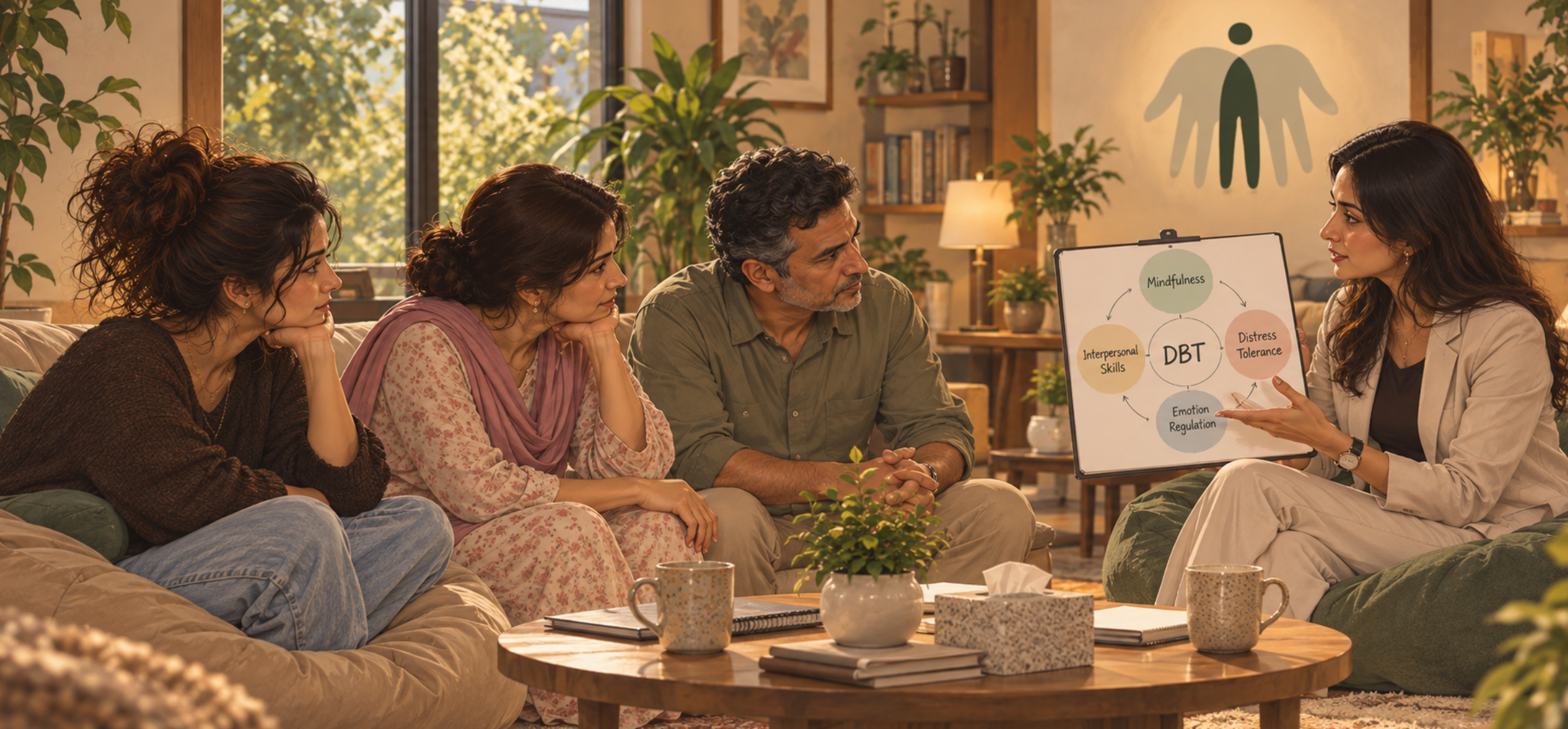
DBT teaches four skill sets. Each targets a different part of the problem.
Mindfulness. Noticing what you feel before you act on it.
Distress tolerance. Getting through a crisis without making it worse.
Emotion regulation. Naming, reducing, and riding out intense feeling.
Handling people. Asking for things and saying no without blowing up the relationship.
A full DBT course runs weekly one-to-one therapy plus a weekly skills group. Expect six months to a year.
Cognitive behavioural therapy also helps reduce mood swings and self-harming behaviour (Source: National Institute of Mental Health, 2024 — nimh.nih.gov).
Other structured therapies exist too. Schema therapy is one. So is mentalisation-based therapy.
The common ingredient matters more than the brand. Structure, steadiness, and a clear crisis plan.
On medicine, be realistic. No drug treats the condition itself.
Medicines are used for set targets. Low mood, anxiety, sleep, or rash acts.
A psychiatrist should review them regularly. Long lists of drugs are a warning sign, not a plan.
Live-in care has a narrow role. It suits acute risk, or a crisis that cannot be held at home.
The long work happens in outpatient therapy. That is where change is built.
One rule holds across all of it. Consistency beats intensity.
A therapist you see every week for a year will do more than three intense months and a gap.
Q: How long does DBT take to work?
A: Most programmes run six months to a year. Many people notice better crisis control within eight to twelve weeks. Deeper change in relationships and identity takes longer.
What Families and Partners Can Do
Living alongside this condition is genuinely hard. Pretending otherwise helps no one.
But families change outcomes more than they realise.
Back the feeling, not the act. These are separate. You can say the hurt is real without saying the reaction was safe.
Be boring and predictable. Consistency lowers fear. Say what you will do, then do exactly that.
Do not threaten to leave in an argument. It confirms the deepest fear, and it escalates everything.
Agree rules when things are calm. Never negotiate boundaries mid-crisis.
Learn the crisis plan. Know who to call, at what point, and what to say.
Take self-harm seriously every time. Never dismiss it as a bid for attention.
Keep your own support. Carers burn out quietly, then blame themselves.
Do not play doctor at home. Naming the condition mid-fight is a weapon, not insight.
Language matters more here than in almost any other condition.
Try naming what you see. Say that you can tell they are in real pain.
Then say what you can offer right now, and what you cannot.
Both halves matter. Endless availability is not sustainable, and collapse helps no one.
Family sessions are worth going to. Skills work better when the whole house uses the same ones.
And keep the long view. Remission is the likely outcome.
The hardest years are often not the permanent ones.
Q: How should I respond when my relative threatens self-harm?
A: Take it seriously every single time. Stay calm, stay close, and remove the means where you can. Call their doctor or emergency services. Never brush it off as attention-seeking.
Simple Things That Help Day to Day
Therapy does the deep work. But small daily habits carry a lot of the load.
None of these replace care. All of them make care work better.
Sleep at the same time each night. Tired brains swing harder. This is the cheapest win there is.
Eat at set times. Low blood sugar and big feelings are a bad mix.
Name the feeling out loud. Say it plainly. I am scared. I am hurt. I am angry.
Naming slows the jump from feeling to action.
Wait ten minutes before you send it. Draft the message. Then put the phone down.
Most of the harm in a bad hour comes from what gets sent in that hour.
Keep one steady person. Not five. One who is calm and who stays.
Use cold water in a crisis. Cold on the face slows the body down fast.
It buys a few minutes. Sometimes that is all you need.
Move every day. A walk counts. Twenty minutes is enough.
Cut back on drink and drugs. Both make swings sharper and shame heavier.
Write down the good days. In a low spell, you will not believe they happened.
A short note beats memory every time.
Have a crisis card. Two phone numbers and three things that help.
Keep it in your wallet. Do not rely on working it out mid-crisis.
Families can hold a copy of the same card.
None of this is a cure. It is scaffolding while the real work goes on.
Pick two habits, not ten. Build them for a month.
Ten new rules will collapse by day four.
Two will still be standing at week six.
Then add a third. Not before.
Slow and small is how this sticks.
Then add one more. Slow beats grand every time.
Q: What helps most on a bad day?
A: Slow the body first. Cold water, a walk, and a delay before sending any message. Then name the feeling out loud. Deep work belongs in therapy, not in the middle of a crisis.
- In a ten-year study, 93% of patients reached remission lasting two years or more —
- Sustained remission of four years or more was reached by 86% of them —
- Full recovery, which adds stable work and social life, was reached by 50% —
- Rates in the general public run from 0.5% to 5.9% —
- Rates of self-harm and suicidal thinking are much higher than in the general public —
- DBT was developed specifically for this condition —
- Between 70% and 92% of Indians needing mental health care do not receive it —
How Ganaa Approaches This Condition
Ganaa has worked in mental health care in India since 2012. We treat psychiatric conditions and substance use across all age groups.
Personality disorders are among the conditions we work with (Source: Ganaa, 2026 — ganaa.in).
Our model matters here because DBT is part of it. CBT, DBT, and neurofeedback run alongside yoga, meditation, and creative therapy.
That mix suits a condition where skills and steadiness matter more than any single technique.
Most people start with an outpatient visit. A psychiatrist takes a full history over more than one session.
Pattern over time is what settles this. We do not rush it.
A clinical psychologist then builds the therapy plan. Care is tailored to the person, not to a template.
Family work is offered from the start, with consent. Households often need the same skills the patient is learning.
Our clinics sit in Faridabad, Greater Kailash, and Greater Noida. Live-in centres are in Delhi, Gurugram, Greater Noida, and South Goa (Source: Ganaa, 2026 — ganaa.in).
Live-in care is reserved for acute risk or a crisis that cannot be held at home. Our published guidance puts programme length at 30 to 90 days (Source: Ganaa FAQ, 2026 — ganaa.in).
For most people, the long work runs through outpatient therapy afterwards.
Support runs 24 hours a day.
If this pattern sounds like you or someone you love, an assessment is a fair first step.
Speak to a Ganaa counsellor on +91 8750075006, or write to info@ganaa.in. You can also book a visit at ganaa.in/booking.
Conclusion: The Diagnosis Is Not the Ending
Borderline personality disorder is badly named and badly understood.
It is not a verdict on character. It is a pattern of pain that responds to care.
The symptoms are real and they are heavy. Fear of being left. Swinging relationships. Emptiness. Impulsive harm.
The stigma is real too, and some of it comes from inside clinics.
But the long-term data is genuinely hopeful. Most people reach lasting remission.
Half go further and rebuild work and relationships as well.
Treatment works, and DBT works best. Consistency beats intensity every time.
Families matter enormously. Be predictable, validate the feeling, and never threaten to leave mid-argument.
If someone has been called hard for years, ask a different question. Ask what has never been properly assessed.
The right name is not a life sentence.
For most people it is where getting better starts.
Ask for a proper review. Then ask for DBT by name.
Those two steps change more than any amount of willpower.
FAQ
Q: Is borderline personality disorder curable?
A: Remission is common rather than rare. In a ten-year study, 93% reached symptomatic remission lasting at least two years. Full recovery, such as stable work and relationships, was reached by about half. Treatment shortens the road a lot.
Q: What is the main treatment for BPD?
A: Dialectical behaviour therapy has the strongest evidence, and it was developed specifically for this condition. Cognitive behavioural therapy also helps. Medicine treats linked problems such as depression, anxiety, or sleep, not the condition itself.
Q: How is BPD different from bipolar disorder?
A: Timing is the clearest difference. Here, mood shifts within hours and often follows a relationship trigger. In bipolar disorder, episodes last days to weeks and often arrive without an obvious trigger.
Q: Is BPD caused by childhood trauma?
A: Often, but not always. Many people report trauma, neglect, or invalidation in childhood. Genetics also play a part. The common pattern is a sensitive temperament meeting an environment that could not hold it.
Q: Can someone with BPD have a stable relationship?
A: Yes. Relationships improve a lot with treatment, especially once skills for handling conflict are learned. Predictable partners and clear agreed boundaries make a large difference.
Q: Why do people say BPD patients are manipulative?
A: It is stigma, not clinical fact. What looks like manipulation is often a desperate attempt to avoid being left. If a doctor uses that language about you, look for a different doctor.
Q: When does BPD often start?
A: The pattern typically becomes clear in the late teens or early twenties, though signs often appear earlier. Diagnosis needs history over time, which is why one short visit rarely settles it.
Bipolar misdiagnosed as depression is common, and the delay runs close to nine years. Learn the clues, why hypomania is missed, and how to get a better review.
Adolescent mental health in India is under-treated. Learn 11 warning signs parents miss, what the data shows, how to start the talk, and when to seek help.
Gaming disorder in teens is a real diagnosis, not a phase. Learn the WHO criteria, how common it is, the signs parents miss, and what actually works at home.