Why Am I Always Tired Even After Sleeping 8 Hours?
Always tired even after sleeping a full eight hours? The cause is often poor sleep quality, low iron or thyroid, or hidden depression. Here is what to check.
Why Am I Always Tired Even After Sleeping 8 Hours?
You slept eight full hours. You still woke up tired.
This is more common than you think. Many people feel always tired even after sleeping a full night. They rest. They wake. The tiredness stays.
The problem is rarely the number on the clock. Eight hours in bed is not the same as eight hours of deep rest.
Sometimes the cause is your sleep quality. Sometimes it is your body. Iron, thyroid, or vitamin levels can be low. And sometimes the cause sits in your mind. Depression, anxiety, and burnout drain your energy in ways sleep cannot fix.
At Ganaa, we see this often. People come in exhausted. They blame themselves. They should not.
This guide walks you through the real causes. We start with the mental health ones. Then we cover the medical ones. We end with clear steps and a simple rule for when to see a doctor.
What Being Always Tired Even After Sleeping Really Means
Let us name the feeling first.
You are always tired even after sleeping when rest does not refresh you. You wake heavy. Your mind feels slow. By mid-morning, you want to lie down again.
This is not normal daytime sleepiness. A short yawn after lunch is fine. This is deeper. It follows you all day.
Doctors call constant tiredness "fatigue". It is a symptom, not a disease. It points to something underneath.
Fatigue has two broad roots. One is physical. Your body is short of fuel, oxygen, or a key hormone. The other is mental. Your mood or stress is stealing your energy.
Often, both play a part. A tired body feeds a low mood. A low mood makes sleep worse. The loop tightens.
The good news is simple. Almost every cause can be found. Most can be treated. You do not have to live tired all the time.
There is one more thing to know. Tiredness is not a weakness. It is data. Your body and mind are telling you something.
Many people push through it for years. They drink more coffee. They sleep on weekends. They blame their age or their job. But the signal stays.
Listening early saves you time. It also saves you needless worry. A clear cause is far easier to treat than a vague fear.
A: Yes. Constant tiredness that lasts more than two weeks is worth checking. It can point to anaemia, thyroid problems, poor sleep, or depression. A doctor can find the cause with a simple review and a few tests.
Sleep Quantity Is Not the Same as Sleep Quality
Here is the big myth. Eight hours means good sleep. It does not.
You can lie in bed for eight hours and still miss deep rest. What matters is what happens during those hours.
Your night runs in cycles. Light sleep. Deep sleep. Dream sleep, also called REM. You need enough of each. Deep sleep repairs the body. REM sleep sorts the mind.
If your sleep is broken, you lose these stages. You wake, but you never truly rested.
Many things break sleep. A snoring partner. A hot room. A late scroll on your phone. A racing mind at 2 a.m. Each one steals a slice of deep sleep.
Then there is sleep inertia. This is the groggy fog right after you wake. For some people it lasts minutes. For others it drags on. The Cleveland Clinic lists poor sleep quality and sleep disorders as key reasons you wake up tired even after eight hours (Source: Cleveland Clinic, 2023. why you wake up tired).
So do not just count hours. Ask a better question. Was the sleep deep and unbroken?
If the answer is no, you have found your first clue.
A: Time in bed is not the same as deep rest. Broken sleep, a warm room, screens at night, or a sleep disorder can rob you of deep and dream sleep. You spend eight hours in bed but get far fewer restful ones.
When Depression Hides Behind Fatigue
Now the part many people miss. Sometimes tiredness is depression in disguise.
Depression is not only sadness. For many, the first sign is low energy. You feel flat. Small tasks feel huge. Sleep does not help.
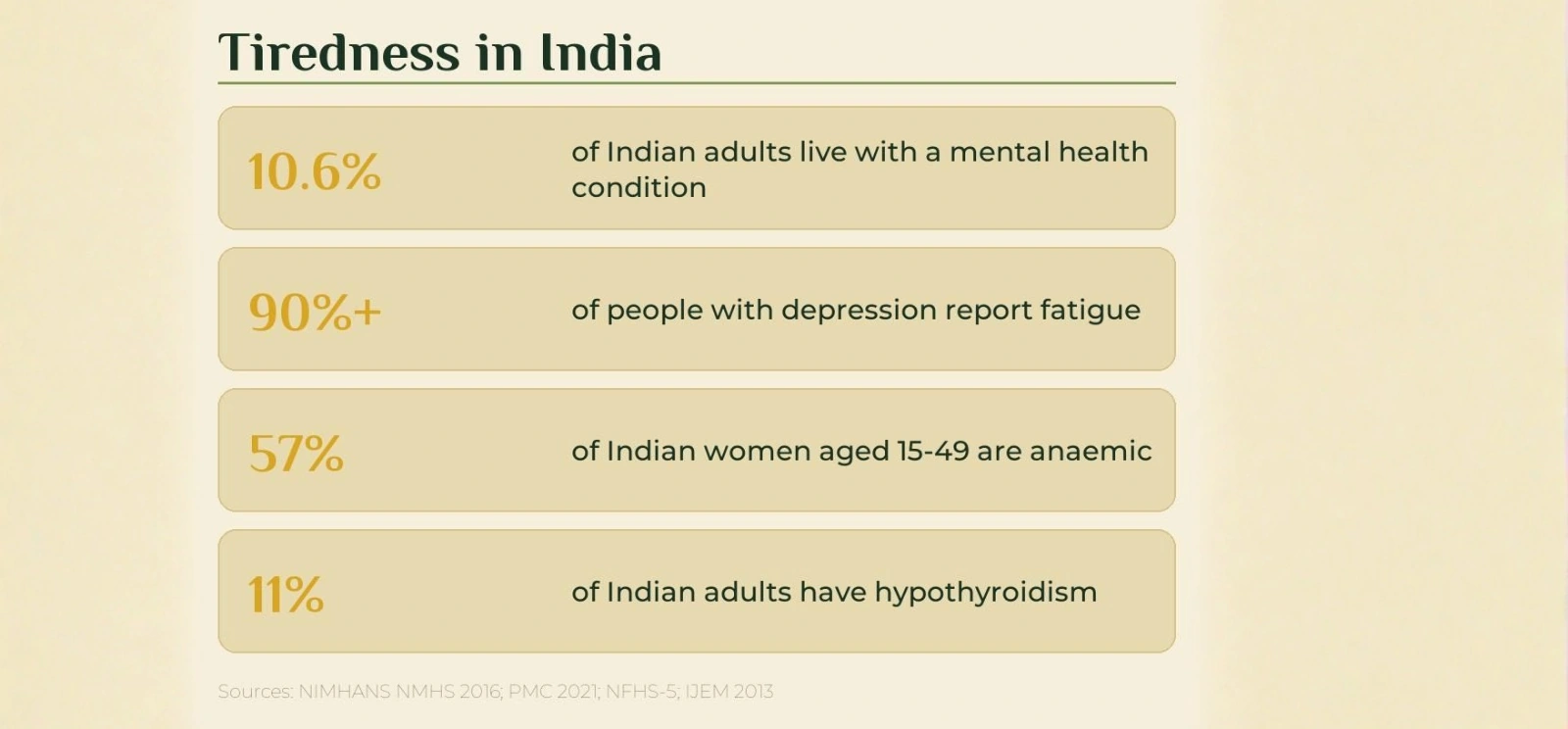
This link is strong. More than 90% of people with depression report fatigue as a core complaint (Source: Frontiers/PMC, 2021. fatigue and brain arousal in depression). Low energy is one of the most common signs of the condition.
Depression fatigue works in a cruel way. It disturbs deep, restful sleep. So you sleep long but wake unrefreshed. Then the low energy feeds low mood. The cycle repeats.
It also lingers. Even after treatment starts, tiredness can stay. In one study of people who recovered from depression, fatigue remained in 38% of them. Sleep problems in 44% (Source: PMC, 2010. residual fatigue in depression). That is why fatigue deserves real attention, not a shrug.
Mental illness is common in India. The National Mental Health Survey found that about 10.6% of Indian adults live with a mental health condition at any given time (Source: NIMHANS / NMHS 2016. epidemiology of common mental disorders). Many never link their tiredness to their mood.
If you feel tired all the time, look at your mood too. Have you lost interest in things you loved? Do you feel low most days? Is your sleep or appetite off?
If yes, this is worth a conversation with a clinician.
There is a stigma to clear here. In India, many still see low mood as a personal failing. It is not. Depression is a health condition, like anaemia or diabetes.
Naming it is the first step. Treating it is the second. Both are possible, and both work.
Chronic fatigue mental health links are now well studied. Doctors take tiredness seriously. So should you.
A: Yes. Depression disturbs deep sleep, so long hours in bed still leave you tired. Fatigue and low energy are core signs of depression. If low mood comes with the tiredness, speak to a mental health professional.
Anxiety, Stress, and Burnout Drain Your Battery
Depression is not the only mind-based cause. Anxiety and stress do it too.
Anxiety keeps your body on alert. Your heart runs a little fast. Your muscles stay tense. Even in sleep, your mind does not fully switch off.
This uses huge amounts of energy. You burn fuel just staying worried. By morning, the tank is low.
Then there is burnout. This is not laziness. It is the deep exhaustion of long-term stress. Work pressure. Caregiving. Money worries. They pile up.
Burnout builds when demands never ease. You give and give. You get little rest in return. The tank runs dry.
Burnout shows up as three things. You feel drained. You feel distant from work or people. You feel you are doing less well. Sleep barely touches it.
India feels this strain. City jobs, long commutes, and always-on phones keep stress high. Many young adults carry it quietly.
The tricky part is overlap. Anxiety, burnout, and depression share the same tiredness. That is why guessing is risky. A clinician can tell them apart.
The chronic fatigue mental health link is now well recognised. Long stress and low mood wear the body down. Care that treats the mind often lifts the tiredness too.
Rest alone will not fix a stressed mind. You need to lower the stress load and treat the anxiety. Then the energy returns.
Watch for the warning signs of burnout. You dread the day before it starts. You snap at small things. Your sleep gets worse, not better.
These signs build slowly. That is why they are easy to miss. You adjust to the exhaustion until it feels normal.
But normal tired is not real health. If rest no longer helps, the cause runs deeper. That is your cue to seek support.
A: Yes. Anxiety keeps your body tense and alert, which drains energy day and night. Burnout from long-term stress causes deep exhaustion that sleep cannot fix. Treating the stress, not just resting, is what helps.
- About 10.6% of Indian adults live with a mental health condition — . - Over 90% of people with depression report fatigue — . - Around 57% of Indian women aged 15–49 are anaemic — . - Nearly 11% of Indian adults have hypothyroidism — . - Around 490 million people in India are vitamin D deficient —
The Medical Causes You Should Rule Out First
Before you blame your mind alone, check your body. Some very common medical issues cause fatigue. A simple blood test can find most of them.
Start with anaemia. This means low haemoglobin, often from low iron. It leaves you tired, pale, and breathless. It is very common in India. Under NFHS-5, about 57% of Indian women aged 15 to 49 are anaemic (Source: NFHS-5 analysis / PMC, 2024. anaemia among women in India). That is a huge, treatable cause of tiredness.
Next, the thyroid. An underactive thyroid slows your whole body. You feel tired, cold, and low. One eight-city study found hypothyroidism in nearly 11% of Indian adults (Source: Indian Journal of Endocrinology and Metabolism / PMC, 2013. hypothyroidism in eight Indian cities). Women are affected more often than men.
Then vitamin D. Low levels cause tiredness and low mood. Deficiency is widespread here. Reviews estimate that around 490 million people in India are vitamin D deficient (Source: Journal of Family Medicine and Primary Care / PMC, 2018. vitamin D deficiency in India). Low vitamin B12 and low blood sugar control also play a role.
Finally, sleep apnea. Here the airway keeps closing at night. Breathing stops and starts. You never reach deep sleep, so you wake exhausted and often snore loudly. Indian community studies show it is far from rare (Source: Lung India / PMC, 2018. sleep apnea in a South Indian population).
There is one more clue to watch. Do you get breathless on stairs? Do you feel cold when others feel fine? These small signs point toward the body, not the mind.
Diabetes and poor blood sugar control also tire you out. So can some medicines. Even a hidden infection can drag your energy down.
None of these are for you to diagnose at home. This is the key rule. See a doctor for the tests and the reading of them.
A good check-up is quick. A few questions. A blood draw. A short wait for results. That small effort can end months of guessing.
A: Common ones are anaemia, an underactive thyroid, low vitamin D or B12, poor blood sugar control, and sleep apnea. A doctor can check most with a simple blood test and a few questions. Do not self-diagnose these.
Daily Habits That Leave You Always Tired Even After Sleeping
Sometimes the cause is closer to home. It is in your daily routine.
Small habits add up. On their own they seem harmless. Together, they wreck your rest.
Screens are a big one. Blue light at night tricks your brain. It thinks it is still day. So deep sleep comes late and short.
Caffeine is another. A late-evening tea or coffee stays in your system for hours. You fall asleep, but the sleep is lighter.
Late, heavy dinners matter too. Your body digests when it should rest. So sleep gets shallow.
Then there is movement, or the lack of it. A day at a desk sounds restful. It is not. Too little activity leaves you sluggish and low.
Dehydration also drains you. So does skipping meals. Your body runs on fuel and water. Short it, and you feel it.
Alcohol deserves a warning. It may help you fall asleep. But it blocks deep sleep later in the night. You wake tired and dry.
The fix here is not dramatic. Small, steady changes work best. We list them further down.
Your body clock matters too. Irregular sleep times confuse it. So do late nights followed by long lie-ins.
The clock likes routine. Wake at the same time daily. Eat at steady hours. Sleep when your body dips. This rhythm alone can lift your energy.
One habit rarely ruins your sleep on its own. It is the stack that hurts. Fix them one by one, and the load lightens.
A: Yes. Late screens, evening caffeine, heavy dinners, low activity, and alcohol all cut into deep sleep. Poor hydration and skipped meals add to it. Fixing these often brings real energy back within a few weeks.
When to See a Doctor, and Who to See
This is the most important section. Please do not skip it.
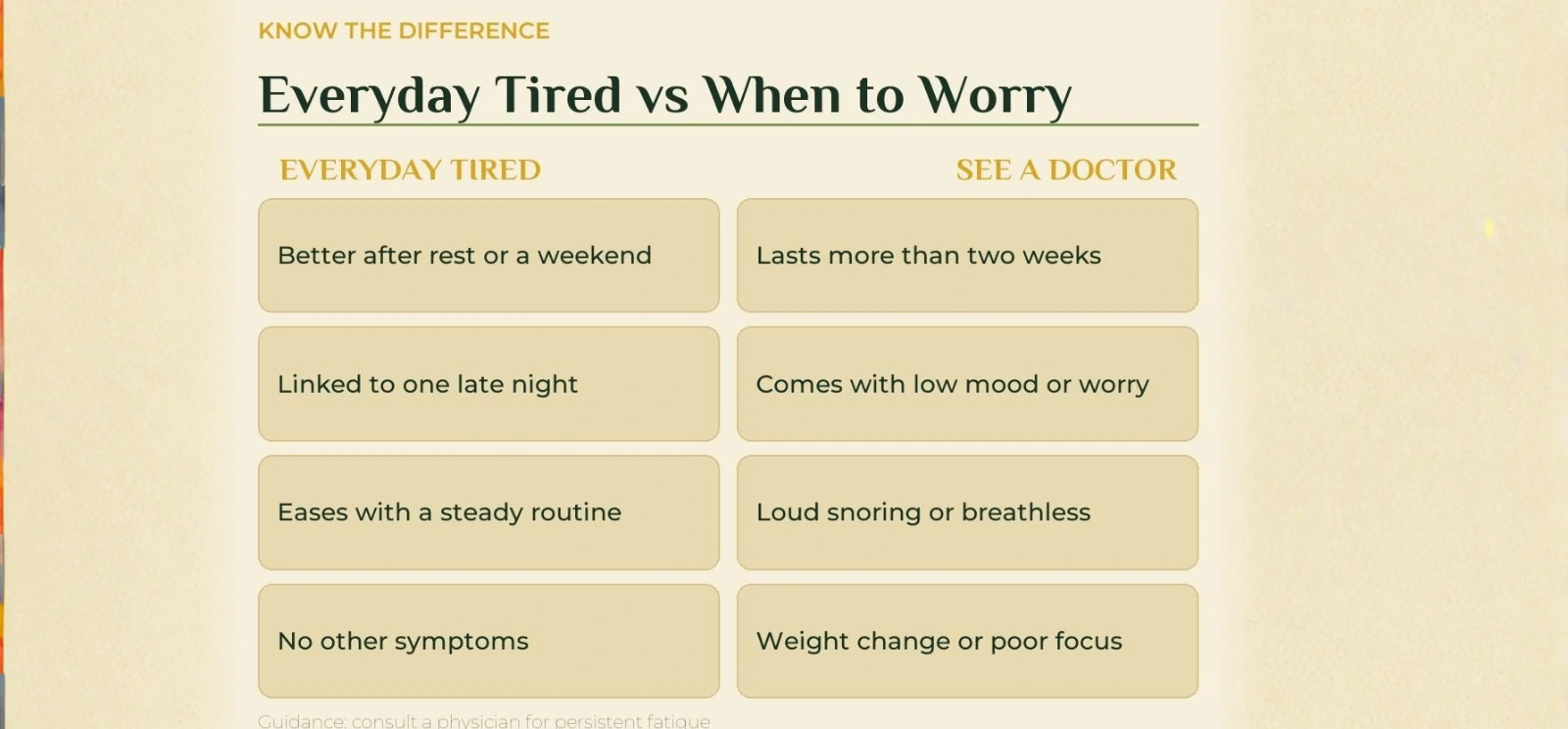
Feeling tired for a day or two is normal. Life gets busy. Rest usually fixes it.
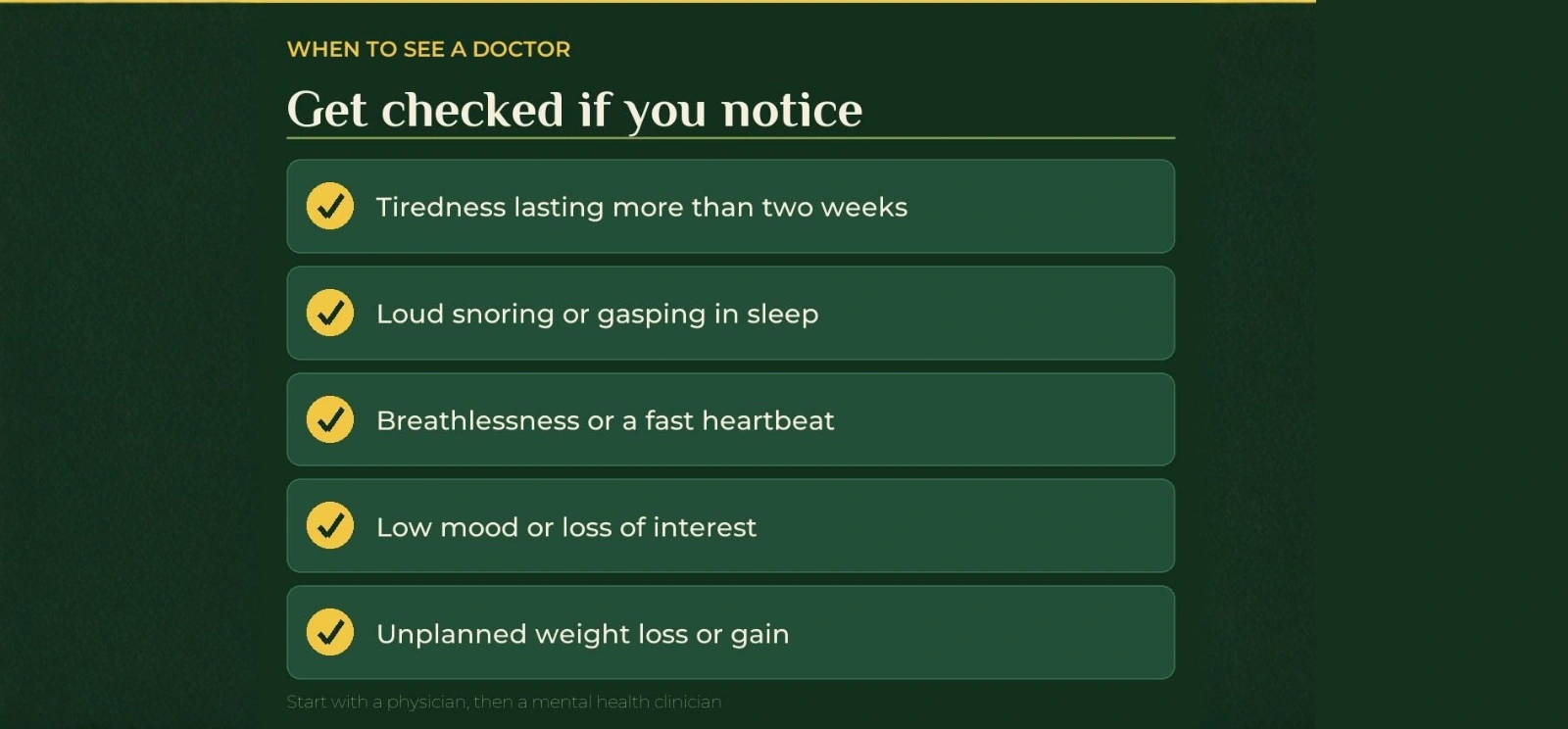
But some tiredness needs a professional. Here is a simple rule. If it lasts more than two weeks, get checked.
See a doctor sooner if the tiredness comes with warning signs. Watch for these:
Start with a general physician. They will check your body and order the right blood tests. This rules out anaemia, thyroid, and vitamin issues.
If the body tests come back clear, look at your mind. That is when a mental health professional helps. A psychiatrist or clinical psychologist can check for depression, anxiety, and burnout.
You do not have to choose one path. Body and mind are linked. Good care checks both.
Bring notes to your visit. Write down when the tiredness started. Note what makes it better or worse. Add your sleep and mood too. This helps the doctor a lot.
Never self-diagnose or self-medicate. Tiredness has many causes. Only a proper review can find yours.
A: See a doctor if tiredness lasts more than two weeks or gets worse. Go sooner with loud snoring, breathlessness, low mood, or unplanned weight change. Start with a physician, then a mental health clinician if the body tests are clear.
Simple Steps That Help You Feel More Rested
While you seek help, you can still act. These steps support better rest. They are safe for most people.
Think of them as good sleep hygiene. None replace medical care. But they build a strong base.
Try these, one at a time:
Be patient with yourself. You will slip some days. That is fine. Just return to the routine the next morning.
Track how you feel in a short note. A line a day is enough. Over weeks, a pattern shows. It tells you what helps and what does not.
Give each change two weeks. Notice what shifts. Energy rarely jumps overnight. It builds.
Also protect your mind. Talk to someone you trust. Slow, deep breathing calms an anxious body. A short daily pause helps.
Cut back on the news scroll before bed. It winds the mind up, not down. Swap it for a calm routine instead.
Sunlight in the day helps at night. It sets your body clock. So step outside, even for a short walk.
Small wins add up here. One better night leads to another. Trust the process and give it time.
If these steps do not lift your energy in a few weeks, that is useful information. It tells you the cause may be deeper. Then it is time for a clinician.
A: Dim the lights early and put your phone away an hour before bed. Keep the room cool and dark. Avoid late caffeine and heavy food. A short breathing practice can settle a racing mind before sleep.
How Ganaa Supports You When Tiredness Is Mental Health
Sometimes tiredness is more than a bad routine. When low mood, anxiety, or burnout sit underneath, you need real support. That is where Ganaa comes in.
Ganaa is a mental health and rehabilitation brand in India. We were founded in 2012.
We treat the whole picture, not just the symptom. Our clinical team looks at your mood, your sleep, and your stress together. We blend modern therapy with calm, restful settings.
Our approach joins two worlds. Modern clinical science, such as CBT and DBT, sits beside yoga, meditation, and mindful care. This helps rest return in a lasting way.
You can reach us in many places. We run five residential centres across India. Two sit in South Delhi: Ganaa South Delhi and Ganaa Chattarpur. Ganaa Gurgaon is in Sector 46. Ganaa Goa is in Velim. Ganaa Greater Noida rounds out the list. We also run OPD clinics in Faridabad, Greater Kailash 2, and Noida.
Care is available around the clock. Programs run across 30, 60, and 90 days, with aftercare that follows you home.
If constant tiredness comes with low mood or worry, please do not wait. Speak to a Ganaa admissions counsellor, or visit ganaa.in to learn about our programs. A short, tailored plan can help you feel like yourself again.
You are not lazy. You may just need the right support.
The Bottom Line
Being always tired even after sleeping is a signal, not a flaw. Your body or your mind is asking for care.
Start with the basics. Check your sleep quality, not just the hours. Fix the small habits that steal deep rest.
Then rule out the body. A simple blood test can catch anaemia, thyroid, and vitamin gaps. These are common and very treatable.
Do not forget the mind. Depression fatigue, anxiety, and burnout are real causes of tiredness all the time. They deserve the same care as any physical problem.
Here is the rule to remember. If tiredness lasts more than two weeks, or comes with low mood, see a doctor. Start with a physician, then a mental health clinician if needed.
You do not have to push through exhaustion alone. Help works. Rest can return.
If your tiredness feels tied to your mood, reach out to Ganaa. The first step is often the hardest, and the most worth taking.
FAQ
Q: Why am I always tired even after sleeping 8 hours?
A: Eight hours in bed does not always mean eight hours of deep rest. Broken sleep, sleep apnea, low iron or thyroid, and hidden depression can all leave you tired after a full night. If it lasts more than two weeks, see a doctor.
Q: Can depression make you tired even after enough sleep?
A: Yes. Fatigue is one of the most common signs of depression. More than 90% of people with depression report low energy. The tiredness stays even when sleep hours look fine, because depression disturbs deep, restful sleep.
Q: When should I see a doctor for constant tiredness?
A: See a doctor if tiredness lasts more than two weeks, gets worse, or comes with low mood, breathlessness, or loud snoring. A simple blood test can check for anaemia, thyroid, and vitamin problems. Do not self-diagnose.
Q: What blood tests help find the cause of fatigue?
A: A doctor may order tests for haemoglobin, thyroid (TSH), vitamin D, vitamin B12, and blood sugar. These check for common medical causes like anaemia and an underactive thyroid. Your doctor decides which tests you need.
Q: Is being tired all the time a mental health problem?
A: It can be. Being tired all the time is linked to depression, anxiety, and burnout. It can also be purely medical. The safest step is to rule out both. A doctor checks your body, and a mental health clinician checks your mood.
Q: How can I get more restful sleep naturally?
A: Keep a fixed wake-up time, cut screens an hour before bed, and get morning sunlight. Avoid late caffeine and heavy dinners. If good habits do not help within a few weeks, speak to a clinician.
Mindfulness-based therapy cuts depression relapse risk in recurrent cases. Here is what MBCT is, what the trials found, and how the eight weeks actually run.
Eating disorders in India hide behind praise for discipline and thinness. Learn the early warning signs, what to say, and how treatment actually works.
High functioning anxiety hides behind good work and a calm face. Learn the hidden signs, what the body does, and when coping turns into the problem itself.